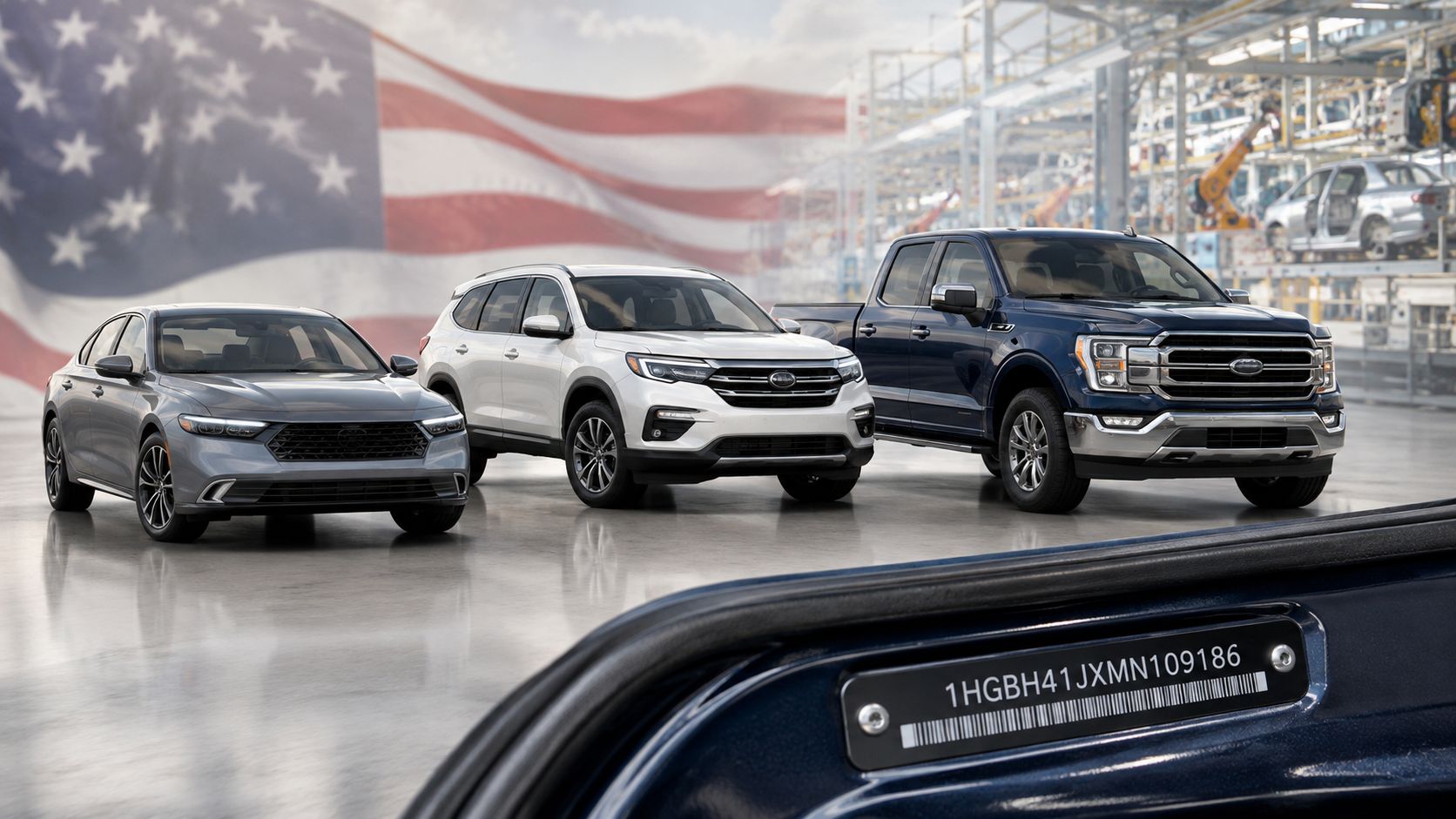
Your truck gets hit, the other driver's insurer starts talking fast, and the settlement number lands low. At that moment, where your vehicle was built stops being trivia and starts becoming evidence. A strong usa made cars list helps you verify assembly, domestic content, and manufacturing footprint so you can support a diminished value claim or challenge a total loss offer with something more solid than a badge on the grille.
The practical issue is simple, American-made isn't one thing. A vehicle can be assembled in the U.S., use North American parts, and still carry a foreign brand name, which is why shoppers and claimants need to look past marketing language and into build data. That matters because appraisers and insurers care about market context, not patriotic slogans.
If you're checking a vehicle for resale strength, claim support, or a fairer settlement, start with the lists that show how a model is built. Some are editorial, some are federal, and some are designed for deeper economic analysis. Used the right way, they can help you verify the facts before you negotiate.
1. Cars.com American-Made Index 2026
A repair shop can show you a clean Carfax and a shiny badge, but that still does not tell you how much of the vehicle was built in the United States. For a claim file, that distinction matters. Cars.com's American-Made Index is a practical starting point for a current, model-level USA made cars list with a transparent scoring method. The 2026 release is in its 21st year, ranked 86 vehicles, and that is an all-time low for the list, down from 99 the year before, which shows how quickly sourcing and production decisions can change the field in a single model year. The top positions were Tesla Model 3, Tesla Model Y, Jeep Gladiator, Jeep Grand Cherokee/Grand Cherokee L, and Honda Ridgeline, and that mix shows why “American-made” is not the same as “American brand” (Cars.com's 2026 American-Made Index release).
Why appraisers use it
The value of Cars.com's list is the methodology. It ranks models using assembly location, parts content, engine origin, transmission origin, and U.S. manufacturing workforce, so it measures more than a window sticker or a brand logo (Cars.com methodology summary). That makes it useful when comparing two versions of the same nameplate, because domestic content can influence how a vehicle is viewed after a loss event. A car that is assembled here and draws more of its content from North American production can present differently in resale, repair sourcing, and settlement discussions than a similar model with a lighter domestic footprint.
Practical rule: if your claim hinges on value, use the trim and model year, not the brochure name. The index is model-specific, but your real-world vehicle is VIN-specific.
Cars.com also notes that nearly two-thirds of the 2026 list was produced by foreign automakers, while the Detroit Three accounted for about one-third of the vehicles. That is a clear reminder that supply chains are global, even when final assembly happens locally. For shoppers and claimants, this list works best as a fast, credible snapshot before you move on to build labels and VIN verification. For more context on that mix, see this guide on Japanese car brands in America.
2. NHTSA American Automobile Labeling Act MY2026 Lists
If you need the closest thing to a primary-source build record, the NHTSA American Automobile Labeling Act data is the place to go. Manufacturers report under Part 583, and the MY2026 lists show assembly location, percent U.S./Canada content, and engine and transmission origin, which makes them useful for verifying what a vehicle really is beneath the badge (NHTSA AALA page). That's the data set I'd trust first when a claim file or appraisal dispute depends on build context.
Where this helps in a claim
A federal labeling file is especially useful when an insurer questions whether a car deserves a stronger market position because of origin. The AALA data doesn't try to sell a narrative, it reports manufacturer-disclosed content, which is exactly what you want when you're documenting a total loss file or building a support packet for diminished value. It also covers full-model information, including trims and variants, so it can catch differences that a generic list misses.
The key limitation is also important. Federal labeling combines U.S. and Canada content, not U.S.-only content, so you still have to interpret the numbers carefully. That's why a shopper should use this file to verify build context, then compare it with the VIN and the door-jamb label before making a valuation argument.
The best claim files use the federal disclosure first, then the vehicle label, then the market comps. Leaving out any one of those weakens your position.
When you're comparing a truck, SUV, or sedan for valuation purposes, this list is less about ranking and more about proof. It's the right tool when you need to answer a specific question, not just browse a headline list. If you're working through a cross-border import or a vehicle with an unusual build history, pair the AALA file with this guide to import vehicle valuation.
3. Kogod Made in America Auto Index 2026
The Kogod Made in America Auto Index takes a broader economic view than a simple assembly list. Instead of stopping at where the vehicle is built, it weights seven factors that estimate overall U.S. economic contribution, including domestic content and broader value-chain effects, which makes it useful for procurement, policy work, and more nuanced appraisals of domestic exposure (Kogod Auto Index 2026). That matters if your goal is to compare the economic footprint of two vehicles that look similar on the surface.
Why this index adds context
This is the list you use when assembly alone isn't enough. A vehicle can be assembled in the U.S. and still rely heavily on global sourcing, or it can have a stronger domestic footprint across engineering, labor, and profitability than the badge suggests. Kogod's approach helps separate the marketing story from the economic story, which is useful when a client wants to argue that one vehicle has a stronger domestic value chain than another.
The trade-off is that Kogod's methodology is not the same as Cars.com's composite index or the federal AALA disclosure. That means you should not treat the scores as interchangeable. In practice, I use Kogod when someone wants a wider economic lens, then I cross-check with build labels and manufacturer disclosures before turning any of it into claim language.
The index is also better for people who care about policy or sourcing than for buyers who want a fast shopping shortcut. It gives you a deeper look at the footprint behind the vehicle, but it won't replace a trim-specific review of where your actual car came from. For a damage claim, that distinction matters because valuation arguments work best when they're tied to the exact vehicle in front of you, not a broad model family.
4. Consumer Reports Best Cars Made in the USA 2026
Consumer Reports is the list to use when you want U.S.-built vehicles that also perform well in testing and ownership context. Its “Best Cars Made in the USA” roundup filters for models that fit its own definition of made in America, then layers in test results, owner-survey data, and reliability context, which makes it especially useful for buyers who care about more than origin alone (Consumer Reports best cars made in the USA). That combination is valuable because a vehicle can be domestic-content heavy and still be a poor ownership choice.
Best use cases for buyers
This list works best when you're shopping with your long-term costs in mind. If you're trying to avoid buying a vehicle that looks attractive on an origin list but disappoints in day-to-day ownership, Consumer Reports gives you a more complete filter. It's not trying to be a pure sourcing index, it's trying to point you toward vehicles that are both built in the U.S. and credible ownership bets.
The main limitation is coverage. It's not an exhaustive catalog of every U.S.-built vehicle, and some content sits behind a membership wall. That said, the value is in the selection process. Instead of asking only where the vehicle was assembled, it asks whether the vehicle is likely to hold up as a sensible purchase.
For claims work, this matters because ownership reputation can influence market perception. A vehicle with strong reliability and testing history is often easier to support in a valuation argument than a model with weak consumer confidence. If you're weighing how a domestic vehicle fits into your own replacement planning, this guide to the average age of U.S. cars helps put ownership longevity into context.
Useful distinction: Consumer Reports is strongest for buyers who want a car they can live with, not just a car they can call American-made.
5. UAW Union-Built Vehicle Guide 2026
The UAW Union-Built Vehicle Guide is the right tool if your definition of value includes labor representation as well as assembly location. It lists vehicles assembled by UAW and Unifor members and identifies primary plant locations, so it helps shoppers who want a plain-language view of union-built options (UAW 2026 guide). For many buyers, that distinction matters almost as much as where the final assembly happens.
What it adds to a shopping decision
This guide doesn't try to rank vehicles by domestic content or overall quality. Instead, it tells you whether the vehicle was assembled by union labor, which is a clean way to screen for value-aligned purchases. If your buying decision is tied to supporting organized labor or U.S. assembly jobs, this is a faster filter than sorting through broad editorial lists.
The limitation is obvious. The guide includes Canada-built vehicles too, so it is not an exclusively U.S.-assembled list. It also isn't a ranking, and production can shift during the model year. That means it's best used as a quick reference, then confirmed against the actual vehicle's label and VIN before you rely on it in a claim discussion.
For appraisals, union-built status is usually a supporting detail rather than the centerpiece. It won't replace market comps, but it can help explain why a vehicle sits in a segment that buyers view more favorably. That can matter when a client is trying to document why a replacement should be priced on a more accurate basis after a loss.
A lot of shoppers conflate “union-built” with “made in the USA,” but those are not identical questions. One is about labor representation, the other is about assembly and content. Treat the guide as a labor screen, not a final answer on origin.
6. Edmunds The Best Cars Currently Made in America
Edmunds does a good job for shoppers who want a practical, editorially selected list rather than a purely data-driven index. Its “Best Cars (Currently) Made in America” feature mixes AALA data with Edmunds' own testing and ownership context, which makes it especially helpful if you want to know which U.S.-built vehicles are also strong daily drivers (Edmunds feature). That blend of data and road-test judgment is useful when the question is “what should I buy?”
Where Edmunds stands out
Edmunds is strong because it speaks the language of shoppers. It doesn't just tell you that a model is assembled in America, it tells you why it's worth a look and what to watch for. That makes it easier to narrow a crowded market to a few realistic candidates, especially if you're comparing SUVs, trucks, and sedans side by side.
The downside is that it's selective. Edmunds is not trying to list every qualifying vehicle, and its editorial thresholds may not match another publication's filter. That means a model could show up on one list and be absent on another without either source being “wrong.” In a claim context, that's why I'd use Edmunds for shopping judgment and the federal labeling data for proof.
For appraisal work, editorial lists help you understand market perception, but they don't replace the vehicle's actual build record.
Edmunds is especially useful when a buyer wants the overlap between domestic build and strong ownership potential. That overlap is where value holds up best in the actual market. If you're comparing a replacement vehicle after a loss, that's the kind of shortlist that keeps you from settling for a weak substitute.
7. Car and Driver Cars, Trucks, and SUVs Built in America, Ranked
Car and Driver's ranking is the best fit if you want a test-driven editorial list with a clean consumer-shopping feel. It focuses on vehicles assembled at U.S. plants and filters them through the magazine's comparative testing, comfort, and value judgment, so you can quickly compare U.S.-built cars, trucks, and SUVs across segments (Car and Driver ranking). That makes it practical when you're shopping by body style first and origin second.
Good for side-by-side shopping
This list works because it connects origin to the things most drivers feel. A vehicle can score well as “American-built” and still be a poor fit if the ride, cabin, or value equation is off. Car and Driver's editorial lens helps keep the focus on vehicles people realistically buy, not just models that look good in an origin discussion.
The downside is that it is still an editorial ranking. It leans on instrumented testing and magazine criteria instead of the content details you'd use in a claim packet. If you're trying to prove a settlement issue, you still need the VIN, the door-jamb label, and the manufacturer disclosure.
That said, it's useful for naming real models your adjuster or appraiser is likely to recognize. When you need a replacement target, a rank list with current-model-year context can help anchor the discussion around comparable vehicles that are on the market. If the goal is to build a defendable valuation argument, this list gives you a shopper-friendly starting point before you move into the paperwork.
For anyone creating a usa made cars list for personal use, Car and Driver fills a different role than federal data. It's better for deciding what to drive than for proving what your car is worth after it's been damaged.
7-Source Comparison: U.S.-Made Car Lists (2026)
| Source | Implementation complexity 🔄 | Resources ⚡ | Expected outcomes 📊 | Ideal use cases 💡 | Key advantages ⭐ |
|---|---|---|---|---|---|
| Cars.com American-Made Index (2026) | Medium, composite scoring across 5 defined factors | Low, public data, annual update | Ranked list of qualifying models (86), shopper/analyst-friendly | Shoppers and analysts seeking an easy, ranked "American-made" view | Transparent methodology; interactive model pages; widely cited |
| NHTSA AALA MY2026 Lists | Low, manufacturer statutory reporting (Part 583) | Low for users, downloadable PDF/CSV primary data | Authoritative assembly locations and % U.S./Canada content for all models | Verification, regulatory checks, primary-source reference | Primary-source data with full-model coverage |
| Kogod Made in America Auto Index (2026) | High, academic 7-factor weighting and economic modeling | Medium, requires economic inputs and analytic methods | Estimates of total U.S. economic contribution beyond parts/assembly | Policy analysis, procurement decisions, academic research | Broader value-chain lens (R&D, profit location, etc.) |
| Consumer Reports: Best Cars Made in the USA (2026) | Medium, integrates testing, surveys, and verification | Medium, test and survey infrastructure; some content paywalled | Quality- and reliability-focused U.S.-built vehicle recommendations | Consumers prioritizing tested reliability and safety in U.S.-built cars | Test-backed, practical guidance with clear explanations |
| UAW Union-Built Vehicle Guide (2026) | Low, straightforward union-assembly listing by plant | Low, plain-language PDF, updated annually | Identification of union-assembled models and primary plant locations | Buyers prioritizing union labor or labor-aligned purchasing | Authoritative source on union-built status; quick filtering |
| Edmunds: The Best Cars (Currently) Made in America | Medium, editorial synthesis of AALA plus testing/ratings | Medium, editorial analysis, inventory/pricing links | Shopper-friendly, segment-based recommendations with trim notes | Shoppers wanting U.S.-built vehicles that are strong ownership candidates | Practical shopping guidance; cross-checks AALA with tests |
| Car and Driver: Cars, Trucks, and SUVs Built in America, Ranked | Medium–High, editorial rankings informed by instrumented testing | Medium–High, instrumented testing and editorial resources | Performance-oriented rankings and spec-focused snapshots | Performance-minded buyers and comparative testers | Trusted instrumented testing and editorial scoring |
From List to Leverage Proving Your Vehicle's Value
The lists only matter if you use them correctly. Start with your own vehicle's VIN and door-jamb label, then confirm assembly location and content details against the manufacturer disclosure and a current index before you talk money with an insurer. That sequence gives you a defensible paper trail, which is exactly what matters in a diminished value dispute or a total loss negotiation.
A lot of owners stop at the badge and assume they've done the homework. That leaves money on the table, because value disputes are built on specifics, not assumptions. If your vehicle is a U.S.-assembled model with strong domestic content, that can help support its market positioning, especially when replacement options are scarce or trim-specific.
Best practice: keep screenshots or PDFs of the exact model, trim, and disclosure you relied on. Claims move faster when you can hand over the evidence instead of arguing from memory.
The same logic applies to imports built in the U.S. or domestic brands built overseas. Insurers and appraisers should be looking at the actual car, not the marketing story. That's why the most reliable usa made cars list is the one you can tie back to your own VIN and the car in your driveway.
If your insurer is leaning on a weak valuation, don't accept the first number as final. Gather the build proof, compare the model against the relevant lists, and push for a settlement that reflects the vehicle's real market standing. Then bring in a certified independent appraisal if the gap still isn't closing.
If your vehicle lost value after a crash or you're facing a low total loss offer, Total Loss Northwest can help you document the car's true market value with a certified independent appraisal. We build claim support around real build data, trim-specific comparisons, and the valuation details insurers tend to overlook, so you're not stuck arguing from the lower number they sent first.