Used car market values tell you what a willing buyer would pay a willing seller today for your vehicle, not the sticker price or a dealer’s trade-in guess. This number matters because insurers use it to set actual cash value after accidents, totals, or diminished value claims.
What Used Car Market Values Really Mean
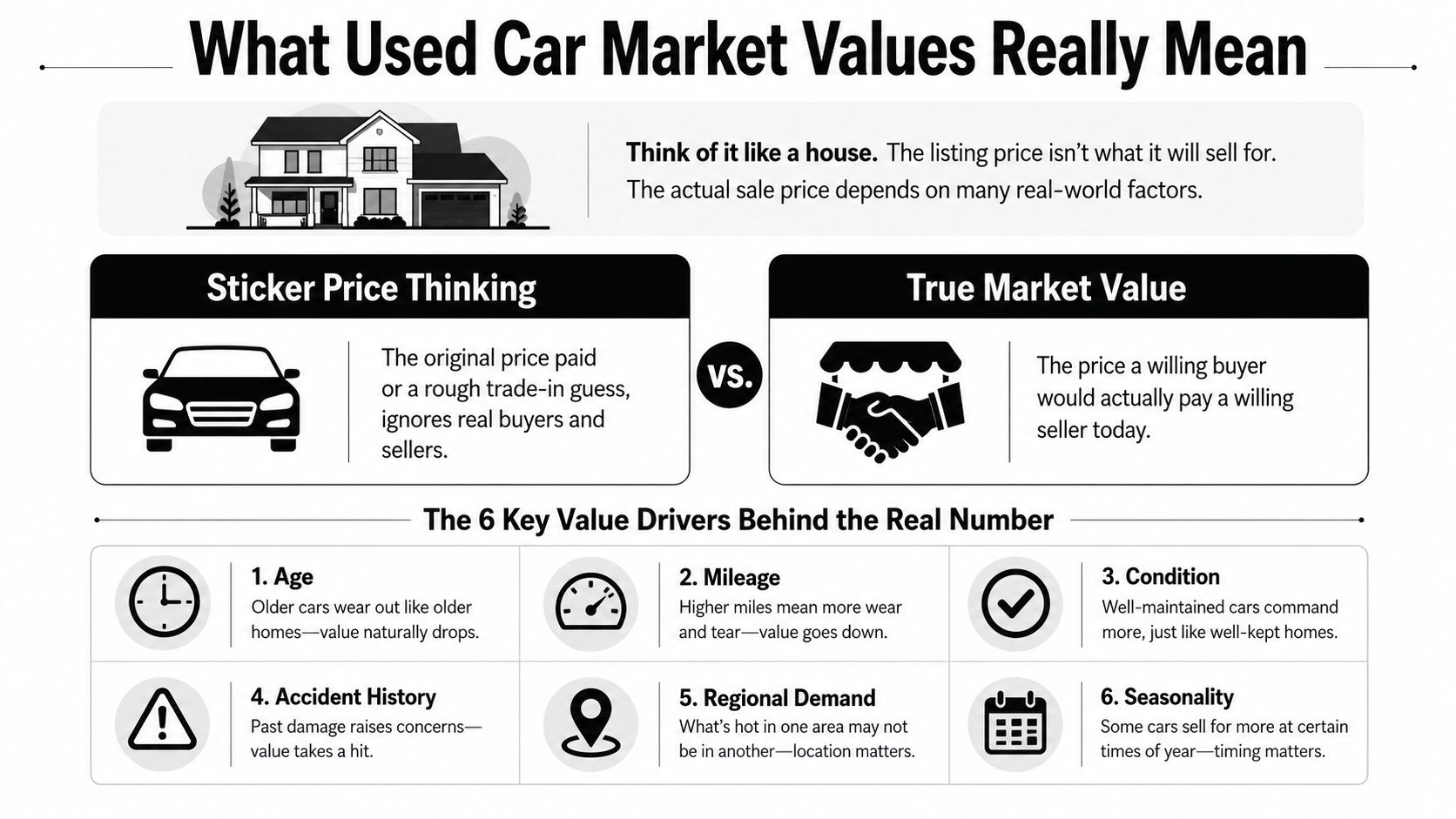
Think of a car like a house: its price depends on the neighborhood, recent sales, and the home’s condition—not what the first owner paid. Market value is the same idea for vehicles. It’s built from real-world transactions rather than a single lookup.
Vehicle data scraping provides the raw market data used to assess used car values, and you can learn about best practices for vehicle data to understand where numbers come from.
Key Points That Shape Market Value
- Age and mileage: Newer cars with low miles retain more value; a two-year-old sedan with 15k miles sells for far more than the same model with 60k miles.
- Condition and damage history: A clean Carfax usually commands a premium; a rebuilt title or visible frame damage cuts value sharply.
- Regional demand and seasonality: Pickup trucks sell for more in rural markets and in fall; convertibles gain in spring and summer.
For example, imagine two identical Tacomas. One is two years old with 12k miles and no accidents; the other has a rebuilt title and a lift kit. The first trades close to private-party comps; the second faces steep discounts from buyers and insurers alike. That difference directly affects the payout if the vehicle is totaled.
Why This Matters With Insurers
- Insurers typically quote market value based on a mix of sources and automated models.
- A settlement that ignores local dealer comps or auction results can underpay you.
- Diminished value reflects the permanent loss after an accident, even when repairs look perfect.
Practical Takeaway
- Collect recent local comps, auction results, and dealer listings to show what real buyers are paying.
- Photograph condition, list premium features, and document maintenance to strengthen your case.
Market value is a snapshot of what the market will actually pay today, not a theoretical or historical figure.
Primary Value Drivers at a Glance
| Driver | How It Moves Price |
|---|---|
| Age | Older lowers value |
| Mileage | Higher miles lower value |
| Condition | Clean increases value |
| Accident History | Reported damage lowers value |
| Regional Demand | Local tastes shift price |
| Seasonality | Time of year nudges price up or down |
Read also: Learn more about fair market value in our guide on What Is Fair Market Value.
Where Insurers and Appraisers Pull Their Numbers
Insurers and appraisers do not just pull a used car market values estimate out of thin air. They build it from several distinct data streams, and each one tells a different part of the pricing story. Think of it like evaluating a house: you look at the curb appeal, the professional appraisal, the recent sale down the block, and the auction where bank-owned properties move fast.
If you have ever shopped for a used car, you have probably checked Kelley Blue Book (KBB). It provides consumer-facing ranges that are great for comparing trade-in, private party, and dealer prices. KBB is handy when you need a quick ballpark, but its ranges can be too generic for insurance claims. The numbers smooth out local anomalies and recent wholesale swings. Consequently, an insurer relying solely on KBB might miss what buyers are actually paying right now.
Then there are the NADA guides. These deliver clean-trade and retail figures favored by dealers and lenders. NADA tends to assume dealer reconditioning and finance margins, so its clean-trade number can overstate what an individual seller gets at a private sale. For claims, NADA helps set expectations for dealership replacement costs, but it can be overly optimistic for direct owner payouts.
Dealer comps and private-party listings reflect what real buyers are paying in the local market today. These sources act as the most immediate mirror of demand, often showing seasonal or regional differences—like higher pickup values in rural Western markets. Gathering several same-trim local listings makes a persuasive, condition-matched case to an adjuster.
Auction results capture true wholesale movement and remove retail markups entirely. Manheim’s Used Vehicle Value Index highlights how volatile wholesale can be: a 54.3% year-over-year spike in April 2021, a 14.9% drop in December 2022, and a 3.6% gain in May 2026. That kind of swing shows why a settlement built on only one source misses the real picture.
A single valuation source is like a single eyewitness; the real picture emerges when you compare multiple, independent accounts.
Each source has its own strengths and blind spots. Here is a side-by-side look at how they stack up.
Comparing the Main Valuation Sources
| Source | Best Use | Main Limitation |
|---|---|---|
| KBB | Quick consumer range | Too generic for local claims |
| NADA | Dealer/finance baseline | Assumes dealer reconditioning |
| Dealer Comps | Real local retail demand | Listings may be aspirational |
| Auction Data | Wholesale reality | Lacks retail adjustments |
No single source gives you the full story. The strongest claims combine local retail comps with wholesale auction context.
Practical Steps for Claim Preparation
- Collect three to five local dealer and private comps matching year, trim, and mileage.
- Pull recent auction results for wholesale context.
- Note how Manheim index moves affect wholesale-to-retail gaps.
The insurance industry is a key audience for understanding market valuations; see this useful resource for professionals automated mail for loan officers.
Read also: Learn more about insurer valuation methods in our guide on How Does Insurance Company Value A Car.
Key Value Drivers Every Driver Should Understand
Age and mileage sit at the foundation of used car market values because they measure expected wear. A two-year-old truck with 12,000 miles will list far higher than that same model with 60,000 miles. This is a practical question: higher age or miles usually means a lower insurance payout.
Condition and damage history shape value next because buyers see what they will inherit. A pristine interior, recent service records, and no accident history push value up. However, a reported accident or a rebuilt title can cut value sharply and reduce settlement offers.
Condition Vs Accident History
- Condition matters in small, additive ways: new tires, no dings, and detailed service receipts each add confidence to a buyer.
- Accident history subtracts value in one noticeable chunk; even perfect repairs rarely erase the stigma.
- Diminished value is the permanent markdown buyers apply after an accident, and insurers often underplay it.
For example, imagine two identical Toyota Tacomas. One is two years old, 12k miles, clean Carfax, and stock. The other has a rebuilt title and a lift kit, with the same miles. The clean Tacoma trades near private-party comps; the modified, rebuilt unit sells for much less and attracts fewer buyers.
Modifications And Market Perception
Modifications like lift kits can narrow your buyer pool and lower market value even if they cost money.
Modifications are a double-edged sword. Performance parts or cosmetic changes may add value for a niche buyer but often lower mainstream appeal. Insurers will discount modified vehicles unless you documented that upgrades increased retail value.
Regional demand and seasonality are powerful, often overlooked drivers. Pickup trucks might fetch a premium in rural markets, while convertibles gain in summer. Carfax segment data shows that in January 2026 luxury cars were up 8.0%, pickup trucks up 3.7%, luxury SUVs up 2.6%, hybrids and EVs up 2.1%, and only vans and minivans were down about 1.6%.
Practical Impacts
- Match local demand when gathering comps so you don't compare to an irrelevant market.
- Time your negotiation—offers in high-demand seasons will be stronger.
- Use segment trends like the Carfax numbers above to justify higher values.
Documentation changes how an adjuster reads each driver. Photos of condition, service records, and matched local listings translate features into dollars. This answers the simple question: will this raise or lower my insurance payout.
Tips For Claim Prep
- Photograph obvious and subtle condition items with dates and odometer shots.
- Pull three to five local dealer and private-party comps for same year, trim, and mileage.
- Include any receipts for premium packages or aftermarket parts to show added value.
Read also: Check out our detailed checklist on vehicle inspections and evidence at Vehicle Condition Inspection Guide.
Small, well-documented differences in age, condition, or history can move a settlement by thousands of dollars—so treat each driver as a line item in your claim.
How Accidents And Total-Loss Events Change Market Value

A fender bender doesn't just leave a dent—it rewrites how the market sees your car. And that rewrite happens in two distinct ways: the lingering stigma after repairs and the math insurers use when they decide your car is totaled.
Here's the reality most people discover the hard way. Even a flawless repair job can't erase the fact that a vehicle was in an accident. Buyers—whether they're walking a dealer lot or scrolling through private listings—approach a car with accident history with caution. They're worried about hidden damage, future reliability, and the hassle of reselling down the line. So they offer less. That gap between what a clean-history car sells for and what yours can fetch? That's diminished value, and it hits your wallet directly.
A clean history is like curb appeal for houses; even flawless repairs rarely restore the original buyer confidence.
Think about it this way. A 2019 sedan with a replaced rear bumper might pass every mechanical and visual inspection. But private-party buyers and dealers will still discount it because the next buyer in line will ask the same nervous questions. The car's story changed, and the market prices that story accordingly.
Estimating diminished value comes down to comparing apples to apples—pre-accident market comps against post-repair comps for vehicles with similar mileage and condition. Local dealer listings and recent private sales give you the strongest evidence because they show what people actually pay, not what a formula predicts.
How Insurers Calculate Total-Loss Offers
When your car gets totaled, insurers typically pay out Actual Cash Value (ACV)—basically what the vehicle was worth right before the accident—minus salvage value and your deductible.
The frustrating part? ACV calculations often feel low. That's because many insurers rely on blended valuation guides and automated models that smooth out local market spikes. Recent Edmunds data from Q1 2026 showed three-year-old used vehicles averaging $31,548 with residuals sitting at 66% of original MSRP—a five-year low. Percentage retention can drop while dollar values stay substantial, which muddies the waters when you're evaluating an offer.
- Insurer step 1: Calculate ACV using guides and comps
- Step 2: Subtract salvage value and deductible
- Step 3: Present an offer, often pulled from a single valuation source
Because insurers might pull from Kelley Blue Book, NADA ranges, or proprietary software, their offers can miss segment-specific trends or recent local sales for your exact trim and condition.
Challenging A Low Offer
The key to pushing back is building a case that mirrors what the insurer claims to value. Match the year, trim, mileage, and condition as closely as possible.
Gather recent dealer sales, private-party listings, and auction results that show higher realized prices for similar vehicles. Reference segment-level data from Edmunds or similar sources to demonstrate that percentage-retention metrics sometimes understate real dollar demand in your local market.
- Numbered steps to dispute an offer:
- Collect three to five local, condition-matched comps with dates and URLs
- Pull recent wholesale auction results as additional context
- Build a one-page comparison showing how each comp supports a higher ACV
Sometimes an independent appraisal is what turns the conversation around. If your policy includes an appraisal clause, each side hires an appraiser and a neutral umpire makes the final call. For well-documented claims, this process can move settlements up by thousands.
Documenting and Proving Market Value for Your Claim
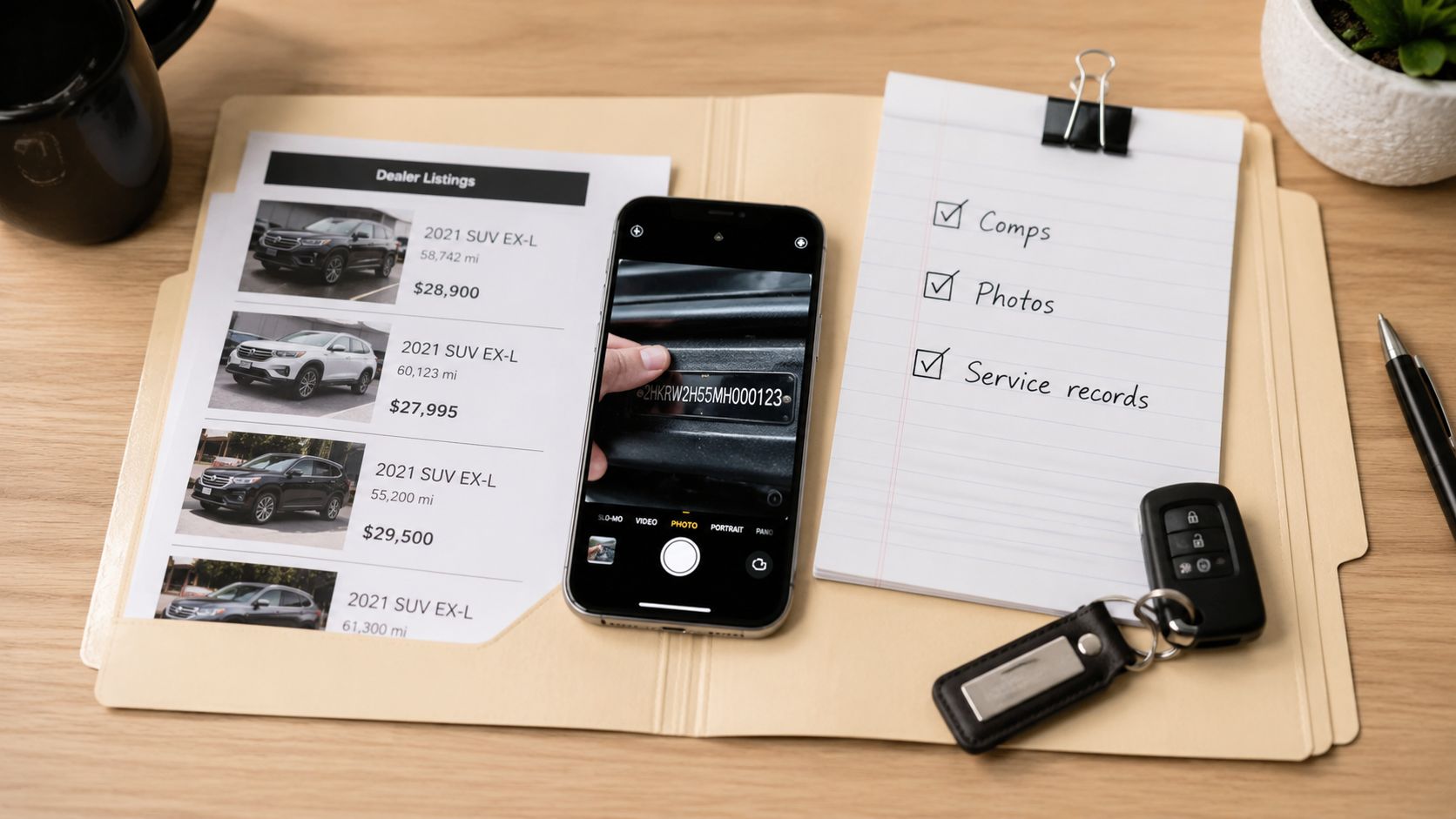
Think of your evidence package as a photo album of value — each piece tells a part of the story that automated valuation software simply can't capture. The goal isn't to overwhelm the adjuster; it's to give them the context they need to see what your car was actually worth.
Start by pulling three to five recent dealer listings that match your year, make, model, trim, and mileage as closely as possible. These create your retail baseline — what real buyers are paying for comparable vehicles right now.
Then go a step further. Grab recent auction comps to show the wholesale side of the picture, along with any local demand spikes that retail listings alone won't reveal. Auction data can be especially powerful when the market is tight and wholesale prices are climbing.
Photograph your vehicle thoroughly: every exterior angle, interior shots, the odometer reading, the VIN plate, and any damage or premium features. Keep your service records and receipts organized chronologically. This kind of documentation demonstrates consistent maintenance and makes it harder for an adjuster to apply automatic condition discounts.
Evidence Checklist to Build Your Packet
- Dealer listings with dates and URLs for direct comparison
- Auction prints or screenshots with sale dates and hammer prices
- High-resolution photos annotated with notes and odometer shots
- Complete service history and receipts for tires, belts, or major work
- Receipts for premium equipment such as packages or aftermarket parts
A tight evidence packet compels adjusters to treat local signals — not just a software output — as the primary input.
Once your packet is assembled, write a one-page narrative that ties your comps to your vehicle's actual condition and offers a clear pre-loss value estimate. Keep it concise and factual.
Include a short table that aligns each comparable listing with mileage, condition, and asking price. Adjusters appreciate being able to scan and compare at a glance rather than digging through pages of information.
How to Use Market Data in Negotiations
- Lead with dealer retail comps to establish the consumer-facing value your vehicle commanded.
- Follow up with auction comps to demonstrate why retail prices are realistic given current wholesale demand.
- Attach your photos and service history to prove condition and push back against automatic depreciation.
For additional context, note that Federal Reserve consumer-price data shows the used-cars-and-trucks index at 180.005 in May 2026, only marginally below January 2026. This supports the case for elevated used car market values. Learn more about these findings.
When documenting your car's market value for an insurance claim, you may first need to prove ownership. See Top Motor Keys V5C advice.
If an adjuster still undervalues your claim despite solid documentation, consider getting an independent appraisal or invoking the appraisal clause to force a neutral third-party determination.
When an Independent Appraisal and the Appraisal Clause Make Sense
An independent appraiser takes all those scattered market signals and turns them into a defendable dollar figure for your car. They physically inspect the vehicle, pull local dealer comps, auction results, and recent private sales, then put together a written report that walks through exactly how they arrived at the pre-loss value. That's a far cry from what an insurer's in-house valuation typically looks like, which often leans on blended guides and automated models that tend to smooth over local market spikes.
Picture this: an adjuster quotes you a single Kelley Blue Book or NADA number and calls it a day. An appraiser, on the other hand, will lay out three actual dealer listings, two auction sales, photos, and receipts that demonstrate why those comps genuinely match your specific vehicle. That evidence-based approach is exactly why appraisal reports consistently push offers higher—often by thousands of dollars for popular or high-end models.
How the Appraisal Clause Works
Most auto policies include an appraisal clause that functions as a built-in tie-breaker when you and the insurer can't see eye to eye on value. If you reach an impasse, each side hires its own appraiser, and those two appraisers select a neutral umpire. Should the appraisers and umpire fail to reach agreement, the umpire's decision settles the dispute. Typically, you split the umpire's fee down the middle while each party covers its own appraiser's costs.
An appraisal isn't litigation—it's a contractual mechanism many policies provide to arrive at a fair market number without ever stepping into a courtroom.
When to Involve an Independent Appraiser
- The insurer's offer sits well below what local dealers are actually asking for the same year, trim, and mileage.
- You're dealing with a high-value, collector, or heavily optioned vehicle where generic guides simply don't capture the premiums those cars command.
- Diminished value is a real factor and the insurer is minimizing the accident history or the market stigma that follows a damaged vehicle.
Total Loss Northwest serves as a certified independent appraiser for Washington and Oregon drivers, preparing diminished value and total-loss reports and invoking the appraisal clause on clients' behalf. We also support diminished value claims across all 50 states, so the same methodology applies even when a local in-person presence isn't practical.
Numbered practical steps to take if you need an appraisal:
- Request the insurer's valuation report and the underlying comps they used.
- Hire a certified independent appraiser to inspect the vehicle and build a documented report.
- If the numbers still don't align, invoke the appraisal clause and move forward with appraisers and an umpire.
Here's a real-world example: a well-documented appraisal for a premium SUV frequently shifts offers upward by a few thousand dollars once retail dealer comps, recent auction evidence, and documented premium equipment are laid out on the table.
Next Steps To Protect What Your Car Is Really Worth
The moment you get an insurance offer, you're essentially sitting across the table from a negotiator. Your first move? Pull your own comps immediately, before you even respond.
Start by hunting down three to five recent listings—dealer and private-party—that closely match your car's year, trim, and mileage. Save the URLs and take screenshots with visible timestamps. This gives you a real-world retail baseline to line up against the insurer's numbers, dollar for dollar.
Then ask the adjuster for their valuation report and the specific comps behind it. This does two things: it forces transparency, and it lets you catch discrepancies in mileage, trim level, or condition assumptions. If they push back or refuse, make sure you document that in writing. That refusal itself becomes part of your paper trail.
Build Your Evidence Packet
Think of your evidence packet as your negotiation toolkit. The stronger it is, the harder your case becomes to dismiss. Here's what to include:
- Screenshots and links to recent dealer and private-party listings matching your car's year, trim, and mileage range, with dates clearly visible
- Recent auction results that show wholesale context and any current market spikes
- High-quality photos of your vehicle's condition, odometer reading, VIN plate, and any premium equipment, paired with dated service records
- A one-page narrative that ties each comp directly to your specific car, explaining why your condition or options justify a higher value
A solid evidence packet takes the abstract concept of "market value" and turns it into hard numbers an adjuster can't easily dismiss.
If the insurer's offer and your research diverge significantly, it's time to bring in a professional. Hire an independent appraiser who will physically inspect your car, pull local retail and wholesale comps, and put together a formal written report. You can present this during negotiations or use it to invoke your policy's appraisal clause. This step matters most for high-value vehicles, collector cars, or heavily modified rides where generic valuation guides miss the premiums entirely.
Numbered Steps To Escalate
- Request the insurer's valuation report and underlying comps in writing.
- Submit your evidence packet with matched comps, photos, and service history.
- If the gap persists, engage a certified independent appraiser and invoke the appraisal clause if needed.
Used car market values aren't pulled from some secret database—they're built from dozens of local signals happening right now. When you walk in with documented condition, local comps, and the confidence to call in an appraiser, you shift the entire dynamic of the negotiation. You stop being someone who accepts a number and start being someone who proves one.
Frequently Asked Questions About Used Car Market Values
How Do Insurers Calculate Actual Cash Value for a Totaled Vehicle?
Insurers pull from a mix of valuation guides, local dealer comparisons, and auction data to estimate what your car was worth right before the loss. They'll typically subtract salvage value and your deductible from that figure. The problem? These generic guides don't always capture what's actually happening in your local market. If retail demand has spiked recently or auction prices have climbed, the insurer's number can fall short. That's why you should always ask for their underlying comps—line by line, so you can spot where they might be lowballing you.
How Long Does a Diminished Value Claim Usually Take?
Most claims land somewhere between a few weeks and several months. The timeline really hinges on two things: how solid your evidence is and how backed up the insurer is. A well-organized packet with three to five local comps can move things along much faster. It cuts down on the back-and-forth that drags these things out.
Can I Challenge the Value After the Insurer Totals My Car?
Absolutely. Start by requesting their full valuation report. Then submit your own matched comps and photos that reflect your car's actual condition. If they still won't budge, you've got two powerful tools: an independent appraisal or invoking the appraisal clause, which forces a neutral third party to settle the dispute.
What Paperwork Best Proves Market Value?
You want a paper trail that tells a clear, dated story. Gather:
- Dealer listings from around the time of loss
- Private-sale screenshots with visible dates
- Auction results for comparable vehicles
- High-resolution photos including odometer shots
- VIN-specific service and maintenance records
- A concise one-page narrative connecting your comps to your car's specific condition
The goal is to make it easy for the adjuster to see why your number makes sense—without them having to dig for it.
If you need help building a claim packet or invoking appraisal, contact Total Loss Northwest at https://totallossnw.com