You just got the letter, the email, or the adjuster's voicemail. The number is lower than you expected, the explanation is thin, and the carrier seems to think you'll accept the first offer because the car is already gone or the repairs are already underway. That's exactly where a USPAP compliant appraisal matters, because it turns your disagreement into a written, defensible opinion that can be read, challenged, and used in negotiation.
For a driver staring at a lowball total-loss offer or fighting for diminished value after a not-at-fault crash, the issue isn't whether the insurer has a valuation. It does. The question is whether you have a report that can stand up to it on its own terms, with the right client, the right intended use, the right value definition, and the market evidence to back it up.
When the Insurance Company's Number Is Not the Final Word
The first bad number usually arrives looking polished. It has a clean layout, a stack of adjusted comparables, and a conclusion that feels final. It isn't final, though, because the carrier's valuation is still just one side of the dispute, and a USPAP compliant appraisal is the document that lets you answer with more than frustration.
A compliant report gives you a real path forward because it is built for accountability. The Appraisal Foundation's USPAP program identifies USPAP as the core standards system for appraisal practice in the United States, and the reporting rules are designed to make the appraiser show the reasoning, not just the result. The Appraisal Foundation's USPAP program page makes that structure central, and that matters when you're trying to move an insurer off a low number.
Why the carrier's estimate is easier to dismiss than a compliant report
An adjuster can glance at an informal opinion and treat it like a complaint. A USPAP-compliant vehicle appraisal is different because it has a defined scope, a signed certification, and a report structure that tells the reviewer exactly what was analyzed and why. That makes it harder to brush off without addressing the comparable sales, the vehicle's condition, and the valuation logic.
For total loss and diminished value claims, that difference changes the conversation. Instead of saying, “I disagree,” you can point to a report that identifies the subject vehicle, explains the assignment, and ties the conclusion to market data. If the carrier wants to push back, it has to engage with the report, not just wave it away.
Practical rule: if the document can't be defended line by line, it won't move the settlement very far.
A good way to think about it is simple. The insurer's number is a position. A compliant appraisal is evidence.
Understanding USPAP and What Compliance Means
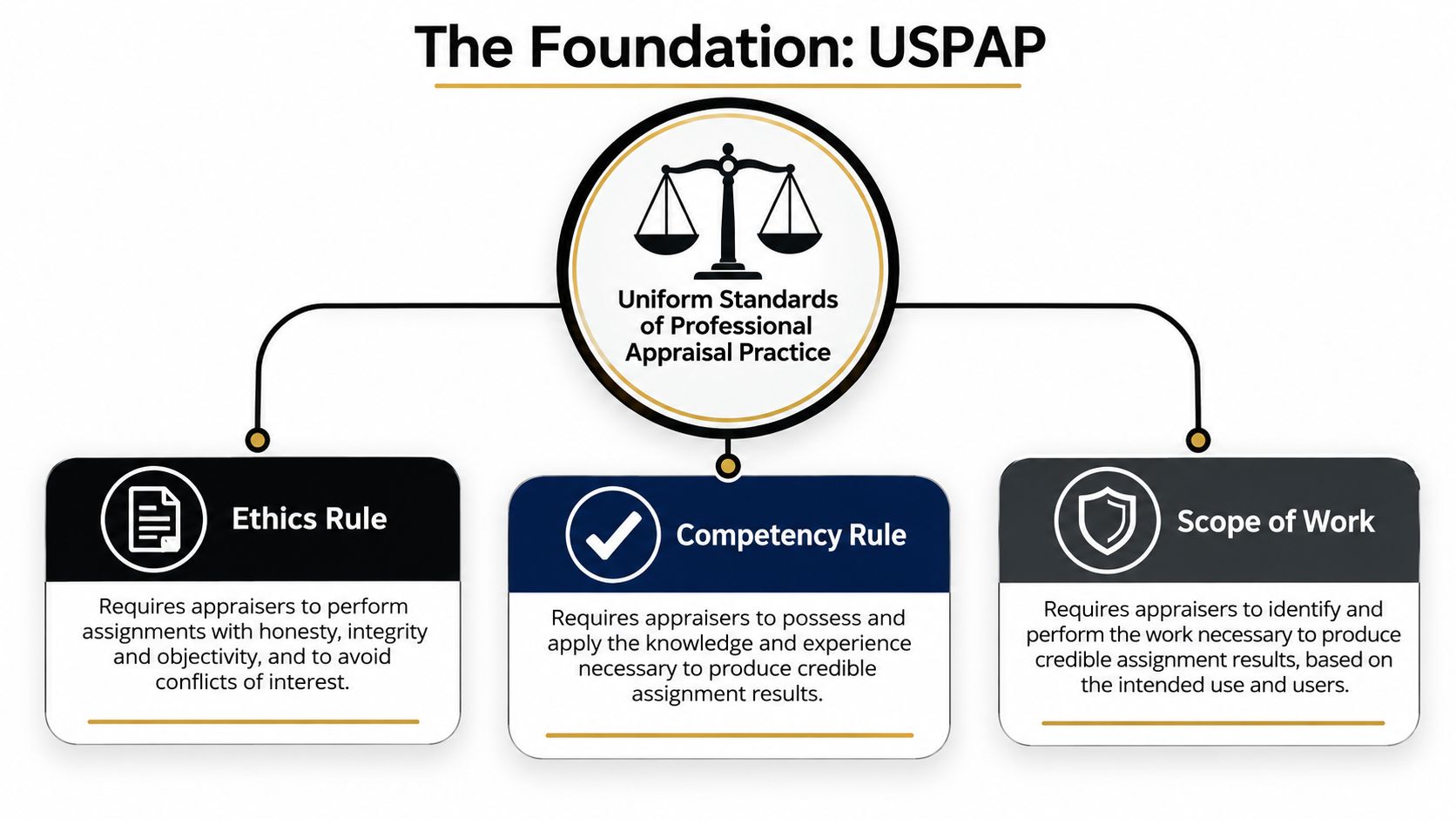
USPAP stands for the Uniform Standards of Professional Appraisal Practice, and in the United States it is the formal framework maintained by The Appraisal Foundation. In plain English, it separates a casual estimate from a professional appraisal. The point is accountability. USPAP makes the appraiser show the reasoning behind the opinion, not just hand over a number.
The report has to say who it is for and why it exists
One of the main reporting requirements sits in Standard Rule 2-2. A written appraisal report must identify the client and intended users, state the intended use, disclose the value definition, and include the effective date of value and the effective date of the report. It also has to be written so it is not misleading, and it must disclose any assumptions, extraordinary assumptions, hypothetical conditions, and limiting conditions used in the assignment.
That sounds formal, but the practical meaning is plain. A compliant appraisal is a documented professional opinion with a defined purpose, scope, and chain of responsibility. If the report does not identify who it was written for, what it is being used for, and what assumptions support it, the report starts out weak before anyone argues about value.
Why the report content matters more than the form
USPAP compliance turns on documentation, not just the final conclusion. The appraiser has to show the work, including the comparable sales, the analysis, the assumptions, and the effective date, so the intended user can follow the reasoning without guessing. That is the part insurance carriers and opposing reviewers focus on first, because a clean conclusion means very little if the supporting file is thin.
For a driver pushing back on a low offer, that matters in the real world. A carrier can dismiss a loose estimate with very little effort. A compliant vehicle appraisal gives them less room to do that because the report is built to be examined line by line, and that kind of file is harder to sidestep without addressing the numbers and the logic. That is also why people dealing with understanding Texas diminished value claims often run into the same issue, the first number from the carrier is not the last word.
A compliant appraisal should read like a professional record, not a confidence statement.
Why Compliance Matters for Total Loss and Diminished Value Claims
A total loss dispute and a diminished value dispute are different fights, but they both run into the same problem, the carrier controls the first number. A casual estimate won't usually change that number because it doesn't force the insurer to answer hard questions about method, data selection, and assumptions. A USPAP compliant appraisal does, because it carries the responsibility of a professional opinion that can be examined.
Total loss claims need a report that shows the market, not just the conclusion
In a total loss file, the carrier is usually trying to establish what the vehicle was worth immediately before the loss. If the report just says the car was worth more, that won't get you far. A compliant appraisal should document the subject vehicle, analyze relevant market data, reconcile the evidence into a final opinion, and explain why any approach or data set was excluded. The insurance appraisal independence resource is useful here because it underscores that the report must use recognized methods and techniques appropriate to the assignment.
That matters because adjusters look for gaps. If they see missing mileage, a vague trim description, or no explanation for why a comparable was rejected, they lean on that gap to protect the initial offer. If they see a report that walks through the exact vehicle and the exact market evidence, they have to respond to substance instead of leaning on software output.
Diminished value claims live or die on pre-loss comparison
A diminished value claim is even more sensitive to method. The argument is not that the vehicle is broken beyond repair, it's that a repaired vehicle can still lose market appeal after an accident. For readers who want a helpful legal overview of that claim type, understanding Texas diminished value claims offers a useful state-specific primer.
The appraisal has to connect the repaired vehicle to its pre-loss value in a way that is understandable and defensible. That means the appraisal should make clear what was compared, what market evidence was used, and why the final opinion makes sense for that particular vehicle. A carrier can argue about the amount, but it has a harder time ignoring a report that explains the pathway from facts to conclusion.
How to Verify an Appraiser and Their Report Before You Pay
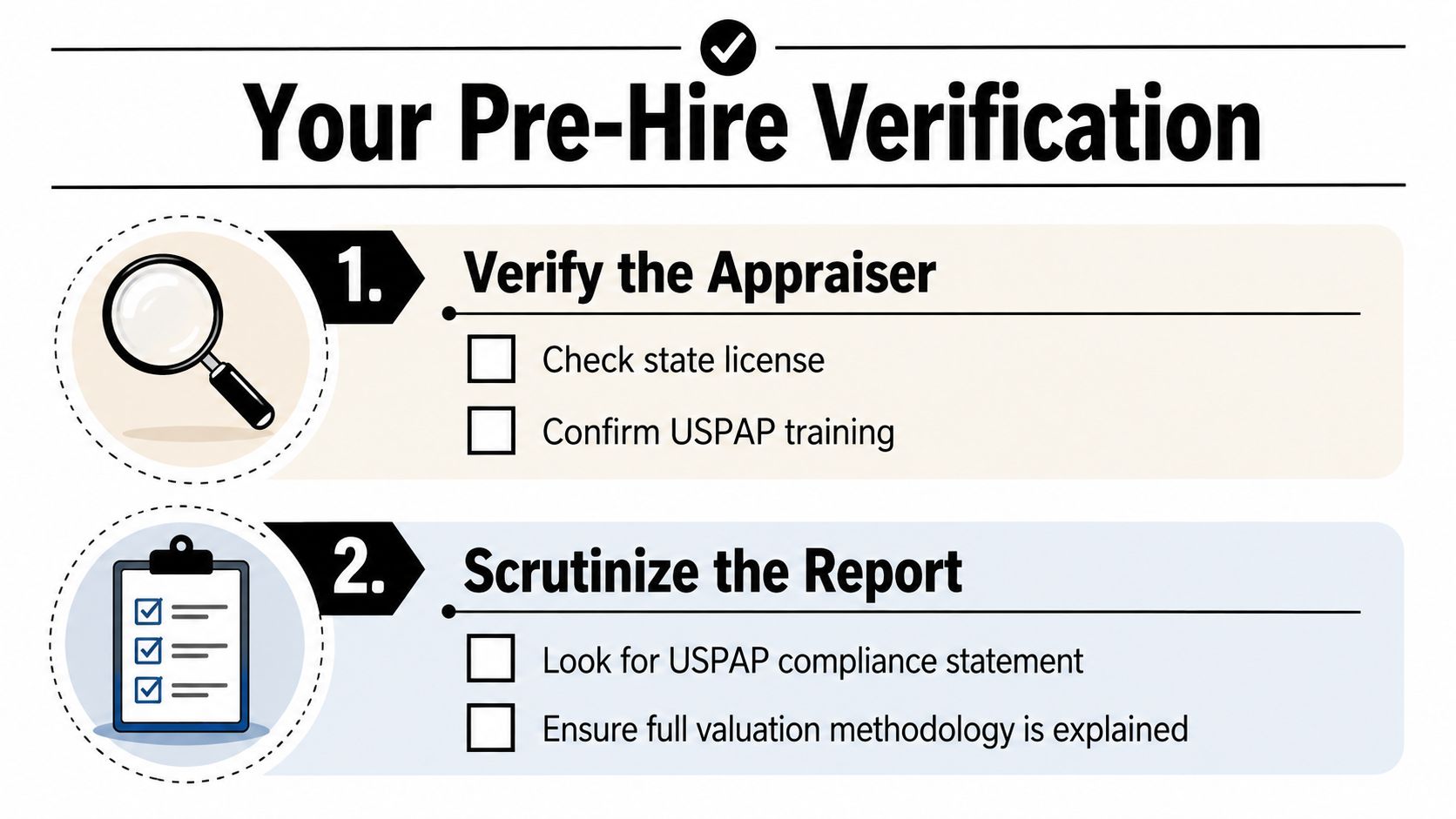
Hiring the wrong person is the fastest way to waste money on a report that won't help. The first check is the appraiser, the second is the document. If either one is sloppy, the claim gets harder, not easier.
Start with the person, not the PDF
Ask whether the appraiser will write under USPAP and which edition they use. The 2020 to 2021 USPAP edition is the version cited in the provided source set, and that matters because you want the appraiser working from the same standards logic that governs the report. If the appraiser can't answer that directly, move on.
Also ask about credentials, state licensing where applicable, and any private designations. For a practical hiring lens, the same kind of credential review used in legal support can be useful. A general overview like credential verification services for law firms shows why the question isn't just “can they appraise,” but “can they document their qualifications in a way that stands up when challenged.”
If you're comparing local options, one focused resource is what to look for in a total loss appraiser. It's worth reading before you hand over money, because the wrong hire often looks professional until the report is tested.
Then inspect the report for the required pieces
The report should identify the client and intended users, state the intended use, disclose the value definition, list the effective date of value and the report date, and include a signed certification. It should also be clear about assumptions, extraordinary assumptions, hypothetical conditions, and limiting conditions. If those pieces are missing or buried so deep that the adjuster can't find them, the report is weak.
Look for a real scope of work statement too. That tells you what the appraiser did, what they didn't do, and why. For vehicle claims, the strongest reports are the ones that make the logic obvious within a few pages, not the ones that rely on jargon to look impressive.
For drivers in legal or insurance disputes, a verification process like this prevents a common mistake, paying for a document that sounds official but lacks the structure needed to move money.
The Anatomy of a USPAP Compliant Vehicle Appraisal
A good report does not hide its parts. It lays them out so the carrier, the insured, and, if needed, the umpire can follow the reasoning without decoding a mystery novel. For a vehicle claim, that clarity is what gives the appraisal weight.
The front end of the report should identify the assignment cleanly
The cover page or opening pages should say who the client is, who the intended users are, and what the intended use is. It should identify the subject vehicle with details like VIN, trim, equipment, mileage, and condition. It should also define the value standard being used and the effective date of value, because those dates matter when the loss happened and when the report was written.
That opening section should not feel generic. A compliant total-loss report should make it clear that the vehicle is being valued as of the loss date, while a diminished-value report should make clear that the value opinion is tied to the pre-loss condition and market. If the opening pages are vague, the rest of the report has to work too hard to recover credibility.
The middle has to show the market work
The report earns its keep. The sales comparison approach depends on available comparable sales data when that approach is needed for credible results, and in a vehicle file that usually means the report walks through why certain comparables were chosen and others were excluded. The Appraisal Institute's guide notes support that method-first approach.
A strong report includes concise comments on condition differences, mileage spread, trim mismatches, options, and market location. If a comparable was excluded because it was too far away, too different, or had an unsupported adjustment, the report should say so. That sort of transparency makes the opinion defendable when the carrier's reviewer starts asking questions.
| Report Component | What It Should Contain | Why It Matters |
|---|---|---|
| Client and intended users | Clear identification of who ordered the report and who may rely on it | Shows the report was written for a defined audience |
| Intended use | The claim purpose, such as total loss, diminished value, or dispute support | Keeps the opinion tied to the right decision |
| Subject vehicle data | VIN, trim, options, mileage, condition, and loss context | Prevents confusion about what was appraised |
| Value definition and dates | The value standard, effective date of value, and report date | Locks the opinion to the correct point in time |
| Scope of work | What data was reviewed, what methods were used, and any limits | Shows the appraiser showed their work |
| Comparable sales analysis | Market comps, adjustments, and exclusion reasons | Lets the reader test the conclusion |
| Reconciliation | Why the final opinion is the number chosen | Connects evidence to conclusion |
| Signed certification | The appraiser's certification and accountability | Confirms the report is a professional opinion |
If you want a practical layout reference, the internal guide on auto appraisal forms helps show how those pieces appear in actual vehicle files.
Turning the Report Into a Higher Settlement
A strong appraisal that never leaves your inbox doesn't change the claim. The pushback has to be specific, timely, and documented. If you hand the carrier the report and ask them to “take another look,” don't be surprised if nothing happens.
Send the report with a pointed written demand
Use a short written submission that points the adjuster to the exact section that matters. For total loss claims, that usually means the comparable sales and reconciliation sections. For diminished value, it's the pre-loss value analysis and the logic connecting the repaired vehicle to its reduced market position.
A well-written demand letter pairs nicely with the appraisal. If you need a structure for that side of the file, this auto accident demand letter guide is a useful companion because it shows how a claim package can be organized around facts instead of frustration.
Escalate if the answer ignores the evidence
If the adjuster doesn't engage with the report, move the file to a supervisor and keep the paper trail clean. Save every email, note every call, and keep track of who said what and when. The goal is to make it easy to show that you gave the carrier a real chance to respond to the analysis.
If the claim still stalls, the appraisal clause is the next lever in many policies. That usually means each side picks an appraiser and a neutral umpire resolves the dispute. The clause doesn't guarantee your number, but it does force the insurer into a process that is more formal than an adjuster's first pass.
Practical rule: if you wait too long, the carrier's first offer starts to harden into the only offer they want to discuss.
For some drivers, that's the point where a service such as Total Loss Northwest comes into the picture as one option among others, because it provides auto appraisals that include a USPAP-compliant report for total loss and diminished value disputes. The value is in the structure, not the sales pitch, and the report only helps if you use it in the claim.
Oregon and Washington Notes for Drivers Filing These Claims
Oregon and Washington drivers face the same core appraisal logic, but the claim process can feel different once the carrier starts responding. In both states, a local report carries practical weight because it speaks the same language the carrier has to answer, market evidence, documented methodology, and a clear scope of work. A USPAP compliant appraisal is especially useful in that setting because it is built as a professional opinion, not a negotiation note.
Local process details can shape leverage
If you're in Oregon or Washington, the appraisal clause in your policy may become important sooner than you expect. Once it's invoked, the file usually stops being a casual back-and-forth and becomes a structured dispute with each side selecting an appraiser and, if needed, an umpire. That changes how carefully the carrier has to read the report.
Washington drivers often ask whether diminished value can be pursued after a not-at-fault loss, while Oregon drivers often want to know how far the carrier has to go in justifying a total-loss number. The practical answer in both states is the same, if your report is precise, local, and well-documented, it's harder for the insurer to dismiss it without a real counteranalysis.
For readers looking for a state-specific vehicle appraisal reference, this total loss vehicle appraisal guide is a useful starting point because it frames the claim in the same regional context many Pacific Northwest drivers are dealing with.
What to expect from a regional carrier response
Regional carriers usually respond fastest to reports that are easy to audit. That means clear vehicle data, clear comparables, and clear conclusions. If your file comes from a local appraiser who understands how Oregon and Washington claims are handled, the carrier is more likely to treat it as a serious dispute rather than an emotional complaint.
The bottom line is simple. In both states, the report has more weight when it is written like evidence and submitted like evidence. That's what gives you the best shot at getting the file off the carrier's first number and onto a fairer one.
If you're fighting a low total-loss offer or a diminished value dispute in Oregon or Washington, Total Loss Northwest can prepare a vehicle appraisal with a USPAP-compliant report and help you put the carrier back in the position of having to answer the evidence. Visit Total Loss Northwest to see how their appraisal process fits a total loss or diminished value claim and decide whether it's the right next step for your file.