Two calls usually hit fast after a serious car wreck. One is from the body shop telling you the vehicle may be a total loss. The other is from an insurance adjuster who sounds friendly and wants to settle before the full cost of the crash is clear.
An injury settlement is the deal that ends your claim. The insurer pays money, and you give up the right to pursue more compensation for that accident. If your case involves both bodily injury and a totaled car, the numbers can get confusing quickly because the carrier often handles the injury claim and the property damage claim on separate tracks while pushing you to treat the overall outcome like one fair package.
That is where people get burned.
A real auto accident settlement is not just about pain and suffering. It can involve medical bills, future care, lost income, out-of-pocket expenses, and the financial gap between what your car was worth and what you still owed on it. Then come the deductions many drivers never see coming, including health insurance reimbursement claims, medical liens, attorney fees, and release language that can shut down valid future claims.
If you are also comparing accident cases with job-related claims, this guide on understanding work injury settlements helps clarify how settlement rules change by claim type.
Before you sign anything, understand one point clearly. The settlement amount is not the same as the money you keep. Your net recovery can drop hard after liens, loan balances on a totaled vehicle, and claim-related tax questions are addressed.
What an Injury Settlement Actually Is
You get rear-ended, your car may be headed for a total loss decision, your back is tightening up, and the adjuster wants to talk money before the full picture is clear. That is the setting for an injury settlement.
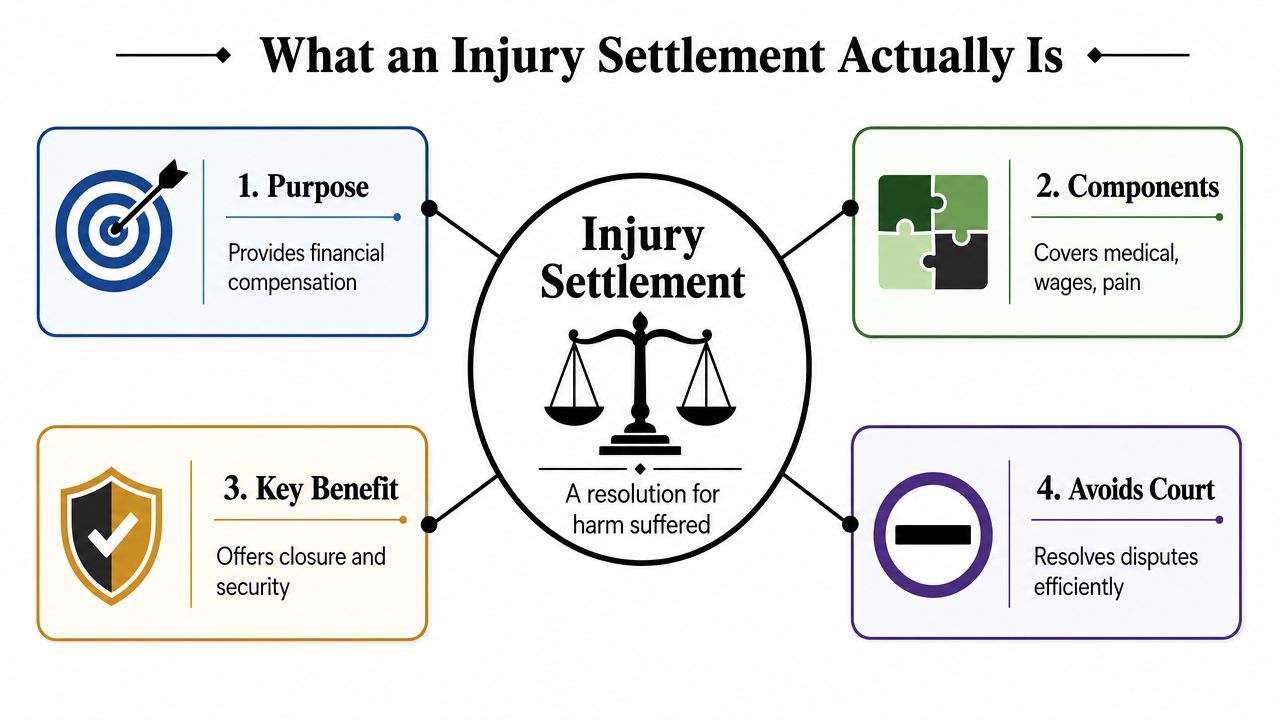
An injury settlement is a binding agreement that closes your claim. The insurer or at-fault party pays a set amount, and you give up the right to ask for more money later for injuries tied to that crash. The basic legal framework is consistent with how settlements are described by the Cornell Legal Information Institute. In plain English, you are trading your future claim rights for money now.
Why insurers push settlement
Insurance companies want finality. A signed release cuts off risk, fixes their cost, and keeps the file from getting more expensive.
Settlement can work for you too, but only if you treat it like a valuation problem instead of a relief valve. In an auto claim, that means looking past the headline number and asking what the check needs to cover. Medical treatment, lost wages, future care, out-of-pocket costs, and the money problems that show up when a totaled car is worth less than what you still owe all belong in that review. If you want a starting point for the math, use an injury settlement calculator for car accident claims, then compare that estimate to the insurer's offer.
Practical rule: Judge a settlement by your net recovery, not the gross number on the release.
What you give up when you settle
Once you sign, the claim is usually over for good. If your treatment drags on, a specialist recommends a procedure later, or your symptoms turn out to be more serious than they looked in the first few weeks, the insurer will point to the release and close the door.
That is why quick settlements are dangerous after a car accident. Soft tissue injuries can develop slowly. So can billing issues. A case that looks manageable at first can shrink fast after health insurance reimbursement claims, provider liens, attorney fees, and vehicle loan balances are taken out. The settlement amount and the money you keep are often very different numbers.
A lot of people also confuse auto injury settlements with other claim systems. If you are sorting out both a crash claim and a job-related injury, this guide on understanding work injury settlements helps show how settlement rules change under workers' compensation.
What this means after a car accident
After a collision, you are often dealing with two separate claims at the same time. One is for bodily injury. The other is for vehicle damage or total loss.
Keep them separate in your own mind, even if the adjuster blurs them together. A weak total loss offer does not set the value of your injury case. A quick injury payment also should not pressure you into accepting a low vehicle valuation, rolling negative equity into the background, or overlooking deductions that can gut your final payout.
Decoding Your Settlement What Is Included
A settlement offer after a car accident can look bigger than it really is.
You see one number. The insurer sees a stack of categories, offsets, and pressure points. If you do not break the offer apart, you cannot tell whether you are being paid fairly for your injuries, your lost income, or the financial hit from a totaled car.
Start by separating the claim into two buckets. First are economic damages, which are losses you can prove with records. Second are non-economic damages, which cover how the injury changed your daily life.
Economic damages
These are the hard-dollar losses tied to the crash. Medical bills, out-of-pocket costs, wage loss, mileage to treatment, rental car charges, and vehicle damage records all belong here.
In an auto accident case, property damage often gets treated like a side issue. That is a mistake. If your car is a total loss, the actual cash value offer, sales tax, title and registration fees, towing, storage, rental, and any loan shortfall can shape your settlement decisions. People under car-replacement pressure often accept weak injury money just to get cash in hand.
Non-economic damages
This part covers the human cost. Pain. Sleep disruption. Anxiety behind the wheel. Loss of mobility. Missing workouts, travel, housework, or time with your kids because your neck, back, knee, or shoulder will not cooperate.
Insurance adjusters often downplay these losses because they are harder to measure. You should not. If the crash changed how you function, that belongs in the value discussion.
Do not let the carrier price your case as if the only losses that count are the ones printed on invoices.
Types of damages in an injury settlement
| Damage Type | Category | Description & Example |
|---|---|---|
| Medical bills | Economic | Emergency room care, imaging, surgery, prescriptions, chiropractic care, physical therapy, follow-up appointments |
| Future treatment | Economic | Ongoing therapy, specialist visits, projected care after the claim is negotiated |
| Lost wages | Economic | Missed pay from time off work after the crash |
| Property damage | Economic | Repair costs, rental expenses, or total loss valuation if the vehicle is not repairable |
| Pain and suffering | Non-economic | Physical pain, reduced mobility, lingering symptoms, daily discomfort |
| Emotional distress | Non-economic | Anxiety while driving, sleep disruption, stress tied to the crash |
| Loss of enjoyment | Non-economic | Missing hobbies, travel, exercise, or family activities because of the injury |
What usually drives the total
The biggest value driver is the seriousness of the injury and how well it is documented. Minor strains with brief treatment usually settle far differently than fractures, surgical injuries, permanent impairment, or cases with clear future care needs. The gap can be enormous.
The same rule applies to total loss pressure. A weak vehicle valuation can force bad decisions on the injury side if you are behind on the loan or scrambling for replacement transportation. Keep the categories separate, but pay attention to how one problem affects your negotiating position on the other.
If you want a rough framework before responding to the adjuster, use this injury settlement calculator for auto accident claims to organize medical costs, wage loss, and pain-related factors in one place.
What people miss most often
Future care gets missed. So do out-of-pocket expenses, mileage, and lost earning time for medical appointments.
Total loss claims create another blind spot. If your car was financed, the insurance check may go to the lender first. If you owed more than the car was worth, that negative equity does not disappear. It can leave you short on transportation while the bodily injury claim is still unresolved. That cash crunch is exactly when insurers try to buy the injury case cheap.
Look at every line item. Then ask a better question than, “What is the offer?” Ask, “What does this offer cover, and what am I still stuck paying myself?”
How Insurers Calculate Your Settlement Offer
Your settlement offer isn't a moral judgment. It's a business calculation.
Adjusters review records, scan for treatment gaps, compare your diagnosis to common claim patterns, and then put a number on the file that protects the carrier's bottom line. If the first offer feels low, that's because it usually is.

What the adjuster is looking at
An insurer usually starts with the basics:
- Liability clarity. If fault looks clean, the carrier loses one excuse to discount.
- Medical documentation. Records matter more than complaints alone.
- Treatment consistency. Gaps create arguments the insurer will use against you.
- Vehicle damage context. Carriers often compare the force of impact against the injury story.
- Exposure risk. If a jury might like your case, the insurer has more incentive to pay fairly.
This is why your file needs to make sense from top to bottom. If your records are scattered, your treatment is delayed, and your wage loss is undocumented, the insurer will exploit every weakness.
Why the first offer is usually low
Insurers negotiate in stages. Early offers often test whether you understand your claim or whether you'll sign just to make the problem disappear.
Some adjusters also use internal software and formula-based valuation systems that reward predictability. Those systems can miss the human reality of your case. They handle patterns well. They handle nuance poorly.
That matters in auto accident claims. A totaled car, disrupted treatment schedule, missed work, and ongoing pain can create a claim that doesn't fit neatly into a generic template. If you leave the insurer's assumptions unchallenged, the offer will reflect their version of your case, not yours.
How to respond
Don't answer a weak offer with outrage. Answer it with evidence.
Use a tight response package that includes:
- A treatment timeline that shows what happened and when.
- A wage loss summary backed by employer records.
- Photos and vehicle documents that support crash severity and property loss.
- A short pain narrative describing how the injury changed your daily life.
- A firm counterdemand that reflects the actual file, not the insurer's shortcut.
The first number is an invitation to negotiate, not a verdict on what your claim is worth.
Hidden Deductions Liens and Release Forms
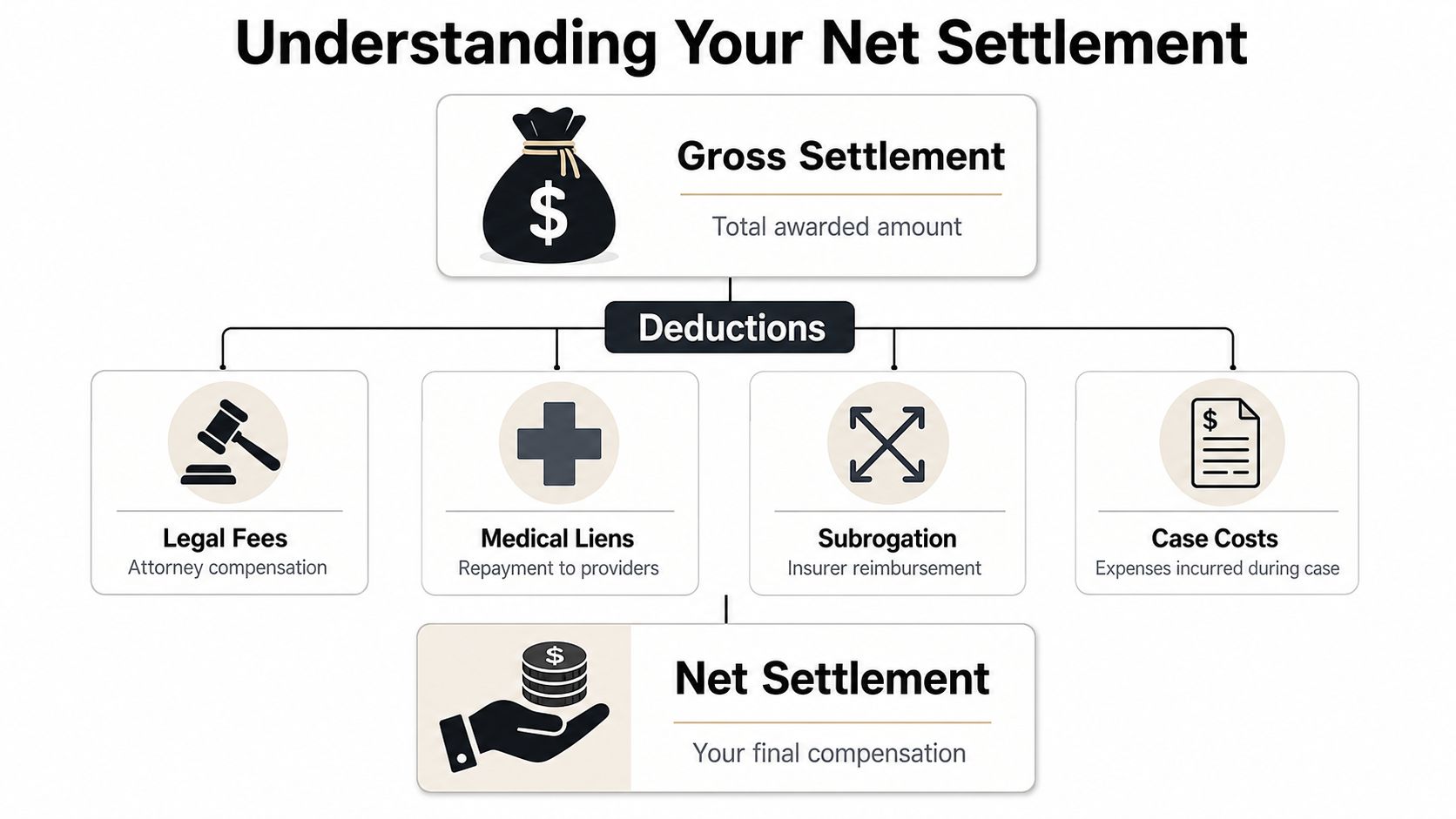
You settle your injury claim after a wreck, the adjuster gives you a number, and you start planning around that amount. Then the check arrives and the practical math begins. Medical providers want payment. Health coverage wants reimbursement. Your lawyer, if you hired one, takes fees and case costs. The number that matters is your net, not the headline figure.
Where the money goes first
In a car accident case, settlement money usually gets divided before you see a dollar. That matters even more in total loss claims, where people often need cash fast for a replacement vehicle, towing bills, rental gaps, and treatment.
The usual deductions include:
- Attorney fees if you hired counsel under a contingency agreement
- Case costs such as medical records, filing fees, deposition costs, or expert reviews
- Unpaid treatment balances from hospitals, chiropractors, physical therapists, or imaging centers
- Medical liens and reimbursement claims from health plans, government programs, or providers
- Subrogation claims from an insurer that paid bills and now wants to be repaid from your settlement
If you are not familiar with that last category, read about insurance subrogation rights before you treat the settlement check like spendable money.
Do not ask only, "What is the offer?" Ask for the payout sheet. You want a line-by-line breakdown showing every deduction, who is claiming it, and whether the amount can be negotiated down.
Liens can wreck your net recovery
Liens are one of the most expensive surprises in an injury settlement. They attach to the money before it reaches you, and they can hit hard after a serious crash with an ambulance ride, ER care, surgery, or extended physical therapy.
The American Bar Association explains that personal injury recoveries may be subject to claims by healthcare providers, insurers, Medicare, Medicaid, child support agencies, or tax authorities, depending on the facts of the case and state law. Read its overview of liens on a personal injury settlement.
For drivers already under financial pressure after a totaled vehicle, this is the trap. You may settle expecting to clear enough to replace your car and catch up on bills, only to find that outside claims eat up the money first.
If tax debt is in the background, learn the difference between tax lien withdrawal vs. release. Those terms are not interchangeable, and the wrong assumption can leave an old claim attached to your finances.
The release form closes the door
A release is the document that ends your claim for good. Sign it, and you usually give up the right to seek more money for that injury, even if treatment lasts longer than expected or a new complication shows up later.
Nolo explains that a settlement release typically requires the injured person to waive any future claims arising from the incident in exchange for payment. Read every line. Look for broad language about "all known and unknown injuries," property damage, loss of income, and future medical care.
That last point matters in auto claims. If your body is still changing, or if your doctors are still sorting out whether your pain is temporary or permanent, closing the file too early can cost you far more than the insurer added to get the release signed.
Before you sign, confirm three things in writing:
- What the settlement covers
- What will be deducted
- Whether your medical condition is stable enough to close the claim
Do not sign because the adjuster says the release is routine. It is the final document in the case, and it controls what you keep and what rights you lose.
Settlement Payouts Taxes and Timing
Once the number is agreed, the next question is simple. How do you want to receive the money?
It is common to think only in terms of a lump sum. That's understandable after a car accident. Bills are due, your transportation situation is unstable, and you want closure. But a structured payout can be the smarter move in some cases.
Lump sum versus structured settlement
A lump sum gives you access to money right away. That can help with debt, car replacement, housing, and immediate treatment needs. It also gives you full control, which is both a benefit and a risk.
A structured settlement spreads payments over time. That can protect someone from burning through funds too quickly and can create a more stable long-term income stream after a serious injury.
Here's the side-by-side view:
Lump sum
- Fast access to funds
- Better for immediate large expenses
- Higher risk of overspending or poor planning
Structured settlement
- Scheduled payments over time
- Better for long-term budgeting
- Less flexibility if you need a large amount at once
Why structured settlements deserve more attention
Patrick Farber reports that 30% of personal injury settlements in 2024 included structured payment components, tied to the IRS-allowed tax-free status of annuity-funded plans under the 1982 Periodic Payment Settlement Act. That matters most in cases involving lasting impairment, ongoing care, or a claimant who needs predictable income instead of one large check.
What about taxes
For physical injury claims, settlement proceeds are often treated favorably for tax purposes. But don't make assumptions about every component of every settlement. The way money is allocated can matter.
If your settlement includes multiple categories, get clear written language in the agreement and ask qualified professionals how those categories affect your situation. That's not overkill. It's basic financial protection.
Timing after the agreement
Once the agreement is final, payment still isn't instant. Release paperwork has to be signed, the insurer has to issue funds, and any liens or costs may need to be resolved before you receive your net amount.
If your car was totaled and you're depending on settlement money to get back on the road, build in that delay. Counting on same-week cash is how people end up pressured into bad financial choices.
Navigating Negotiations and When to Hire Help
Two weeks after your crash, the adjuster calls with a quick offer. Your car is already in the salvage yard, you need another vehicle, and the money sounds tempting. That is when people give away value. The pressure usually comes from the total loss side first, then spills into the injury claim.

Insurance companies count on that squeeze. If transportation is gone and medical bills are stacking up, a weak injury offer can feel like relief. Treat that feeling as a warning sign. Settlement decisions should come from records, numbers, and timing, not stress.
How to negotiate from strength
Effective negotiation starts with a file the adjuster cannot casually dismiss.
- Document treatment from day one. Save every bill, visit summary, prescription receipt, imaging report, and work note.
- Track daily limits. Write down missed work, trouble sleeping, pain while driving, canceled family plans, and anything else that shows the full effect of the injury.
- Keep the injury claim separate from the total loss claim. The insurer may handle both, but each claim has its own value and its own pressure points.
- Refuse artificial deadlines. If the adjuster says the offer expires immediately, ask for the reason in writing.
- Respond in writing when the numbers are wrong. Point to treatment records, wage loss documents, photos, repair or valuation disputes, and medical recommendations.
A good demand package reads like a timeline with proof attached. Crash details. Diagnosis. Treatment. Restrictions. Lost income. Future care if your doctors have identified it. Then a settlement number that matches the damages.
Red flags that mean you should stop handling it alone
Some cases stay simple. Many do not, especially after a serious wreck or a total loss.
Get outside help if any of these problems show up:
- Your injuries may last longer than expected or your doctors are still evaluating future treatment.
- Fault is disputed and the insurer is trying to shift part of the blame to you.
- Your vehicle valuation is wrong because the insurer ignored condition, mileage, trim, recent work, or aftermarket additions.
- Medical liens, health insurance reimbursement claims, or benefit eligibility issues are in play. Those deductions can shrink your net payout far more than people expect.
- The insurer sends a release before your condition is stable or before you understand what claims you are giving up.
That last point matters. A release is not routine paperwork. It is the document that closes the claim, and in many cases closes it for good.
What kind of help solves what problem
Match the problem to the professional.
If the fight is over what your totaled car was worth, bring in appraisal or valuation help. If the dispute involves injury severity, future treatment, comparative fault, liens, or a broad release, talk to a lawyer. If public benefits or repayment claims could be affected by the settlement, get advice before the money is allocated or signed away.
If you are comparing fees before deciding whether legal help makes financial sense, review this guide to car accident lawyer price.
A short video can also help you think through the process before you respond to the insurer:
Early help usually costs less than fixing a bad release, a missed valuation issue, or a low settlement you already accepted.
FAQs About Injury Settlements
How does my injury settlement affect my separate total loss claim for my car
They're usually separate claims, even though they come from the same crash. Your injury settlement addresses harm to your body and related losses. Your total loss claim addresses the value of your vehicle.
The trap is cash pressure. If the insurer lowballs your car and drags out payment, you may feel pushed to accept a weak injury offer just to replace transportation. Don't merge those decisions in your head. Evaluate each on its own merits.
How long does it take to get money after signing a settlement release
There's no one-size-fits-all timeline. After signing, the insurer still has to process the release, issue payment, and, in many cases, route funds through an attorney trust account or resolve liens before disbursing your net proceeds.
If anyone tells you settlement money is basically instant, ignore that advice. Build a buffer. Payment often takes additional administrative steps after the agreement is reached.
Can I reopen my claim if my injuries get worse after I settle
Usually, no. Once you sign the release, the case is typically over for that accident. That's why settling too early is dangerous.
If your doctor is still evaluating symptoms, if treatment is ongoing, or if you suspect long-term effects, don't let the insurer rush you into final paperwork. Final means final.
Should I accept the first offer if it seems reasonable
Not without reviewing the file carefully. A first offer may look decent only because you haven't accounted for future treatment, time off work, lien exposure, or the difference between gross and net recovery.
A better question is this: does the offer reflect the full claim, or just the part the insurer is willing to acknowledge right now? Those are not the same thing.
What if my injuries seem minor right after the crash
Minor symptoms can turn into documented injuries over time. Soft tissue pain, headaches, back stiffness, and numbness may not show their full impact immediately. Get evaluated, follow treatment recommendations, and keep records.
The insurance company benefits when you minimize your own condition early. You don't.
If your accident claim includes a low total loss valuation or diminished value dispute, Total Loss Northwest helps drivers challenge insurance company numbers with certified independent appraisals. If the carrier's valuation software is dragging down what your vehicle is worth, get a real market-based appraisal before you agree to anything.