
The wreck is over, but the financial part has just started. Bills show up from the ER, the radiology group, the ambulance company, your primary doctor, physical therapy, and sometimes providers you don't even remember seeing. Meanwhile, the at-fault insurer acts like the file is simple. It isn't.
A common misconception is that if the other driver caused the crash, the insurer will just “pay the medical bills.” In practice, car accident settlement medical bills are tied to documentation, timing, negotiating power, and the deductions that happen before you ever touch the check. A settlement offer can look decent on paper and still leave you short once health insurance reimbursement, provider liens, and fees are taken out.
That's the part many drivers don't see coming. The gross number matters, but the net is what changes your life.
Your Guide Through the Post-Accident Financial Maze
A common scene goes like this. You're sore, missing work, and trying to keep up with normal life. Then the mail starts stacking up. One envelope says “balance due.” Another says “insurance pending.” Another says “final notice.” The adjuster asks for records, then goes quiet. You send over a few bills and expect movement, but nothing about the claim feels organized.
That's because handing bills to an adjuster isn't a strategy. It's just one piece of the file.
The difference between a weak claim and a strong one usually isn't whether you were hurt. It's whether you can prove, line by line, what the crash caused, what treatment was reasonable, what symptoms persisted, and what future care may still be needed. If you're still in active treatment, getting consistent care matters. For people trying to understand the medical side of recovery, resources on treatment for car accident injuries can help you recognize why prompt, documented care supports both healing and the claim itself.
Practical rule: The insurance company evaluates what it can verify, not what you know happened.
The range of outcomes can be wide. According to FairSettlement.org's settlement statistics, claimants with attorney representation average $77,600, compared with $17,600 for unrepresented claimants, and 95% of personal injury cases settle before trial. That doesn't mean every case needs a lawyer, but it does show that preparation and bargaining power change results.
What the insurer sees versus what you're owed
Adjusters often start with a narrow view of value. They look for gaps in treatment, missing records, delayed care, and anything they can label “not related.” You need a broader view that includes:
- Every medical charge tied to the crash
- Out-of-pocket costs
- Lost income if you missed work
- Pain and suffering
- Future treatment that hasn't happened yet but is medically expected
If you miss that distinction, you can settle a claim that covers some bills but leaves too little for the rest of the damage the crash caused.
Mastering Your Medical Documentation
Two people can have the same injury, the same treatment, and the same amount billed. The one who keeps better records usually keeps more of the settlement check.

That happens because settlement value is not built from symptoms alone. It is built from records that connect the crash to the treatment, show what was charged, show what health insurance paid, and show what balance may still come back as a lien or subrogation claim later. If you miss those details, you can settle for a number that looks fair on paper and still give up too much of it after everyone else gets paid.
Start by building one file that answers four questions clearly: what care you received, why you received it, what it cost, and who paid what. A messy stack of portal screenshots and unopened bills creates problems later, especially when you try to verify balances or challenge a provider charge before the final release is signed.
Use this working checklist:
- ER and urgent care records: Get provider notes, diagnosis codes, discharge instructions, and the bill.
- Imaging records: Keep the radiology report, not just the invoice.
- Physical therapy logs: Attendance records matter because missed visits often get used against you.
- Prescription receipts: Save proof of what you paid out of pocket.
- Itemized bills: Ask for line-by-line billing with service dates, procedure codes, provider names, and charges.
- Explanation of Benefits forms: These show what health insurance allowed, paid, adjusted, or denied.
- Referral and specialist records: These help tie ongoing care back to the collision.
- Pain journal entries: Track symptoms, activity limits, missed work tasks, and sleep disruption in plain language.
If you need a practical system for storing and labeling everything, use a guide to insurance claim documentation. Good organization saves money. It also makes it easier to spot billing errors before they become settlement deductions.
The documents that carry the most weight are the ones that tie diagnosis, treatment, and billing together. An adjuster may look at a balance due and treat it as inflated. A health insurer may claim reimbursement rights based on what it paid. A provider may be willing to reduce a bill if you ask before the case closes, but that conversation goes badly if you do not have the itemized statement and EOB in front of you.
That is why I tell clients to separate three different numbers for every provider: the amount billed, the amount paid, and the amount still owed. Those numbers are rarely the same. If you do not track them separately, it is hard to know whether you are negotiating the injury claim, a provider balance, or a health insurance lien.
What to collect and what to question
Generic account summaries are weak support. They often leave out procedure details, diagnosis information, write-offs, and insurance adjustments. Ask for records that let you verify the treatment and audit the balance.
Pay close attention to itemized bills and EOBs. They often reveal duplicate charges, coding mistakes, denied services, or balances that should have been adjusted under the provider's insurance contract. For readers trying to understand the coding side of these records, Patient Talker on CPT physical examination rules gives useful background on how exam services are categorized.
Keep one master timeline, too. List the crash date, each appointment, each new symptom, each referral, each imaging study, and each workday missed. That timeline does more than help prove the claim. It helps you catch gaps, missing records, and treatment that may need a clearer explanation before the insurer uses it to cut value.
Your pain journal needs facts, not drama
A good pain journal reads like evidence. Short entries work best.
Include:
Pain level and location
Neck stiffness, headaches, back pain, numbness, shoulder limits.Functional limits
Trouble driving, lifting, sitting at work, sleeping, or caring for children.Treatment response
Symptoms improved after therapy, flared after activity, or changed after medication.Daily impact
Missed events, reduced chores, shorter work tolerance, anxiety in traffic.
That record helps in two ways. It supports the non-billing side of the claim, and it gives you a clearer basis for discussing unresolved treatment, future care, and bill reductions before the settlement check is cut. That is how documentation protects your net recovery, not just the headline number.
Calculating the Full Value of Your Medical Claim
A driver finishes treatment, adds up the bills, and assumes that number sets the case value. Then the settlement check arrives, health insurance wants reimbursement, a provider balance is still open, and the amount left in hand is far lower than expected.
That is why claim valuation has to start with net recovery, not just gross settlement.
A fair case value usually includes four parts: medical expenses, future care, income loss, and pain and suffering. Your goal is to document each category well enough that the insurer cannot shave it down with vague objections, while also keeping an eye on what will have to be paid back once the case settles.
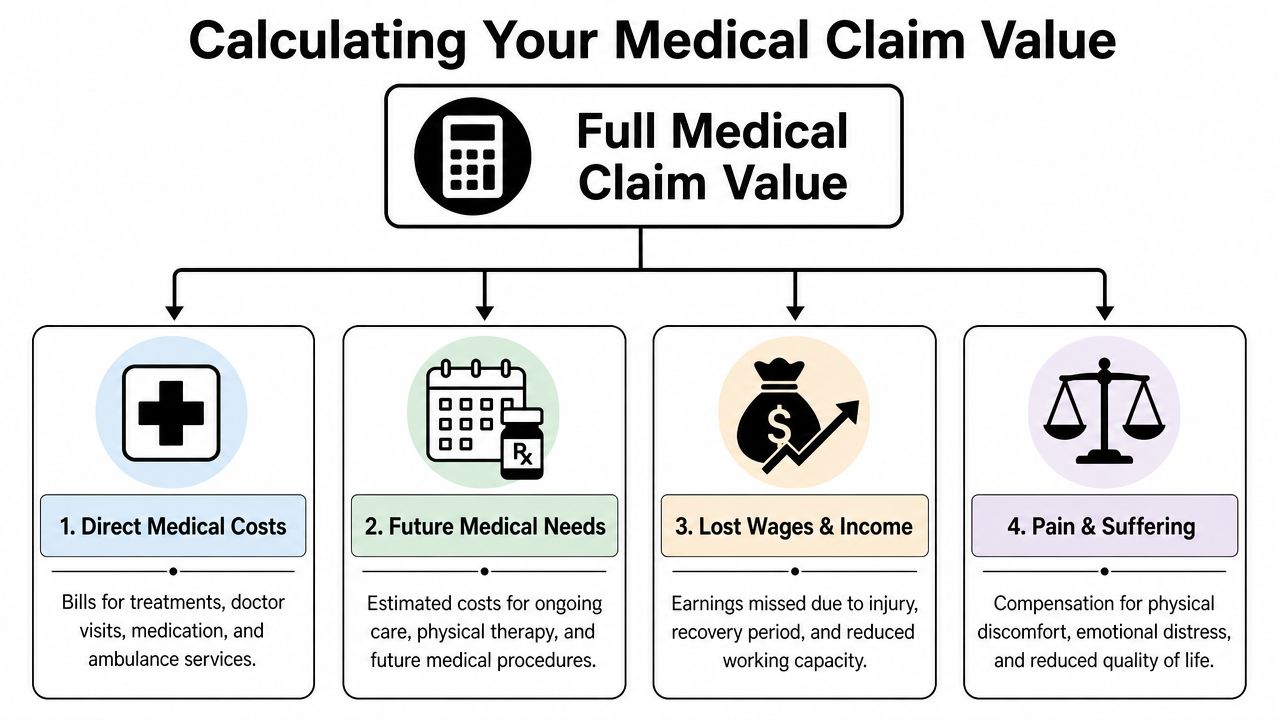
The four buckets that matter
| Claim component | What belongs in it | Why it matters |
|---|---|---|
| Direct medical costs | ER care, imaging, follow-ups, PT, medication | Sets the starting floor for the claim |
| Future medical needs | Additional therapy, specialist care, injections, ongoing treatment | Keeps expected care from coming out of your own pocket later |
| Lost wages and income | Missed work, reduced hours, lost earning capacity | Adds economic loss the adjuster may ignore if you do not prove it |
| Pain and suffering | Physical pain, sleep disruption, activity limits, emotional strain | Often depends on how well the medical record explains the impact |
Raw bills are only part of the picture. The main question is which charges are reasonable, which treatment is still expected, and which of those amounts may later be claimed by health insurance or a medical provider.
For readers sorting out how exam services are coded in treatment records, Patient Talker on CPT physical examination rules gives useful background. That kind of detail helps when a bill, chart note, and explanation of benefits do not line up cleanly.
Start with economic damages, then test the pain and suffering value
Adjusters usually build value from the economic losses up. They review the medical bills, compare them to the records, look for gaps in treatment, question charges they view as excessive, and examine whether the injury changed your work or daily function.
Pain and suffering is often estimated from that medical foundation. Serious injuries with consistent treatment, clear physician findings, and documented limits usually justify a stronger number. Thin records, long treatment gaps, and unresolved questions about causation usually pull that number down fast.
That trade-off matters. If the insurer cuts $8,000 from the medicals, the total reduction can be much larger once the pain and suffering portion is recalculated from a lower base.
A structured injury settlement calculator for estimating a realistic demand range can help you test your numbers before you negotiate. Use it as a check on your reasoning, not as a substitute for the records, bills, and future care opinions that support the claim.
Future care can change the value more than people expect
Settling before the treatment picture is clear is one of the most expensive mistakes I see.
If your doctor expects more therapy, injections, follow-up imaging, medication management, or specialist evaluation, get that opinion in writing before serious settlement talks. Adjusters rarely add future care because an injured driver says it may be needed. They want a treatment recommendation, a medical basis for it, and a timeline that makes sense.
Future care also affects your net. If you settle too early and then need more treatment, the settlement does not reopen just because the recovery took longer than expected. The bill becomes your problem.
Calculate the number you keep
Before you accept any offer, run a simple net sheet. List the proposed settlement amount, unpaid medical balances, health insurance reimbursement claims, med-pay offsets if they apply, attorney fees if you have counsel, and any case costs.
That exercise changes how you evaluate an offer. A larger gross settlement with no lien reduction can leave you with less money than a slightly smaller settlement where the medical balances and reimbursement claims were negotiated down first.
The strongest demand packages show three things clearly: what treatment was reasonable, what problems remain, and what financial obligations will hit the settlement proceeds once the check is issued. That is how you value the claim like a professional, not just like a patient adding receipts.
Strategic Negotiation with the Insurance Adjuster
The adjuster calls with an offer before your financial side is mapped out. That is the point where a lot of injured drivers give away money they never recover.
Once your records and numbers are in order, negotiation becomes a documentation exercise. The insurer is testing whether you know the file, whether you can answer reduction arguments with records, and whether you are focused only on the gross settlement instead of the net amount you keep.

The first offer usually deserves a hard look, not a quick answer. In my experience, early numbers often leave out part of the treatment story, downplay ongoing symptoms, or reduce bills the adjuster considers excessive. If you react before you know which balances, reimbursement claims, and provider accounts will come out of the check, you can end up negotiating the wrong target.
What a good demand letter includes
A demand letter should read like a clean case presentation. Keep emotion under control. Put the adjuster in a position where denying value requires a written explanation tied to the records.
Include these parts:
Liability summary
State how the crash happened and why their insured is at fault.Treatment timeline
Lay out the care in order, from the first visit through the most recent provider.Diagnosis and functional impact
Identify the injuries and explain how they affected work, sleep, driving, lifting, childcare, or other daily activities.Economic losses
List medical charges, wage loss, out-of-pocket costs, and any other documented expense.Physician support for ongoing care
Attach recommendations if treatment is continuing or follow-up care is expected.Settlement demand
State the amount you want and tie it directly to the records and losses.
How to talk to an adjuster without hurting your position
Good negotiation is calm, brief, and specific. Long calls usually help the carrier more than they help you.
Useful language sounds like this:
- On low valuation: “Your offer does not account for the full course of treatment or the documented functional limits in the records.”
- On disputed treatment: “The provider notes connect the symptoms to the collision and show continued complaints throughout care.”
- On future treatment: “I am not resolving the claim until the expected treatment is accounted for.”
- On unexplained reductions: “Please identify which charges you are disputing and the medical or billing basis for that position.”
One request matters more than people realize. Ask the adjuster to put reductions in writing. Vague phone comments disappear. Written positions can be answered line by line.
Negotiate for net recovery, not just the headline number
This is the part many settlement guides miss.
A higher gross offer does not always leave you with more money. If health insurance reimbursement claims, provider balances, or lien-based treatment accounts are still sitting unresolved, the “better” settlement can produce a worse result at disbursement.
That is why I tell clients to work both sides of the file. Press the adjuster for fair claim value, but also review every medical balance before the release is signed. Some providers will reduce balances, accept a lower payoff, or agree to settlement-based payment terms. Handled correctly, that can improve what you keep.
A practical sequence looks like this:
- Get the full billing ledger: Confirm what was billed, what insurance paid, what was adjusted off, and what is still owed.
- Separate provider balances from insurance reimbursement claims: They are different obligations and should be negotiated differently.
- Avoid paying balances too early: A premature payment can reduce flexibility and, in some cases, weaken your position on claim value.
- Get every reduction in writing: Verbal assurances create problems when the settlement funds are distributed.
There is a trade-off here. If you push a provider reduction the wrong way before the claim is valued, the adjuster may argue the original charges were inflated. Handle timing carefully.
When negotiation stalls
If the adjuster keeps repeating the same unsupported number, there is usually a pattern behind it:
| Insurer tactic | What it usually means | Your response |
|---|---|---|
| “Treatment was excessive” | They see a weak point in the care pattern | Point to referrals, consistent complaints, and provider notes supporting the treatment |
| “You had prior issues” | They are trying to shift causation | Use records showing a change in symptoms, aggravation, or a new problem after the crash |
| “Gaps in treatment hurt the claim” | They found a reason to reduce the offer | Explain the gap with documentation if there was a real reason |
| “That's our top offer” | They are testing whether you will stop pushing | Counter in writing and make them reevaluate the file |
Once the dispute turns technical, especially on causation, future treatment, Medicare issues, ERISA reimbursement, or large lien balances, self-representation can get expensive fast. That is usually the point where a good attorney or settlement professional earns their fee by improving the net result, not just the settlement headline.
The Hidden World of Liens and Subrogation
You settle for a number that sounds fair. Then the checks start lining up against it. Your health insurer wants reimbursement. A clinic that treated you on a lien wants its balance paid. Medicare may have a claim. The result is simple. The settlement figure is only the starting point. What matters is the net amount you keep.
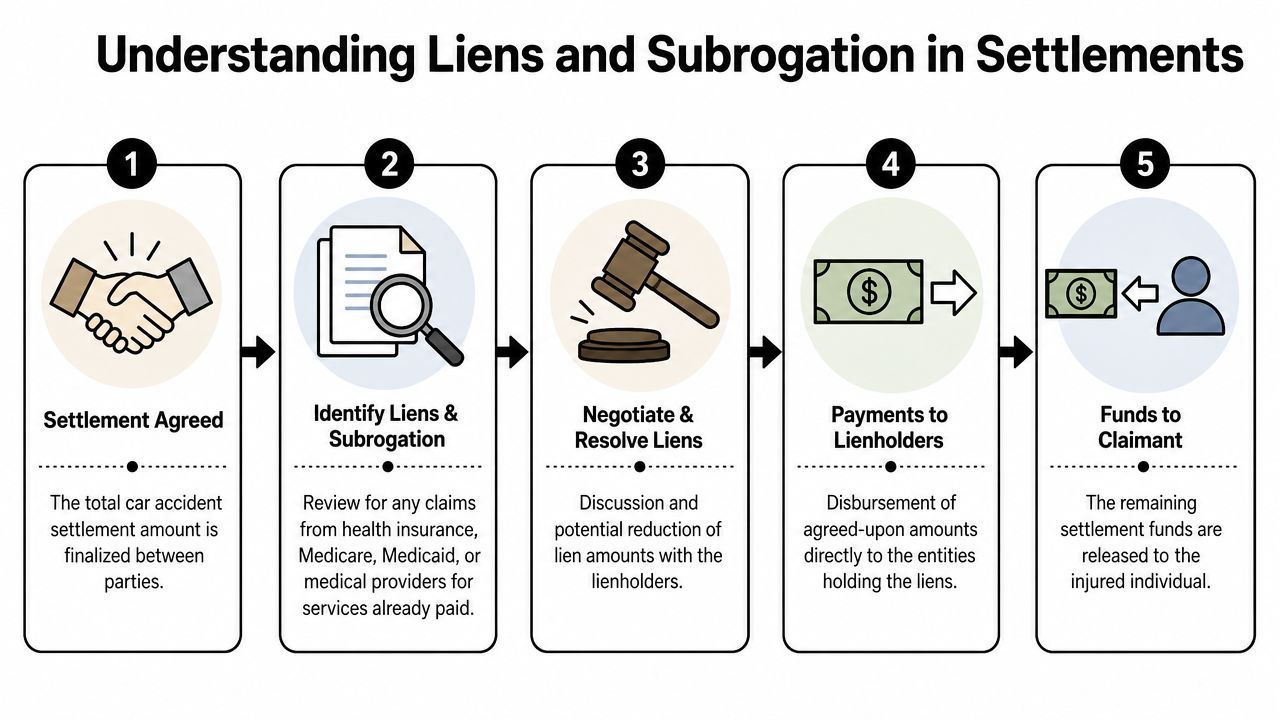
Liens and subrogation are where many people lose money they could have protected. I see that happen when claimants focus on the gross offer and wait until the release is signed to ask who gets paid out of the settlement. By then, the pressure is higher and the room to negotiate is smaller.
The deductions that shrink a settlement after the deal is made
If your health insurance paid accident-related treatment, the plan may demand reimbursement. If a provider agreed to wait for payment until the case resolved, that provider may assert a lien. Government payers such as Medicare or Medicaid can also seek repayment for related care.
Mahaney & Pappas explains how unpaid accident bills and reimbursement claims can attach to settlement proceeds. The practical point is the same in nearly every file. Money can be spoken for before it ever reaches your account.
That is why experienced claim handling is not just about getting the offer up. It is also about getting the deductions down.
Who may claim part of the settlement
The usual players include:
- Health insurance carriers that paid crash-related medical bills
- Medical providers that treated under a lien or deferred payment arrangement
- Government programs such as Medicare or Medicaid
- Employer or benefit plans with reimbursement language in the plan documents
If you are also weighing legal help, do not look only at the fee percentage. Look at whether counsel can improve the final number you keep after liens, reimbursements, and costs. This breakdown of how car accident lawyer pricing usually works is useful for that reason.
Gross settlement versus net settlement
Use this distinction every time you evaluate an offer, especially before signing a release.
| Term | What it means |
|---|---|
| Gross settlement | The total amount agreed to with the insurer |
| Net settlement | What remains after liens, reimbursement claims, fees, and case costs are paid |
The better question is not, “What did they offer?” It is, “What clears after every valid claim is resolved?”
Do not sign a final release until you know who is asserting reimbursement rights, what they are claiming, and whether those numbers have been audited.
The real work happens before disbursement
Some liens are valid as stated. Some are inflated. Some include unrelated treatment, duplicate billing, or charges an insurer never paid. I have also seen health plan demands sent without the plan language needed to support them.
Push for documents before the settlement check is issued, not after. Ask for:
- A current lien or reimbursement statement
- An itemized ledger tied to accident-related dates of service
- Proof of payment if an insurer seeks repayment
- The plan language or legal basis for the claim
- Confirmation that unrelated or adjusted charges were removed
Timing matters here. If you negotiate provider reductions too early, the liability carrier may try to use that against you on value. If you wait too long, the parties seeking repayment know you are trying to close and may hold firmer on the balance.
The strongest position is usually this one: settle the injury claim with a clear paper trail, then review each lien carefully before disbursement and challenge anything unsupported. That is how you protect the net recovery instead of just chasing a headline settlement number.
When to Call for Backup Deciding on an Attorney
A claim can look manageable right up to the point it stops being one. You are still treating, the adjuster starts questioning whether the crash caused your symptoms, and three different parties may want a slice of the settlement check. That is usually the point to stop thinking only about the gross offer and start looking hard at what you will keep.
You should seriously consider hiring counsel if the injuries are significant, treatment is still ongoing, fault is disputed, or the insurer is pushing back on causation. The same goes for claims involving future care, lasting symptoms, policy limit issues, or providers who treated on a lien or deferred-payment basis. Those files can lose value fast when the medical story, billing record, and reimbursement demands are not lined up properly.
A pain journal can still help support your day-to-day damages, but it does not replace legal strategy. Once the case turns on future losses, medical necessity, lien reductions, or disputed insurance reimbursements, experience becomes the dividing line.
Signs you shouldn't go it alone
- Severe injuries: Broken bones, surgery, spinal injuries, head trauma, or permanent impairment
- Complicated billing: Multiple providers, health insurance reimbursement claims, ERISA issues, hospital liens, or disputed balances
- Causation disputes: The insurer argues your symptoms were pre-existing, minor, or unrelated to the crash
- Coverage problems: Low policy limits, multiple claimants, uninsured or underinsured motorist issues
- Pressure tactics: Delay, selective document requests, unexplained denials, or pressure to settle before treatment is reasonably clear
Attorney fees matter, so look at the numbers with a clear head. If you are comparing options, review how a car accident lawyer price setup usually works. In harder injury cases, the right question is whether handling the claim alone will leave more money on the table through undervalued damages, missed future care, or unreduced liens than the fee would cost.
A good attorney does not just chase a bigger settlement figure. They protect the net by documenting the claim properly, pushing back on weak causation arguments, and negotiating reimbursement demands before the final disbursement. That work can matter as much as the top-line number.
If your accident also involves a disputed vehicle value, a low total loss offer, or diminished value the insurer is brushing aside, Total Loss Northwest provides independent appraisals that help drivers in Oregon, Washington, and beyond challenge biased insurance valuations with market-based evidence.