You've probably got the same routine now. Refresh email. Check voicemail. Open the insurance app. Read another vague update that says your claim is “under review.” Then nothing. Meanwhile, your car is sitting in a yard, in a shop, or in your driveway, and every day that passes feels like somebody else is controlling your money.
That frustration is justified. A delayed settlement doesn't just waste time. It jams up your transportation, your schedule, your budget, and your ability to move on. If your car accident settlement is taking too long, the answer isn't to sit and hope the adjuster gets around to you.
You need a plan. A real one.
Is Your Car Accident Settlement Dragging On Forever
A lot of drivers end up in the same spot. The crash happened. You reported it promptly. You sent photos. You gave the statement. You answered questions you've already answered once. Then the process slowed to a crawl.
The adjuster says they're waiting on review. Then they say they need another document. Then a different adjuster takes over and asks for the same file again. At that point, it's hard not to assume you're being ignored.
If that sounds familiar, stop blaming yourself. You're not impatient. You're reacting to a process that often becomes opaque on purpose. Some delays are legitimate. Plenty aren't. And if you don't push back, the file can sit.
You don't get points for being the easiest claim to delay.
The key is knowing whether you're in a normal processing delay or in a stall. If you need a broader look at what the process can involve, this guide on average time for a car accident settlement gives useful background. But once the wait turns into repeated non-answers, you need to stop waiting passively.
What this usually feels like
- You keep getting soft language like “we're still evaluating.”
- Nobody commits to a date for inspection, payment, or valuation.
- Your claim contact changes and the story resets.
- The settlement number never arrives even though the damage is obvious.
That's when frustration turns into an advantage. You have the right to ask for status, demand clarity, challenge a low value, and escalate above the person who's stalling. If the dispute is over what your vehicle is worth, you may also have a more powerful tool sitting right in your policy.
Why Your Insurance Settlement Is Delayed
Not every delay means bad behavior. Some claims take longer because the facts aren't settled yet. Others drag because the insurer benefits when you get tired. You need to tell the difference.
The delay might be normal
A claim can move slowly for valid reasons. Liability may still be under review. A body shop may not have finalized a supplement. A salvage bid may still be pending on a total loss. If injuries are involved, the property damage side can also get tangled up with the larger claim.
The question isn't whether any delay can happen. It can. The question is whether the insurer is moving the file forward in a visible way.
Here's a practical benchmark table you can use.
Car Accident Settlement Timelines
| Claim Type | Typical Resolution Time | When to Escalate |
|---|---|---|
| Simple repair claim with clear fault | Usually resolved faster when documentation is complete and damage is straightforward | Escalate when you get repeated silence, repeated requests for the same items, or no clear next step |
| Repair claim with supplement or parts issues | Often takes longer because the shop and insurer may go back and forth on scope and pricing | Escalate when the insurer won't confirm approval status or keeps delaying inspection decisions |
| Total loss claim | Commonly slows down over valuation, comparable vehicles, options, condition adjustments, or storage pressure | Escalate when they won't explain the valuation method or keep pushing a number without support |
| Diminished value claim | Often delayed because insurers resist paying value loss after repairs | Escalate when the insurer dismisses the claim without analysis or refuses to engage the valuation dispute |
| Claim involving injury and property damage together | Usually slower because multiple parts of the file can affect handling | Escalate when the property damage portion is being held hostage without a clear reason |
Red flags that should bother you
Some patterns tell me the problem isn't complexity. It's inertia, disorganization, or pressure tactics.
- Adjuster reassignment without continuity means nobody owns the file.
- Requests for documents you already sent usually signal poor handling or deliberate slowing.
- No written explanation of valuation is a bad sign in total loss and diminished value disputes.
- Phone promises with no follow-up email leave you with no paper trail.
- Pressure to settle before questions are answered usually means the number favors them, not you.
Delays that hit vehicle claims hardest
Property damage claims have one especially common pressure point. Value. The insurer may move quickly right up until it's time to put a number on your vehicle. Then the file gets sticky.
That's where drivers get trapped. They think the only issue is time, but the actual issue is control over valuation. If your car accident settlement is taking too long because they won't justify the amount, you're not waiting on administration. You're in a value dispute.
Practical rule: If the insurer can't explain how they got to the number, don't treat the delay like paperwork. Treat it like a negotiation problem.
Taking Control with Documentation and Communication
You need a file that is cleaner than the insurer's file. That's how you stop vague answers and start pinning people down.
If you don't document every step, every delay looks accidental. Once you document it, patterns show up fast. Missing callbacks. duplicate requests. unexplained gaps. That paper trail matters if you escalate to a supervisor, file a complaint, or invoke a policy right later.
For a stronger framework, review this breakdown of auto claim documentation. Then build your own claim folder like somebody may need to review it cold tomorrow.
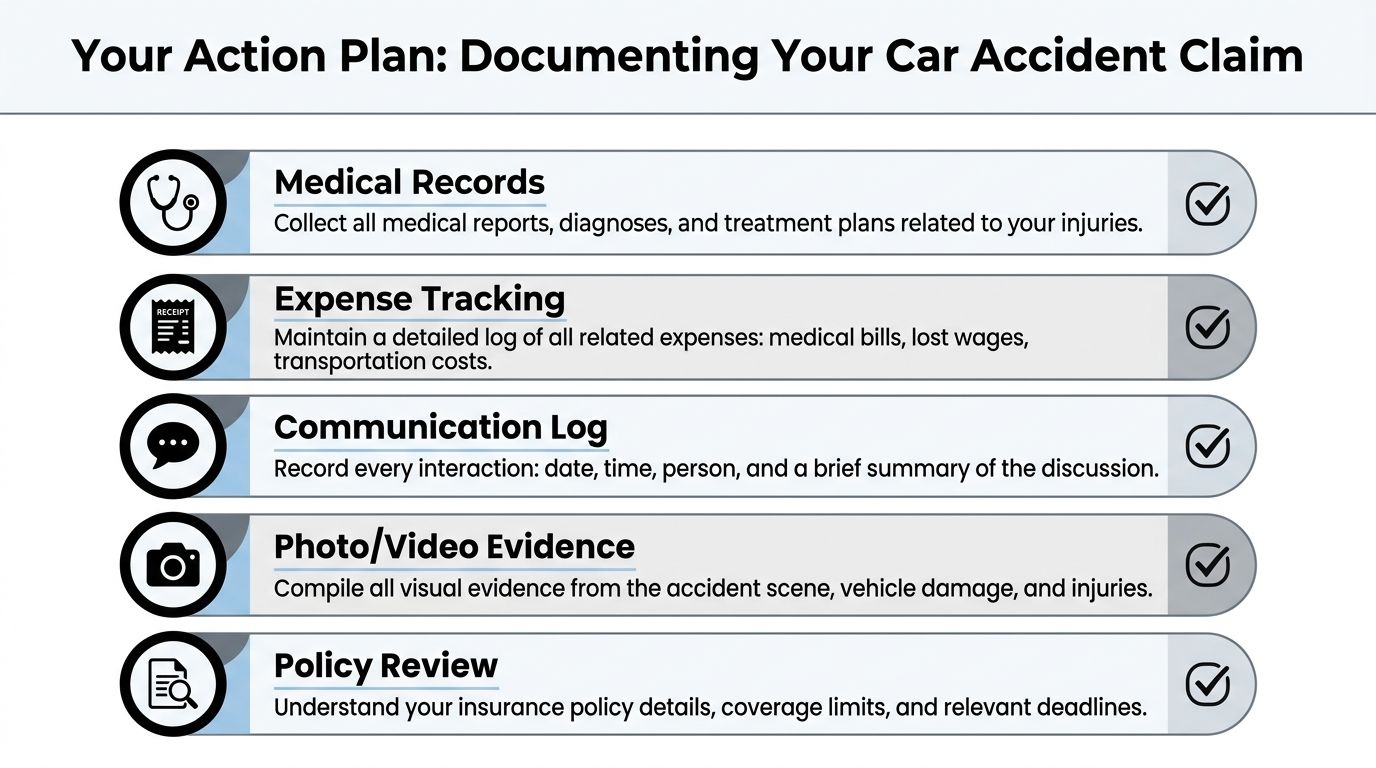
Your non-negotiable claim file
Keep one digital folder and one running log. Put everything in it.
- Police report and claim number. Save the report, incident number, and every insurer reference number.
- Photos and video. Include scene photos, all vehicle angles, close-ups of damage, interior shots, odometer, VIN sticker, and any visible options or upgrades.
- Repair documents. Save estimates, supplements, invoices, tow bill, storage bill, and body shop communications.
- Vehicle proof. Keep registration, title if available, payoff details if financed, maintenance records, and receipts for major recent work.
- Medical and expense records. If injuries are part of the situation, keep those separate but organized.
- Communication log. Date, time, who you spoke to, what they said, and what they promised.
Write like a professional, not a supplicant
Individuals often follow up too softly. They ask for “any update.” That invites another vague answer. Instead, ask for a specific status, a missing item list, and a deadline for the next action.
If you need help shaping a firm but polite message, a good proven invoice reminder template shows the kind of concise, deadline-based language that gets responses in business settings. The same approach works with claims.
Use this email and customize it.
Subject: Request for written claim status and next-step timeline
Hello [Adjuster Name],
I'm requesting a written update on claim [claim number]. Please confirm:
- The current status of the claim
- Any documents or information still needed from me
- The specific next step your office will take
- The expected date for that next step
I've already provided [brief list of key items]. If anything is missing, please identify it specifically in writing.
If the claim is being delayed due to valuation, inspection, liability review, or supervisor approval, please state that directly so I have a clear record.
Thank you,
[Your Name]
[Phone Number]
What you're doing with this email
You're forcing clarity. The adjuster now has to either answer directly or create a written record of dodging you. Both help you.
A phone call can disappear. A clean email chain doesn't.
Escalating Your Claim Past the Adjuster
When an adjuster goes quiet or keeps circling without progress, stop treating that person as the only gatekeeper. Claims departments have supervisors, team leads, and managers. Use them.
A lot of people wait too long to escalate because they don't want to sound difficult. That's backwards. You're not making trouble. You're documenting claim handling and asking for movement.

Go over the adjuster's head correctly
Call the main claims line if you need to. Ask for the adjuster's supervisor by name. If they won't give it, ask for the claims manager assigned to that unit. Stay calm. Be precise.
What gets results is not anger. It's chronology.
Include these points in your escalation email:
- Claim identity. Claim number, date of loss, vehicle year make and model.
- Short timeline. What you submitted and when.
- Problem summary. No response, repeated requests, unsupported valuation, delayed inspection, or no written explanation.
- What you want. A written status update, supervisor review, valuation support, or decision timeline.
Here's a practical template.
Subject: Supervisor review requested for delayed claim handling
Hello [Supervisor Name],
I'm requesting your review of claim [claim number]. I reported the loss promptly and submitted the requested materials, including [brief list]. Despite repeated follow-up, I still do not have a clear written update on the current status and timeline for resolution.
The issues I need addressed are:
- lack of written status updates
- repeated or unclear document requests
- no clear explanation of the valuation or delay
Please provide, in writing, the current claim status, any remaining items needed, and the expected timeline for resolution.
Thank you,
[Your Name]
When a demand letter makes sense
If supervisor escalation doesn't work, send a formal demand letter. This is more serious than a follow-up email. It puts the insurer on notice that you're documenting their handling and formally stating the dispute.
A good property-damage demand letter should include:
- your identifying claim information
- a factual summary of the accident
- the vehicle damage issue in dispute
- the documents already provided
- the amount or valuation issue being challenged
- the action you expect from the insurer
- a reasonable deadline for response
Don't ramble. Don't write like you're venting. Write like someone who may hand the letter to a regulator, attorney, or appraiser later.
What not to do at this stage
Don't threaten a lawsuit in every email. Don't write emotional essays. Don't keep accepting phone-only explanations.
A supervisor can ignore a rant. It's harder to ignore a clean timeline with attached documents.
At this point, your goal is simple. Build pressure inside the carrier while keeping your record tight enough to support the next move.
Using Your Rights to Force a Fair Settlement
If polite follow-up and supervisor escalation haven't moved the claim, employ tactics outside the adjuster's workflow. Through this, frustrated drivers finally regain control.
It is often believed there are only two options. Accept the offer or hire a lawyer. That's not always true, especially in a property damage dispute. There are usually stronger intermediate steps, and the most important one is often sitting in the policy language itself.
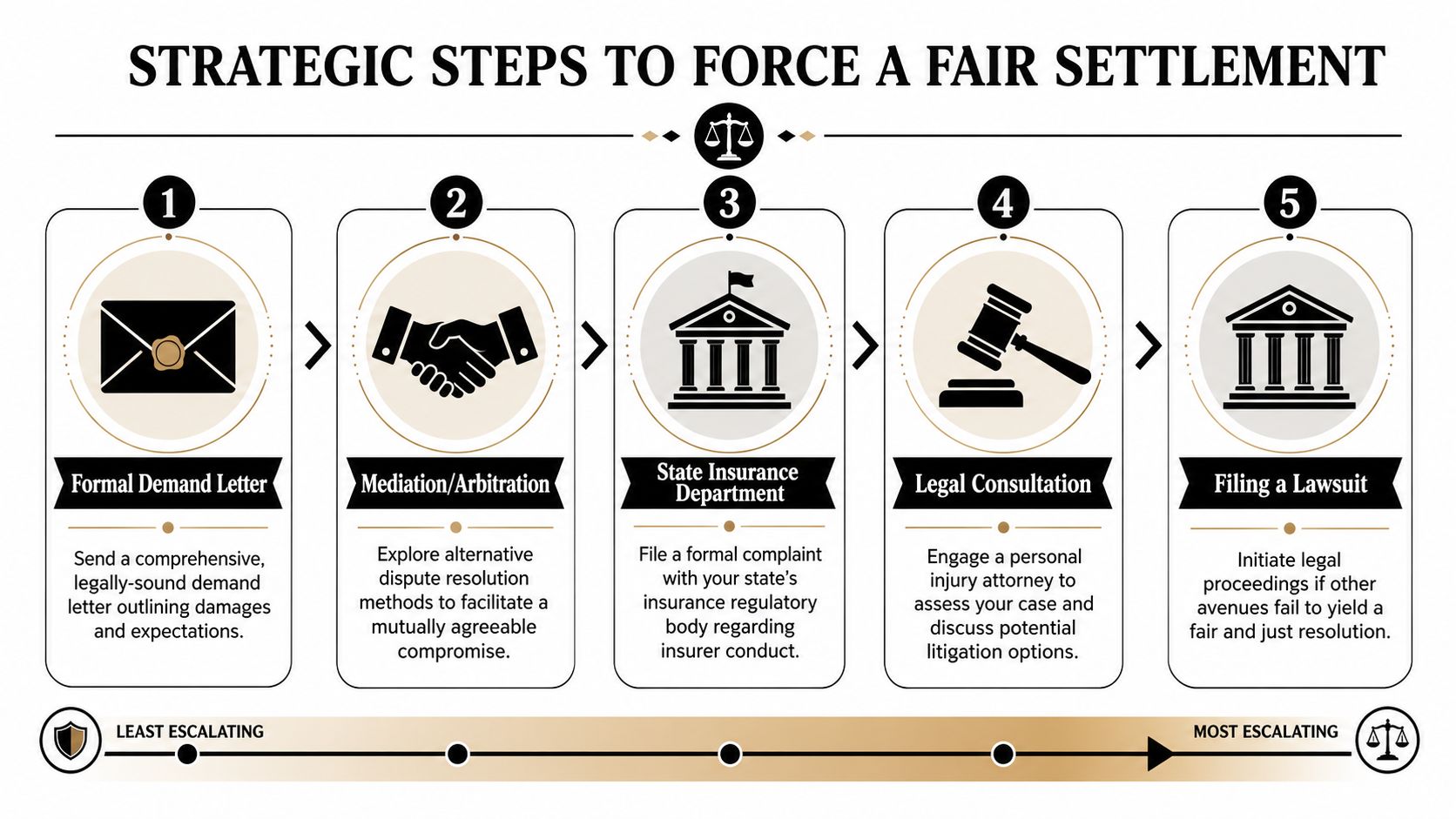
This visual lays out the general progression of pressure points.
File a complaint when conduct is the problem
If the insurer is ignoring communication, misrepresenting the process, or refusing to explain a position, a complaint to your state's Department of Insurance can create pressure. It won't magically decide your vehicle's value for you, but it can force the company to respond through a formal channel.
A complaint is most useful when the issue is claim handling behavior, such as:
- unexplained silence
- failure to answer correspondence
- refusal to provide basis for denial or valuation
- repeated administrative runaround
Before you submit anything, gather your timeline, your emails, and notes from calls. If you recorded calls or are considering it, make sure you understand your state's consent rules first. This SpeakNotes guide on recording laws is a useful starting point.
The appraisal clause is the real leverage point
If your dispute is about what the car is worth, stop arguing value in circles with the same desk adjuster. Check your policy for the appraisal clause.
This clause is one of the most underused tools in auto claims. It exists for exactly this reason. You and the insurer disagree on value. Instead of staying stuck in a one-sided negotiation, each side selects an appraiser. Those appraisers work to determine the amount of loss under the policy process.
That matters because valuation disputes often get contaminated by internal insurer software, unsupported comparables, poor condition adjustments, or flat-out lowball assumptions. The appraisal clause shifts the fight away from “because we said so” and toward documented market-based analysis.
If you want a plain-language overview of how it works, read this explanation of the insurance appraisal process.
When appraisal is the right move
Appraisal is especially useful in these situations:
- Total loss valuation disputes where the insurer's number doesn't reflect actual local market value, equipment, condition, or recent work.
- Diminished value disputes where the insurer minimizes the post-accident loss in resale value.
- High-value, collector, or modified vehicles where generic valuation tools miss what makes the vehicle worth more.
- Claims stuck in endless negotiation where nobody will move off a weak number.
If your car accident settlement is taking too long because the insurer keeps repeating a low value without meaningful support, appraisal isn't a side issue. It's often the solution.
Here's a short explainer worth watching before you make that move.
Why an independent appraiser changes the balance
Not all valuation evidence carries the same weight. A random online listing printout won't do much. A qualified independent appraiser can inspect the file, evaluate comparable vehicles properly, account for options and condition, and produce a report designed to hold up in a dispute.
That's the difference between complaining and presenting evidence.
An independent appraiser also changes the psychology of the claim. The insurer is no longer dealing with an irritated vehicle owner trying to negotiate from instinct. They're dealing with a documented challenge to their number from someone who understands valuation.
Bottom line: If the disagreement is about vehicle value, your strongest move usually isn't another argument with the adjuster. It's forcing a valuation process the insurer doesn't fully control.
Keep your escalation ladder in order
Use the steps in sequence unless the insurer's conduct is extreme:
- Document everything
- Demand written status
- Escalate to a supervisor
- Send a formal demand letter
- File a regulatory complaint if handling is the issue
- Invoke the appraisal clause if value is the issue
That sequence gives you an advantage without wasting time on the wrong fight.
Knowing When You Need a Car Accident Attorney
For pure vehicle value disputes, an attorney often isn't your first or best move. If the problem is that the insurer undervalued a total loss or brushed off diminished value, an independent appraiser and the appraisal process are usually more direct.
That changes when the claim goes beyond property damage.
Signs you need a lawyer
You should talk to a car accident attorney if any of these apply:
- Serious injuries are involved and medical treatment, future care, or lost income are part of the claim.
- Liability is disputed and the insurer is unfairly blaming you for the crash.
- The claim was broadly denied rather than just undervalued.
- Bad faith conduct appears likely, especially if the insurer is refusing to honor policy obligations in a larger way.
- Medical treatment is being challenged or blocked.
Lawyer versus appraiser
An appraiser handles the value fight. A lawyer handles the legal fight.
If the settlement delay is tied to a number on the car, start with valuation strategy. If the delay is tied to injuries, fault, claim denial, or broader legal exposure, bring in counsel.
Frequently Asked Questions About Settlement Delays
How long is too long for a car accident settlement
There isn't one magic cutoff because some claims are simple and some are messy. The better test is whether the insurer can clearly explain what is happening right now, what's still missing, and what happens next. If they can't answer those basic questions in writing, the delay has already become a problem.
Is it illegal for an insurance company to ignore me
Ignoring a claimant can cross into improper claim handling depending on the facts and the policy obligations involved. The word people often hear is bad faith. You don't need to prove bad faith before you act, though. Start by documenting the silence, escalating internally, and preserving every communication.
What's different about a total loss delay versus a diminished value delay
A total loss delay usually centers on the insurer's valuation of the whole vehicle, along with condition, options, comparables, salvage, or title issues. A diminished value delay usually centers on whether the insurer will acknowledge post-repair market stigma and how much value was lost after the accident. Different dispute, same core issue. They're trying to control the number.
Should I keep calling every day
No. Daily calling often creates noise, not pressure. Use scheduled, written follow-up. Ask clear questions. Set response expectations. Escalate if the deadline passes.
Should I accept the offer just to get this over with
Not if the amount is unsupported. Relief is expensive when you sign away a valid valuation dispute for less than your car was worth.
If you're stuck in a total loss or diminished value dispute and the insurer's number doesn't make sense, get someone in your corner who deals with valuation fights every day. Total Loss Northwest provides certified independent auto appraisals for drivers dealing with lowball total loss offers and diminished value claims, helping you use the appraisal process to push for a fair settlement.