SUVs made up 48% of global car sales in 2023, a record that shows how thoroughly they've moved from niche choice to default family vehicle, commuter car, and status symbol at once, according to the International Energy Agency's SUV sales analysis. That single figure answers part of the question. If nearly half the world is buying SUVs, this isn't a fad. It's the center of the modern car market.
But the better question isn't only why SUVs are popular. It's why they became so hard to avoid, and why so many buyers still don't see the financial tradeoffs until after a crash.
Most explanations stop at cargo room, all weather confidence, and the higher seating position. Those reasons matter. They just don't tell the whole story. SUV demand sits at the intersection of psychology, regulation, product design, and marketing pressure. Then, once an owner has bought in, another issue appears that almost never gets discussed in mainstream automotive coverage: a popular, expensive vehicle can become surprisingly vulnerable in a total loss or diminished value claim.
The Unstoppable Rise of the SUV
In the United States, SUVs and pickup trucks accounted for 80% of new vehicle sales in 2024, according to JATO Dynamics' market analysis of the shift away from sedans. That figure matters because it shows the SUV is no longer a side preference or a family-only choice. It has become the default shape of the new-vehicle market, which changes how cars are priced, financed, insured, and valued after a crash.
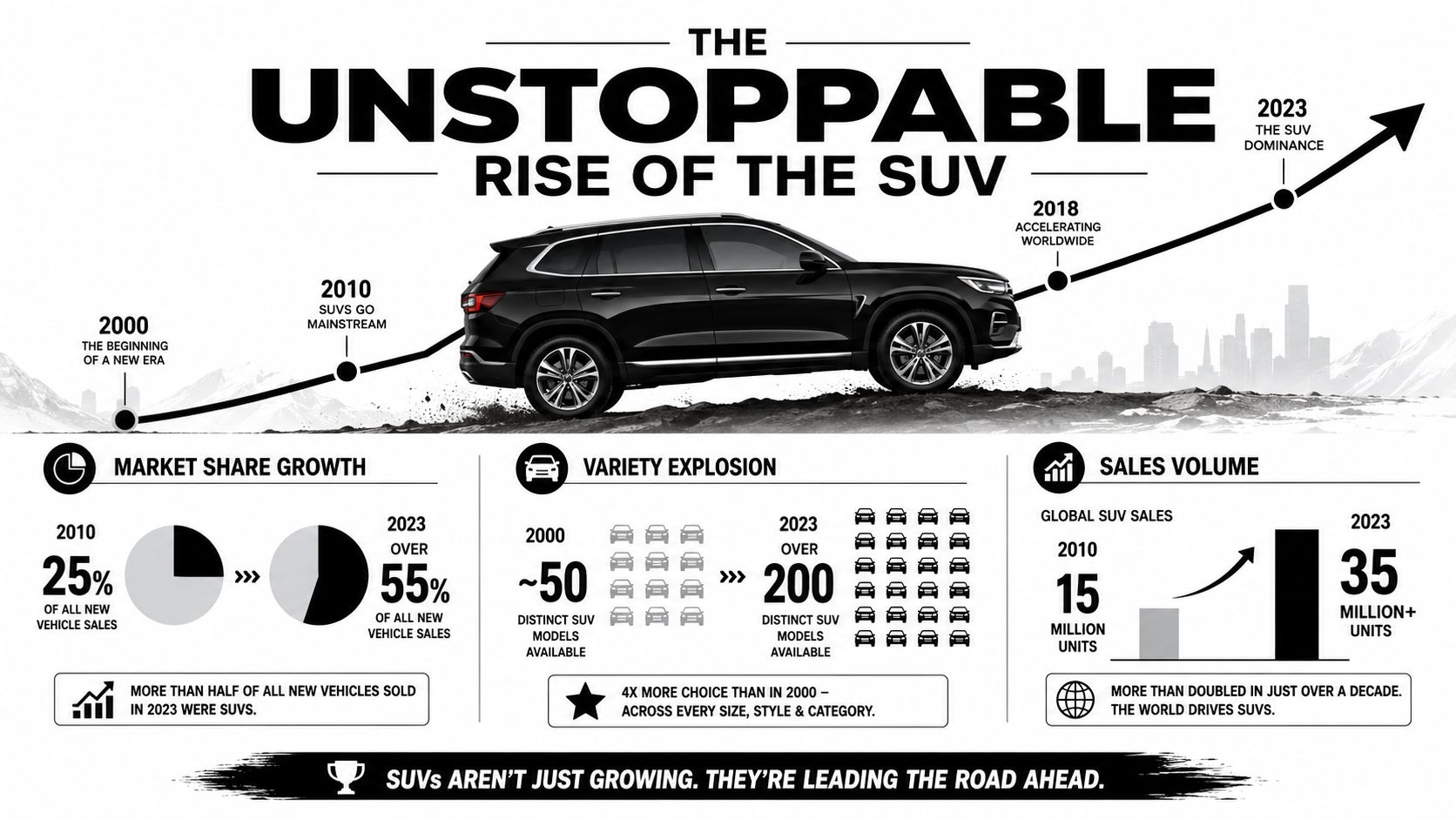
The market effect is bigger than popularity alone. As sedan lineups shrank and wagons nearly disappeared from many showrooms, households lost direct alternatives. Buyers who might once have chosen a midsize sedan, minivan, hatchback, or wagon increasingly found themselves comparing one crossover against another. That narrows choice while giving manufacturers and dealers more room to hold pricing on the body style buyers feel pushed toward.
That matters most after the sale.
A popular SUV often carries a higher transaction price, a longer loan term, and more expensive trim packaging than the car it replaced. If that vehicle suffers major structural damage, the owner is exposed on several fronts at once. A total loss settlement may not match the payoff amount early in the loan. A repaired vehicle may carry measurable diminished value even if the work looks competent. Because SUVs are so common, many owners treat them as the safe default purchase and pay less attention to how claim valuation works until they need it.
Why dominance changed consumer expectations
Once SUVs became the standard family purchase, the baseline shifted. Buyers stopped asking whether they needed an SUV and started asking which SUV best fit the budget. That sounds like a small psychological change, but it has consequences across the ownership cycle.
It increases pricing power for the segment. It also normalizes larger monthly payments and higher replacement costs. In an insurance claim, those higher stakes become concrete. The owner is not just arguing over transportation. The owner may be arguing over negative equity, comparable vehicle values, sales tax treatment, and the post-repair market stigma attached to an accident history.
SUVs did more than take share from sedans. They redefined what buyers accept as normal, including ownership costs that become much harder to ignore after a serious collision.
The deeper reason behind the SUV boom is market consolidation. One vehicle category absorbed family duty, commuting, cargo flexibility, and image value at the same time. That made SUVs easier to sell in volume and easier for buyers to justify. It also created a blind spot. The more normal and universal the SUV became, the less often buyers questioned the downside risk tied to insuring, repairing, and valuing a high-demand vehicle when something goes wrong.
The Allure of Command and Versatility
Ask a driver why they prefer an SUV and the answer usually starts with how it feels from behind the wheel. The seating position is higher, traffic feels easier to read, and the cabin often feels more open. For many commuters, that “command” feeling matters as much as any spec sheet item.
A parent loading sports bags, a stroller, and groceries into one vehicle doesn't need a technical explanation of utility. They need a tailgate opening that works, rear seats that fold flat enough, and a cabin that doesn't feel cramped when life gets messy. SUVs solve that problem in a way that feels straightforward.
Why the higher driving position matters emotionally
Drivers often describe SUVs as easier to place on the road because they can see farther ahead in traffic. That doesn't make every SUV objectively safer in every situation, but it does make many people feel calmer and more in control. In dense traffic, that perception is powerful.
The emotional appeal works on several levels:
- Visibility: You sit higher and often feel less boxed in by surrounding traffic.
- Confidence in weather: Even when the hardware differences are modest, buyers associate the shape and ride height with capability.
- Social signaling: An SUV can project practicality and success at the same time.
Utility that fits modern life
The modern household often wants one car to cover many jobs. SUVs offer a shape that adapts well to those mixed demands.
| Everyday need | Why an SUV fits |
|---|---|
| Family hauling | Easier loading for passengers, bags, and bulky gear |
| Weekend travel | Flexible cargo area and a cabin that feels less restrictive |
| Urban errands | Higher seating can reduce stress in traffic and parking lot maneuvering |
| Mixed weather use | Buyers associate the format with stability and confidence |
This is one reason the question “Why are SUVs so popular?” keeps producing the same broad answer from real owners: they feel less specialized than sedans. A sedan can be excellent at commuting. An SUV feels ready for commuting plus everything else.
Buyers often aren't choosing maximum off-road capability. They're choosing a vehicle shape that asks for fewer compromises during an ordinary week.
That combination of practical convenience and perceived control gives SUVs a broad base of appeal before regulation, marketing, and insurance even enter the discussion.
Safety Perceptions Versus On-Road Reality
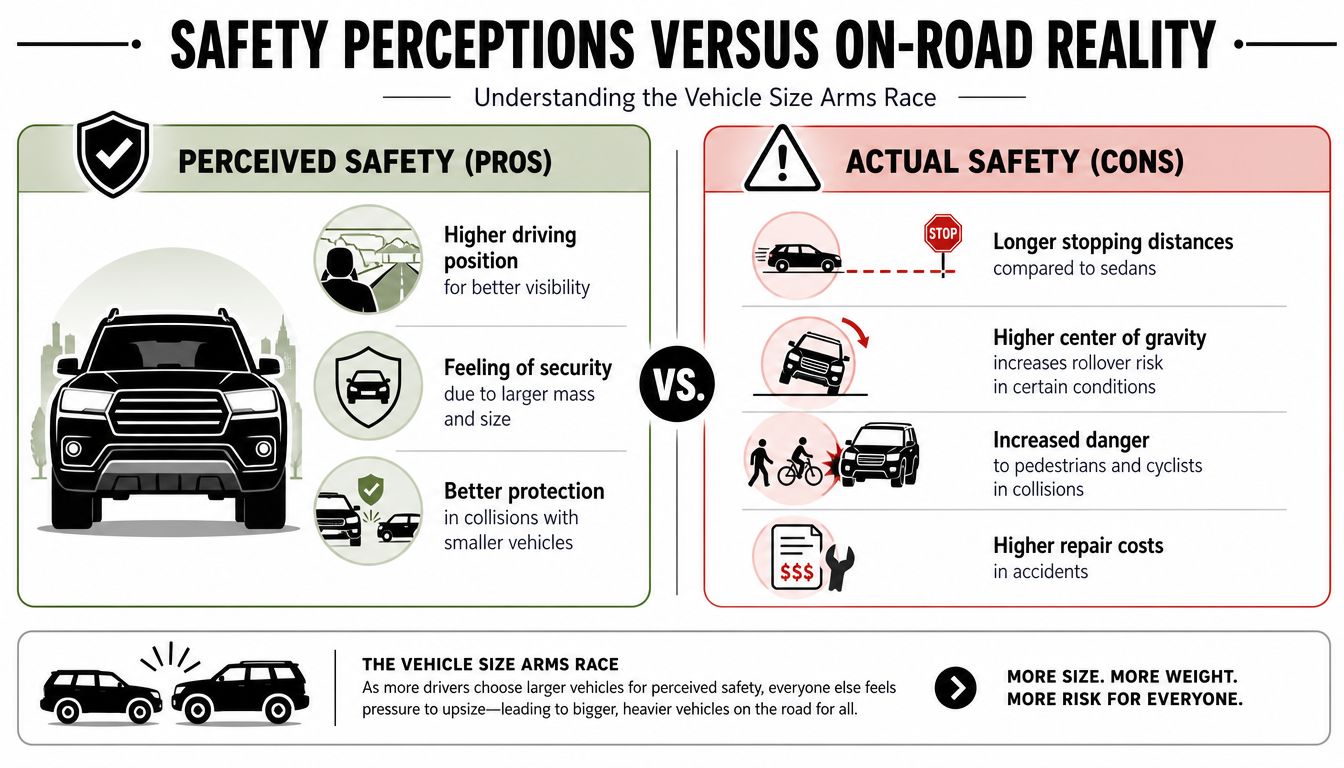
Safety may be the strongest emotional driver in the SUV boom. Many consumers believe that larger and taller means safer, especially when surrounded by other large vehicles. That belief helps fuel a vehicle size arms race, where each buyer responds to the road as it already exists.
Modern crossover engineering has made that feeling more credible than it was in the era of truck-based SUVs. According to StorageCafe's review of crossover design and SUV adoption, crossovers use car-based unibody construction and a lower center of gravity than traditional truck-based SUVs, which reduces rollover risk while preserving the higher ride height drivers want. The same source notes that the higher seating position gives drivers a broader view of the road, improving situational awareness.
What buyers get right
The crossover solved a major weakness of older SUVs. Buyers can now get the upright seating position and flexible body style without committing to the tippy, truck-like behavior that gave early SUVs a rougher safety reputation.
That helps explain why many drivers see today's crossover as a rational compromise:
- Higher seating position: Better forward visibility for many drivers.
- Unibody construction: More car-like handling than older body-on-frame SUVs.
- Lower center of gravity than traditional SUVs: Reduced rollover risk relative to older designs.
Where perception gets too simple
The problem is that “I feel safer in it” isn't the same as “it creates the safest environment overall.” Bigger vehicles change crash dynamics, repair costs, and damage severity. When an SUV hits a smaller vehicle, the financial consequences can escalate quickly because the collision often involves more expensive components, larger panels, and more structural questions.
That's one reason even a modest crash deserves close scrutiny. If an insurer flags structural concerns, understanding what frame damage reported on a vehicle history record can mean becomes critical. The physical repair is one issue. The market stigma after repair is another.
A modern crossover is safer and easier to live with than many older SUVs. It still isn't a free pass from high repair bills or post-accident value loss.
The on-road reality is nuanced. Crossovers improved the formula enough to make SUV demand durable. But the same size, complexity, and market positioning that make these vehicles attractive can raise the stakes when a collision moves from a body shop estimate to an insurance valuation.
How Regulations and Marketing Built the SUV Boom
Consumer preference didn't form in a vacuum. In the United States, one of the biggest structural advantages for SUVs came from policy. A key driver of SUV popularity was the light truck loophole, which treated many SUVs more leniently than passenger cars under fuel economy and emissions rules, according to this discussion of the light truck loophole and SUV market economics. The same source states that the global SUV market was valued at USD 869.6 billion in 2023.
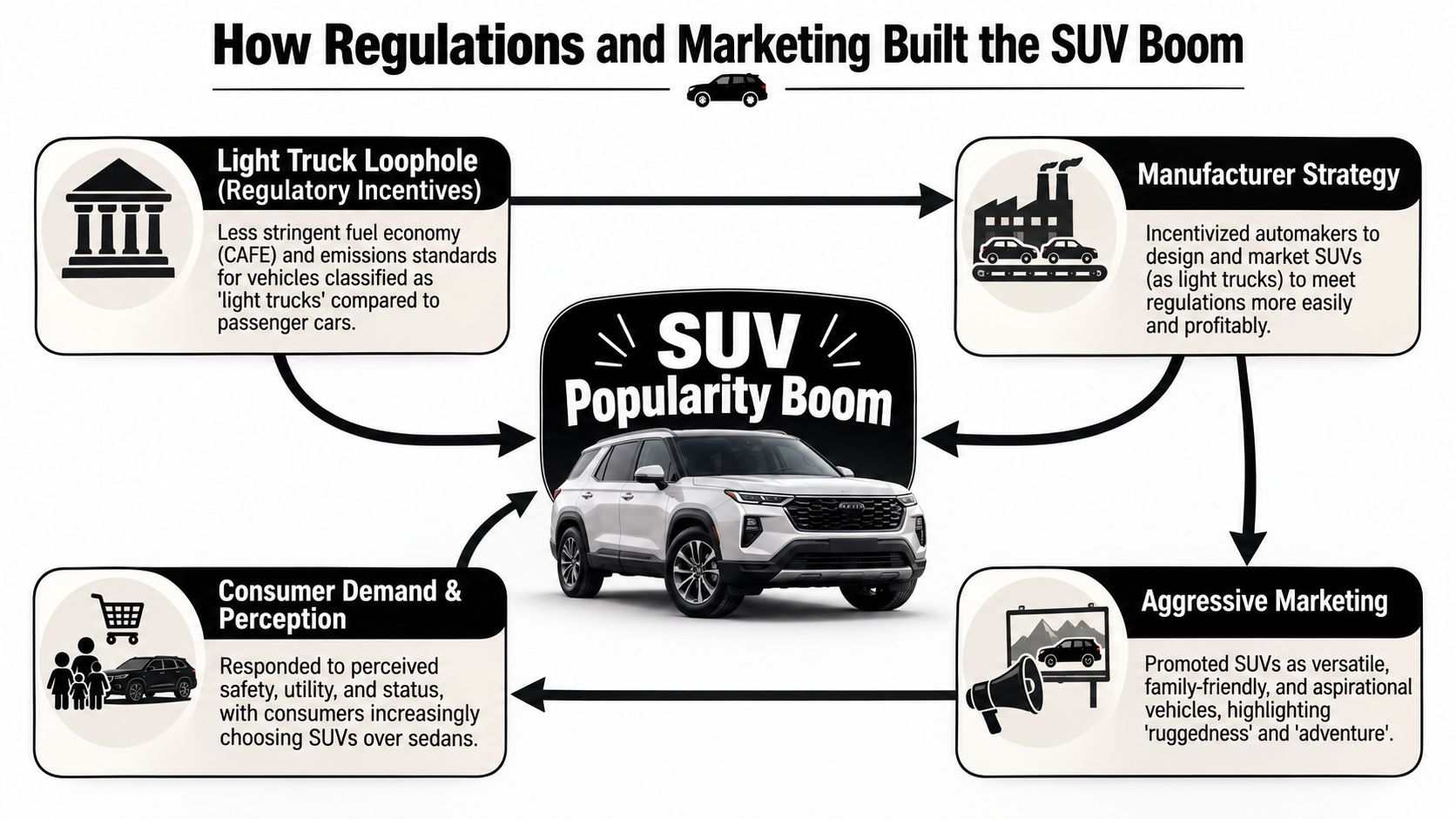
Manufacturers didn't merely notice that buyers liked SUVs. They had a reason to steer buyers there. A vehicle classified more favorably under regulations could also generate stronger margins. Once that incentive aligned with customer demand for space and status, the market moved fast.
The policy effect on showroom choices
The loophole mattered because it changed what automakers chose to prioritize. Product planners and advertisers didn't have to invent demand from nothing. They only had to reinforce the idea that the smartest family car was no longer a sedan or minivan.
That message worked because it blended utility with aspiration. SUVs were sold as rugged without being crude, upscale without being flashy, and family friendly without looking domestic.
A short explainer helps show the chain reaction:
- Regulation shaped supply: Looser treatment for light-truck-classified vehicles made SUVs more attractive for manufacturers.
- Supply shaped advertising: Automakers promoted SUVs aggressively because they wanted more buyers in higher-margin products.
- Advertising shaped identity: Buyers came to associate SUVs with safety, success, and capability.
- Identity shaped demand: Once enough neighbors and coworkers drove them, the category reinforced itself.
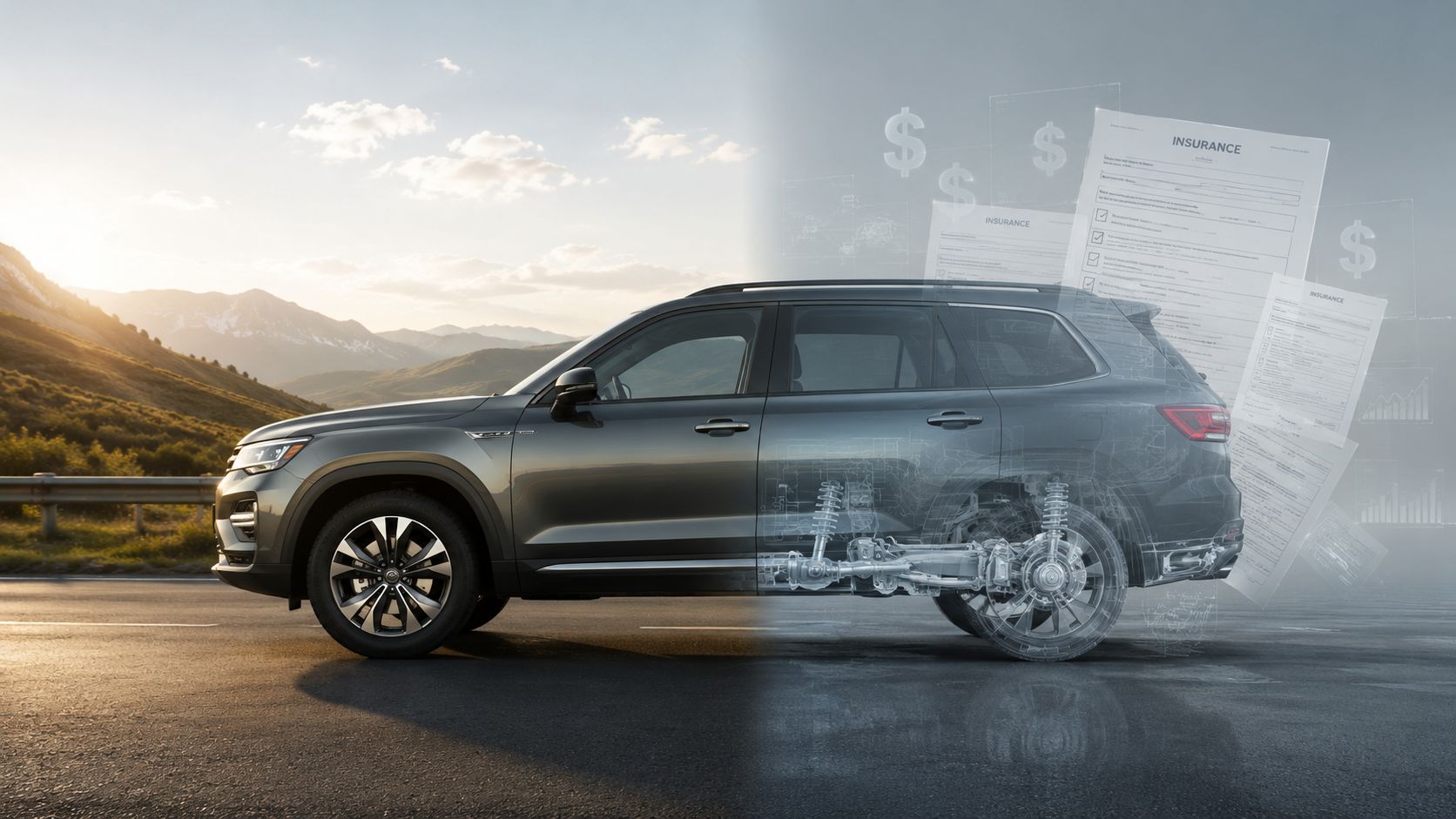
A visual summary helps make that chain easier to see.
Marketing did more than sell a vehicle
Marketing changed the meaning of the vehicle. An SUV became the answer to family life, outdoor life, uncertain weather, and social status all at once. Sedans increasingly looked narrow in purpose by comparison.
When regulation makes a product attractive to build and marketing makes it attractive to own, popularity stops looking accidental.
That's the part many consumers miss when asking why SUVs are so popular. The answer isn't just “people like them.” It's also that the industry spent years giving buyers fewer reasons to choose something else.
Closing the Gap in Efficiency and Technology
SUVs used to ask for a clearer tradeoff. You got space and ride height, but often paid with clumsy handling, rougher ride quality, and weaker efficiency. That gap narrowed when crossovers replaced many traditional truck-based SUVs.
Why crossovers changed the equation
The key engineering change was the move to unibody design in many mainstream SUVs. That gave buyers a more car-like experience without giving up the hatch opening, upright cabin, and raised seating position they wanted. For many drivers, the result feels close enough to a sedan in daily use that the old sacrifice no longer feels severe.
That matters because consumer decisions are often comparative, not absolute. If an SUV drives “well enough,” parks “well enough,” and delivers the features buyers expect, the practical advantages become more persuasive than the remaining drawbacks.
Technology made the format easier to justify
Powertrains also evolved. Buyers can now shop across gasoline, hybrid, plug-in hybrid, and electric SUV models, depending on brand and budget. That broadens the category's appeal and weakens the old assumption that choosing an SUV automatically means accepting a crude or outdated machine.
Regulatory pressure is part of that technology story too. If you're comparing ownership costs and compliance concerns, it helps to understand how emissions oversight is changing in some markets. For California drivers, this overview of 2026 diesel smog regulations gives useful context on how tightening standards can shape what remains practical to own.
Here's the larger point: SUV popularity grew because the category improved enough to remove many old objections. A buyer no longer has to think, “I want utility, but I'll hate the drive.” In many compact and midsize crossovers, that compromise has been softened to the point that buyers hardly feel it.
The Hidden Financial Risk in a Total Loss Claim
The typical SUV narrative overlooks a critical aspect. Most coverage explains why people buy them. Very little explains what happens when one is wrecked and the insurance valuation doesn't match the owner's real loss.
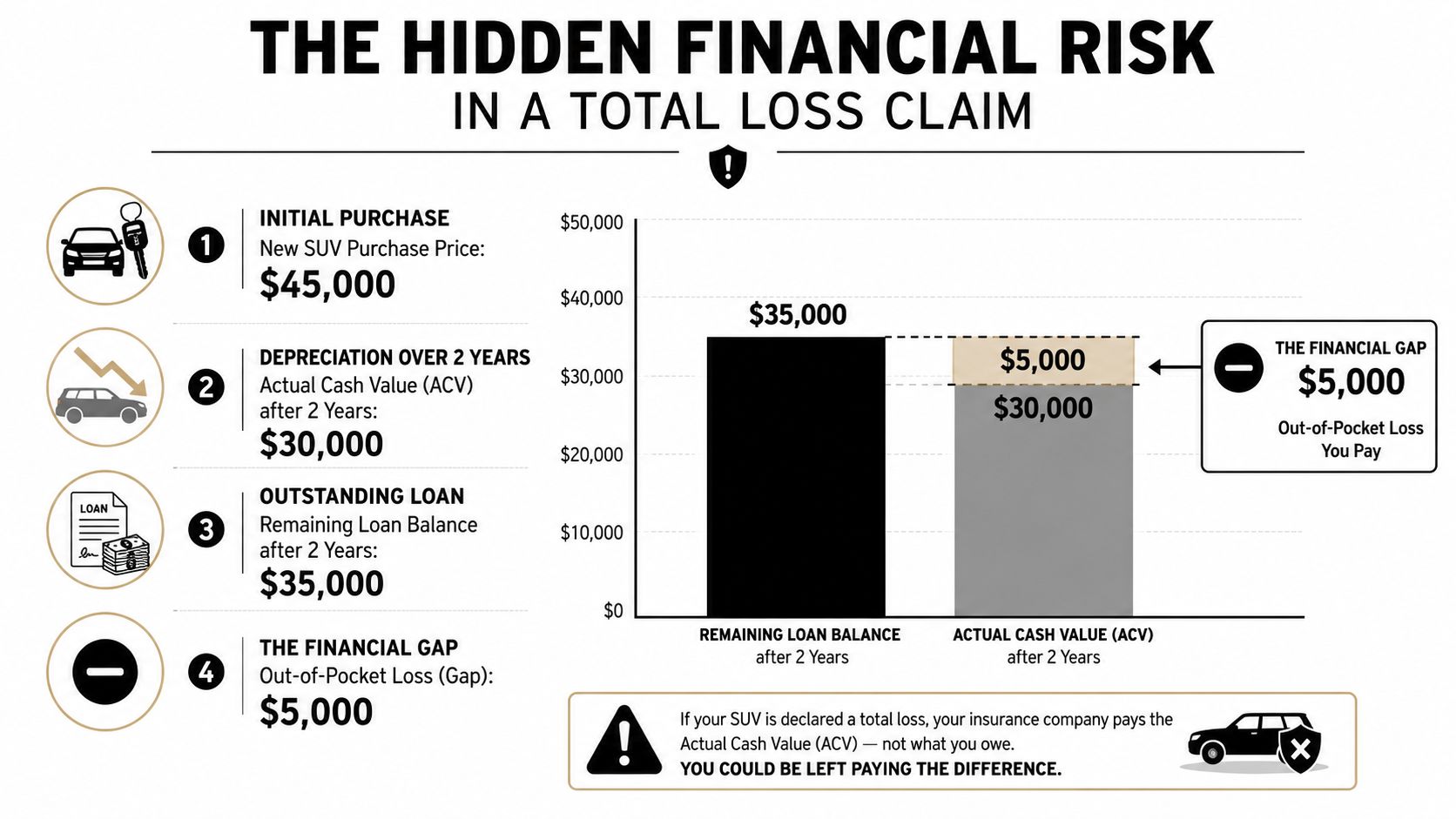
The overlooked issue is the insurance and total loss bias gap. A BBC-linked discussion of this underserved angle points out that most content focuses on comfort or manufacturer profits while rarely addressing how an SUV's higher market value and post-accident valuation behavior can create settlement risks owners don't anticipate.
Why SUV owners can be exposed
SUVs often carry higher transaction prices, more trim variation, and more expensive options packages than buyers appreciate once the paperwork is signed. In a total loss claim, that creates a valuation problem. Insurance software may compare your vehicle with imperfect local matches or fail to capture equipment, condition, upgrades, or the premium attached to a desirable model configuration.
That risk becomes more obvious when there's negative equity involved. If the insurer's actual cash value comes in below what you owe, the owner is left absorbing the gap. Anyone dealing with that issue should understand what an underwater car loan after a total loss can mean for settlement negotiations and next steps.
Why diminished value gets overlooked
Even when an SUV is repaired rather than totaled, owners can still lose market value because buyers discount vehicles with accident history. That discount may be especially frustrating for owners who assumed a popular utility vehicle would hold value well after a minor incident. Popularity doesn't erase accident stigma.
Two practical points matter here:
- Higher starting value means more money at stake: A small valuation error on an expensive vehicle can produce a meaningful dollar loss to the owner.
- Complex option structures muddy comparisons: Trim, drivetrain, wheel packages, technology packages, and condition can all affect what the vehicle was worth before the crash.
The hidden risk of SUV ownership isn't just repair cost. It's the gap between what the vehicle was worth in the real market and what the insurer's system decides it was worth.
That issue isn't limited to gasoline models. Luxury and electric SUVs can be especially vulnerable because price, equipment, and depreciation patterns are harder to summarize in one generic database output. Owners comparing coverage should find this Forever Florida Insurance EV guide useful because it frames how gap-related exposure can become more serious with high-value electric vehicles.
The analytical takeaway is simple. The more popular SUVs become, the easier it is for buyers to forget they're often buying costly, configuration-sensitive assets. That's exactly the kind of vehicle that can be undervalued after a serious accident.
Protecting Your Investment in a Popular Vehicle
According to a 2025 vehicle trend analysis from TLC Motors, SUVs account for 54% of global sales and often carry a higher initial price, averaging $50,000 in 2025. That scale helps explain their popularity. It also creates a blind spot for owners. A vehicle that feels mainstream at purchase can still become a high-stakes financial asset the moment an insurer has to price a loss.
That matters because post-accident risk is rarely discussed at the dealership. Buyers hear about cargo room, ride height, all-weather confidence, and family utility. They hear much less about what happens if a late-model SUV with expensive options, prior upkeep, and strong local demand is reduced to a line item in a claims system. Broad market appeal does not guarantee an accurate settlement. In practice, it can make owners less skeptical of the first number they receive.
Protection starts before any collision report is filed.
Condition, service history, and cosmetic upkeep influence resale value and can strengthen your position if the vehicle later has to be appraised. In harsh climates, corrosion prevention is part of that equation. Guidance on rust proofing for Canadian winters is useful because underbody rust and visible corrosion can affect both buyer perception and valuation support.
After a crash, the job shifts from preservation to proof. Owners need records that show what the SUV was, not just what an insurer's software says it was. That includes option packages, mileage, prior condition, recent maintenance, and comparable local sales. A pre-loss condition evaluation can help document those factors before they are flattened into a generic adjustment.
The financial exposure is straightforward. A higher-value, configuration-heavy SUV leaves more room for disagreement on actual cash value and more room for owners to absorb the shortfall if that value is understated. The same popularity that supports strong retail demand can mask how vulnerable these vehicles are in total loss and diminished value disputes.
A popular SUV can be easy to buy, easy to insure, and expensive to defend after an accident.
Owners do not need to avoid the segment. They need to treat SUV ownership like ownership of a depreciating but still valuable asset, one that can lose money twice after a serious crash. First in the impact itself, then in the valuation process that follows.
If your SUV was declared a total loss or lost value after an accident, Total Loss Northwest can help you challenge a low settlement with an independent appraisal. They specialize in diminished value and total loss appraisals, invoke the appraisal clause on behalf of vehicle owners, and build market-based reports designed to hold up in negotiation.