You opened the claim expecting help and got a number that doesn't match what you know you owned. That's common after a motorhome accident in Oregon or Washington. The carrier's offer arrives dressed up as objective, but to the owner it often feels detached from reality. The layout you searched months to find, the service records you kept, the upgraded electrical setup, the condition of the coach, none of it seems to matter.
That frustration usually comes from one problem. The insurance company is valuing a specialized vehicle as if it were simple, interchangeable inventory. A motorhome isn't a sedan with a bigger roof. It's part vehicle, part living space, and its value turns on details that generic valuation tools often flatten or ignore.
Your Motorhome Is Worth More Than They Say
A typical claim starts the same way. The owner reports the loss, sends photos, answers questions, then waits. A settlement number comes back. It looks final, but the logic behind it is often thin. Comparable units may be from the wrong region, the wrong trim, the wrong floorplan, or in weaker condition than yours. If the coach had documented upgrades or exceptional care, those details may never make it into the insurer's math.

In the Pacific Northwest, I see another issue. Owners often assume the company's first number must be close because it came from a recognized system. It may not be. A motorhome has regional demand patterns, seasonal swings, and condition factors that don't fit neatly into a canned report. Coastal exposure, mountain use, storage habits, moisture issues, and full-time occupancy all matter.
What owners usually try first
Many individuals often turn to free online estimators. That's understandable. They're fast, familiar, and they feel like a way to push back. The problem is that those tools don't carry much weight in a formal dispute. The Heartland RVs guidance states that these owner-supplied data Internet evaluations are considered meaningless to lending institutions or courts of law, and that a real appraisal requires an in-person evaluation by a professional, as explained in Heartland RVs' overview of RV worth estimates.
Free value tools can help you sanity-check a listing price. They usually won't win an insurance valuation dispute.
That doesn't mean online research is useless. It just has a limited role. For broader context on how condition and resale appeal affect what buyers look for, Motor Sportsland's RV value insights are worth reviewing. They're helpful for understanding market behavior. They are not a substitute for a defensible appraisal.
What actually changes the conversation
An independent appraisal changes the discussion because it shifts the argument from opinion to evidence. Instead of saying, “I think my motorhome is worth more,” you present a report built around the actual unit, actual condition, and actual market support.
That matters because the insurance company already has an internal process. If you don't answer it with a stronger process, you're left arguing feelings against software.
Understanding Key Appraisal Concepts
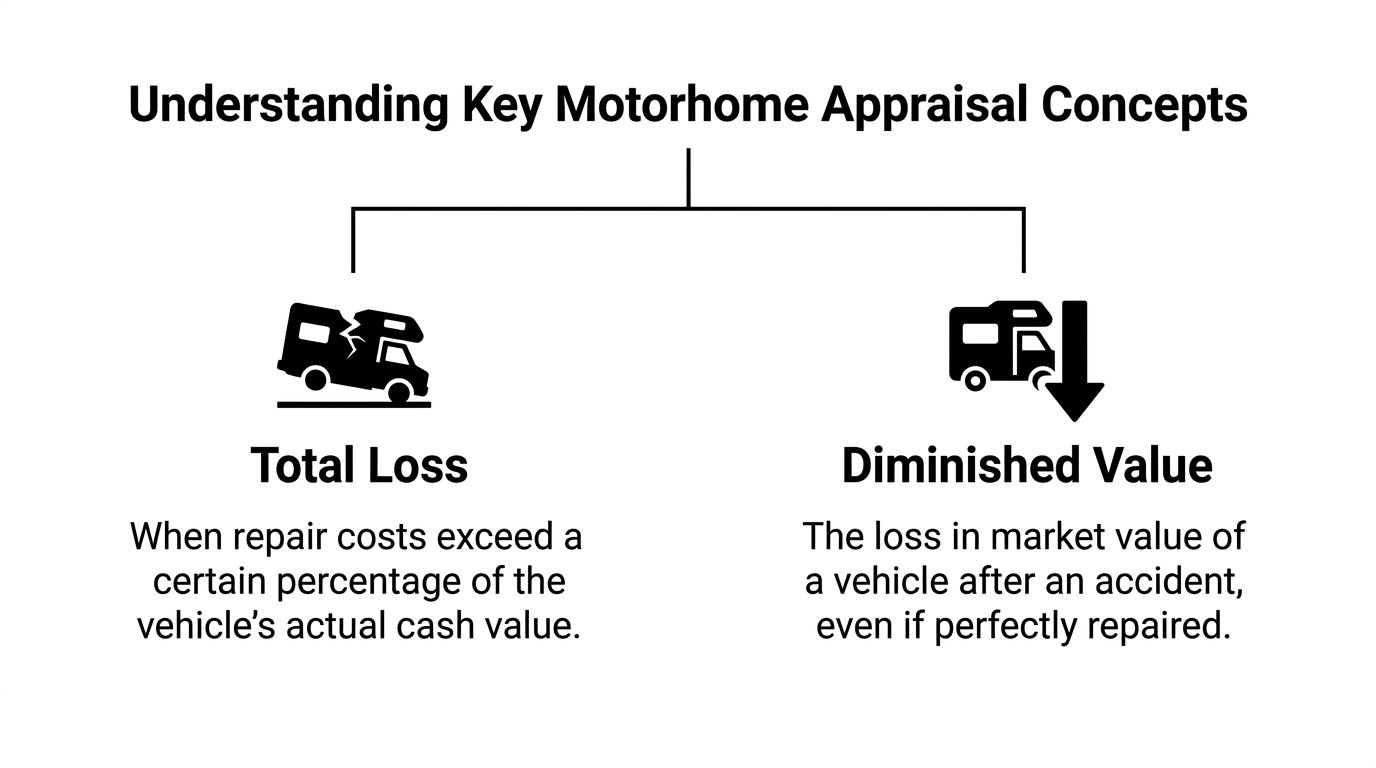
Two claim issues drive most disputes with motorhomes. One is total loss value. The other is diminished value. Owners often hear both terms without getting a useful explanation of what they mean in practice.
The market stakes are not small. The motorhome segment generated USD 40.4 billion globally in 2025, and average selling prices for motorhomes reached $63,472 in Q3 2025 before softening to $62,637 in Q4 2025, a 2.2% quarter-over-quarter decline and 1.5% year-over-year decrease, according to GM Insights' recreational vehicles market analysis. When values move like that, a static guide can miss the mark.
If you need a category-specific look at how specialty valuations are handled, specialty vehicle appraisal support gives a useful frame for these disputes.
Total loss isn't just about obvious destruction
Many owners think “total loss” means burned to the ground or crushed beyond recognition. In claims work, it often means something else. The carrier decides the unit isn't economically sensible to repair compared with its pre-loss value.
That creates a pressure point. If the insurer values your motorhome too low at the front end, the rest of the claim gets distorted. A lower pre-loss number can make their decision look cleaner and their payout look smaller. That's why the pre-loss valuation matters so much.
A motorhome complicates this further because repair economics aren't limited to body work. Damage can reach:
- Coach structure: Roof, sidewall, slide-out framing, cap assemblies.
- Living systems: Plumbing, electrical, appliances, generator integration.
- Utility loss: A unit can be drivable and still function poorly as a motorhome.
Diminished value is the scar that stays
Diminished value is the market loss that remains after repairs. Put two otherwise similar motorhomes side by side. One has no accident history. The other had major damage and was repaired properly. Buyers don't treat them the same.
That difference is the loss.
Practical rule: Repairs restore function. They don't automatically restore market confidence.
Motorhomes can carry diminished value more sharply than ordinary cars because buyers worry about hidden issues behind walls, under flooring, around roof penetrations, and in slide mechanisms. A cosmetic repair can look fine while a knowledgeable buyer still discounts the unit because of what might be lurking underneath.
Why these concepts matter to owners
Owners don't need legal jargon. They need to know what financial harm occurred and how to prove it. In motorhome appraisal services, a sound report ties the loss to real market behavior. It doesn't just name a category. It measures the effect on value.
Why You Need an Independent Motorhome Appraiser
Insurance adjusters and independent appraisers are not doing the same job. That's the starting point. The adjuster works for the company paying the claim. An independent appraiser works to determine fair market value from evidence.
That difference matters most when the numbers are close enough for the insurer to defend, but not close enough to be fair.
The conflict you are actually dealing with
A carrier wants the claim closed. Fast closure isn't always bad, but speed tends to favor standardized methods. Standardized methods are weakest when the vehicle is specialized, customized, or condition-sensitive. Motorhomes are all three.
A proper appraisal works differently. It asks questions software can't answer well:
| Issue | Insurance shortcut | Independent appraisal approach |
|---|---|---|
| Floorplan impact | Often generalized | Evaluates buyer demand for that layout |
| Upgrades | May be partially ignored | Reviews documentation and market relevance |
| Condition | Broad grade bucket | Physical inspection and unit-specific analysis |
| Local demand | May rely on wider pools | Considers regional market behavior |
| Coach systems | Frequently underweighted | Examines living-space utility and defects |
The appraisal clause is your leverage
Most owners don't realize their policy may contain an Appraisal Clause. This is one of the strongest tools available when you disagree with the insurer's value. It typically allows each side to select an appraiser, then follow the policy's dispute process for resolving the value question.
That clause matters because it changes the fight. You are no longer asking the insurer to please reconsider. You are exercising a contractual right.
In Oregon and Washington, that can be especially useful for motorhomes because regional inventory, camping culture, dealer networks, and owner usage patterns can affect value in ways a national template may not capture well. A Class C used for family travel in the Northwest may attract different demand than the same unit in another market, especially when condition, storage, and coach maintenance are well documented.
What an independent appraiser does better
An independent appraiser can:
- Inspect the actual unit: Not a database version of it.
- Separate vehicle value from settlement strategy: The report should answer value, not budget pressure.
- Document support for every conclusion: That matters if the claim hardens into a formal dispute.
- Address motorhome-specific defects: Water intrusion, coach wear, utility failures, and non-obvious damage.
If your insurer says, “That's what the system came up with,” the right response is not another opinion. It's a better valuation.
The owners who do best in these cases stop debating and start documenting.
The Motorhome Appraisal Process Step by Step
Once you decide to challenge the number, the process becomes manageable. Most owners feel better the moment they understand what happens next and what they need to gather.
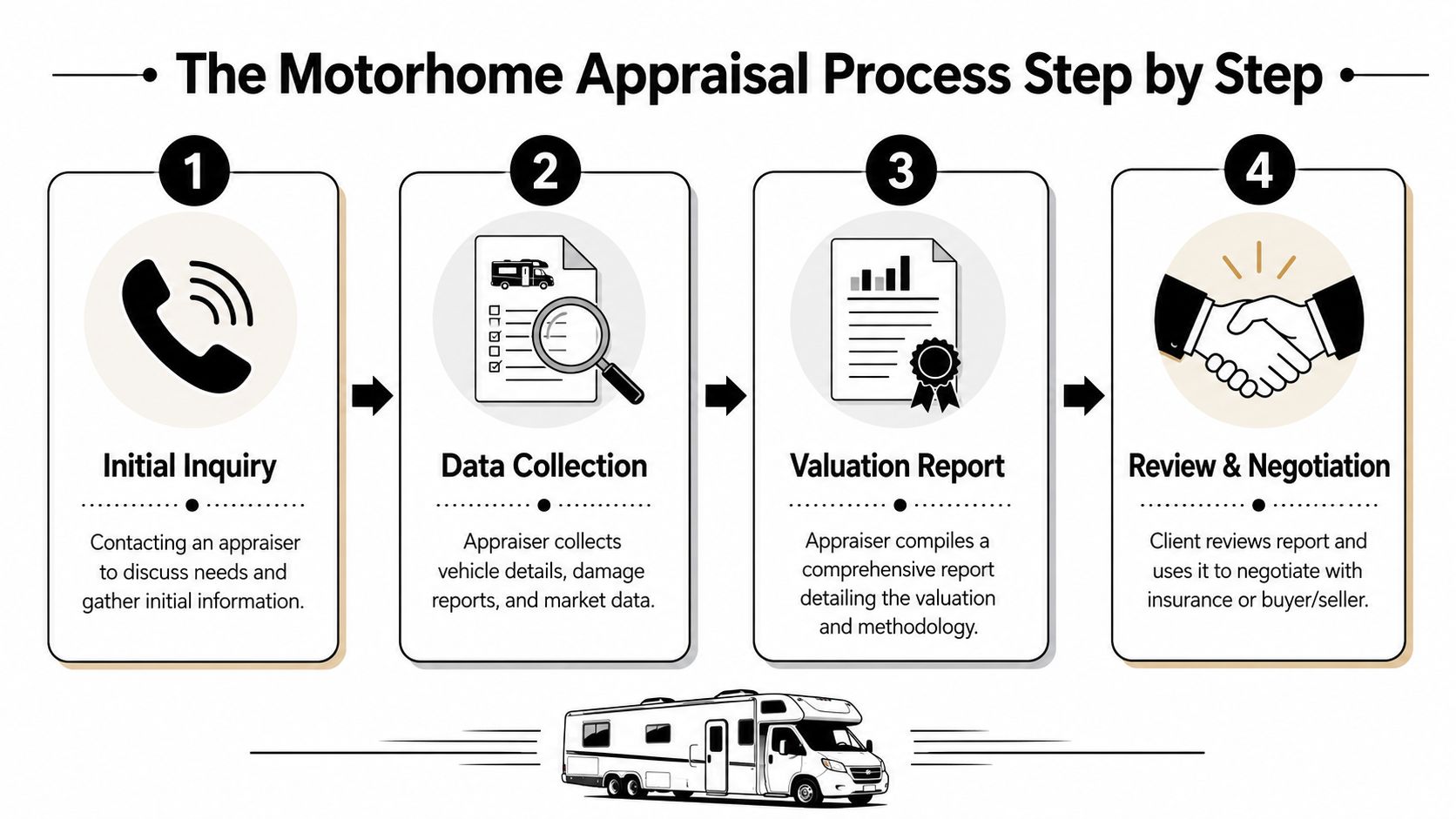
Step one starts before inspection
Begin by collecting the claim paperwork, the insurer's valuation report, photos, and your policy. Read the valuation report carefully. Don't skim it. Look for obvious misses such as wrong model designation, omitted options, bad condition assumptions, or questionable comparables.
Then gather the evidence the insurer probably doesn't have in one place:
- Maintenance records: Service invoices, inspection reports, coach-system servicing.
- Upgrade receipts: Solar, batteries, electronics, suspension work, interior improvements.
- Ownership proof: Registration, title information, purchase documents if available.
- Photos from before the loss: Exterior, interior, roof, bays, appliances, upholstery.
The physical inspection is where motorhomes separate from cars
A real appraisal is not a drive-by glance. The damage appraisal process described by Car Appraisal's explanation of motorhome damage appraisal notes that a standard physical inspection service typically takes two to four hours depending on damage complexity. That time matters because hidden structural and cosmetic issues often change the value picture.
Here's a short visual explanation of how a formal appraisal usually unfolds:
During inspection, the appraiser is looking beyond visible dents. In motorhome appraisal services, critical observations often include body integrity, slide operation, signs of moisture, cabinet alignment, appliance function, floor softness, seal condition, and repair consistency if work has already been performed.
After inspection comes market work
The research phase is where many weak valuations fall apart. Good appraisal work compares your unit against relevant market evidence, then adjusts for meaningful differences. The best report won't just list “similar” motorhomes. It explains why each comparable matters and where it does not.
Bring your records even if you think they're minor. Owners often underestimate what supports value.
The last part is review and use. Read the report closely. Make sure the listed options, condition notes, and history are accurate. Then use it in the claim process, whether that means direct negotiation, invoking the appraisal clause, or pushing back on a total loss number that doesn't reflect the market.
Anatomy of a Bulletproof Appraisal Report
A strong report is not just a final number on letterhead. It is a chain of support. Every major conclusion should trace back to inspection findings, market evidence, and a clear adjustment logic.
What the report needs to contain
At minimum, a credible motorhome appraisal report should include these parts:
- Vehicle identification: Year, make, model, VIN, class, floorplan, mileage, major options.
- Condition narrative: Exterior, interior, mechanical, coach systems, visible defects, prior damage indicators.
- Documentation review: Maintenance history, upgrade receipts, service records, photos.
- Comparable market analysis: Similar units with explanation of relevance.
- Adjustments and conclusion: How the appraiser moved from raw comparables to the final value.
If those pieces are thin, the report won't carry much force when challenged.
The coach matters as much as the chassis
Many car-based valuation methods fall short when assessing motorhomes. A motorhome's living area can add or destroy value quickly. This motorhome valuation guidance from Scone Caravan and Motorhome Buyers makes the point directly: habitation checks for water ingress, gas systems, and electrical integrity are critical, and failing to document those checks or repair visible defects can render a guide price meaningless.
That's exactly right in practice.
A good report should address questions such as:
| Report element | Why it matters in a motorhome claim |
|---|---|
| Damp or water intrusion evidence | Hidden moisture can cut value sharply |
| Gas and electrical condition | Safety issues affect use and marketability |
| Appliance and utility operation | Buyers pay for a functioning living space |
| Roof and seal condition | Deferred sealing often leads to larger defects |
| Slide and leveling function | Functional utility drives demand and price |
If you want to see the type of intake information owners are usually asked to assemble, these appraisal intake forms reflect the kind of detail serious reports are built on.
What weak reports usually miss
Weak reports often rely too heavily on broad pricing guides, fail to account for coach condition, or make blanket adjustments without explanation. In a dispute, that's a problem. The carrier already has a broad, generic process. An owner needs something narrower, more specific, and harder to dismiss.
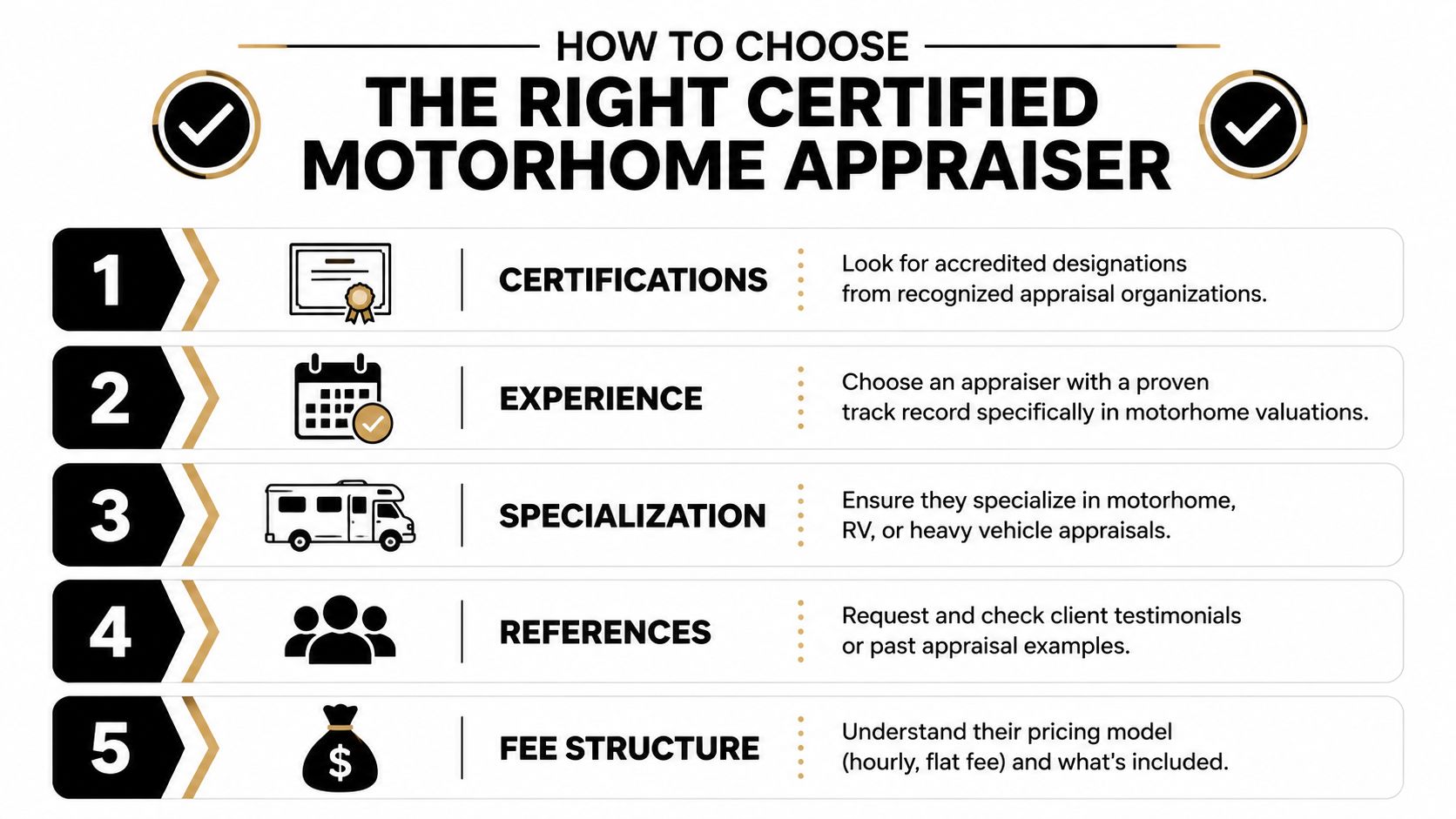
How to Choose the Right Certified Appraiser
Not every appraiser is equipped for motorhomes. Some are solid with everyday vehicles but weak on RV construction, coach systems, or motorhome-specific market behavior. That gap matters because a polished report with shallow RV knowledge can still miss value.
Start with the non-negotiable standard
The first screen is USPAP compliance. According to RV Appraisers' explanation of USPAP-compliant motorhome appraisals, expert motorhome appraisals must adhere to the Uniform Standards of Professional Appraisal Practice, and that compliance is what makes a valuation defensible in insurance claims and legal proceedings.
That isn't marketing language. It's the difference between a report that reads well and a report that holds up.
If you're in Oregon or Washington, a Pacific Northwest auto appraiser familiar with regional claims can also be especially useful because local market awareness changes how comparable units are selected and interpreted.
Questions worth asking before you hire
Ask direct questions. A capable appraiser should answer without dancing around the process.
- How do you handle motorhome-specific condition issues? Listen for discussion of coach systems, habitation concerns, and actual inspection practice.
- What kind of comparables do you rely on? You want real market support, not generic guide dependence.
- Will your report support an appraisal clause dispute? The answer should be clear, not evasive.
- Do you need my records and upgrade receipts? A serious appraiser will.
- Can you promise a number today? If they say yes, walk away.
Red flags owners miss
Some warning signs are subtle. Others are obvious once you know what to look for.
Warning sign: If an appraiser guarantees a value before seeing the unit and records, you're not buying analysis. You're buying a predetermined answer.
Other red flags include poor explanation of methodology, no mention of standards, little interest in physical condition, and no serious questions about the living quarters. For motorhome appraisal services, that last one is disqualifying.
Cost and speed should not be your first filter
Owners often shop for the cheapest appraisal because they already feel squeezed by the claim. That's understandable. But the cheapest report can become the most expensive choice if it fails when the insurer pushes back.
A better question is this: will the report still stand when someone challenges the comparables, condition adjustments, and conclusions? If the answer is uncertain, keep looking.
Conclusion Getting the Fair Settlement You Deserve
If your motorhome was undervalued, you are not stuck with the first offer. That's the main point. Insurance companies present their number as if it came from neutral ground. Often, it didn't. It came from an internal process that may not reflect your unit, your region, or your evidence.
Motorhome claims demand more than a generic vehicle valuation. They require someone to account for the coach, the floorplan, the systems, the condition, and the local market. That is why independent appraisals matter so much in Oregon and Washington, where motorhome use patterns and regional demand can change what a fair number looks like.
The broader market also explains why this issue keeps coming up. North America holds over 40% of global motorhome revenue, and the region was valued at USD 11,817 million in 2024. Class C motorhomes held a 46.26% share of global deliveries in 2025. An estimated 1 million United States households live full-time in RVs, and 54% of remote-work households perform their jobs from an RV, according to Cognitive Market Research's motorhome vehicles market report. For many owners, this isn't just a recreational asset. It's a core financial and lifestyle asset.
If the carrier's number feels wrong, treat that instinct seriously. Read the policy. Look for the appraisal clause. Gather your records. Get the unit inspected by someone who understands motorhomes as motorhomes, not just oversized vehicles. That's how owners take control back.
If you're dealing with a low total loss offer or need help using the appraisal clause in Oregon or Washington, Total Loss Northwest provides certified independent appraisals focused on diminished value and total loss disputes. Their work is built for owners who need a defensible market value, not an insurance company shortcut.