You just got the insurer's first number, and it's lower than the car in your garage deserves. The adjuster skimmed the photos, ignored the restoration binder, and treated your classic like a generic old car. That's exactly where a strong antique car appraisal form earns its keep, because the form is not paperwork, it's the evidence package that tells the market story of the vehicle and makes a low offer harder to defend.
A defensible form starts with the basics, but it doesn't stop there. It forces the owner and appraiser to document the full VIN, odometer reading, factory options, engine details, numbers-matching components, recent repairs, high-resolution photos, and the purpose and timeline of the appraisal, because those are the data points that materially affect value assessment and market comparison (FormCreatorAI). That's the difference between a casual worksheet and something an adjuster, arbitrator, or judge can read as evidence.
For owners comparing repair photos and archived records, even a visual reference like find antique jewelry photos from First Class Insurance can be useful as a reminder of how carefully preservation details have to be documented when condition drives value.
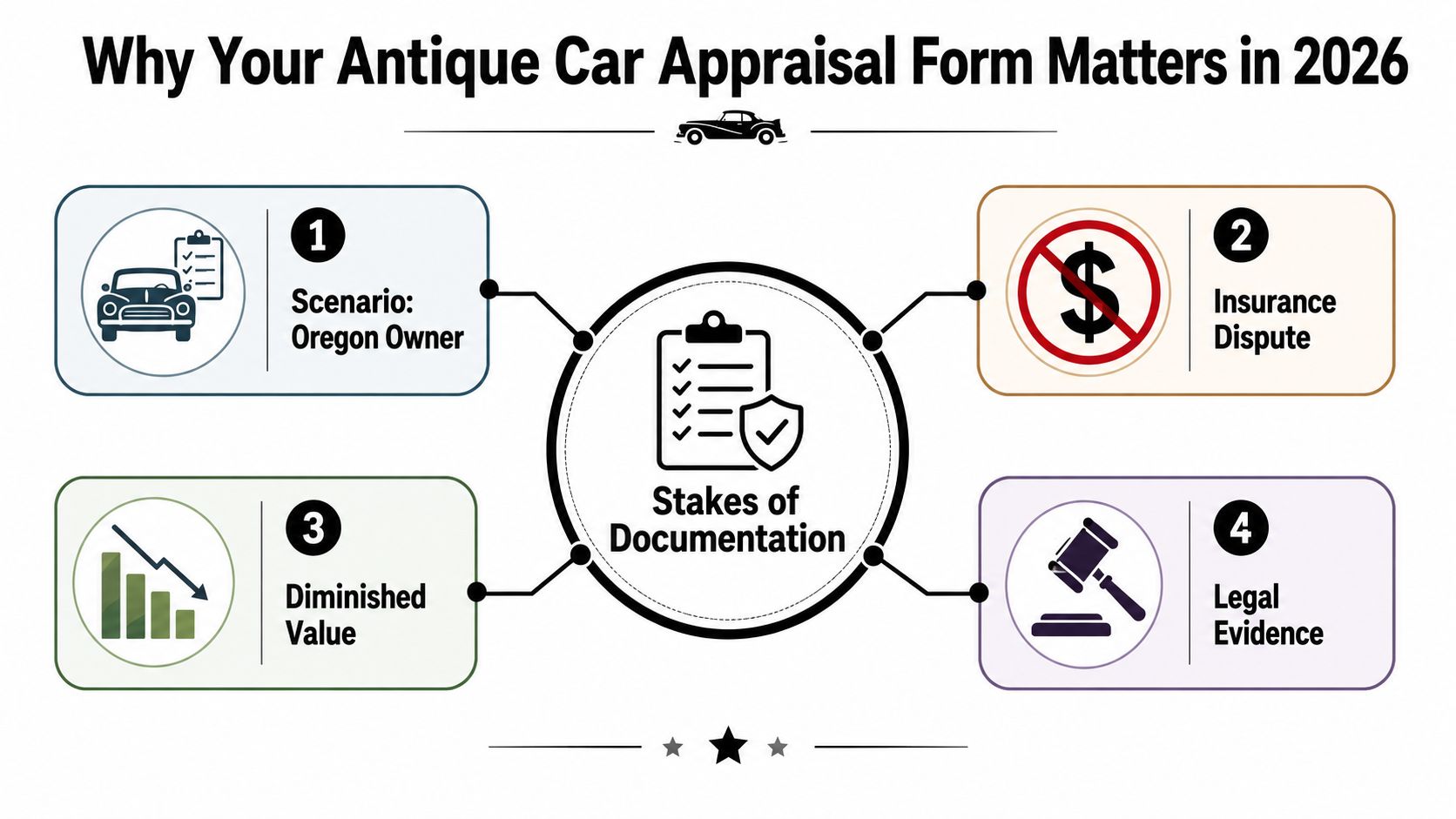
Why Your Antique Car Appraisal Form Matters in 2026
A low settlement usually starts with a thin file. The insurer opens the claim, runs the car through generic valuation software, and then strips out the things that drive value, like restoration quality, original trim, or matching-numbers parts. If your form does not capture those facts cleanly, the insurer gets to define the car for you.
The form is the proof chain
The old habit was to treat collector cars as if age alone set value. That approach does not hold up now. Modern collector-car valuation depends on originality, provenance, and condition as real inputs, and the form is where those inputs become visible (FormCoach). A half-filled form fails because it leaves room for an adjuster to call the car just “nice for its age.”
A proper antique car appraisal form also has to match the way the market prices these cars. Appraisers compare the subject vehicle against documented market comps, and auction results are one of the cleanest benchmarks for that work (Sotheby's Motorsport). If the file does not contain the identifiers and condition notes needed for that comparison, the valuation is easy to challenge and easy to push down.
Why Oregon and Washington owners should care
In Oregon and Washington, total-loss and diminished-value disputes turn on evidence, not attitude. Insurers are comfortable with shortcuts, but they have a harder time dismissing a file that pins down what the car was before the loss. If you are preparing for a fight over value, the form is the document that keeps restoration receipts, option codes, and originality from getting buried.
For owners who are building photo files and repair records, a visual reference like find antique jewelry photos from First Class Insurance can be useful as a reminder of how carefully preservation details have to be documented when condition drives value.
A strong form also fits the claim process itself. Total Loss Northwest auto appraisal forms are built around the kind of documentation that survives insurer pushback, because a total-loss file needs more than a sentimental description and a rough estimate. It needs a clear record of identity, condition, and market position.
Practical rule: if the adjuster cannot see the car's identity, condition, and market comparables in one package, the insurer will default to the cheapest interpretation.
A checklist-style inspection sheet asks, “What is here?” A defensible appraisal file asks, “What is this car, what changed, and what would a comparable buyer pay for this exact version?” That is the question that matters.
Core Fields Every Antique Car Appraisal Form Must Capture
Start with identity, and keep it tight. The form should identify the car by year, make, model, body style, VIN, engine size, factory options, and matching components before anyone talks value. That order matters because originality and configuration change the comp set, and the wrong car always pulls the wrong number.
Identification and provenance first
The strongest forms force the appraiser to document the car's build facts and ownership story in the same package. Titles, build sheets, restoration records, and any paperwork showing how the car changed over time belong together because they help prove whether a vehicle is close to factory spec or significantly modified. That difference is not cosmetic. It changes which cars are comparable.
The odometer reading and recent repairs should be recorded in plain language, not buried in a narrative paragraph. Mileage can support use patterns, while recent repairs show whether the car was maintained, refreshed, or partially restored. If the file leaves those points vague, the insurer uses the gap to discount the claim.
Condition and purpose control the value conclusion
The appraisal purpose field matters more than most owners realize. Insurance replacement value, estate documentation, and collection records can point to different conclusions even when the car is the same. The form has to state why it exists before a value goes in.
The form also needs condition grading space that is clear enough to defend later. A vague “good condition” note is weak. A direct description of rust, repaint quality, interior wear, aftermarket changes, and cosmetic flaws gives the appraiser a way to match the vehicle to the right market evidence.
Use the valuation method that starts with the car, not the guide. Classify the vehicle, grade condition, then compare it to the market, the same approach laid out in collector-car valuation guidance and in the Hagerty methodology for valuing classic cars. That sequence is what keeps the report credible when someone pushes back on the number.
Total Loss Northwest's auto appraisal forms are a useful reference point if you want to see how a claim-oriented form is typically organized.
A disciplined appraisal form does one more job well. It creates a record that an adjuster can read without guessing. That is why the fields have to capture factory identity, provenance, condition, repair history, and the basis for value in a single file that can survive insurer challenge in Oregon and Washington.
For owners who need to keep the file private, SendPhoto password protection tips are worth using before you share records with anyone outside the claim.
Building a Photo and Documentation Checklist That Holds Up
A photo file and a paper file have to work together. If the owner has the story but not the proof, an insurer can pick it apart in minutes. Clear photos, dated receipts, and documents that match each other force the discussion back onto the car instead of speculation.
Visual evidence that actually gets reviewed
A serious file should start with the photo set collector-car guidance expects, with at least 12 photos of the actual vehicle plus detailed documentation of condition and modifications (NAACC guidance). Use those shots for the parts an adjuster will challenge first. Skip duplicates and filler angles.
- Full exterior walkaround: Shows overall presentation and confirms the body style and trim.
- Front and rear views: Helps prove completeness and spot visible damage or missing parts.
- Engine bay: Lets the reviewer verify engine details and possible non-original parts.
- VIN and trim tags: Supports identity and originality claims.
- Dashboard and odometer: Confirms mileage and interior condition.
- Interior seats, door panels, and carpet: Shows wear, restoration quality, and originality.
- Undercarriage or floor pans: Useful when rust or prior repair is part of the dispute.
- Restoration in progress or completed areas: Proves the quality of work, not just the invoice total.
Paper evidence that strengthens the file
The paper trail should do the same job as the photos. It should connect the car to factory identity, restoration work, ownership history, and condition history without gaps.
- Build sheets and window stickers: Support factory configuration and option codes.
- Restoration invoices and parts receipts: Show what was done, by whom, and with what materials.
- Ownership history: Helps establish provenance and continuity.
- Club judging sheets or concours records: Useful when the car has been evaluated by knowledgeable enthusiasts.
- Maintenance logs: Useful when the issue is whether the car was cared for or neglected.
For the claim packet itself, Total Loss Northwest's claim documentation guidance is a practical model for how the support file should be arranged. That kind of order matters in Oregon and Washington, where a sloppy packet gives an adjuster room to stall or discount the file.
Date every document you can. Watermark copied photos if they are likely to circulate, and keep the originals untouched in a separate folder. If you need to store or share the file securely, SendPhoto password protection tips are worth using before you send records to an adjuster, appraiser, or attorney.
Photo and Documentation Minimums
| Category | Item | Why Insurers Ask for It |
|---|---|---|
| Visual | Exterior walkaround | Confirms body style, trim, and overall condition |
| Visual | Engine bay | Supports engine details and originality claims |
| Visual | VIN and trim tags | Verifies identity and factory configuration |
| Visual | Interior and dashboard | Shows wear, restoration quality, and mileage context |
| Visual | Undercarriage or floor pans | Documents rust, repairs, or structural concerns |
| Paper | Build sheet | Supports factory equipment and option history |
| Paper | Restoration invoices | Shows the scope and quality of the work performed |
| Paper | Parts receipts | Helps prove originality or replacement quality |
| Paper | Ownership history | Supports provenance and continuity |
| Paper | Club or concours records | Adds third-party evidence of condition |
Estimating Value Through Comparable Market Evidence
A number on an antique car appraisal form means nothing unless the market can support it. Start with classification, move to condition grading, then build comparables analysis that an insurer or opposing appraiser can test. I see weak valuations all the time when someone starts with a price guide and then works backward to justify the number.
Pick comparables the way a hard-nosed buyer would
The best comparable is the one that matches the subject car in the ways buyers pay for. Year, make, model, body type, engine, trim, originality, and restoration quality belong in the first pass, before anyone starts arguing about price. The valuation file should explain why each comparable made the cut and where it differs from the subject car.
Closed auction results carry real weight because they show completed market behavior, not wishful asking prices. Major auction houses such as Mecum, Barrett-Jackson, and RM Sotheby's publish realized sale prices, and those completed prices are stronger evidence than listings that may never trade. The claim must stay grounded, though. If the appraiser relies on a listing, the file should say why that listing still matters and what adjustment was made to account for it.
The file should never pretend that every comparable is identical. It should show the subject car, the comparable, the reason it was selected, and the adjustment logic in plain language. That is the part many owners skip, and it is the part that survives pushback.
What belongs in the comparison logic
- Body style: Coupes, convertibles, and hardtops do not always trade at the same level.
- Trim level: A base model is not a special edition.
- Originality: Matching-numbers and factory-correct cars usually sit in a different market lane than modified examples.
- Restoration quality: Driver-quality work and high-level restoration are not the same thing.
- Geographic market: Local buyer demand can change how a car is perceived and priced.
Use the Hagerty valuation framework only as a structure, classify the car first, assess condition next, then compare it to market evidence such as auction results, listings, and private sales. That method keeps the number tied to the vehicle, not to the owner's hopes. For a clean example of how to think about comparison sets in appraisal work, Total Loss Northwest's comparables guidance is worth reading before you assemble your own file.
A small trim detail can change how a build is read, especially on vehicles where appearance cues signal package level or originality. For that reason, even something like Jeep decals for Wrangler fenders can matter when the appraiser is documenting factory appearance, replacement parts, or period-correct presentation.
Here is a simple structure for a valuation summary:
| Subject | Comparable | Why It Was Chosen | Adjustment Notes |
|---|---|---|---|
| The insured classic | Closest body style match | Same model family and similar condition | Adjust for originality, trim, and restoration quality |
| Second comp | Similar factory equipment | Closest engine and option profile | Adjust for mileage and documented repairs |
| Third comp | Recent market sale | Strong market evidence | Adjust for body style and local demand |
If the car is rare, heavily modified, or already in a dispute, hire an independent appraiser. A guided owner-built form can work for a well-documented collection car, but once the insurer starts pushing back, the report needs a professional voice and a tighter comparables set.
Using the Form in Oregon and Washington Total Loss and Diminished Value Claims
When a classic gets hit, the form becomes a claim weapon. In Oregon and Washington, the owner usually needs one clean file that shows what the car was, what was lost, and why the insurer's first number misses the mark. That is especially true when the vehicle was repaired after a not-at-fault crash and still lost value in the market.
How to present the file to the adjuster
Lead with the facts the insurer can't ignore. Send the completed appraisal form, the photo set, the supporting documents, and a short cover letter that states the vehicle identity, the valuation issue, and the evidence supporting your position. Keep the tone professional, and keep the ask direct.
If the policy has an Appraisal Clause, that clause is the path to force an independent valuation when you disagree with the insurer's number. The point of the form is to support that demand with a file that already documents condition, originality, factory options, and market comparables, so the insurer has less room to claim the valuation is speculative.
Practical rule: if the adjuster excluded a restored engine, matching numbers, or a rare option, make those facts impossible to miss in the first page of the file.
How diminished value fits in
A repaired classic usually doesn't come back to the same market level it had before the loss. That loss should be documented in the appraisal record, especially when the car is collectible, rare, or known for originality. The file should explain the pre-loss condition, the repair history, and the comp set used to show how the market treats repaired examples.
The insurer may lean on software or broad averages. Your job is to show why those tools miss the details that matter in a collector-car claim. A well-built form does that by linking the physical vehicle, the repair history, and the market evidence in one place.
If the claim is active, the numbers are high, or the insurer is already arguing with your documentation, bring in professional appraisal support instead of trying to hand-wave the dispute away. An independent report is often the difference between a stalled claim and a settlement that reflects the vehicle.
Common Mistakes and Final Tips for a Form That Actually Wins
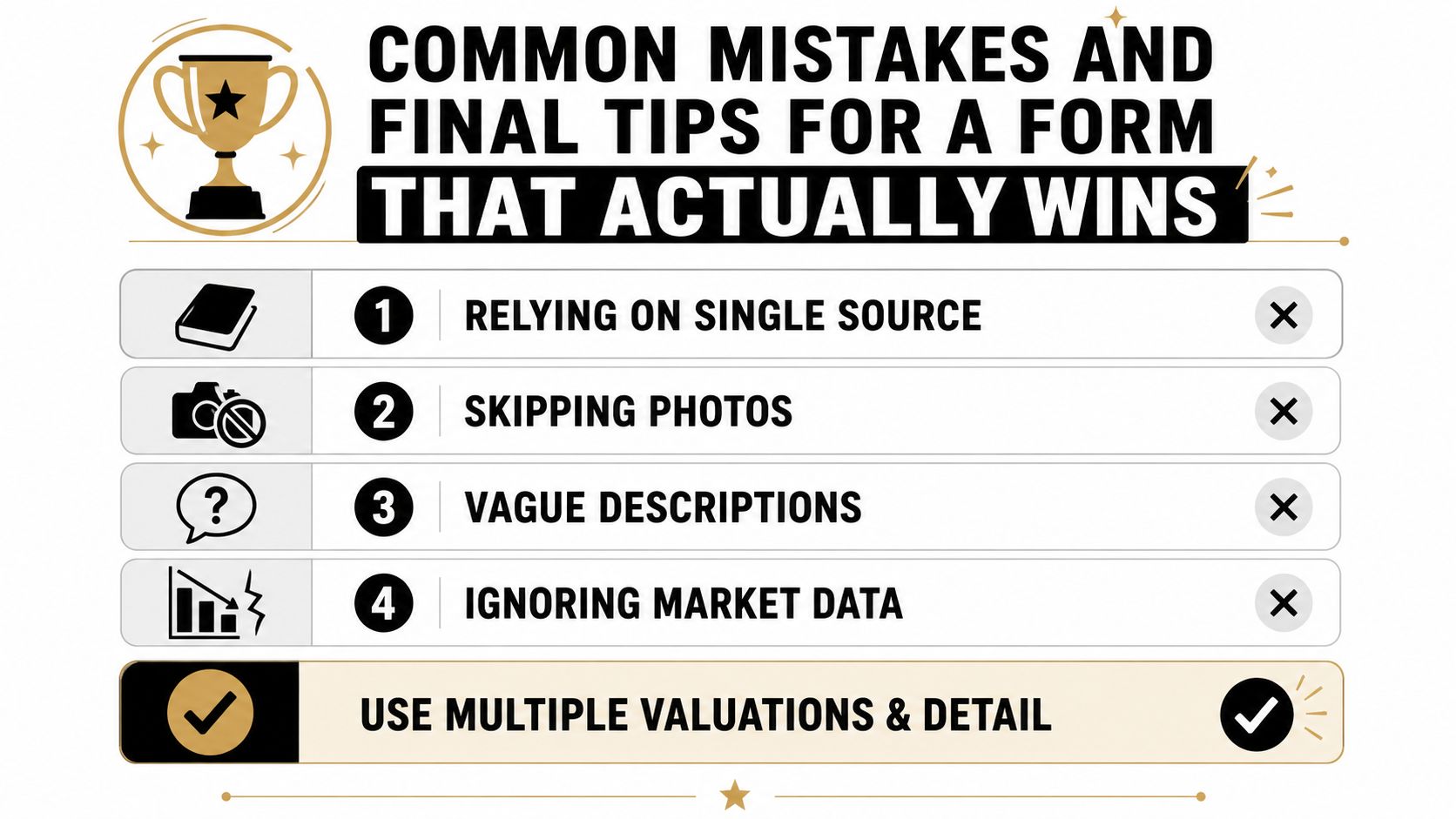
The same mistakes show up over and over in weak appraisal files. They're fixable, but only if you treat the form like evidence and not a hobby worksheet.
- Relying on a single source: Use multiple recognized references and current comparables, not one optimistic price guide.
- Skipping photos: Include the actual vehicle from every angle that matters, plus tags, engine bay, and interior.
- Vague descriptions: Say what's original, what's modified, and what was repaired.
- Ignoring market data: Use realized sales or tightly matched current offerings, not asking prices alone.
- Leaving out the purpose: State whether the report is for insurance, estate, or collection records.
The final rule is simple. Use multiple valuations and detail the evidence. That means the file should prove identity, condition, originality, repairs, and comparable-market logic without forcing the reviewer to guess.
If your antique car is already part of a claim, don't let the insurer define it from a few photos and a software printout. Build the form like you expect pushback, because that's exactly what happens.
A CTA for Total Loss Northwest. If your antique car is tied to a total-loss or diminished-value claim in Oregon or Washington, send the documentation and get a professional appraisal review before you accept the insurer's number.