Agreed value insurance is coverage where you and the insurer lock in a specific dollar amount for the vehicle before a loss occurs, and that amount minus the deductible is paid on a covered total loss. It gives you a fixed settlement instead of forcing you into a post-loss actual-cash-value fight.
You're usually looking at this because you already know the uncomfortable part of a standard policy. The car is special, the build is unique, or the market won't treat your vehicle fairly if it gets totaled next week.
The Core Idea Behind Agreed Value Insurance
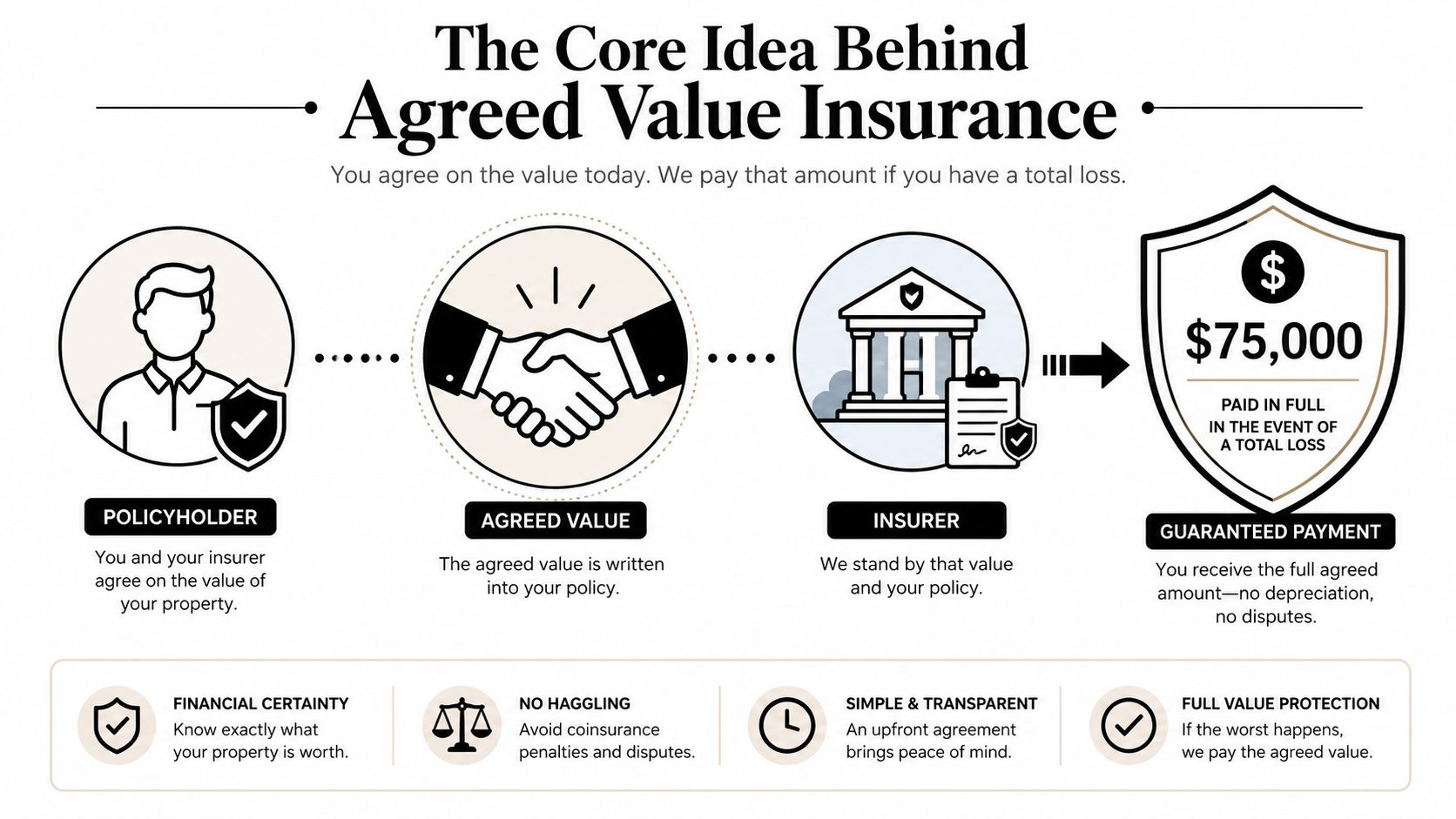
A totaled vehicle creates a simple question with a complicated answer. Agreed value insurance answers that question before the loss happens. You and the insurer set a specific dollar amount in advance, and that amount becomes the basis for a covered total-loss payout, minus the deductible, instead of leaving the settlement to be calculated after the wreck. Major consumer guides also describe this structure as guaranteed value coverage, which is why classic and collector-car owners often seek it when ordinary depreciation-based pricing does not fit their vehicle well. InsurerBrain's agreed value definition
That matters most when the car is not a normal commuter vehicle. A classic coupe, a restored truck, or a custom build can mean far more to its owner than a standard market model suggests on paper, and a regular policy may still pay actual cash value after the loss. With agreed value, the payout amount is already set before the loss happens, so there is far less room for a post-claim argument about what the vehicle was worth. That is the part owners are usually trying to protect. Lockton's explanation of agreed value
A simple example makes the mechanics clearer. A classic car is damaged beyond repair in a storm. Under agreed value, the insurer does not begin with a depreciation model or a fresh market search after the fact, it starts with the amount already written into the policy. That is why owners who have spent years restoring a vehicle often prefer this type of coverage, because it is designed to reflect the car's insured worth before a disaster turns the claim into a valuation fight. A diagram explaining agreed value insurance, showing the process from policyholder agreement to guaranteed total loss payout.
Practical rule: if the number is fixed before the loss, the argument shifts from “what was it worth?” to “was the number set correctly?”
The core issue is not the label on the policy, it is whether the agreed figure was set fairly enough to survive a claim. If the amount was chosen without solid support, the owner can still run into trouble when the insurer reviews the vehicle after a loss. That is why the next questions are so important: how the number gets set, how the coverage differs from stated value, and what happens when the insurer pushes back at claim time.
How Agreed Value Differs From ACV and Stated Value
The easiest way to understand the differences is to hold one vehicle in your head and compare the payout rules. A 1969 Mustang, a restomod pickup, or a modified import can all look “insured” on paper, but the claim math changes completely depending on the coverage type. The name on the policy matters less than the settlement method behind it. For a side-by-side overview, see this agreed value vs actual cash value comparison.
Actual cash value puts the insurer in control of the number
With actual cash value, the insurer figures out what the car is worth after the loss, then subtracts depreciation from replacement pricing or comparable-market logic. That means the owner usually has little control over the result, especially if the vehicle has upgrades, restoration work, or collector demand the standard valuation model doesn't capture. The payout is not fixed in advance, so the number can land far below what the owner expected. Agreed value definition
Stated value looks similar but behaves differently
Stated value sounds reassuring because a number appears on the policy, but that number often acts more like an upper limit than a guaranteed payout. In many explanations, the insurer may still pay the lower of the stated amount, repair cost, or actual cash value. That's why stated value can feel close to agreed value on the declarations page while delivering a very different result after a total loss. Agreed value vs stated value
Agreed value locks the payout in advance
With agreed value, the insurer and policyholder accept the value before the loss, and that amount is the claim basis for a covered total loss. Sources also note that the amount is typically fixed for a policy term and can be updated later if the asset appreciates. This is the key distinction for owners who don't want depreciation or market swings deciding the final settlement. Agreed value mechanics and term
| Coverage Type | When Value Is Set | Payout on Total Loss | Depreciation Risk |
|---|---|---|---|
| Actual cash value | After the loss | Insurer-calculated market value | High |
| Stated value | At policy setup, often as a declared figure | Often the lower of stated amount, repair cost, or ACV | Moderate to high |
| Agreed value | Before the loss | The agreed amount, minus deductible | Low |
The takeaway is practical. Stated value and agreed value are not the same promise, even if they can look similar in a policy summary. If you own a vehicle whose true worth is tied to condition, build quality, or collector demand, that difference can decide whether you get a fair check or a frustrating negotiation.
How Insurers Determine the Agreed Value
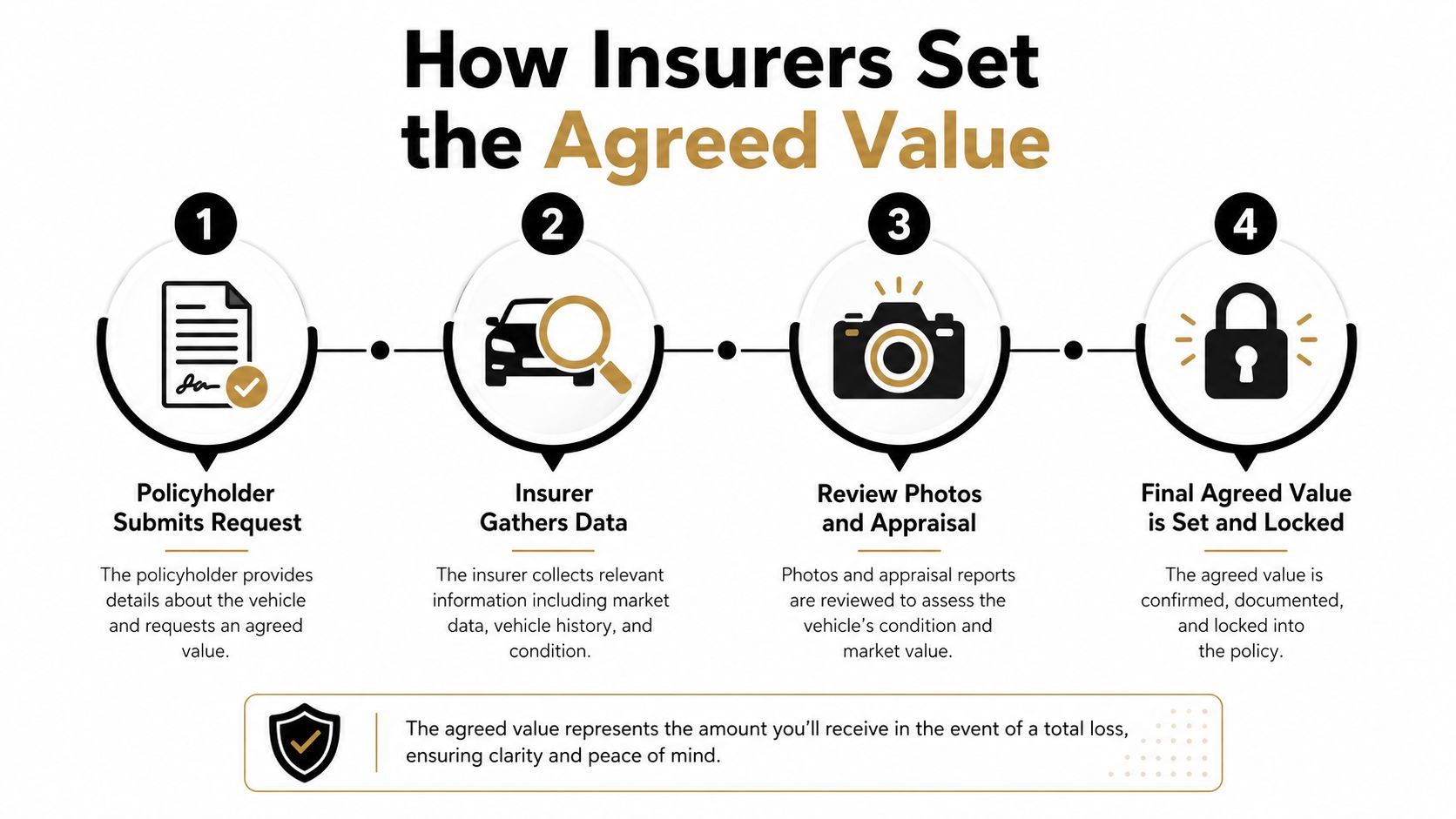
A total loss claim can expose the gap between a policy's headline number and the amount that survives scrutiny at settlement time. Insurers usually do not pick the agreed figure out of thin air. They ask for a value statement, photos, or an appraisal, then compare what you submit with their own valuation sources before they bind the coverage. For many classic, modified, or high-value vehicles, the agreed figure comes from a documentation contest, not a guess. A good starting point is an agreed value appraisal overview.
The owner's evidence shapes the starting point
A strong file changes the conversation fast. Clear photos, build records, restoration invoices, and a credible valuation report give the insurer a better basis for accepting a higher number. If you submit little more than a rough estimate, the company has room to anchor low and wait for you to prove otherwise.
That is why condition, options, provenance, and restoration history matter so much. A car with rare trim, documented labor, or a carefully restored engine bay is not just “the same model” as a tired example with unknown history. The agreed value should reflect that difference, and the supporting paperwork is what makes that case legible to the underwriter.
The number is usually fixed for the policy term
One useful feature of agreed value is stability during the policy term. Several explanations note that the amount is often locked for about 12 months unless the policy is renewed or adjusted for appreciation, which protects owners from market swings that can distort a later claim estimate. Agreed value term explanation
Underwriting reality: if you do not show the car well, the insurer can only value what it can prove.
That is also why midterm updates matter. If the vehicle appreciates, or if a major restoration changes its worth, the old number may fall behind the car. Locking the value once and forgetting it can leave a gap between the policy and the vehicle's current replacement or restoration cost.
If you want to see how that file gets built from the owner side, this appraisal-focused guide shows how evidence turns into a defensible number. The core idea is simple, though. The insurer is looking for proof that the figure matches the actual vehicle, not just the owner's hope.
Documentation and Appraisals That Lock In a Fair Number
The fastest way to improve an agreed-value submission is to think like the underwriter. You're not just saying the car is valuable, you're proving why the number is fair with records the carrier can trust. A clean file beats a vague story every time.
What to gather before you ask for a quote
Start with the basics and build outward from there.
- Receipts for parts and labor: Keep invoices that show what was installed, who installed it, and when.
- Build sheets and restoration records: Document the work that changed the car from stock into the version you own today.
- Before-and-after photos: Show condition, completeness, and the quality of the finished work.
- Third-party valuation reports: Independent documentation carries more weight than a self-assigned number.
A formal appraisal is especially useful when the vehicle has modifications, scarce trim, or restoration work that doesn't show up in standard book values. The appraiser's job is to document condition, options, mileage, and comparable sales, then turn that evidence into a defendable figure. That's the part owners often miss, because a car can be emotionally priceless without being valuation-proof.
When to use an independent appraiser
Use a professional when the value matters enough that a bad number would hurt. That usually means a classic, a custom build, or a vehicle that has changed materially since the last policy review. Independent reports are helpful because they replace casual estimates with a market-based explanation that can stand up in a claim discussion.
For claim disputes, some owners also work with a certified independent appraiser who can press the carrier through the Appraisal Clause and force a fresh valuation process. That's especially important when insurer software misses rare options, workmanship, or unusual market demand. If you're looking for a service that does total-loss and fair-value work, Total Loss Northwest is one option that prepares independent auto appraisal reports used in insurance valuation negotiations.
The document stack is the asset. The more complete it is, the harder it is for anyone to pretend the car is ordinary.
Owners often ask whether the insurer will “just know” the value. It usually won't. If the car's worth depends on details that can't be seen in a standard VIN lookup, the paperwork has to do the heavy lifting.
Who Agreed Value Coverage Is Really Built For
Agreed value fits best when the car's worth is tied to more than mileage and age. Classic cars, collector cars, restomods, custom builds, limited-production imports, and high-value vehicles with hard-to-price parts are the obvious matches. Those are the cars where depreciation-based pricing can miss the point entirely. For a collector-focused overview, see classic car agreed value insurance.
When it helps most
A vehicle benefits from agreed value when replacement cost, restoration cost, or collector demand is the primary factor. That includes cars with rare trim, extensive modifications, or workmanship that standard valuation guides don't capture well. It also helps when a car is appreciating, because locking in a number now can protect against a more expensive replacement later.
This is why specialty shoppers often look for policies built around classic-car use. If you're comparing options and want a place to start, you can find vintage car policies through Schneider and Associates Insurance Agencies and then compare the valuation terms carefully.
When it may not be worth the extra effort
Daily drivers with ordinary market values often don't need this structure. If a vehicle is easy to replace and its market price is already well captured by standard coverage, agreed value may add complexity without much benefit. The main question is whether you'd fight over the number after a total loss.
A simple test helps.
- Would a standard book value feel low if your car disappeared tomorrow?
- Would an upgrade, restoration, or rare trim be ignored by ordinary depreciation math?
- Would you be upset if the settlement depended on a market snapshot taken after the loss?
If you answered yes to any of those, agreed value deserves a look. If the answer is no, standard coverage may already be close enough for your situation.
The point isn't to buy a fancier policy just because it sounds better. It's to match the valuation method to the way your car holds value.
Real-World Payout Scenarios You Can Picture
A policy reads differently once you see how the claim would pay.
A classic car owner keeps a restored roadster in the garage. A storm totals it. The policy lists a fixed agreed amount, so the payout starts there and the only adjustment is the deductible. There's no depreciation argument, no back-and-forth over book value, and no need to prove that the car meant more than a standard used-car estimate.
A second owner drives a modified daily driver with an upgraded suspension, custom wheels, and documented labor. The agreed value was set high enough to reflect the work, so a covered total loss pays that upgraded amount after the documentation is verified. The lesson is simple, the build only gets protected if the records were strong enough to support the number at underwriting.
The third case is the one that catches people off guard. An owner of a high-value import lets the policy sit for a long time without updating the figure after the car rises in value. After a loss, the old agreed amount is still on the declarations page, and the gap between that number and current replacement cost becomes obvious. An independent appraisal later shows the mismatch, but the policy can only pay what was locked in.
These are not abstract policy differences. They're settlement outcomes tied to whether the agreed figure was accurate and current when the loss happened.
Common Pitfalls and How to Protect Your Agreed Value
The biggest mistake is assuming the number stays correct forever. A car that was fairly valued two years ago can be underinsured today if the market moved, the build changed, or restoration work added value that never got reported. That's how a good policy turns into a disappointing check.
Another trap is buying stated value while thinking you bought true agreed value. The declarations page can look comforting, but the payout mechanics can still let the insurer fall back on a lower valuation. If the company doesn't lock the number in advance, the owner is still exposed.
You also need a plan if the carrier pushes back at claim time. The Appraisal Clause exists for a reason, it gives both sides a contractual way to resolve a valuation dispute with independent appraisers rather than letting the insurer's software have the final word. That matters most when the issue isn't whether the car is covered, but whether the insurer is honoring the number that was supposed to be fixed.
If you own a classic, custom, or high-value vehicle, don't let the declarations page trick you into thinking the number is current. Get the valuation updated, gather the records, and make sure the policy matches the car you have today. If you need help proving value after a loss or challenging a low settlement, Total Loss Northwest prepares independent total-loss appraisals and fair-value reports that are built for these disputes.