You open the trunk after a loss, a restoration dispute, or a private-sale inspection, and the jack looks like the least important item in the car. It's rusty. It may be tucked under a mat. Sometimes it's missing the handle, or it has old paint and grime that make it look disposable.
For a classic car owner, that assumption can cost real money.
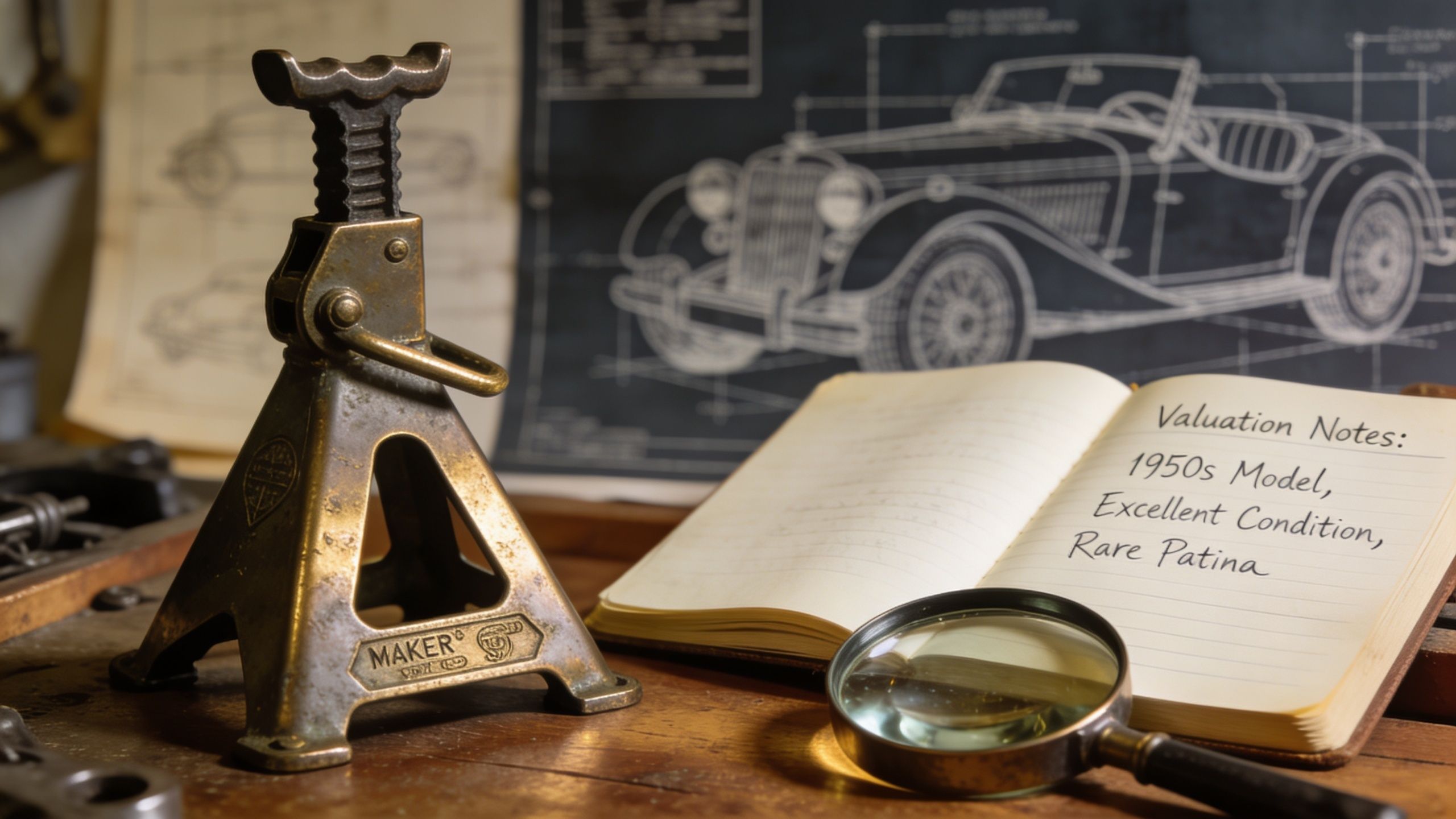
An original jack is often part of the vehicle's period-correct toolkit, and that means it can matter to both authenticity and value. In collector transactions, buyers don't just ask whether the car runs well. They ask whether the details are right. The factory jack, handle, lug wrench, bag, decals, and date-appropriate markings all help answer that question. If you're dealing with an insurance claim, the burden is usually on you to show why that old tool isn't just trunk clutter.
Why Your Old Car Jack Could Be a Valuable Asset
A typical scenario goes like this. A classic car is damaged, stolen, or declared a total loss. The insurer values the vehicle, but the toolkit gets treated as incidental. The owner knows the jack came with the car, knows it matches the era, and knows other collectors care about it, but doesn't yet have the documentation to prove what it's worth.
That's where antique car jack value stops being a hobby question and becomes an appraisal question.

The price spread alone should tell you not to guess. On 1stDibs vintage car jack listings, vintage jacks range from $99 to $12,500, with an average selling price of $1,800. That doesn't mean your jack is automatically expensive. It means the category is too wide for casual pricing.
Why collectors care
A jack can add value for three reasons at once:
- Vehicle authenticity: An original jack helps show the car still retains correct equipment from its era.
- Completeness: A complete toolkit often attracts more serious buyers than an incomplete one.
- Provenance: A jack that fits a specific make, model, and period usually matters more than a generic old lifting tool.
Practical rule: In a collector car appraisal, a correct original jack is judged as part artifact, part accessory, and part evidence.
What works is a documented, period-correct identification tied to the car. What doesn't work is treating every old jack as “antique” and assuming age alone creates value. In my experience, owners usually overvalue bright repaints and undervalue original, worn examples with the right marks and hardware.
That distinction matters in both private sales and insurance files. A rough but original jack can support a stronger valuation than a cleaner restored one if it's the right type for the car.
First Steps in Identifying Your Antique Jack
Before you assign any value, identify the jack as precisely as possible. “Old bumper jack” or “vintage screw jack” isn't enough for a defensible appraisal. You need manufacturer evidence, type, approximate era, and any clue tying it to a specific vehicle application.
Clean only enough to reveal evidence
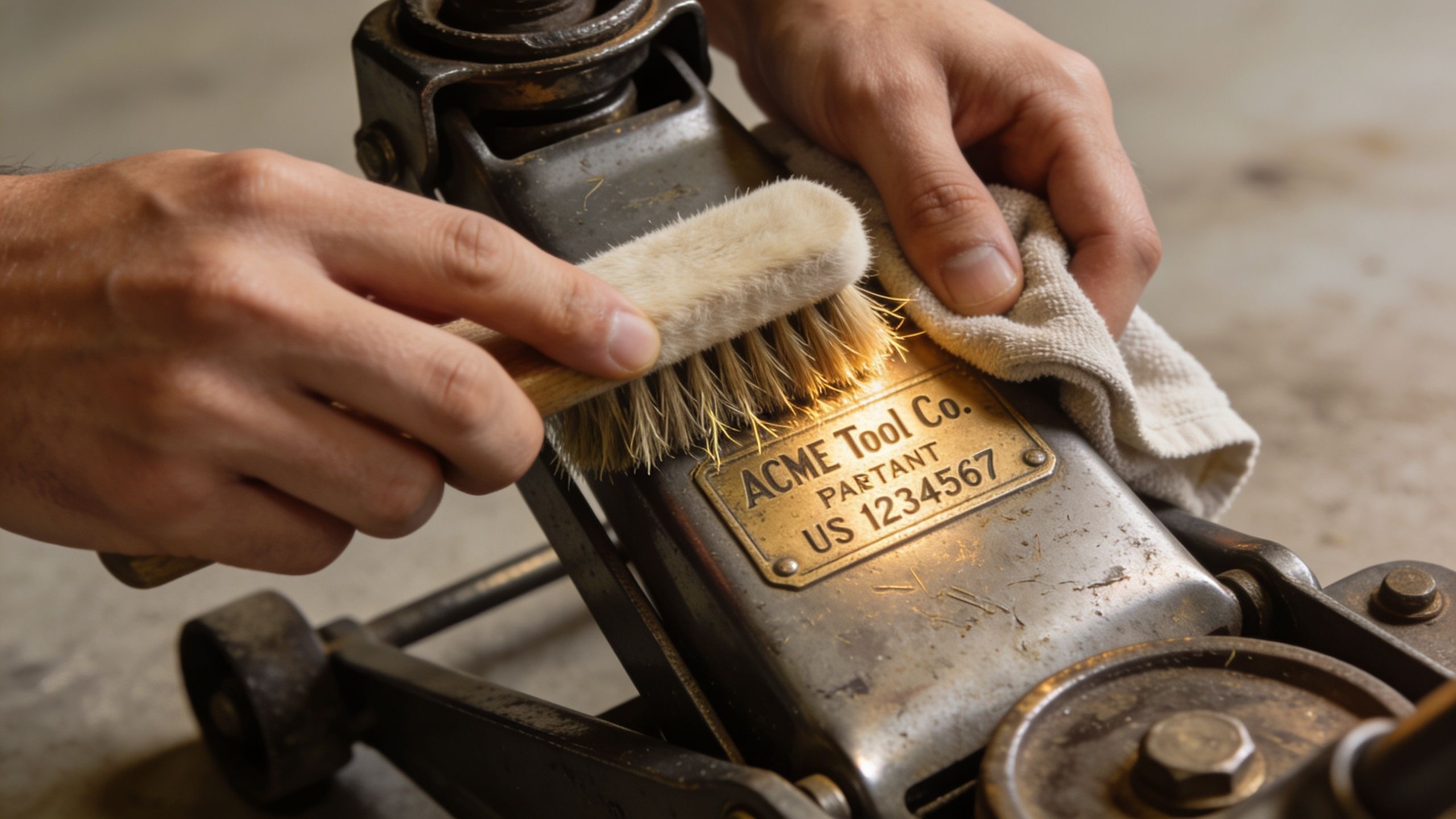
Start with dry wiping, a soft brush, and careful removal of loose dirt. Don't strip paint. Don't sand away oxidation. Don't polish the metal to make it “presentable.” Original finish, decals, and age patterns can support authenticity.
What works is controlled cleaning aimed at exposing marks. What hurts value is aggressive restoration before documentation.
Check these areas closely:
- Base and column: Many maker marks appear on the base plate, upright post, or side of the mechanism.
- Ratchet housing or screw body: Patent numbers and stamped model details often sit where the lifting mechanism is most visible.
- Handle socket and attachments: These areas can reveal whether the handle type is original to the jack or a later substitute.
Look for named makers and dated clues
The strongest first step is finding a brand or patent reference. The historical timeline helps. The Amesbury Carriage Museum's carriage jack history notes that David True patented a carriage jack in 1885, and Weaver produced its first “Auto Twin Jack” in 1910. The same source highlights the importance of known manufacturers such as Walker, Hein-Werner, and AUSCO.
A named maker doesn't prove vehicle application by itself, but it moves the jack out of the “generic tool” category.
Use this inspection sequence:
- Photograph it before further handling. Capture full views, base, lifting head, mechanism, and any stampings.
- Record every mark exactly as seen. Include abbreviations, partial letters, patent numbers, and casting numbers.
- Describe the jack type plainly. Screw jack, bumper jack, hydraulic jack, ratcheting post jack, or carriage-derived form.
- Compare dimensions to the vehicle's storage area. A jack that physically fits the factory trunk bracket or compartment is more persuasive than one that merely seems old.
A moving visual can help if you're unfamiliar with common forms and parts:
Separate identification from assumption
Owners often make two mistakes.
First, they assume the jack is original because it was in the trunk when they bought the car. Second, they assume a patent date is the manufacturing date. A patent date may only show the earliest protected design, not when that exact unit was made.
The best identification files include photos, measurements, exact markings, and a note explaining why the jack fits the vehicle, not just why it looks old.
If you can connect maker, design, wear pattern, and storage fit to the car, you're building evidence. If you can't, you may still have collectible value, but your case becomes weaker for insurance or concours-level claims.
How to Grade Your Jack's Condition Like an Appraiser
Once identification is established, condition becomes the next major driver of antique car jack value. This part has to be objective. “Nice for its age” is not an appraisal grade.
A practical collector framework treats condition as a mix of originality, completeness, legibility, and mechanical integrity. According to this appraisal framework for antique car jacks, an Excellent jack retains about 80% or more of its original finish, has legible maker marks, a straight post or screw, an intact pawl, and the correct handle. Good examples show honest wear. Fair and Poor/parts examples with heavy rust, pitting, missing parts, or frozen mechanisms drop sharply.
Use a four-grade system
| Grade | Key Characteristics |
|---|---|
| Excellent | About 80% or more original finish, legible marks, straight post or screw, intact pawl, correct handle, strong originality |
| Good | Honest wear and patina, readable marks, mechanism largely intact, handle present or replaceable, still credible as a collector piece |
| Fair | Heavy rust, pitting, replaced hardware, missing parts, weaker originality, discounted value |
| Poor or parts | Frozen mechanism, broken components, severe deterioration, mainly useful for parts, pattern reference, or low-end display |
What to inspect closely
Condition grading should focus on details that change both desirability and credibility.
- Original finish: Old paint, decals, and surface oxidation usually help more than a fresh repaint.
- Mechanism condition: Check whether the screw turns, the pawl engages, and the post is straight.
- Completeness: The correct handle matters. Missing or incorrect hardware lowers confidence fast.
- Mark legibility: If the maker mark or patent information can still be read, the jack is easier to authenticate.
- Restoration quality: Over-restored examples with bright powder coating or polished raw metal often lose appeal.
Original beats shiny
A common owner error is grading cosmetic freshness higher than originality. In this niche, that's backward. A jack with worn original paint and readable marks is often more valuable than one that has been blasted and refinished.
Appraiser's note: Don't confuse improvement with preservation. Cleaning for identification can help. Refinishing usually removes evidence.
Mechanical function still matters, especially when the jack is being valued as part of a complete toolkit rather than purely as shelf decor. But even a non-working jack can retain collector value if it remains original, correct for the car, and complete enough to document. By contrast, a heavily altered jack can lose appeal even if it looks better on a workbench.
Researching Comparables to Find a Realistic Value
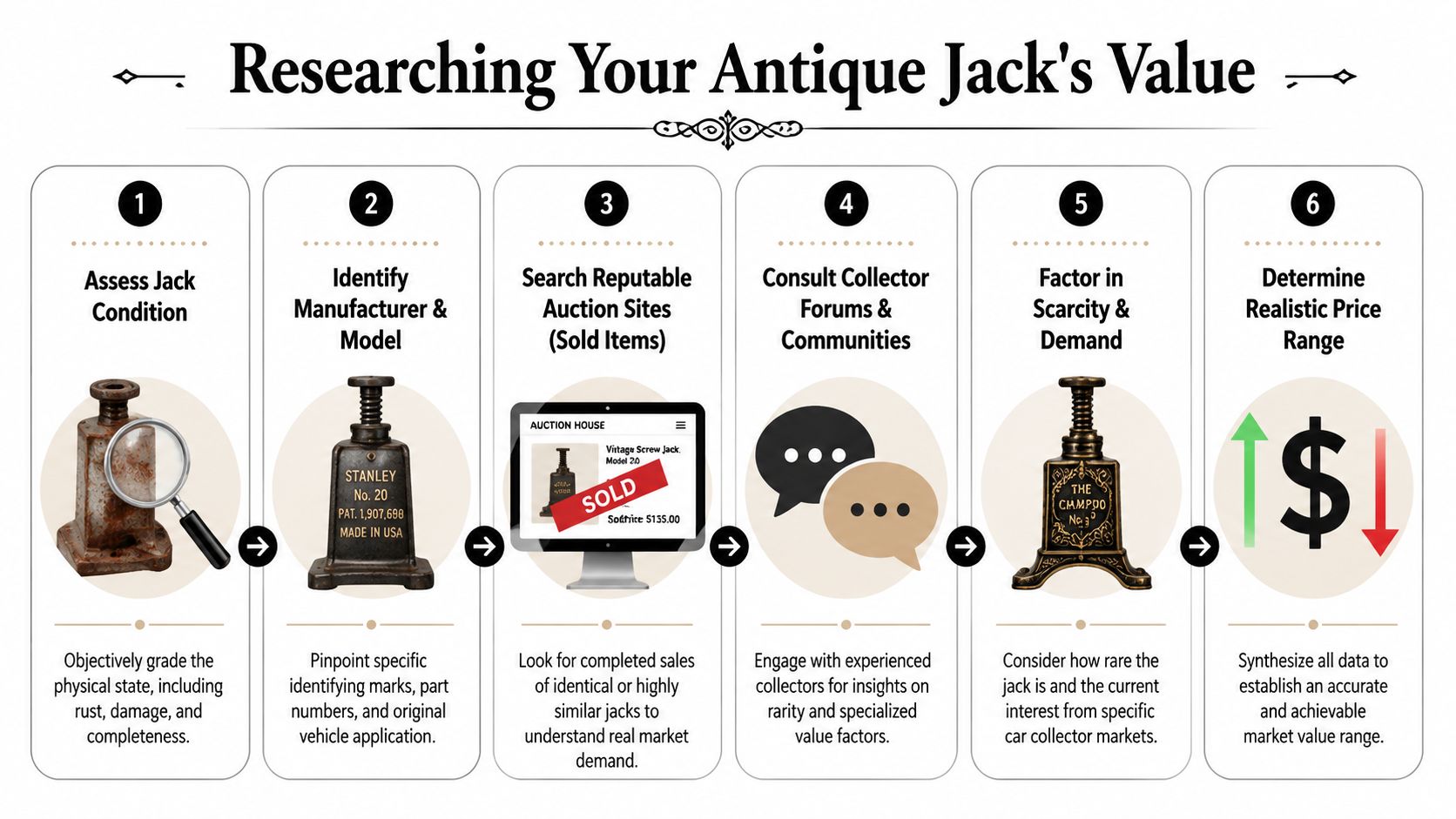
After identification and condition grading, the next job is building a realistic value range, not chasing the highest asking price you can find. For insurance and private sale purposes, asking prices are weak evidence unless they're supported by actual market behavior.
That's why comparables matter.
Match the comp to the actual jack
A good comparable should be close on all of the following:
- Maker
- Jack type
- Patent era or approximate production period
- Condition grade
- Completeness
- Vehicle application, if known
- Geographic market and selling channel
If your jack is a period-correct OEM bumper jack for a sought-after car, don't compare it to generic shop jacks. If it's an unmarked miscellaneous jack, don't use premium asking prices from highly curated dealer listings as your baseline.
Thin markets create bad conclusions
Low sales volume is one of the biggest traps in this category. A British vintage jack database reported just a single sale in 2024, with an average price paid of £12.41 for miscellaneous one-off jacks. That doesn't prove every obscure jack is worth very little. It proves that sparse data can distort value if the comp set is too thin.
That's why broad averages need context. One sale is not a market. It's a clue.
A defensible appraisal doesn't ask, “What's the highest number online?” It asks, “What did similar examples actually sell for, and how close are they to this one?”
Build a value range, not a single guess
Use sold listings, auction archives, collector discussions, and your physical evidence together. Then create a value range with a reason behind it. If you need a practical primer on how valuation standards work, this explanation of fair market value is useful background for claim situations.
A simple comp worksheet should include:
- Comparable identification with maker, type, and visible marks
- Sale format such as auction, dealer listing, or peer-to-peer marketplace
- Condition differences between the comp and your jack
- Adjustments for missing handle, repaint, weak markings, or stronger provenance
- Final range that reflects what a knowledgeable buyer would likely pay
What works and what doesn't
What works is using the closest available comp and adjusting carefully. What doesn't work is averaging unrelated jacks into a made-up midpoint.
If direct comps are scarce, narrow your claim. Instead of saying, “This jack is rare and valuable,” say, “This jack appears to be a named maker example with matching period characteristics, original finish, and evidence of correct application to this vehicle.” That language is disciplined, and disciplined language holds up better when someone challenges your number.
Documenting Your Findings for an Insurance Claim or Sale
If you can't show your work, your valuation won't carry much weight.
An insurance adjuster, buyer, or outside appraiser needs more than your conclusion. They need the evidence behind it. The strongest files I see are simple, visual, and organized. The weakest are verbal claims with no photos, no measurements, and no comparable support.
Build a one-page evidence summary
Your summary should include:
- Vehicle information: year, make, model, and why the jack matters to the toolkit
- Jack identification: type, maker, marks, patent references, and dimensions
- Condition grade: Excellent, Good, Fair, or Poor/parts, with a short explanation
- Completeness: handle, base, mechanism, decals, and storage fit
- Comparable support: sold examples or market references with notes
- Conclusion: a value range, not just a single unsupported number
This doesn't need to look fancy. It needs to be clear.
Photograph like you're proving a claim
Take full shots and tight close-ups in even light. Include scale where useful. Photograph every issue that could reduce value, not just the flattering angles. Credibility matters more than salesmanship.
A collector guide cited in this antique jack valuation workflow shows how details can shift value sharply. Bare or oxidized rods were associated with $500 to $700, gray rods with $200 to $300, and beige or cream with $70 to $80. The same guide places an early-1900s patent example in the $300 to $400 range, compared with $100 to $120 for a 1970s patent example. Whether or not your exact jack fits those tiers, the lesson is the same. Small physical details can materially affect price, so they must be documented.
If you need to understand what a formal valuation document is meant to do, this guide to what an appraisal for a car is gives the broader context.
Good documentation answers objections before the other side raises them.
Include the bad news too
If the handle is missing, say so. If the mechanism is frozen, say so. If the finish appears repainted, note that directly. Owners often weaken their position by hiding defects that will be obvious in person.
A clean file with honest negatives usually persuades better than an inflated pitch. That's especially true when the jack is being valued as one component of a larger collector vehicle claim.
When to Hire a Certified Appraiser
Some jack valuations can be handled with careful owner research. Some can't.
If the jack is part of a routine private sale and both parties understand the market, your own documentation may be enough to support a reasonable number. But if the toolkit is tied to a high-value classic, a total loss claim, or a disputed authenticity issue, a certified appraiser often becomes necessary.
Situations that justify professional help
Hire an appraiser when any of these apply:
- The insurer disputes the toolkit value. This is common when the jack is treated as incidental rather than collectible.
- The vehicle is rare or highly original. Correct accessories matter more when originality drives the whole vehicle's value.
- The market evidence is thin. Sparse comps require stronger interpretation and better reporting.
- The toolkit affects the car's broader valuation. In some cases, the jack matters because it supports a complete, period-correct presentation.
- You need a report that can withstand negotiation. A professional report usually presents evidence in a form insurers and buyers take more seriously.
What a certified appraiser adds
A qualified appraiser doesn't just estimate. They identify, compare, document, and explain. That matters when the dispute isn't really about the jack alone, but about whether the vehicle should be valued as an ordinary old car or as a documented collector example with correct accompanying equipment.
If you're in that position, working with classic auto appraisers can help move the discussion from opinion to evidence.
The right time to hire one is before you accept a weak settlement, not after.
If you're dealing with a total loss, diminished value dispute, or an insurer who's overlooking the true value of a classic vehicle and its original equipment, Total Loss Northwest helps owners document and defend what they're genuinely owed. Their certified independent appraisals focus on real market evidence, not insurance software shortcuts, and they work with classic, high-value, and everyday vehicles across Oregon and Washington.