You're standing in the driveway after the tow truck leaves, looking at a repaired car that still doesn't feel right. The body shop says the work is done, the insurer says the file is closed, and your gut says the settlement missed something important. That gap is where appraiser qualifications matter, because the person who writes the report can either expose the loss clearly or hand the insurer an easy excuse to ignore it.
A weak report costs money in the quietest possible way. It sounds professional, arrives fast, and still fails the first serious pushback from an adjuster who knows the difference between a credential and actual claim-specific competence. The question isn't whether you can find someone with letters after their name. It's whether those letters line up with your vehicle, your loss type, and the fight you're about to have.
Why Appraiser Qualifications Matter After an Accident
A not-at-fault driver usually doesn't need a lesson in valuation theory. They need a number that stands up when the insurer starts trimming it. That's why the person you hire matters as much as the damage itself.
A car can be repaired correctly and still be worth less afterward. The core dispute is not whether the vehicle was fixed, it's how much market value the accident permanently took away. A bare-bones report often gives the carrier exactly what it wants, a reason to say the loss is unproven. A defensible appraisal gives the driver something better, a documented valuation the insurer has to answer.
Practical rule: If the appraiser can't explain the methodology in plain English, they probably can't defend it when the file gets challenged.
An insurer's adjuster is not your counterparty. That person is paid to manage the claim inside the company's rules, not to maximize your recovery. An independent appraiser should do the opposite, build a report that tests the insurer's position with market evidence, repair context, and a clear conclusion. For a plain explanation of how an appraisal fits into a vehicle claim, see what an appraisal for a car actually does.
The cheapest report is usually the most expensive mistake. Fast turnaround can be useful, but not when it means the appraiser skipped market support, ignored condition details, or leaned on a generic template. The goal is not paperwork. The goal is a strong negotiation tool.
The Formal Qualification Framework Most Appraisers Work Under
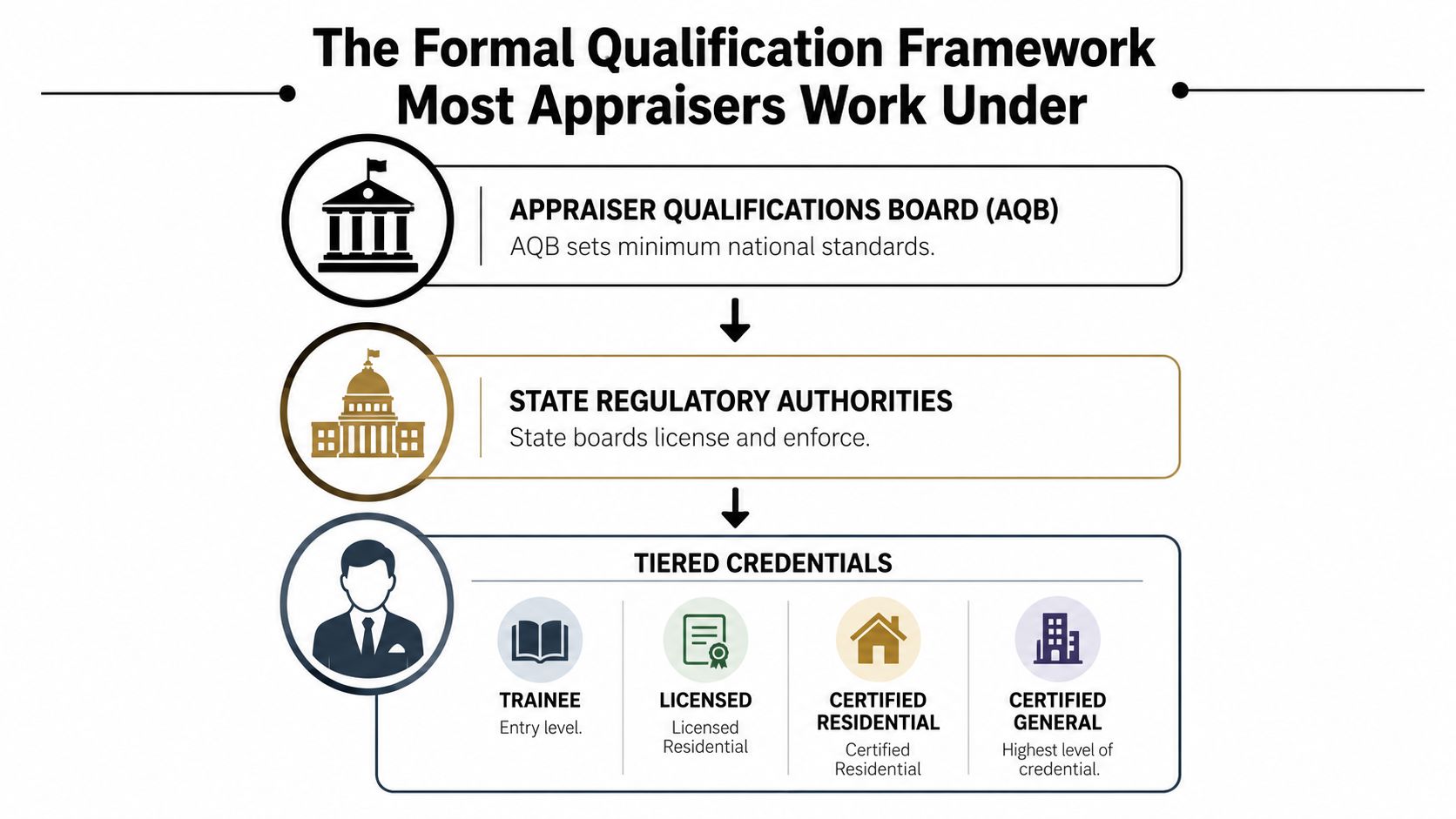
A claim file can fall apart fast when the person signing the report does not have the right training for the job. The U.S. appraisal system is built around a floor, not a shortcut. The Appraisal Subcommittee says the Appraiser Qualifications Board sets minimum education, experience, and exam requirements under FIRREA, and the bachelor's degree requirement for Certified appraisers took effect in 2015. That structure exists because the system is supposed to separate casual opinion from documented competence, not let someone self-declare expertise. State regulators then enforce the rules in practice, which is where the gatekeeping happens. The Appraisal Subcommittee's description of the qualification framework makes that hierarchy plain.
What the ladder actually looks like
At the bottom, a trainee learns under supervision. Above that, the state tiers build in more education, more documented work, and more testing. Michigan's licensing page shows how concrete the bar can be, 200 hours of pre-licensure education, 1,500 hours of documentable experience in at least 12 months, plus continuing education. California's certified residential path also requires a bachelor's degree or approved alternatives, 200 hours of qualifying education, and the 15-hour USPAP course. Those are not vibes. They are audited thresholds.
The Appraisal Foundation's published criteria for a Certified Residential appraiser are even more specific, 200 hours of qualifying education, 2,500 hours of experience over no fewer than 24 months, a minimum of an associate's degree or equivalent coursework, the National Uniform Licensing and Certification Examination, and 14 hours of continuing education each year after credentialing. That is the standard most consumers never check, and it is exactly why weak reports slip through. If you need a practical example of how those credentials should translate into claim work, a certified auto appraiser should be able to explain the gap between paper qualifications and property-specific competence without hand-waving.
Bottom line: a credential is a regulated starting point, not proof that the appraiser is right for your specific loss.
The market still rewards this profession because it is structured, not casual. The U.S. Bureau of Labor Statistics reports a median annual wage of $65,420 in May 2024, with employment projected to grow 4% from 2024 to 2034. That doesn't make every appraiser good. It does show the field is formal enough to attract ongoing demand and oversight. The BLS wage and outlook figures help explain why. For another useful reference point, MyMentions license terms spell out how licensing language is framed in practice.
License Tiers and What Each One Actually Authorizes
The biggest mistake consumers make is assuming a higher-sounding title automatically means a better fit. It doesn't. License tier controls scope, not universal skill. If your claim is a vehicle loss, a credential that fits a residential house may not be the credential that best handles your file.
Compare the tiers against the work they can actually support
| Tier | Education | Experience | Authorized Scope |
|---|---|---|---|
| Trainee | Introductory qualifying education | Supervised learning | Assisted assignments only |
| Licensed Residential | State-approved entry requirements | Documented supervised work | Lower-complexity residential valuation |
| Certified Residential | 200 hours qualifying education, degree or equivalent coursework | 2,500 hours over 24 months | Residential assignments within credential scope |
| Certified General | Higher coursework, often 300 hours in state frameworks | 3,000 hours over at least 18 months | Broader, including non-residential work |
The Certified General tier matters because it shows breadth, not just volume. Maryland requires 300 hours of approved coursework, a bachelor's degree or higher, and 3,000 hours of appraisal work over at least 18 months, including 1,500 hours in non-residential appraisal. Colorado likewise requires 3,000 hours in no fewer than 18 months for the higher tier, and federal qualified-appraiser rules require a current Certified General Appraiser license, good standing, and USPAP compliance for the property type being valued. Maryland's qualification requirements show how deep the ladder gets at the top.
That matters because scope is the whole game. A higher tier usually means more technical breadth, but it still doesn't guarantee the right experience for a niche assignment. A residential specialist can be perfectly competent on homes and still be a poor choice for a complex, nonstandard vehicle loss. A general credential can help, but only if the appraiser has the actual claim-relevant experience to back it up.
If you're comparing license terms and title language across firms, MyMentions' license terms reference is useful for understanding how businesses describe their permissions and obligations. It won't tell you whether the report is good. It will help you read the fine print with less confusion.
For vehicle claims specifically, a general background on certified auto appraiser language can help you separate marketing from substance. Titles are cheap. Scope is what counts.
Translating Real Estate Credentials to Auto Appraisal
A real estate appraisal background can help in auto appraisal, but only up to a point. The trap is treating a valuation credential as proof of vehicle competence. Someone can understand appraisal theory and still miss the facts that drive a diminished value or total loss file.
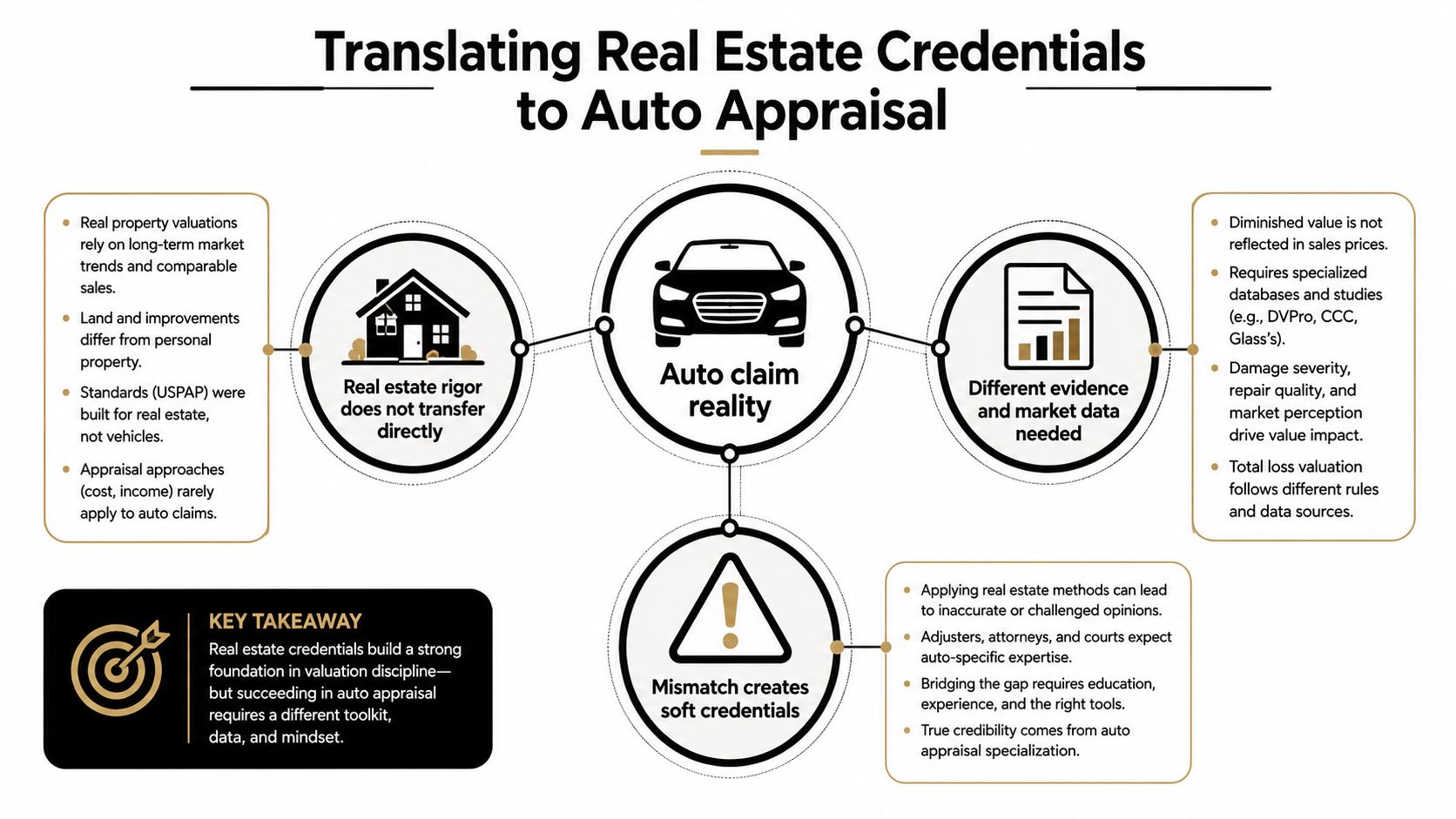
A house and a car live in different markets. They draw on different evidence, different buyer behavior, and different claim pressure. A real estate credential shows that someone learned a formal valuation system. It does not prove they understand collision repair, structural replacement, trim-package pricing, or how those details affect resale on a specific vehicle. That is why the badge alone tells you very little.
What transfers and what doesn't
The part that does transfer is discipline. A competent appraiser knows how to document a conclusion, reconcile evidence, and avoid hand-waving. That matters. The evidence set changes the moment the subject is a vehicle, though. Comparable sales, mileage, options, accident history, repair quality, and market response carry the weight, not the language of a residential report.
A strong auto appraiser borrows the discipline of real estate valuation, then applies it to vehicle-specific market reality.
Consumers get burned in the gap between those two skill sets. A report can look polished and still be soft if the writer does not understand the vehicle segment, the repair profile, or the resale dynamics that affect loss. That problem shows up fast on diminished value claims and total losses, where insurers look for any sign that the appraiser used the wrong framework. A title from another field does not fix that mistake.
Recent policy direction points the same way. Maryland's 2026 criteria include recurring valuation-bias training every two years, which shows regulators are treating judgment and fairness as part of qualification, not just hours and exams. Good appraisers do more than count evidence. They keep bias out of the conclusion.
How to Verify an Appraiser's Credentials Before You Hire
Start with the state board. Don't take a website bio at face value. A license lookup should confirm the credential tier, expiration date, and any disciplinary history. If the person won't give you a state where they're licensed, walk away.
Then ask whether they're in good standing with the regulator and whether they work under USPAP standards for the assignment type. If they dodge that question, you're not dealing with a serious professional. You're dealing with a marketing page.
A quick vetting workflow
- Check the state license record: Confirm the tier, status, and any discipline.
- Ask for a redacted sample report: Read the reasoning, not just the conclusion.
- Verify E&O insurance: If they can't show it, don't assume it exists.
- Ask about testimony: Appraisers who defend their work under oath tend to write sturdier reports.
A sample report tells you more than a logo ever will. You can see whether the appraiser explains methodology, identifies the subject properly, and ties the number to evidence instead of filler. If the report reads like a form letter, the credential is probably doing the heavy lifting for them.
Professional memberships can help, but only if they're backed by real work. Membership alone doesn't prove competence. Appraisal Clause experience matters far more, because an appraiser who has defended a report in a dispute knows the difference between a report that sounds credible and a report that survives pressure.
If you're searching for a specialist, a page like independent auto appraiser near me can help you frame the right questions before you make the call. Use it as a starting point, not as a substitute for verification.
Red Flags That Disqualify an Appraiser No Matter the Letters
A long string of letters can hide a weak practice. I've seen it too many times. The certificate looks impressive, the website is glossy, and the report falls apart the moment the insurer asks for support.
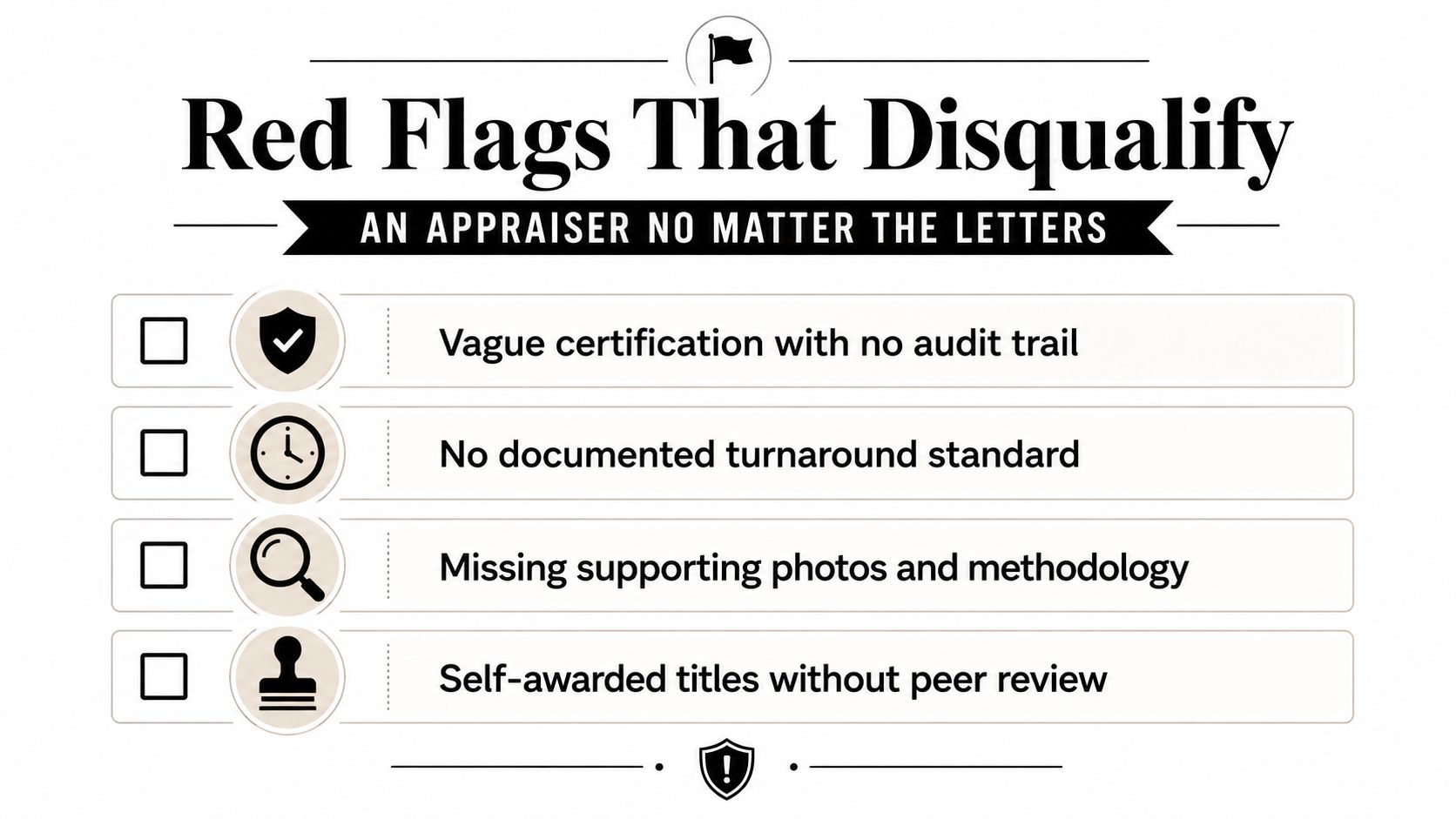
The first warning sign is a vague certification with no audit trail. If the designation comes from a body nobody can clearly verify, treat it as decoration. The second is no documented turnaround standard. Complex claims do not get better because someone rushed them. The third is missing supporting photos and methodology, which usually means the appraiser is asking you to trust the conclusion without seeing the work. The fourth is self-awarded titles without peer review.
What usually gives the game away
- Vague certification with no audit trail: If the issuer can't be checked, the title is marketing.
- No documented turnaround standard: Speed without substance is a liability.
- Missing supporting photos and methodology: That's not an appraisal, it's a guess in a formal font.
- Self-awarded titles without peer review: If nobody else can challenge the work, the title means little.
Refusal to provide references from prior diminished value clients is another hard stop. So is any appraiser who won't explain whether they've testified or defended the report in a contested file. If they've never had to answer hard questions, they may not know how fragile their process is.
Rule of thumb: If the appraiser sells confidence harder than evidence, keep looking.
The embedded video below is worth your time if you want to see how weak valuation language gets exposed in practice.
What a Defensible Appraisal Report Should Include
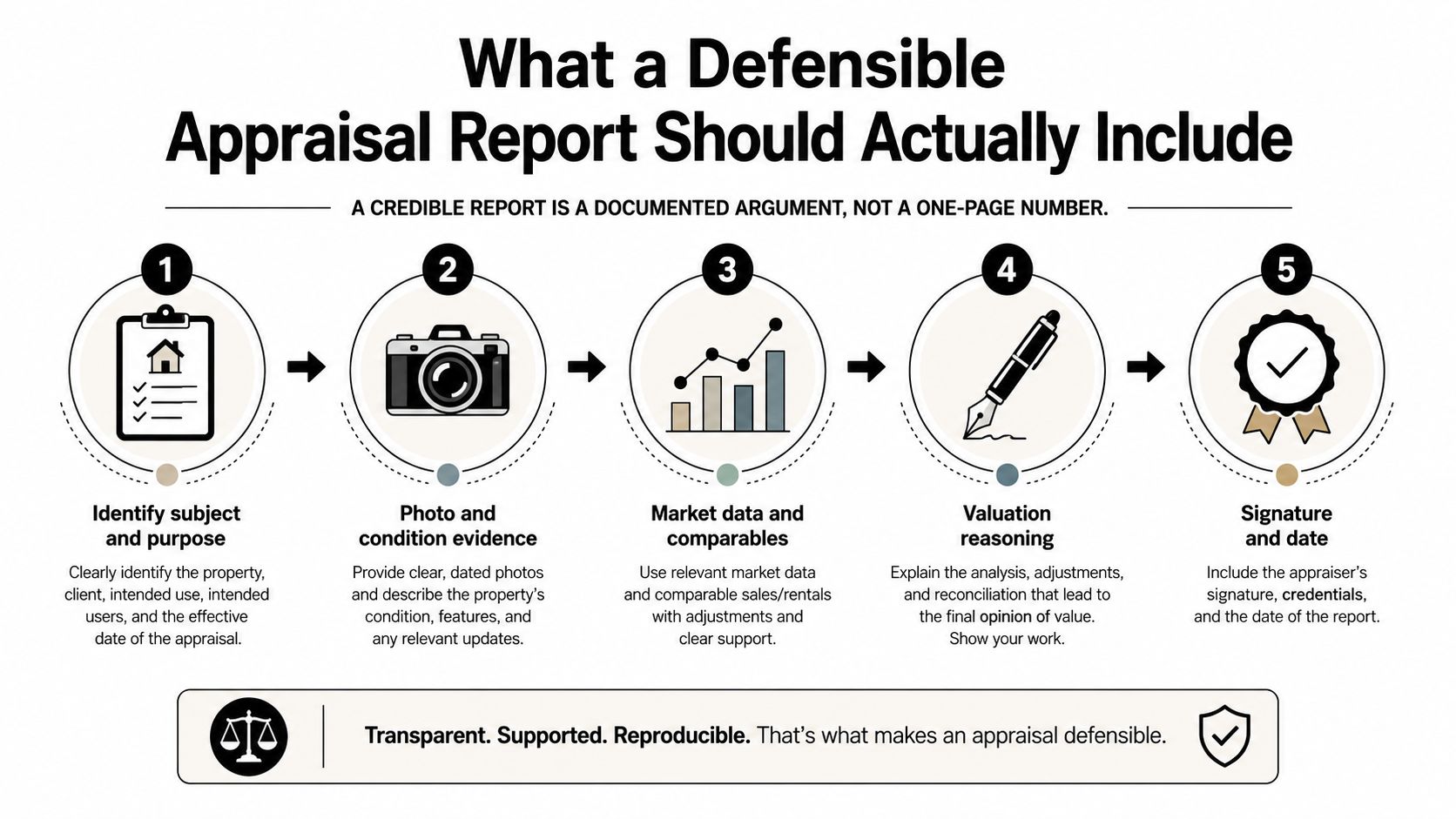
A strong report starts with proof, not with a conclusion. If the number stands alone, it is a guess dressed up as an opinion. A defensible appraisal shows the trail from inspection to final value, so the insurer has to answer the evidence instead of brushing the file off as a soft estimate.
The parts that should never be missing
| Component | What it should show |
|---|---|
| Subject and purpose | Exactly what was appraised and why |
| Photos and condition | Timestamped visual evidence of condition and damage |
| Market data and comparables | Actual real-world vehicles or losses used for support |
| Valuation reasoning | How the conclusion was built from the evidence |
| Signature and date | Accountability for the final opinion |
For diminished value, the report should state the method used, explain why the selected comparables fit the subject, and deal with the insurer's likely objections before they show up. For total loss, the report should line up condition, options, and local market behavior against the insurer's settlement number. If you need to verify what changed before and after the loss, use find vehicle damage details before the claim discussion starts.
A credible report reads like a documented argument. It does not read like a one-page number. If the appraiser cannot show how the conclusion was reached, the report is too thin to trust. If the photos do not match the narrative, the narrative loses force. If the methodology section is vague, the insurer will use that weakness immediately.
Good reports make the logic easy to follow. Weak reports hide behind jargon. You do not want jargon. You want a file an adjuster cannot dismiss without explaining why.
If you are still screening local candidates, start with independent auto appraiser near me and judge the report quality before you judge the price.
Choosing the Right Appraiser for Your Specific Claim
Start with fit, not branding. Pick the appraiser whose credentials match the asset, whose experience matches the claim type, and whose work can survive a dispute. Anything less is a gamble with your settlement.
Your shortlist should be small and ruthless. Verify each person on the state board, ask for a sample report, ask whether they've defended reports in the Appraisal Clause process, and compare the depth of methodology. Price matters, but only after the appraiser proves they know how to build a report the insurer can't casually dismiss.
If you're still searching locally, independent auto appraiser near me is the right phrase to use, but it's not the end of the vetting process. The true test is whether the appraiser understands your vehicle, your loss, and the arguments the insurer is likely to make.
Best choice: the appraiser who can connect credentials to claim-specific proof, not the one with the flashiest title.
Total Loss Northwest helps drivers who need a serious appraisal, not a soft opinion dressed up as one. If your claim involves diminished value or a total loss dispute, visit Total Loss Northwest and compare your situation against a report built to hold up in negotiation.