You just got the call or the email no driver wants, the insurer's number is lower than expected, and the first instinct is to argue from memory. That usually goes nowhere. A defensible auto appraisal online gives you something better than frustration, it gives you a report built from market evidence, vehicle details, and a valuation method the other side has to read carefully.
For claims involving total loss, diminished value, collector cars, or heavily repaired vehicles, the difference between a quick estimator and a certified appraisal can decide the settlement. Online appraisal tools and software are being used more widely across the valuation process, which is one reason insurers, dealers, lenders, and owners rely more on standardized records when a claim needs support. That shift matters because the report has to stand up to questions, not just produce a number on a screen.
Beyond the Instant Estimator Why You Need a Certified Appraisal
A low offer often arrives after the vehicle has already been inspected, the claim file is open, and the adjuster has presented a number that feels final. At that point, many owners reach for free estimators, dealer opinions, or a rough sense of what the car “ought” to be worth. That approach rarely holds up in a dispute, because a quick estimate is not built to carry the burden of an insurance claim.
Consumer-facing tools are useful for a rough benchmark, but they are still guide-based. They can miss the full weight of condition, reconditioning assumptions, local demand, or post-loss damage details. A certified appraisal is a different product entirely. It is built to document the vehicle in a way that supports a claim file, not just to generate a number for curiosity.
What the insurer is counting on
Most insurers expect the average owner to stop at the first number that looks official. They know a free estimator can feel persuasive, even when it has not inspected the car and does not know the claim context. A certified report interrupts that pattern by documenting the vehicle, the valuation purpose, and the comparable market evidence in a way that can be submitted, reviewed, and challenged line by line.
A dispute is not won by saying the insurer is wrong. It is won by showing why the number does not fit the car, the market, or the claim file.
If the car is involved in a total-loss or post-accident valuation fight, a certified report gives you a structured basis for reconsideration. A practical starting point is Total Loss Northwest's certified auto appraiser page, which shows the kind of claim-focused service that is meant to support a dispute rather than casual pricing.
Why certified matters more than “instant”
The word certified matters because it signals a report designed for use beyond curiosity. Online tools often give a number. A certified appraisal gives a purpose, supporting evidence, and the kind of documentation that can survive an insurance review. That distinction matters when the settlement is supposed to reflect fair market value, not a broad estimate presented as convenience.
The process also changes the question you ask. Instead of asking, “What is the car worth today?” you are asking, “What can I prove the car was worth, given its condition, history, and market?” That is the better question when money is on the line, and it is why a certified appraisal is often the stronger path when the insurer's offer misses the mark.
If the claim file includes foreign-language records, repair documents, or ownership paperwork that needs to be read accurately, official document translation from Translators USA can help keep the supporting paperwork clear and usable.
Preparing for Your Online Appraisal A Complete Checklist
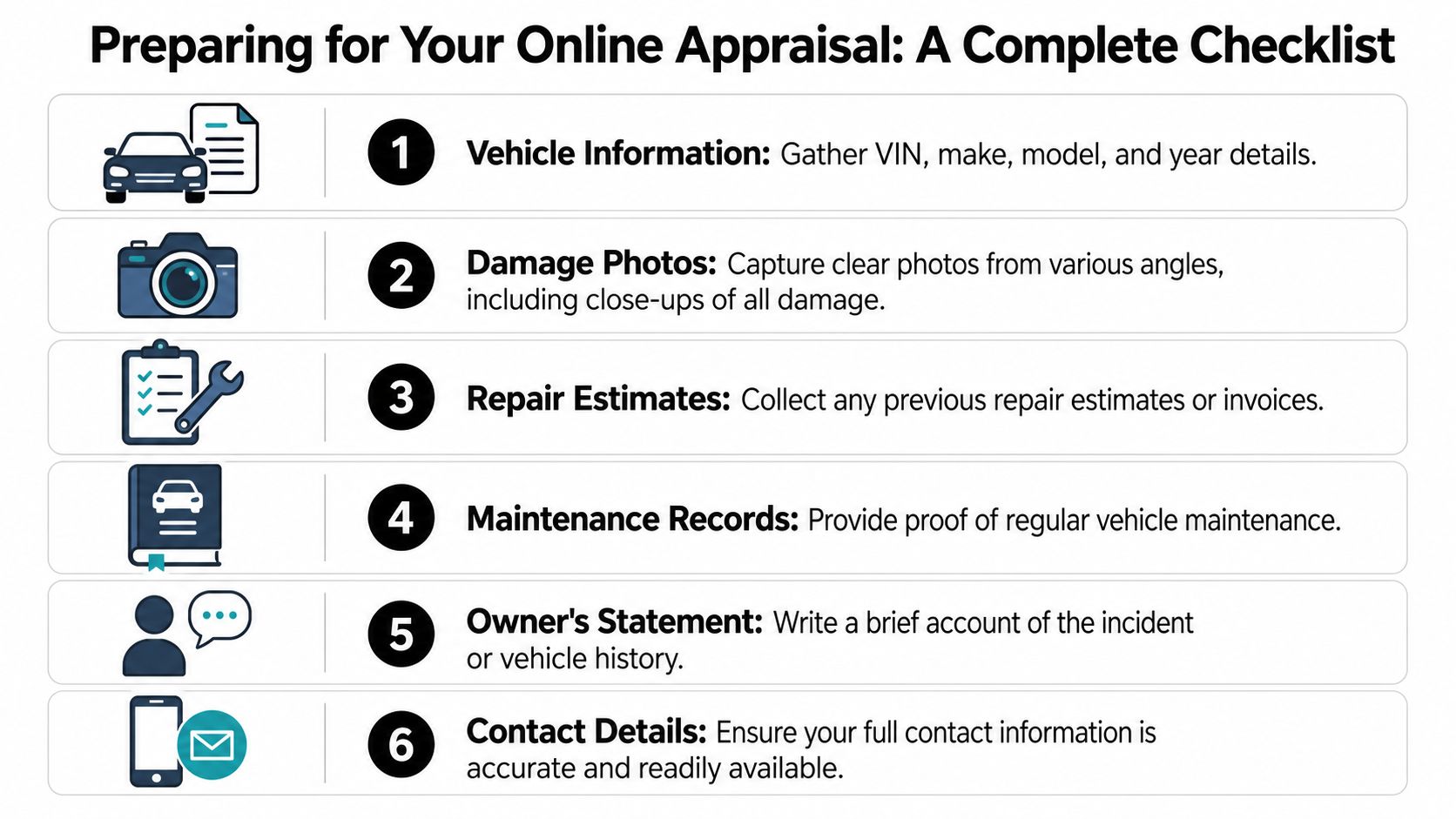
A strong appraisal starts before you upload anything. If the packet is thin, the appraiser has to spend time chasing basic facts instead of analyzing the value drivers that matter in a claim. That weakens the report, especially when the vehicle is a total loss, has accident history, or carries equipment the standard databases don't capture well.
Gather the claim file first
Start with the documents that show what happened and what the insurer already knows. You want the police report if there was one, the insurer's estimate, repair invoices, and the title or registration. If there are supplements or prior repair estimates, include those too. For specialty and post-loss vehicles, the valuation burden often shifts to the owner, so accident history, service records, aftermarket additions, and title status need to be documented clearly, as emphasized in guidance on instant car appraisal for fast vehicle valuation.
Then organize the file by relevance, not by whatever order the papers were dropped into the glove box.
- Claim paperwork: insurer estimate, claim number, correspondence, and any supplement requests.
- Identity records: title, registration, and a clear VIN record.
- Repair history: invoices, estimates, and post-loss repair notes.
- Ownership evidence: service records, accessory receipts, and modification records.
- Incident details: police report, photos from the scene if you have them, and your written summary.
Take the photos that prove condition
A good photo set does more than show damage. It shows context. Capture all four corners, straight-on front and rear views, close-ups of every damaged area, the VIN plate, the odometer, the interior, and any add-ons or custom work. If the car has airbag deployment, prior bodywork, uneven tire wear, corrosion, or mismatched panels, those details should be visible, because they affect value and can explain why a simple estimator missed the mark.
Practical rule: if a photo helps explain value, include it. If it only repeats what another photo already shows, leave it out.
For specialty cases, title status and evidence of upgrades matter just as much as the damage itself. Generic tools often miss rarity, modifications, or prior loss history, which is why documentation has to do some of the work the software can't.
Add the notes an appraiser can actually use
A short owner statement helps more than people expect. Write down when the loss happened, what was repaired, what was not repaired, and anything unusual about the vehicle. If you have recent maintenance, note that too. The goal is to make the file easy to verify, because a clean packet supports a cleaner report.
This is also where translation or official paperwork support can matter if your claim file includes documents in another language or must be presented formally. A useful reference for that kind of document handling is official document translation from Translators USA. A well-prepared packet saves time, reduces back-and-forth, and gives the appraiser enough evidence to build a report that feels anchored, not speculative.
How the Certified Online Appraisal Process Works
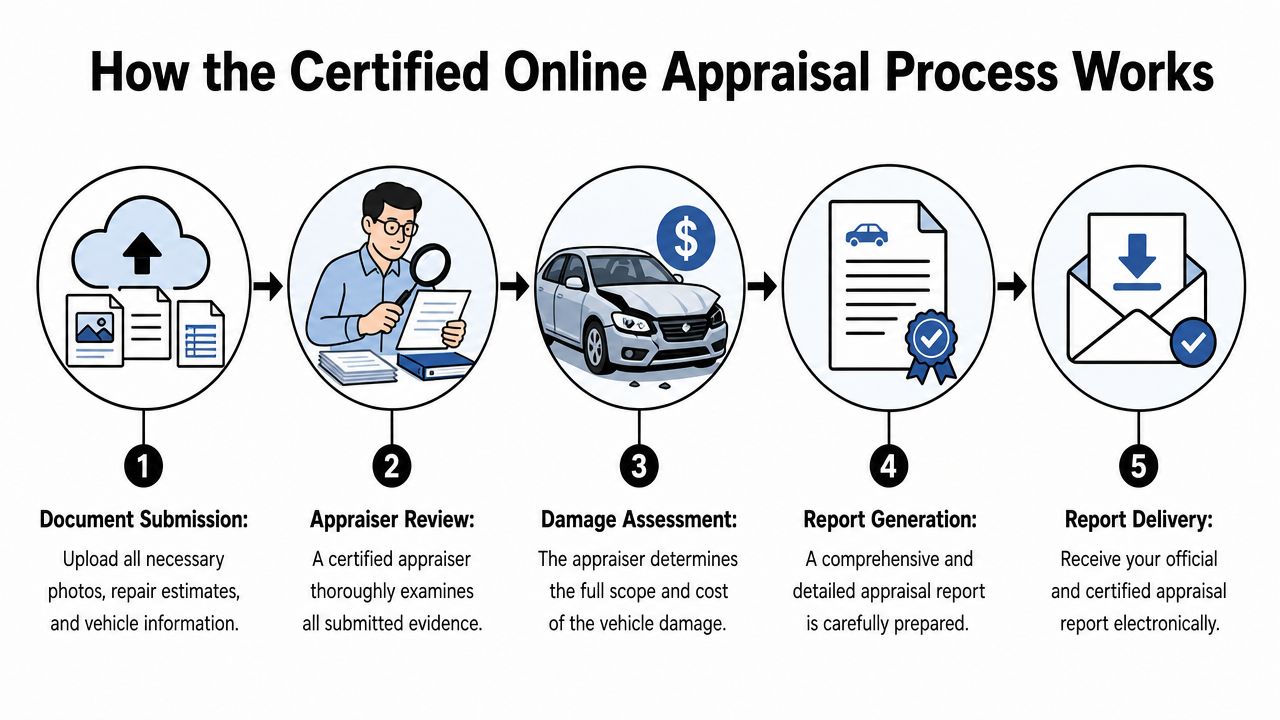
Once the file is complete, the work shifts from gathering to analysis. A certified auto appraisal online should not feel like an instant calculator with a nicer logo. It should feel like a structured review where the appraiser tests the numbers against the vehicle and the market before a report is issued.
Submission and review come first
You upload the documents, photos, and vehicle details. The appraiser then checks whether the file is complete enough to support an opinion of value. That early review is where missing mileage photos, unclear damage shots, or incomplete repair records get flagged.
The better the packet, the less time gets wasted correcting obvious gaps. For online vehicle appraisal, the workflow described by iDrive Certified's appraisal method guide uses 3–5 comparable vehicle sales matched on year, trim, mileage, and regional market, with adjustments for factors like color and options. That comp-based structure is the core of a defensible valuation.
Research is the real value
A certified appraiser doesn't rely on one guidebook or one dealer website. The strongest results come from cross-checking guidebooks, dealer listings, auction data, and transaction evidence so a single odd listing doesn't distort the result. That is the part free tools can't do well, because they usually return a broad estimate rather than a documented analysis.
The comparative analysis stage in the cited workflow typically takes 1–3 days. That timing is useful to know because it sets expectations. A serious report takes time, not seconds, and that delay is usually the sign that the numbers are being checked rather than guessed.
The report should read like evidence, not advertising
A solid appraisal report needs a full vehicle description, the appraisal purpose, the valuation method, the inspection and valuation dates, the appraiser's qualifications, and a signature. Those elements matter because they show when the vehicle was evaluated, why the valuation exists, and who is standing behind it.
If you need another example of an appraisal process built for claim handling, Total Loss Northwest's auto insurance appraisal page is relevant. It reflects the kind of claim-centered workflow that's different from a consumer value widget.
The best reports also explain the adjustments. If mileage, trim, condition, regional demand, or damage history moved the number, that should be visible in the report itself. When the insurer reads the file, there should be no mystery about how the value was reached, only a dispute over whether the market evidence was properly weighed.
Vetting Your Appraiser Credentials Timelines and Costs
A low quote can become the most expensive choice in the file, because an insurer can dismiss a thin appraisal as unsupported or irrelevant to the claim. The goal is not to find the cheapest option. It is to buy a report that another professional has to take seriously.

Credentials matter more than slogans
Look for an appraiser who can explain their process plainly, show claim experience, and produce a report that fits the purpose. A good fit for a diminished-value or total-loss dispute is someone who understands how insurers evaluate loss files, not just someone who can estimate resale price. Experience with custom, modified, collector, or post-loss vehicles matters too, because those cases need more than a generic market pull.
A report should include the vehicle description, valuation method, purpose, inspection and valuation dates, the appraiser's qualifications, and signature. That requirement sounds simple, but it separates a formal appraisal from a casual opinion. If the report is missing these basics, it is easier for the insurer to push back.
When comparing car appraisal companies, ask what kind of claims they handle and how they document comparable sales. A provider that only talks about general values may be fine for curiosity, but not for a file that may be reviewed by an adjuster, an attorney, or an umpire.
Cost reflects the depth of the work
Independent appraisal guidance notes that complex situations often cost about $250–$750, with higher fees for custom or modified vehicles that need deeper documentation, according to AutoAppraisal.com's overview of the car appraisal process. That range makes sense because a real appraisal is not just a database lookup. It includes inspection review, evidence evaluation, and reporting that can stand up under negotiation or litigation pressure.
If the fee sounds too low to cover market research, documentation, and a defensible report, it probably is.
A stripped-down quote can be fine for curiosity. It is not fine when the file may be reviewed by an adjuster, an attorney, or an umpire.
Use the right kind of provider
Some drivers only need a market reference. Others need a formal report that stands up in a claim. Total Loss Northwest fits that second use case because it focuses on diminished value and total-loss appraisal support rather than casual resale estimates. If you are comparing providers, ask what the report contains, how they handle comparable sales, and whether the output is designed for claim submission.
A quality appraiser will answer direct questions without hiding behind jargon:
- What evidence do you use? You want market comps, not vague “industry data.”
- What does the report include? It should list dates, method, purpose, and vehicle specifics.
- How do you handle modified or post-loss cars? The answer should address documentation, not guesswork.
- What happens if the insurer questions it? A serious appraiser should be able to explain the report again, clearly.
That vetting step protects you from buying a report that looks official but does not move the claim forward.
Using Your Appraisal to Win Your Insurance Claim
The report matters most once you put it to work. An appraiser's number by itself will not force an insurer to change course, but a documented submission can move the discussion from opinion to evidence. That is why the way you deliver it, and the language you use around it, matter as much as the report itself.

Submit it like a claim exhibit
Send the appraisal to the adjuster with a short cover note that lists the claim number, the vehicle, and the reason for submission. Keep the tone professional and firm. You do not need a long argument in the email, just a clear request for reconsideration based on a certified appraisal and the supporting documentation in the file.
Use the report to show the mismatch, not to vent about the process. If the insurer's estimate missed condition details, recent repairs, or market comps, point to those sections in the appraisal packet and ask for a written response. When value is disputed, clarity beats outrage every time.
Know where the Appraisal Clause fits
Many policies include an Appraisal Clause, sometimes called a Right to Appraisal, which lets each side hire an appraiser and then choose a neutral umpire if they disagree. That process matters because it keeps the dispute from sitting inside the insurer's internal estimate review. The clause is not a magic switch, but it gives you a formal path for a structured review.
If you need practical background on the claims side of the process, the car repair insurance guide from Carmedics Autowerks Inc. is a useful companion reference. It helps frame how repair and claim discussions often move once the insurer has a documented position to answer.
The market context also supports the move toward formal valuation records. As noted earlier, the automotive appraisal and inventory management software market reflects how much insurance and claim work depends on standardized valuation records rather than casual opinion.
Push the claim the right way
A clean submission usually includes the appraisal, the photos, the supporting repair paperwork, and a concise explanation of why the original offer misses the mark. If the insurer refuses to move, the next step is usually to invoke the policy's appraisal process rather than argue by phone. That puts both sides on notice that the disagreement is now evidence-based.
Expect pushback. Adjusters may respond with a revised number, ask for more documentation, or insist their valuation is still reasonable. That is normal. A certified appraisal strengthens your position because it changes the question from whether the offer feels fair to which valuation method and market evidence will hold up under review.
Keep the file organized
Save every version of the report, every claim email, and every response from the insurer. If the process moves into an umpire stage or counsel gets involved, a clean record prevents avoidable confusion. A strong appraisal gets stronger when the paper trail around it is just as solid.
Common Questions About Online Auto Appraisals
Drivers usually ask the same questions after they see an insurer's number and start comparing it with other value estimates. A generic estimator can still be useful as a rough reference, but it should not be treated as the final word when the claim is large, the vehicle is unusual, or condition details can change the settlement.
What if the car is modified or a classic
Use a certified appraisal instead of a broad online estimator. Specialty vehicles need documentation for upgrades, originality, prior damage, service history, and title status, because generic tools often miss the features that add value or reduce it. If the car has restoration work, aftermarket parts, or collector significance, the owner has to provide evidence the tool cannot infer on its own.
Can you get an appraisal before repairs are done
Yes, and in many claim situations that is the smarter move. A pre-repair or post-loss appraisal can document condition before work changes the vehicle's appearance, structure, or parts inventory. That matters when the dispute is about loss value rather than the cost of a repair ticket.
What if the insurer rejects the report
Start by asking what part they object to. The issue may be the comparable sales, the condition assessment, the purpose of the report, or the qualifications of the appraiser. Once you know that, you can tell whether the problem is technical, procedural, or a disagreement over market evidence.
If the response does not close the gap, the Appraisal Clause may be the next move. Consumer valuation tools can be inaccurate because they rely on broad assumptions about condition and reconditioning costs, while real-world offers can shift based on the specific factors a detailed appraisal captures, as noted by Consumer Reports.
Is the online process good enough for every claim
No. It works well for a documented, evidence-based dispute, but not every situation needs the same level of formality. If the car is mainstream and the question is simple resale value, a quick estimate may be enough. If the settlement could change materially based on condition, history, or loss type, a certified report is the safer move.
For drivers dealing with a low total-loss offer or a diminished-value dispute, send the claim file, photos, and vehicle details to Total Loss Northwest so you can get a certified appraisal built for the insurance conversation, not just a number on a screen.