You've probably already had the call.
The adjuster sounded calm, polite, and efficient. They asked where to send the estimate. They told you they wanted to “move things along.” For a moment, it felt manageable. Then the offer landed, and it was nowhere near what your vehicle was worth. Maybe it barely covered repairs. Maybe it ignored the fact that your car now carries an accident history. Maybe it treated your total loss like a disposable appliance instead of a real vehicle with a real market value.
That's the point where individuals often make the wrong move. They argue. They vent. They try to “negotiate harder.”
Wrong approach.
A car accident settlement without lawyer can work, but mostly on property damage claims where the facts are clean and the dispute is about value, not injury. In that lane, your advantage doesn't come from sounding upset. It comes from using the insurer's own process against them. Two tools matter more than anything else: Diminished Value and the Appraisal Clause.
If you don't raise diminished value, many insurers won't volunteer it. If you don't invoke the Appraisal Clause when valuation goes sideways, you stay trapped inside the insurer's number. That's how people get lowballed, sign releases, and realize too late they settled the wrong claim for the wrong amount.
The Reality of Settling a Claim on Your Own
You hand over the estimate, liability is accepted, and the insurer acts like the file is basically done. Then the number arrives, and it only covers part of what you lost.
That is how property damage claims get underpaid.
The repair bill is only one piece. Your vehicle can be repaired correctly and still take a market value hit the day it shows an accident history. That loss matters most on newer vehicles, luxury models, performance cars, collector cars, and trucks with expensive trim packages. Buyers care. Dealers care. Appraisers care. Insurance companies know that, even when they stay quiet about it.
Money is not usually lost through carelessness. It is lost when a driver settles the repair cost and never claims the vehicle's reduced resale value.
The same problem shows up in total loss cases. The carrier sends a valuation report and presents it like a neutral answer. It is not neutral. It is their valuation, built from their comparables, their condition adjustments, and their omissions. If the trim is wrong, the options are missing, the mileage is off, or the comps are weak, the offer drops fast.
When settling solo makes sense
Handling a claim yourself works best when the dispute is narrow and the pressure point is vehicle value. That usually means:
- No meaningful injury claim: You are not trying to price future treatment, pain and suffering, or permanent medical issues.
- Liability is clear: The other driver caused the crash, and fault is not the main fight.
- The dispute is about property damage money: Repair cost, total loss value, rental charges, or diminished value.
- You can prove your numbers: You have photos, estimates, receipts, comparable vehicles, and a paper trail.
What actually gets the offer raised
Adjusters do not pay more because someone sounds frustrated on the phone. They pay more when the file becomes expensive to defend.
That happens when you document damage well, calculate the full loss, and use the tools built into the claim process. For repairable vehicles, that includes a diminished value claim. For valuation disputes, it often means invoking the Appraisal Clause instead of wasting weeks arguing with an adjuster who has no reason to move.
That is the difference between asking for a favor and forcing a proper valuation.
Laying the Groundwork in the First 48 Hours
The critical importance of the first two days after the crash is often underestimated. It is then that weak claims are built. Sloppy photos, bad notes, missing witness info, and casual statements to the adjuster can box you in before you even know the value dispute exists.
Treat the scene and the aftermath like evidence collection, not a routine inconvenience.
Build an evidence file the adjuster can't shrug off
Start with your phone, but don't stop at close-up damage shots. You need context.
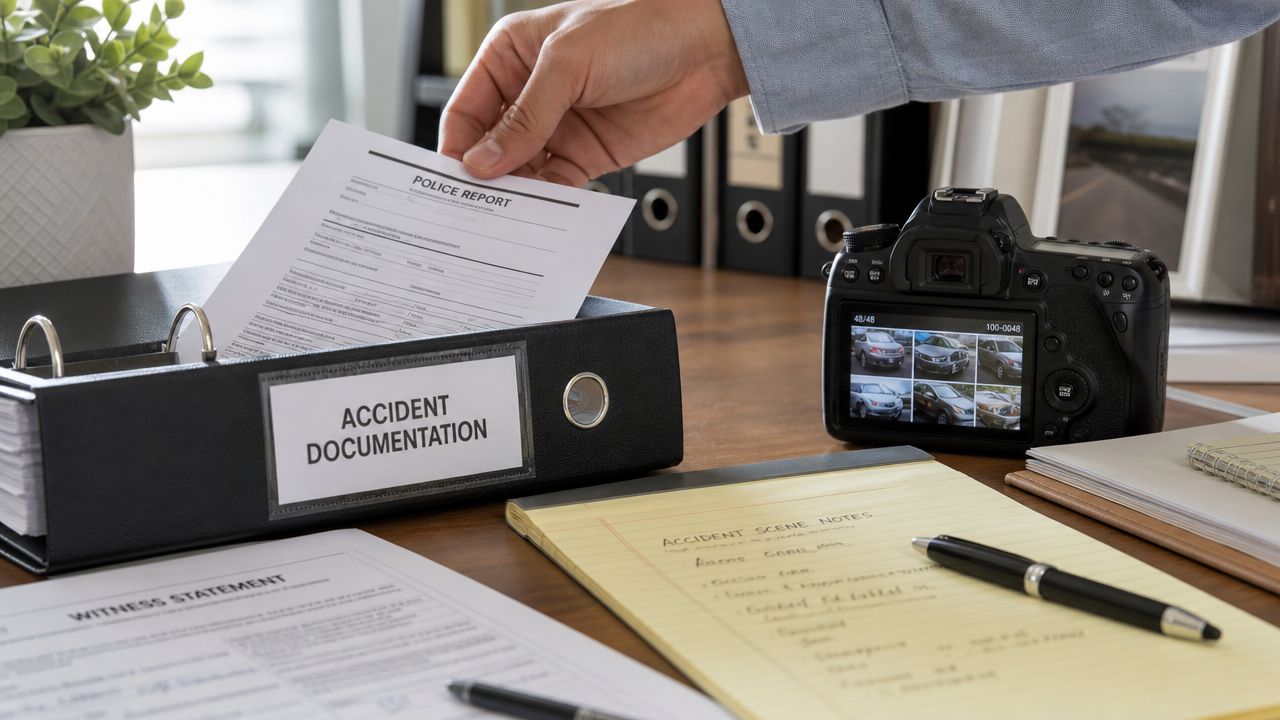
Capture these angles and details:
- Wide scene photos: Show lane position, intersection layout, debris, skid marks, and resting position of both vehicles.
- Traffic controls: Photograph stop signs, signals, lane arrows, merge points, and any obstructed signage.
- Conditions: Record weather, lighting, road surface, puddles, ice, glare, and visibility.
- Every vehicle corner: Front, rear, both sides, wheel area, and interior if airbags deployed or cabin damage exists.
- VIN and odometer: These help later if the insurer undervalues the trim, mileage, or equipment package.
- Witness details: Get names and numbers right away. People stop answering later.
If the car goes to a tow yard or body shop, photograph it again before repairs begin. Hidden damage often becomes visible only after teardown, and insurers love pretending the first impression was the full picture.
Get the police report and audit it
Don't assume the police report is perfect. Officers work fast, and small errors create big headaches.
Check the report for:
- Vehicle information errors
- Wrong location or lane details
- Incorrect insurance information
- Bad driver statements
- Missing witness references
If you find mistakes, contact the reporting agency and ask about the correction process immediately. Be factual. Don't write a novel. Point to the exact field that's wrong and attach supporting material if you have it.
Practical rule: If a report contains an error that hurts liability or vehicle identification, fix it before the adjuster builds the file around it.
What to say when the insurer calls
The other driver's insurance company is not calling to help you maximize the claim. The adjuster is collecting statements to limit exposure. Keep your answers short and factual.
Use this script:
- On the basics: “I'm willing to confirm the date, time, location, and vehicles involved.”
- On injuries or condition: “I'm still assessing the full impact of the collision.”
- On vehicle damage: “The vehicle is being inspected, and I'll provide documentation.”
- On recorded statements: “I'm not giving a recorded statement at this time.”
Never say these things:
- “I'm fine.”
- “I didn't really see them.”
- “Maybe I could have reacted faster.”
- “The damage doesn't look too bad.”
Those phrases get written into claim notes and used later to cheapen the file. You're not there to be agreeable. You're there to be accurate.
Calculating What You Are Owed
The insurer's first number is designed to close the file cheap. If you let their estimate define the claim, you hand them the advantage. Build your own valuation from the start, and make every dollar stand on documentation the adjuster has to answer.
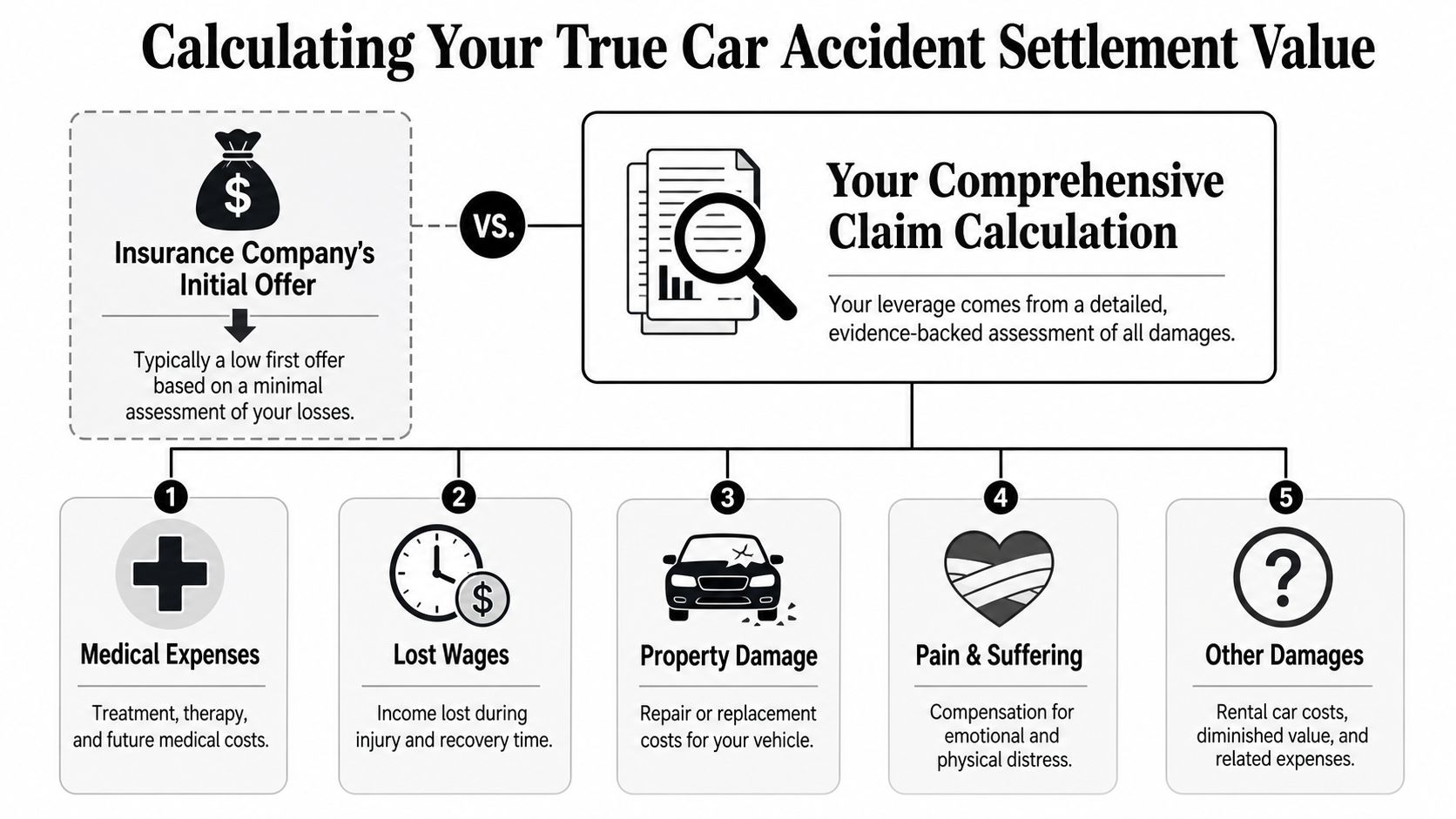
A property damage claim is not one number. It is a stack of separate losses. Treating it that way gives you an advantage later if the carrier refuses to pay and you need to press the issue through appraisal or a formal demand.
Use a working list like this:
| Claim component | What to gather |
|---|---|
| Repair cost | Independent repair estimates, supplement reports, photos |
| Rental or loss of use | Rental receipts, reservation records, timeline of repairs |
| Total loss value | Comparable local listings, trim/package proof, maintenance records |
| Diminished value | Appraisal support, market evidence, accident history impact |
| Out-of-pocket costs | Towing, storage, deductible issues, related receipts |
If you also got treatment, keep that file separate. For documenting care and making sure your records reflect the crash clearly, a practical resource on car accident injury treatment can help you understand what providers usually track after a collision.
Repairs are only the starting point
For a repairable vehicle, get at least one independent estimate from a shop that does collision work every day. Then compare it line by line against the insurer's sheet. Adjusters cut claims through omissions. Calibrations disappear. Scan time gets skipped. One-time-use parts get ignored. Structural and suspension damage often shows up later as a supplement.
Do not let the carrier roll all of that into a vague conversation about whether the vehicle is "basically fixed." A repair bill answers the cost to restore function and appearance. It does not answer post-repair market loss.
Diminished value is where people often lose money without realizing it
A clean repair does not erase accident history. Buyers pull vehicle history reports. Dealers reduce trade offers. Online valuation tools factor prior damage into resale price. That loss belongs in the claim if the facts support it.
This matters most when the vehicle had solid pre-loss value, low mileage, newer model-year status, or significant structural repairs. If the crash shows up on the VIN history, the market will care. You should care too.
Ask two separate questions. Was the vehicle repaired correctly? What would a buyer pay for it now compared with the same vehicle with no accident record?
That second question is how you find diminished value. If the adjuster brushes it off, make them explain their basis in writing. If they still stonewall, that is often the point where an independent appraisal starts doing real work.
Total loss value lives in the local market, not the insurer's template
If the insurer totals the vehicle, inspect the comparable vehicles they used before you argue about the final number. Bad comps sink total loss offers. The wrong trim, wrong drivetrain, inflated mileage adjustments, missing options, and distant listings can knock real money off the valuation.
Pull your own comparable listings and save them before they disappear. Use vehicles that match your year, trim, mileage range, options, and market area as closely as possible. Screenshots matter. Window stickers, service records, receipts for recent major work, and proof of factory packages matter too.
A strong total loss file usually shows:
- Correct trim and drivetrain
- Mileage in a realistic range
- Factory and dealer-installed options
- Recent service or upgrades that support condition
- Listings from the same local or regional market
Put your number on paper before you start arguing it. If you need a model for organizing the dollar amount and backup, this guide on a car accident settlement demand letter shows how to present the claim in a way an adjuster cannot easily ignore.
Your goal is simple. Force the insurer to respond to evidence, not to your frustration. That is how you stop a lowball offer from becoming the final number.
Writing a Demand Letter That Gets Results
Once you know your number, put it in writing. A phone complaint goes nowhere. A clean demand package forces the adjuster to respond to a structured claim.
The tone matters. Don't sound angry. Sound prepared.
What the letter must include
A strong demand letter has five parts:
Accident summary
Keep it short. Date, location, vehicles involved, and a plain statement of what happened.Liability statement
Explain why the other driver is responsible. Reference the police report, witness statement, photos, or traffic rule violation if applicable.Itemized damages
List each category separately. Repair cost, rental, towing, storage, diminished value, or total loss valuation dispute.Supporting documents
Attach estimates, photos, receipts, comps, and any appraisal material.Specific settlement demand
State the amount you're demanding and give a reasonable deadline for response.
If you need examples of treatment paths and documentation that often support the injury side of a claim, this overview of car crash injury solutions is useful background when organizing records.
Use firm language, not drama
Write like someone who expects to be taken seriously. That means no threats, no sarcasm, and no rambling personal speech about how stressful this has been. The stress is real, but the claim gets resolved through proof.
A practical reference for structure is this guide to a car accident settlement demand letter. The best letters are direct enough that an adjuster can hand them to a supervisor without rewriting the file.
A sample damages block
Use a simple format like this in the body of the letter:
Calculation of Damages
Vehicle repair estimate: $[amount]
Rental and transportation expense: $[amount]
Towing and storage: $[amount]
Diminished value claim: $[amount]
Total amount demanded to resolve property damage claim: $[amount]
That block works because it's hard to misread. It also stops the adjuster from pretending your demand was vague.
Attachments matter as much as the letter
A demand letter without exhibits is just an opinion. A demand letter with a clean evidence packet is a claim file.
Include:
- Photos in order: Scene, exterior damage, interior damage, hidden damage if available
- Repair documents: Original estimate, supplements, final invoice
- Proof of value: Comparable listings, option sheet, maintenance records
- Loss documentation: Rental receipts, tow bill, storage invoice
- Diminished value support: Appraisal or market-based justification
Finish the letter with a deadline and a clear statement that you expect a written response. Keep a copy of everything. Send it in a way that creates a record.
Negotiating and Invoking the Appraisal Clause
Most adjusters don't fold because your demand letter was well written. They respond with a lower number, a partial denial, or a vague explanation that “the market data doesn't support your figure.” That's the point where many claimants waste time going in circles.
Don't.

How to handle the first lowball response
Treat every counteroffer as a request for clarification. Make the adjuster explain the gap.
Ask questions like:
- Which comparable vehicles support your valuation?
- Did you account for the correct trim, options, and mileage?
- Why was diminished value excluded or reduced?
- What documents would change your position?
This does two things. It forces the insurer to show its work, and it keeps you from making emotional concessions.
A low offer isn't the end of the claim. It's a signal that you need a better process, not a louder argument.
If the dispute is small and the adjuster engages fairly, you may resolve it through written back-and-forth. If the dispute is rooted in vehicle value and the carrier keeps hiding behind its report, stop chasing approval and look at the policy.
The Appraisal Clause is your leverage
The Appraisal Clause is one of the most underused tools in property damage disputes. As noted in this discussion of how policyholders use the Appraisal Clause in valuation disputes, it's a provision in most auto policies that allows the owner to demand an independent appraisal when the insurer's value and the owner's value differ, effectively removing the need for a lawyer on property damage disputes while ensuring a fair market value.
That matters because valuation fights often stall for one reason. The insurer wants you stuck inside its software output. The Appraisal Clause gives you a route around that.
If you want a broader breakdown of what the process usually looks like, this overview of the insurance appraisal process is a useful reference.
When to invoke it
The clause is most useful when:
- The vehicle is a total loss and the insurer's value is too low
- The vehicle has meaningful diminished value and the carrier won't address it fairly
- The adjuster keeps repeating the same report without engaging your evidence
- You've already presented comps and documentation and hit a wall
At that point, negotiation alone often becomes a dead end.
How the process usually works
Read your policy. Find the appraisal language. Then follow it exactly. Carriers pay attention when you invoke contract language correctly.
The basic sequence usually looks like this:
- You notify the insurer in writing that you're invoking the Appraisal Clause due to a disagreement over value.
- Each side selects an appraiser.
- Those appraisers review the loss and attempt to reach agreement.
- If they can't agree, an umpire may become involved depending on the policy language.
- A valuation is reached through the appraisal process rather than ordinary haggling.
Details matter. A weak appraiser won't save you. A qualified independent appraiser with market-backed support can shift the entire dispute.
A quick explainer can help if you want to see the concept discussed visually:
Why this changes the power dynamic
Standard negotiation leaves the insurer in control of the frame. They chose the report. They chose the comps. They chose the assumptions. The Appraisal Clause interrupts that control.
That's why I recommend a simple rule. If the issue is property damage value, fight with evidence first. If the insurer still won't move, invoke process. Procedure beats pleading.
Knowing When You Absolutely Need a Lawyer
Here's the line I'd draw without hesitation. If your claim involves injuries, trying to handle it alone is usually a bad financial decision.
Property damage disputes are one thing. Injury claims are different. Once you're dealing with ongoing treatment, future care, pain and suffering, missed work beyond the obvious, or any argument over causation, you're out of DIY territory.
According to reporting on Insurance Research Council findings, claimants with legal representation receive settlements nearly 3.5 times higher than those who settle without a lawyer. The same source states that even after legal fees, clients still typically secure about three times more compensation in injury cases.
That should end the debate for most injury claims.
Use this decision guide
| Situation | Recommended Action |
|---|---|
| Property damage only, clear fault, dispute is over repair value or total loss value | Settle solo if you're organized and ready to document everything |
| Property damage plus diminished value dispute | Settle solo only if you can support the loss with evidence or appraisal help |
| Any physical injury, even if it first seems minor | Hire an attorney |
| Ongoing treatment, injections, or surgery discussion | Hire an attorney |
| Fault is disputed | Hire an attorney |
| Insurer delays, stonewalls, or appears to be acting in bad faith | Hire an attorney |
| You're being asked to sign a broad release and you're unsure what it covers | Hire an attorney |
Don't confuse saving fees with saving money
A lot of drivers think skipping a lawyer means they keep more of the settlement. On injury claims, that logic often backfires. You can read about costs and fee structures in this guide on car accident lawyer price, but the bigger issue is bargaining power, valuation, and claim scope.
If the claim is about a bent fender, a bad total loss number, or a missing diminished value payment, you may be able to handle it yourself. If the claim is about your body, your future treatment, or your ability to work, get legal help.
That's the dividing line.
If your insurer is lowballing your total loss or ignoring diminished value, Total Loss Northwest helps drivers fight back with certified independent appraisals and Appraisal Clause support. They focus on the numbers that insurers miss, understate, or leave out, so you can pursue a fair market-based property damage settlement instead of accepting the carrier's version of value.