You've just been told your car is worth less than you expected, and the number on the insurer's worksheet feels too low to trust. Maybe the adjuster is pointing to a valuation report that ignores upgrades, prior repairs, or the way your market prices similar cars. That's the moment car appraisal certification stops sounding like jargon and starts becoming a practical question about whether an independent report will carry real weight.
Car appraisal certification means more than a badge on a website. In a dispute, it signals that the person valuing the vehicle has followed a recognized process, inspected the car, documented the market, and signed a report that can be defended if someone challenges it. The key question isn't whether a person uses the word “certified.” It's whether the report is built in a way an insurer, attorney, or arbitrator can rely on.
What Car Appraisal Certification Actually Means
A certified vehicle appraisal is not the same thing as a dealer trade-in offer or a fast online estimate. Those numbers can be useful as starting points, but they're built for speed, not for a dispute where someone may need to justify every adjustment. A credentialed appraisal is an inspection, a documented market analysis, and a signed report that ties the conclusion to evidence rather than guesswork.
That distinction matters because each party in a claim sees the vehicle through a different lens. The insurer may use valuation software, the dealer may focus on wholesale exposure, and the owner may focus on the car's real replacement cost or post-loss loss in value. A certified appraiser bridges those viewpoints by creating one report that explains condition, comparables, and the reasoning behind the final number.
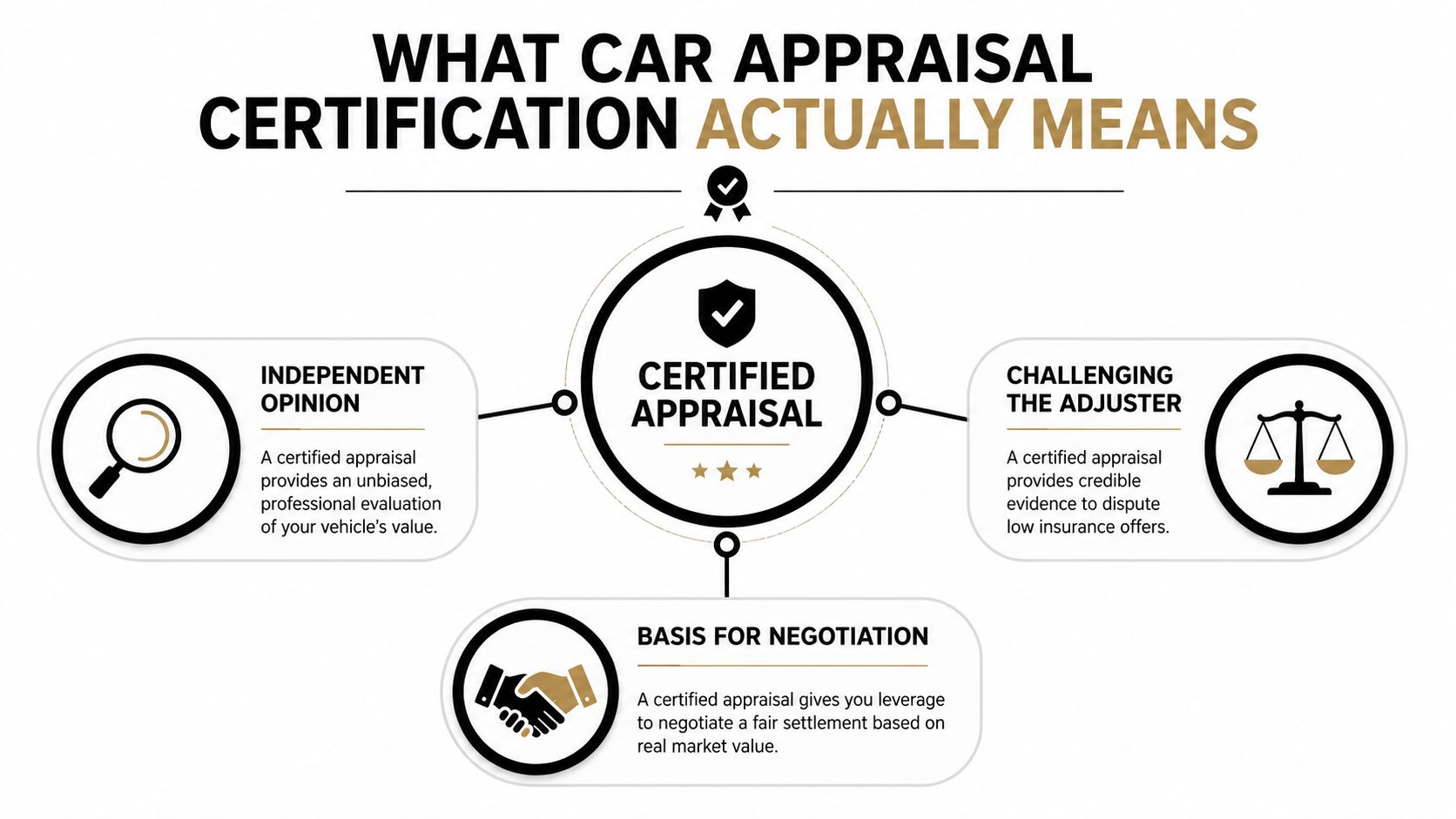
Practical rule: if the document doesn't show what was inspected, what was researched, and who signed it, it's not the same thing as a defensible appraisal.
The phrase car appraisal certification matters because it points to process, not decoration. A real credential says the appraiser has been trained to evaluate condition, market context, and report structure in a way that can stand up outside a casual conversation. That's why a certified appraiser is a credentialed professional, not just someone who picked a number and sent an invoice.
Inside the Credentialing Process
A certification file should read like a trail, not a label. Training, exam work, and report discipline connect to show whether the appraiser can inspect a vehicle, explain the findings, and defend the conclusion under scrutiny. One North American example uses a 40-hour course that covers visual inspection, appraisal practices, ethics, documentation, appraisal review, personal-property reporting, and collision-estimating standards, then follows that with a qualifying exam that requires a passing score of 80% on an Automotive Personal Property examination in at least one framework. Those requirements help separate a credential from a self-issued title. 40-hour curriculum and exam framework and Automotive Personal Property examination threshold
What the training tests
The coursework is built to show whether the appraiser can separate surface damage from structural damage, record repairs with care, and write a report that explains why a condition adjustment was made. Technical modules often include terminology, parts identification, frame and unibody analysis, mechanical systems, bodywork, and painting procedures, because those are the places where weak valuation work tends to fall apart.
In an insurance dispute, that training appears in the report language. A certified appraiser should be able to state what was observed, what could not be verified, and what limited the valuation. If the scope is unclear, the other side has an easier time challenging the report.
Why the exam matters
A published passing threshold does more than show someone studied. It sets a floor for competence, which matters when an appraiser's opinion may be read by an adjuster, a lawyer, or a judge. The point is not charm. The point is whether the appraiser can defend each adjustment if someone asks why the number changed.
A good credential should make the report harder to dismiss, not harder to understand.
The Major Certifying Bodies and What Each One Covers
The auto appraisal space is crowded, and not every acronym means the same thing. Some credentials are built around USPAP and personal-property reporting. Others are tied to estimating, damage training, or industry education. A claimant doesn't need to rank every organization. You just need to know what each one is good for when a claim gets contested.
| Credential | Focus | Typical Use Case |
|---|---|---|
| USPAP-based personal property certification | Ethics, competency, scope of work, and report structure | Insurance disputes, legal valuation, lending, and any report that needs a defensible framework |
| ASE-related or damage-estimating training | Repair knowledge, parts identification, collision estimating, and technical vehicle assessment | Damage review, repair-based disputes, and estimating-related work |
| I-CAR training | Collision repair education and technical industry knowledge | Supporting knowledge for appraisers who evaluate repair evidence and structural issues |
| Independent auto-appraisal body credentials | Vehicle valuation methodology, report writing, and specialty valuation work | Total loss, diminished value, classic cars, and specialty vehicles |
The most important divide is between formal appraisal credentials and broader industry training. ASE or I-CAR can strengthen a professional's technical background, especially when the vehicle has repair complexity, but they don't automatically tell you the person is prepared to write a USPAP-style valuation report. In a claim file, the credential that matters most is usually the one tied to the report standard the forum expects.
USPAP-based credentials carry particular weight because USPAP defines the appraiser's behavior through the Ethics Rule, Competency Rule, and Scope of Work Rule. That means the appraiser has to be independent, has to know the subject matter, and has to disclose exactly what research and inspection work was done. The USPAP certification requirements for vehicle appraisals make the structure behind the opinion much clearer than a casual estimate ever could.
Where Certification Pays Off in a Claim
Certification earns its keep when the number on your side has to stand up to the insurer's number. That usually shows up in diminished value, total loss settlements, and litigation or expert witness work. In those settings, an uncertified estimate can be brushed aside because it does not show enough method, inspection detail, or report discipline.
A certified appraisal matters most when the disagreement centers on what the damage means in dollars rather than whether it exists. A diminished value dispute asks what the market lost after repair. A total loss dispute asks whether the insurer's actual cash value is too low. A legal dispute asks whether the report can survive scrutiny from the other side's counsel.
Why the fee tier matters
The fee attached to dispute work tells you something about the assignment. One industry guide lists $500–$2,000+ for expert witness or litigation support, $500–$800+ for classic or specialty vehicles, and $250–$450 for total loss disputes, which reflects the added work of research, documentation, and defensible reporting. A pricing guide for dispute and specialty appraisal pricing does not guarantee acceptance, but it does signal that the appraisal is being built for a contested forum, not a quick convenience quote.
How the report changes the conversation
A well-structured report shifts the argument from opinion to evidence. The appraiser's photographs, comparable sales, and scope of work give the adjuster something concrete to answer. That matters more than whether the final value is high or low.
The report also has to read like work that was done, not a conclusion dropped on top of the file. In an Appraisal Clause dispute, that means the file should show the inspection basis, the reasoning behind the value conclusion, and enough support for another reviewer to follow the path from vehicle condition to final number. If the claim grows into a contested file, the cleaner the record, the easier it is for the appraisal to hold its shape.
If you are collecting records for a dispute, a clean file helps. A tool like case file receipt organization tools can help keep repair invoices, photos, and claim correspondence in one place so the appraiser can work from a complete record instead of scattered screenshots.
A claimant can also save time by checking how the service presents itself. The Total Loss Northwest certified auto appraiser page is one example of a place where you can review how an appraiser describes scope, specialty, and claim support before paying for the report.
How to Verify an Appraiser's Certification Before You Pay
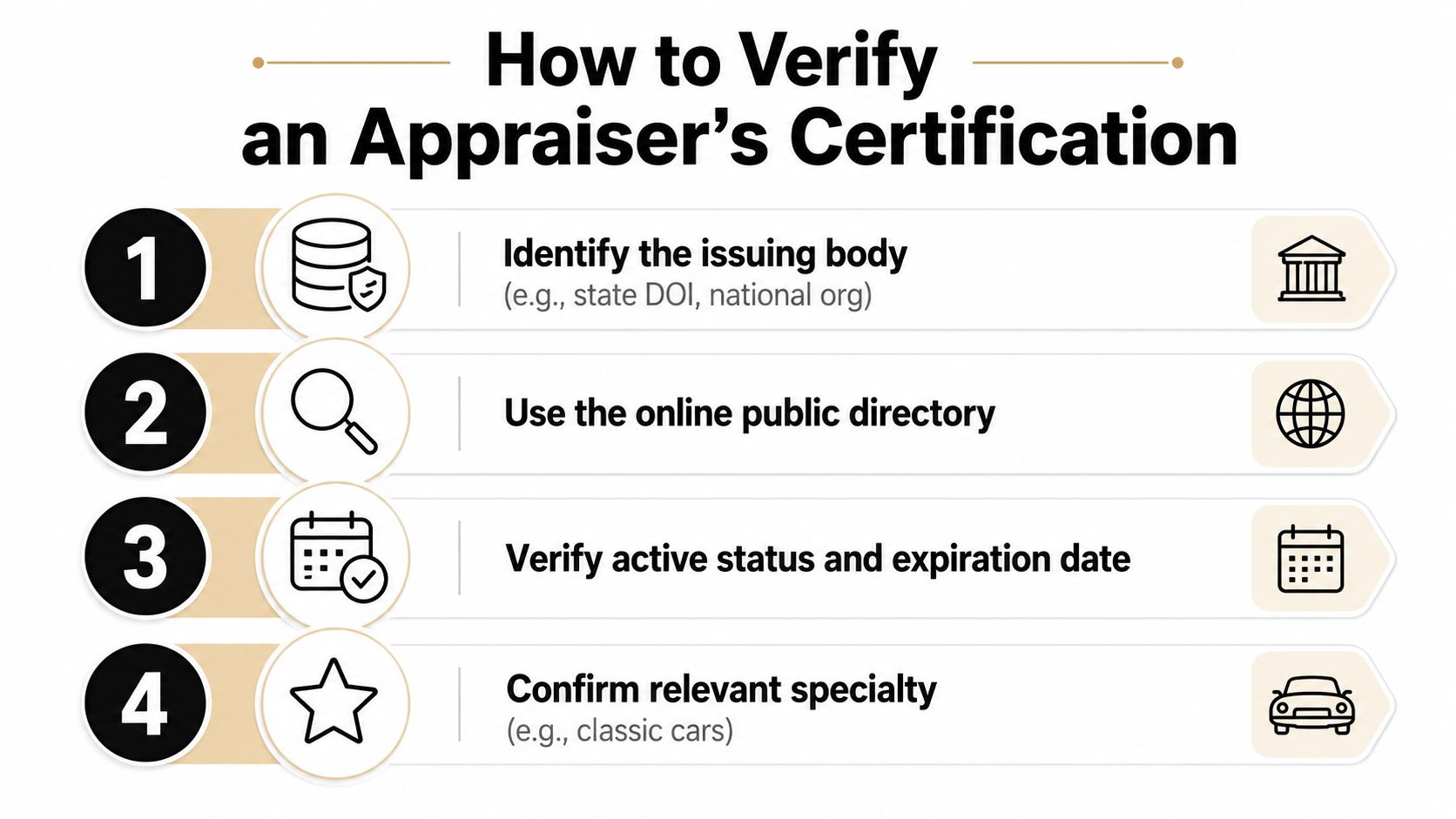
Start with the issuing body, not the business card. A real credential should be searchable in the organization's public directory, or in a state licensing database if the appraiser works under a state regime. If the name isn't there, or the listing shows an expired status, pause before you hire anyone.
Then check the report itself. A USPAP-compliant appraisal should show the appraiser's stated competency, the scope of work, and a signature block with an effective date. Those items matter because they tell you what the appraiser examined, what standards guided the assignment, and when the opinion was finalized. The Total Loss Northwest certified auto appraiser page is a useful example of how claimants can review a service and ask the right questions before moving forward.
What to look for in five minutes
- Issuing body: Confirm the appraiser can name the organization behind the credential, not just say “certified.”
- Public listing: Use the directory or lookup tool to verify active status, expiration, and specialty area.
- Report header: Look for competency language, scope of work, and a clear signature block.
- Relevant specialty: Make sure the appraiser handles your claim type, whether that's total loss, diminished value, or specialty vehicles.
- Red flags: Be cautious if the appraiser won't share the credential number, hides the issuing body, or sends a report with missing sections.
A real certification check is a quick credibility screen. If the report cannot be tied to a body, a scope, and a signature, it's much harder to use when the claim gets pushed into dispute.
Classic, Modified, and High-Value Vehicle Cases
A generic valuation tool often struggles once a vehicle stops resembling the average car in its database. That happens with collector cars, modified builds, and high-value exotics, where condition, originality, and replacement options can move the value quickly. The issue is not only price. These vehicles often sit in thinner markets, so the appraisal depends more on informed judgment than on a simple lookup.
A modified 4×4 may carry parts that matter to the owner but do not fit neatly into standard pricing guides. A numbers-matching classic may turn on documentation, originality, and knowledge of the right market segment, not just a model-year entry. A low-mileage exotic may call for replacement-cost analysis and market trend research instead of a basic mileage adjustment. For specialty vehicle guidance, the practical question is not whether the car is rare, but whether the appraiser understands how that rarity is priced, as discussed in certified vehicle appraisal guidance for specialty vehicles and the related classic car appraisal certification guidance.
Where the wrong appraisal goes off track
Generic tools usually treat the car as a database entry. A specialty appraiser treats it as a market problem that has to be explained, supported, and compared against the right evidence. That difference matters because a car with unique trim, custom work, or scarce comparables cannot be valued accurately without a deeper inspection and a documented comparison set.
The more unusual the vehicle, the more important it becomes to justify adjustments with real evidence. A report should explain the condition grade, the repair evidence, and the market segment used as the reference point. When those pieces are missing, the appraisal becomes easier to challenge under claim review or the Appraisal Clause.
A claimant should read the report like a skeptic would. If the appraiser says a feature adds value, the report should show why the market agrees. If the car has a major modification, the report should explain whether that change helps value, limits buyer interest, or does both at once.
The claim question that actually matters
Most owners ask whether certification will get them a higher number. The better question is whether the appraiser can justify the number with the right comps and the right methodology. That is the ultimate test in specialty claims, because a number that looks generous but cannot be defended still leaves the file exposed.
The strongest appraisal is the one that explains itself clearly. For rare or modified cars, that means the report should identify the vehicle accurately, describe the condition in plain terms, show the comparable market used, and connect each adjustment to evidence the insurer can review. If those pieces line up, the appraisal has a much better chance of holding up when the claim turns into a dispute.
Oregon and Washington Considerations for Claimants
An Oregon or Washington claimant often meets the same problem first. The insurer's number feels out of step with the local market, and the question becomes whether the appraisal can survive scrutiny in an Appraisal Clause dispute. In that setting, the credential matters, but only as part of a larger test: does the report show real knowledge of the vehicle's market, the region, and the method used to reach value?
A regional appraiser is more likely to recognize nearby comparable sales, local repair realities, and the way buyers in the area price similar vehicles. That can matter when the file is built around Portland, Seattle, or another Pacific Northwest market, because a generalist from outside the area may miss details that change the number. A claimant does not need a theory about value. They need a report tied to the market where the car was bought, driven, and likely to be replaced.
The Pacific Northwest auto appraiser page fits that situation because many Oregon and Washington drivers are not looking for a friendly estimate. They are looking for a report that can hold up under claim review, and, if needed, under the appraisal process itself. A locally informed credential can carry more weight when the insurer asks whether the appraiser understands the market being argued.
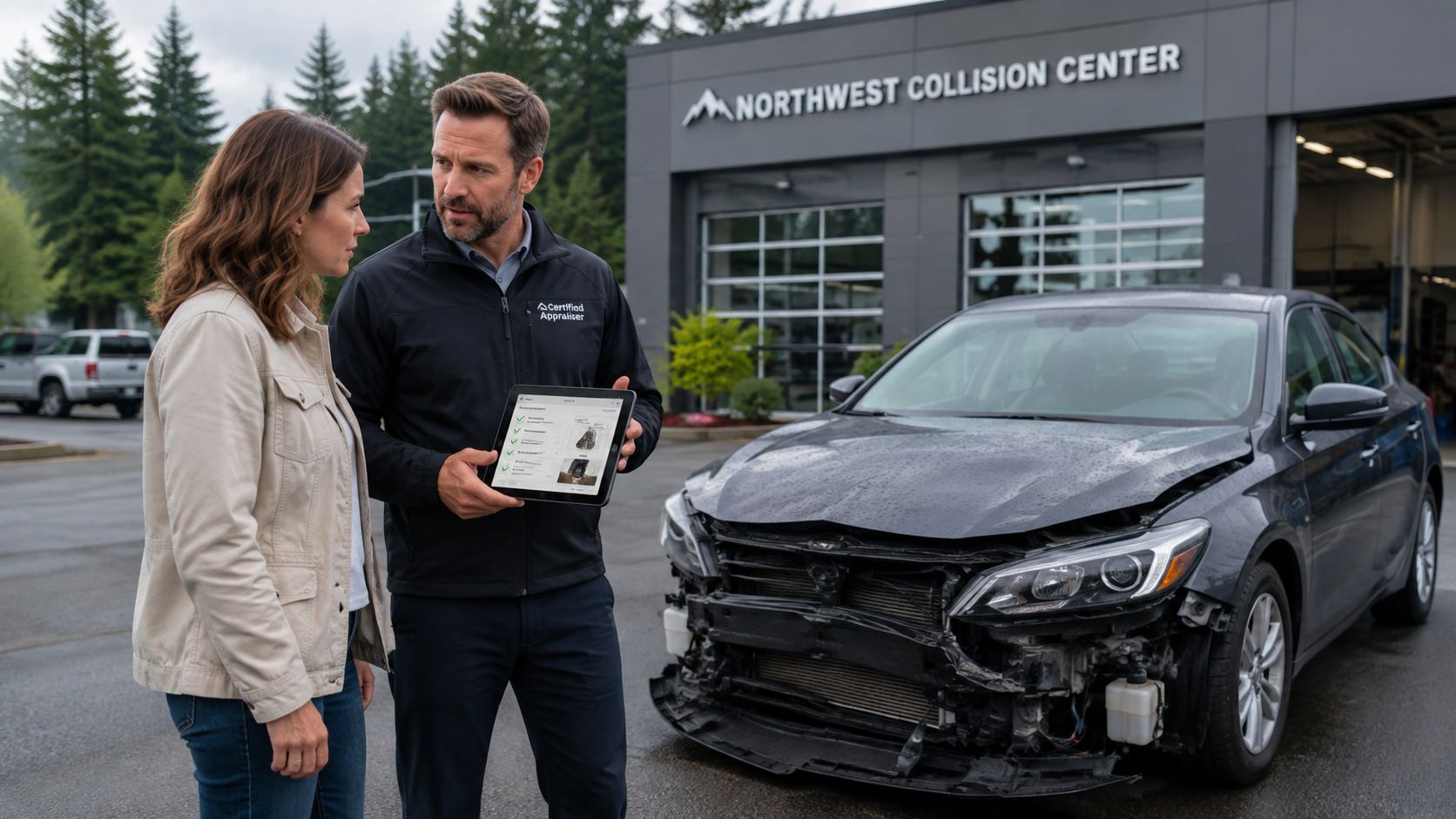
The claim question that matters most
Regarding the credential, the forum may be the same, but the acceptance test is different. An insurer may look closely at the exact certification, the method, and whether the report reads like it came from someone who knows the region. A court or appraisal-clause process may care even more about whether the scope, the comparable set, and the reasoning are easy to defend line by line.
That is why Pacific Northwest claimants should think in terms of recognition, not just certification. The right credential is the one the other side has the hardest time dismissing because the method, the market data, and the location all point in the same direction.
Using a Certified Appraisal to Get the Settlement You Owe
Start by documenting the vehicle before anything else disappears from memory. Gather photos, repair estimates, service records, parts receipts, and anything that shows pre-loss condition or the quality of the repairs. Then give the appraiser a clear scope of work so the report matches the claim you're making.
A solid report goes to the insurer with a direct request for re-evaluation. If the carrier still won't move, the next step is to press the Appraisal Clause or move into the legal path your state and policy allow. A certified appraisal matters here because it gives you a report that can support the next conversation instead of ending the first one.
Questions to ask before you hire
- Claim experience: Have you handled total loss, diminished value, or appraisal-clause disputes before?
- Sample reports: Can you show a redacted report so I can see the structure and detail?
- USPAP compliance: Does the report follow USPAP personal-property standards?
- Testimony readiness: Will you explain or defend the report if the claim escalates?
A certified appraisal is overkill for a simple curiosity check, but it becomes the right tool when the settlement number is too important to leave to a generic estimate. That's especially true when the car has unique trim, special repairs, or a repair history that the insurer's software didn't capture.
If you need a firm next step, Total Loss Northwest works on diminished value and total loss appraisal disputes in Oregon and Washington, and it can be a practical option when the claim needs a report built for negotiation rather than a quick opinion.