Most advice about a classic car value blue book starts in the wrong place. It tells you to look up a number, compare a few listings, and treat that result like fact. That's fine for a late-model commuter car. It's terrible advice when you're dealing with a collector vehicle and an insurance claim.
If you're here because your classic was damaged, declared a total loss, or came back from repairs with diminished value, the stakes are different. You aren't asking a casual question about resale. You're trying to prove value to an insurer that may rely on software, generic condition assumptions, and a version of the market that doesn't look anything like the collector world.
The hard truth is simple. For classic cars, the familiar "blue book" idea is mostly a myth. What matters is evidence, specialized valuation sources, and a defensible appraisal strategy.
Searching for a Classic Car Value Blue Book
You searched for a classic car value blue book because you want one clean answer. I understand that instinct. When an adjuster asks what your car was worth before the loss, a single trusted number sounds like the easiest path.
It isn't.
The first mistake is assuming the collector market works like the used-car market. It doesn't. A classic car's value isn't built from ordinary commuting utility. It's built from desirability, originality, documentation, restoration quality, and what buyers will pay for that exact type of car in that exact condition.
Why this search term leads people astray
The phrase classic car value blue book survives because Kelley Blue Book became shorthand for vehicle pricing in general. But shorthand creates expensive misunderstandings. If your insurer starts from the wrong framework, you can end up arguing over a number that never reflected your car in the first place.
That's why I tell owners to stop chasing a single magic figure and start building a valuation file. If you need a practical starting point, this guide on how to value a classic car is the right kind of conversation. It focuses on what matters when a collector vehicle's value is under scrutiny.
A classic car claim isn't won by saying, "I know what I've got." It's won by showing why the market agrees with you.
The insurance claim changes everything
A normal pricing lookup is casual. An insurance dispute is adversarial.
When a total loss or diminished value claim lands on your desk, every weak assumption gets exposed. The insurer may group your car with loosely similar vehicles. They may overlook originality. They may ignore provenance. They may treat old restoration work and recent mechanical investment as background noise rather than valuation evidence.
That leaves owners frustrated because the number feels wrong, but they can't explain why in terms the insurer has to respect.
You need a better standard than household-name pricing mythology. You need sources and proof that fit the collector market. That's the difference between accepting a low offer and forcing a fair one.
Why Standard Blue Books Fail for Classic Cars
A standard blue book works best when vehicles behave like commodities. Most late-model cars do. They have broad transaction volume, predictable depreciation, and relatively consistent market comparisons.
Classic cars don't behave that way.
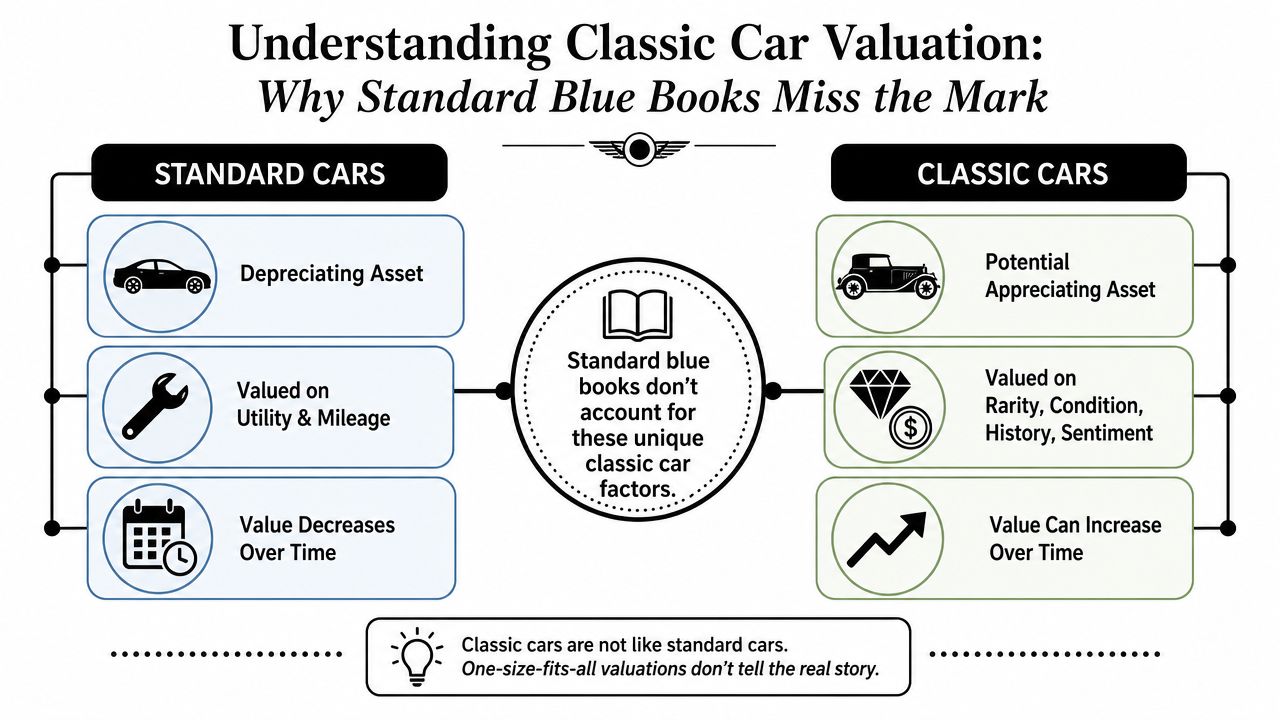
Kelley Blue Book does not provide valuations for classic cars in the way owners expect. Its data is limited to vehicles 21 years or newer, which makes it technically inapplicable for many collector vehicles, especially pre-1995 models, according to Woodside Credit's explanation of classic car valuation resources. That same source explains the core mismatch clearly: standard used cars depreciate based on mileage and condition, while classics can appreciate based on rarity and cultural relevance.
Daily driver logic versus collector logic
Think of a modern family sedan. Buyers expect ordinary wear, compare dozens of similar listings, and discount for age, miles, and prior damage in a fairly linear way.
Now think of a sought-after classic coupe with matching numbers, original trim, correct drivetrain, and documented history. That vehicle isn't priced like transportation. It's priced like a collectible. Buyers don't just ask, "Does it run?" They ask whether the engine is correct, whether the interior is period-correct, whether the restoration respected original specifications, and whether the car has provenance that supports the story.
Those aren't side details. They are the value.
Where standard valuation models break down
Blue-book style systems depend on broad, recent transaction data. That's useful when the market is standardized. It fails when the inventory is fragmented and every example differs in meaningful ways.
Here's where standard systems usually miss:
- Originality matters more than age alone. A car with original components and supporting documentation may sit in a very different market position than a similar car with heavy modifications.
- Auction and specialty dealer activity matter. Collector pricing often forms in places generic used-car models don't fully capture.
- Rarity changes the comparison pool. Sometimes there are very few true comparables, and the ones that exist vary sharply in quality.
- Emotional and historical pull affect demand. That's not fluff. In the collector market, desirability is part of value.
If you want a better benchmark than general-purpose pricing, review classic car value information through NADA-focused guidance. It aligns more closely with how collector vehicles are evaluated.
Practical rule: If a valuation method would work just as well for a rental fleet sedan, it probably isn't refined enough for a collectible car claim.
Why owners get lowballed
Owners often think the insurer is arguing over condition. In many cases, the actual problem starts earlier. The insurer is using the wrong valuation logic entirely.
Once that happens, every conversation after that is skewed. Your documentation looks "extra." Your originality looks "subjective." Your comparable sales look "outlier." In reality, those are exactly the things a proper collector valuation should examine.
That's why I reject the standard blue-book mindset for classics. It's the wrong tool. And in a claim, the wrong tool costs money.
Exploring Real Classic Car Valuation Guides
If Kelley Blue Book isn't the answer, what is?
You use specialized guides, then you compare them. That's the professional approach. No single guide owns the market. Each one sees part of it. Your job is to understand what each tool contributes and where each one falls short.
According to Alex Manos on Kelley Blue Book classic car values, Kelley Blue Book does not provide valuation data for classic cars manufactured before 1992, and collectors as well as insurers must rely on specialized sources such as Hagerty Valuation Tools and NADA Guides Classic Car Values.
The guides that actually matter
Three names come up repeatedly in serious classic car valuation work.
Hagerty Valuation Tools is widely used in the collector space because it speaks the language of enthusiast ownership. It tends to be useful when you're assessing condition tiers and trying to place a car within the collector marketplace rather than the ordinary used-car stream.
NADA Classic & Collectible Car Values remains important because many people in the automotive and insurance world still recognize it. That's useful in disputes. A guide doesn't need to be perfect to be persuasive. It needs to be credible, relevant, and properly interpreted.
Hemmings is valuable because it keeps you close to actual enthusiast listings and market behavior. Listing data isn't the same as a final sale, but it helps show how sellers position similar vehicles and how the market describes condition, originality, and desirability.
A fourth resource worth reviewing is carBoost classic car valuation. I don't treat any single online tool as the last word, but resources like that can help owners understand the moving parts behind a valuation before they step into a dispute.
Classic Car Valuation Guide Comparison
| Valuation Guide | Primary Data Source | Best For | Key Limitation |
|---|---|---|---|
| Hagerty Valuation Tools | Collector market valuation data and condition-based collector guidance | Understanding enthusiast-market positioning and condition tiers | Not a substitute for a claim-specific appraisal |
| NADA Classic & Collectible Car Values | Specialty guide data recognized across the auto market | Building a benchmark that insurers may recognize | Can still miss the story of a specific car |
| Hemmings | Enthusiast listings and market visibility | Seeing how comparable vehicles are presented in the market | Listings are not the same as closed transactions |
How to read these guides without fooling yourself
Owners often misuse good tools in predictable ways.
They pick the highest number and call it value. That's not analysis. That's wishful thinking.
They also pick condition categories that flatter the car instead of describing it accurately. That's just as damaging, because the insurer will attack your credibility the moment your photos, receipts, and mechanical reality don't match the claimed condition.
Use the guides this way instead:
- Start with accuracy. Year, make, model, trim, engine, transmission, and major originality points must be right.
- Choose condition conservatively. If the car presents well but has notable flaws, price it where the evidence supports it.
- Build a range, not a fantasy. A fair market position is usually stronger than a heroic number.
- Check the market narrative. Guide values should make sense alongside listings, dealer offerings, and collector demand.
If the range from multiple sources clusters reasonably well, you're getting closer. If it doesn't, that's a signal that the car's specifics are doing the heavy lifting and you likely need a professional appraiser.
Why comparison beats blind faith
No single source can define exact market value for every collector car. The market is too fragmented, and condition grading varies too much from car to car. That's why experienced appraisers compare guides, listings, auction-facing data, dealer context, and documentation rather than bowing to one printed number.
A guide is a reference point. It is not your case by itself.
How Insurance Companies Handle Classic Car Claims
When a classic car claim starts, the insurer often acts as if the process is routine. They request photos, gather vehicle information, and return with a valuation report or settlement offer.
For collector vehicles, that "routine" process is where problems start.
What a lowball classic claim usually looks like
Let's say your classic is hit while parked. The damage is severe enough that the insurer leans toward a total loss. You expect a thoughtful review because the car had documented work, rare factory options, and a history file.
Instead, the insurer's vendor produces a report built around broad market assumptions. They use distant comparables, flatten condition distinctions, and give little weight to originality or provenance. The offer comes back lower than what informed buyers would likely pay.
That doesn't always happen because the adjuster is malicious. Sometimes it's simpler than that. They are using a system built for standard vehicles, and your car doesn't fit the template.
The language insurers use
A few terms matter in these disputes.
Actual cash value is the insurer's estimate of what the vehicle was worth immediately before the loss. On a classic, this number becomes controversial fast if the valuation method is generic.
Total loss means the insurer has decided the car should be treated as a constructive write-off under the policy and claim process, even if the vehicle is physically repairable.
Diminished value comes up when the car is repaired but carries a market stigma afterward. Collector buyers can be especially sensitive to prior damage history, repair quality, and loss of originality.
Insurers often speak in clean, standardized language. Collector cars live in messy, highly specific facts.
Where the dispute usually turns
The insurer makes its first offer. The owner objects, usually with good reason, but often without a structured package of evidence. That's when negotiations stall.
The carrier may respond by repeating the report, defending the vendor, or asking for "supporting documentation" without telling you what would move the number. Owners then waste time sending random receipts, old photos, and emotional explanations that don't connect directly to market value.
A better response is targeted. You challenge the valuation method, the comparables, the condition assessment, and the omitted vehicle-specific features.
The appraisal clause matters
Many policies include an Appraisal Clause. That clause can give you a formal path to dispute value instead of arguing in circles with an adjuster.
It changes the conversation from "please reconsider" to a structured valuation disagreement. That's a stronger position. It doesn't guarantee an easy outcome, but it can reduce some of the insurer's advantage if their valuation rests on generic software or weak comparables.
If your classic claim feels off, don't assume the first number is close enough. In collector car disputes, "close enough" is often just another way of saying you absorbed the insurer's shortcut.
How to Prove Your Classic Car's True Value
If you're in a claim dispute, stop arguing in generalities. Build proof.
A classic car owner with organized evidence is hard to dismiss. A classic car owner with opinions and no file gets ignored. That's unfair, but it's how these claims work.
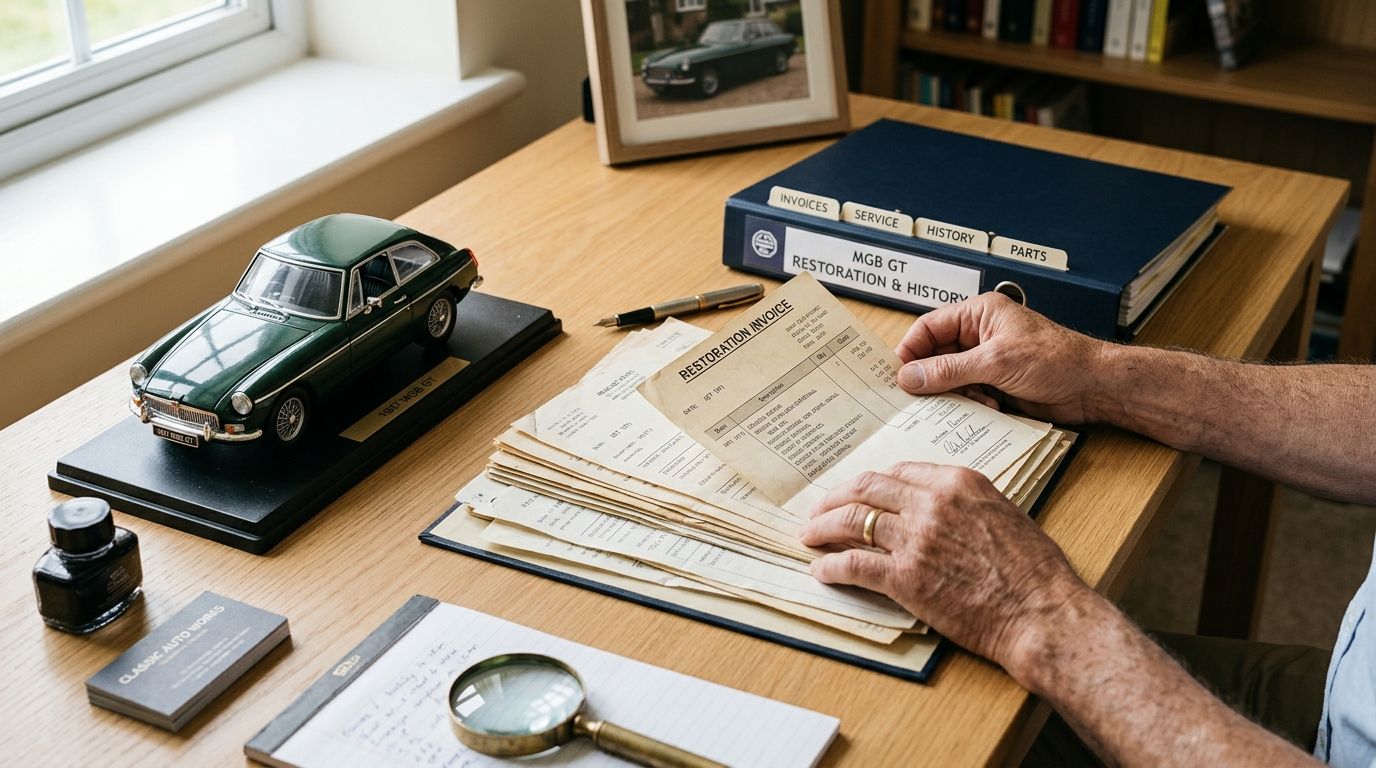
Start with the documents that insurers can't wave away
Gather everything that makes your car more than a generic example.
- Ownership records. Title history, prior registrations, and any paperwork that supports continuity and legitimacy.
- Restoration invoices. Parts, labor, paint, upholstery, engine work, and specialist services.
- Maintenance history. Routine upkeep matters because it shows stewardship, not just cosmetic effort.
- Photos. Use clear images of exterior, interior, engine bay, undercarriage, VIN, tags, and any unique features.
- Historical material. Build sheets, window stickers, marque certificates, awards, show history, and prior appraisals if they exist.
According to American Collectors on classic car values, technical specifications such as VIN, engine and transmission type, original component integrity, and provenance records are critical to professional appraisal work, and those factors can shift valuations by 40 to 60 percent compared with theoretical algorithmic estimates. That's exactly why paperwork matters.
Treat originality like evidence, not nostalgia
Owners often say a car is "all original" or "correct" without backing it up. That language means nothing in a dispute unless you can prove it.
Document matching components where possible. Identify non-original items accurately. If the car was restored, show whether the work preserved factory-correct specifications or introduced modifications that affect the buyer pool.
If you're dealing with imported collector vehicles, market context can matter too. For example, buyers researching sourcing American muscle cars to EU often pay close attention to condition, specification, and provenance because cross-border buying raises the stakes on getting the details right. That same discipline helps in a domestic insurance dispute.
Appraiser's view: The strongest file doesn't say your car is special. It proves exactly how and why.
Build a market range before you demand a settlement
After you've assembled the documentation, use the specialized guides and comparable market evidence to build a value range.
Don't force a fake precision number if the market doesn't support one. A defensible range is often stronger than a single unsupported demand because it shows you're approaching the issue like an appraiser, not like an angry owner.
Use this sequence:
Verify the exact vehicle identity
Match the VIN, drivetrain, trim, factory options, and major originality points.Place the car in an honest condition bracket
Overgrading hurts you. Underwriting departments and adjusters can spot inflated self-assessments quickly.Collect relevant market support
Use specialized guide values, enthusiast listings, dealer offerings, and claim-relevant comparables.Explain adjustments in plain English
If your car deserves a stronger number because of provenance, rare options, or superior originality, say so clearly and support it with records.
For a quick visual primer on what appraisers look for, this video is useful:
Know when DIY stops working
Some owners can assemble a strong package on their own. Many can't, especially once the insurer has already anchored the discussion around a low valuation report.
You need an independent appraiser when:
- The insurer's comparables are weak and you need a professional rebuttal.
- The car has unusual features that generic systems won't weigh correctly.
- Provenance or originality is central to the value dispute.
- The claim involves total loss or diminished value and the dollar gap is large enough that a formal appraisal can change the outcome.
- The policy's Appraisal Clause is in play and you need an expert report that can hold up under scrutiny.
If you need a benchmark for what a claim-ready expert should provide, review this page on classic auto appraisers. The right appraiser doesn't just assign a number. They show the reasoning, the market support, and the evidence trail.
Hiring an appraiser isn't a luxury in these disputes. It's an advantage.
From Blue Book Myth to Appraisal Reality
The phrase classic car value blue book sounds reassuring because it promises simplicity. That's why people keep searching for it. But simplicity is exactly what gets classic car owners in trouble during insurance claims.
Collector vehicles don't fit commodity pricing models. Their value sits in details that generic systems often flatten or ignore. Original components, correct drivetrains, provenance, restoration quality, and market positioning aren't side notes. They are the claim.
What a fair approach looks like
A fair valuation doesn't start with a household brand name. It starts with the right evidence and the right valuation logic.
That means using specialized guides as references, reading condition accurately, gathering records before the insurer asks for them, and challenging weak comparables when the report doesn't fit the car. It also means understanding that an insurer's first offer is often just an opening position, not a conclusion you have to accept.
The owner who documents the car well and challenges the method has a much better chance than the owner who argues from memory.
The right mindset in a dispute
If your classic was totaled, don't settle for a number that treats it like old transportation. If it was repaired and lost market appeal, don't let the insurer pretend the loss ends when the body shop invoice is paid.
Approach the claim like a valuation case. Build the file. Use the right guides. Bring in an independent appraiser when the dispute turns technical or the insurer starts hiding behind software.
That's how you move from confusion to control. Not by chasing a mythical blue book number, but by proving what your car is worth in the collector market.
If you're dealing with a total loss or diminished value dispute and the insurance company's number doesn't reflect reality, Total Loss Northwest can help. They provide certified independent appraisals, support Appraisal Clause disputes, and build claim-ready valuation reports for owners who need a fair settlement instead of a lowball offer.