You got hit, the body shop fixed the metal, and now the car still feels smaller in the market. That's the part insurers hate talking about. A repaired vehicle can look fine in the driveway and still bring less money at trade-in because the accident history follows it.
That lost resale value is the core of a diminished value appraisal Illinois drivers can use to prove their loss. If you were not at fault, you're not asking for a favor. You're pursuing the difference between what the car was worth before the crash and what it's worth after repairs, which is a real property-damage issue, not a complaint about paperwork.
Why Your Car Is Worth Less After an Illinois Accident
You can do everything right after a crash. The shop can replace panels, blend paint, and return the car looking clean. Then you walk into a dealership, and the first offer comes in lower than you expected because the car has an accident history attached to it.
That's diminished value in plain English. The problem isn't whether the repair looks good from ten feet away, it's that the car's pre-accident market value and post-repair market value are no longer the same. Illinois valuation guidance recognizes that repairable personal-property damages can include both the repair bill and the remaining market-value gap when the asset is still worth less after repairs, and that gap is the part many vehicle owners miss. Chicago Tribune legal guidance on diminished value claims

The market doesn't forget the crash
A repaired car can still be harder to sell, especially if the damage was structural, the vehicle is newer, or the local market has better alternatives. Chicago-area guidance says Illinois diminished value recoveries often fall between $2,000 and $7,000, depending on vehicle type, age, repair quality, and market demand, and that range is exactly why a generic “your repairs were completed” response misses the point. Chicago-area diminished value guidance
Practical rule: if the accident history would make a buyer hesitate, the car has lost value, even if the repair invoice looks clean.
Insurers love to act as if a proper repair erases the loss. It doesn't. The repair restores function, but it doesn't erase the stigma, and it doesn't recreate a clean history report or a stronger resale market. That's why an independent diminished value appraisal matters. It puts a number on the loss instead of letting the insurer wave it away with a generic estimate.
Illinois Law and Insurer Obligations for Diminished Value
In Illinois, a diminished value claim is usually handled as a third-party property-damage claim. That means you're pursuing the at-fault driver's insurer, not trying to squeeze the loss out of your own carrier. Illinois consumer reporting on the issue also describes these claims as something a not-at-fault driver can pursue after a collision, with independent appraisals and market comparisons used to prove the loss. Illinois diminished value claim guidance
The deadline matters, and people miss it when they wait too long. Illinois treats these claims under the state's 5-year civil statute of limitations in 735 ILCS 5/13-205, and the clock generally runs from the date of loss, not the date the repair shop closes the file. That is a huge difference in real life, because waiting for a perfect repair estimate doesn't stop the filing window from running. Illinois statute context for diminished value claims
What the insurer owes, and what it won't volunteer
The insurer's job is to defend its payout, not to do you favors. In a diminished value claim, the obligation is tied to the actual market loss caused by the crash, not to whatever internal software spits out after someone checks a few boxes. That's why Illinois guidance focuses on proving the loss with documentation, repair details, and market data rather than expecting a fair opening offer.
The small claims court cap in Illinois is $10,000, which is a useful benchmark for many moderate disputes. Illinois small claims and diminished value context In practice, that gives drivers a realistic fallback when the insurer won't move and the claim sits in the middle range. For modest losses, the court limit is often close enough to the actual dispute to make litigation practical.
If you want a deeper state-specific overview, this Illinois guide from Total Loss Northwest's diminished value claim resource tracks the same third-party framework and helps you see where your claim fits.
Illinois law doesn't require an insurer to accept your number without proof. It does require you to prove the loss the right way.
That proof starts with valuation, not frustration. If you can show what the car was worth before the wreck and what it's worth after the repairs, you're speaking the insurer's language. Everything else is noise.
How Diminished Value Is Calculated in Illinois
The cleanest way to think about the math is simple. Start with the vehicle's pre-accident market value, then compare it to the post-repair market value. The difference is the diminished value loss. Illinois case-law guidance summarized by legal sources says repairable property damage can include that residual market-value gap when the asset is still worth less after repairs, which is exactly what a good appraisal is built to measure. Illinois diminished value valuation context
Why insurer formulas miss the real number
A lot of insurers lean on a 17c-style framework as a starting point. That method uses a retail guide value, applies a maximum base loss cap of 10%, then adjusts with damage and mileage multipliers. It can be a rough screening tool, but it is not the market. A formula does not know what buyers are paying in your neighborhood, what a clean title car is worth next to an accident-history car, or how a specific repair affects resale confidence. Illinois appraisal practice and 17c-style framework
The better appraisal asks a different question. What are local buyers willing to pay for this exact vehicle, with this history, in this condition, in this market? That's where local comparables matter. Vehicle age, mileage, repair quality, and vehicle type all influence the result, and Chicago-market guidance says ordinary claims often land in the $2,000 to $7,000 range. Chicago diminished value recoveries and market factors
Sample Illinois diminished value calculation
| Step | Value or Adjustment | Notes |
|---|---|---|
| Pre-accident market value | Baseline | Established from the vehicle's condition before the crash |
| Formula starting point | Up to 10% of retail guide value | A 17c-style cap used as a baseline, not a final answer |
| Damage adjustment | Reduced by damage severity | Heavier damage generally supports a larger loss |
| Mileage adjustment | Reduced for higher mileage | Mileage can lower the measurable loss |
| Post-repair market check | Market comparison | Compares repaired car value against similar clean-history cars |
| Final diminished value figure | Claim amount | The true loss is the gap the market still recognizes |
A simple example makes this clearer. If a newer vehicle with solid market demand suffers meaningful repair history, the insurer's formula may produce a low number, while local comparables show buyers still discount the car heavily. That's how a repair bill that looks ordinary can still leave you with a real multi-thousand-dollar loss. The formula is just the starting point. The appraisal is what closes the gap between theory and the actual Illinois market.
Documentation Checklist and Appraisal Process
A strong claim lives or dies on paper. If your file is thin, the insurer will treat your loss like a guess. If your file is organized, specific, and backed by a real appraisal, you force them to deal with facts instead of convenience.
What to gather before you ask for money
Start with the basics and don't skip the history. You want pre-accident photos, maintenance records, the police or accident report, repair invoices, repair photos, and any prior vehicle history reports. Those documents show the car's condition before the crash, the extent of the damage, and what was repaired. The stronger the paper trail, the less room the insurer has to argue that the loss is speculative.
- Pre-Accident Documentation: Gather photos and service records that show the car was in good condition before the collision.
- Repair Documentation: Keep the full invoice set, supplement pages, and photos of the damage before and after repair.
- Accident Report: Use the official report to lock down fault, date, and collision details.
- Vehicle History Reports: Save any reports that show how the damage is being described in the market.
What a real appraisal report should include
An independent diminished value appraisal should not read like a guess or a one-line estimate. It should identify the vehicle, state the pre-accident value, explain the post-repair value, and show the local market comparables used to support the conclusion. If the report doesn't show how the number was reached, it won't carry much weight in negotiation or in court.
That is why an appraisal from a qualified independent appraiser matters. It bridges the gap between the insurer's formula and what the market says. One option drivers use for this type of work is Total Loss Northwest's appraisal service page for Chicago, especially when they need a report that can be used in a third-party claim.
Best practice: keep every document in one folder, digital or paper, and label it by date. Disorganized claims get delayed. Organized claims get taken seriously.
If you want an extra layer of support, local comparable listings matter too. They help show how accident history affects real asking prices in the same market, which is why a claim file should be built around current market evidence, not just repair invoices. A good resource on gathering comparables is this guide on comparables for appraisal work.
How to use the appraisal in the claim
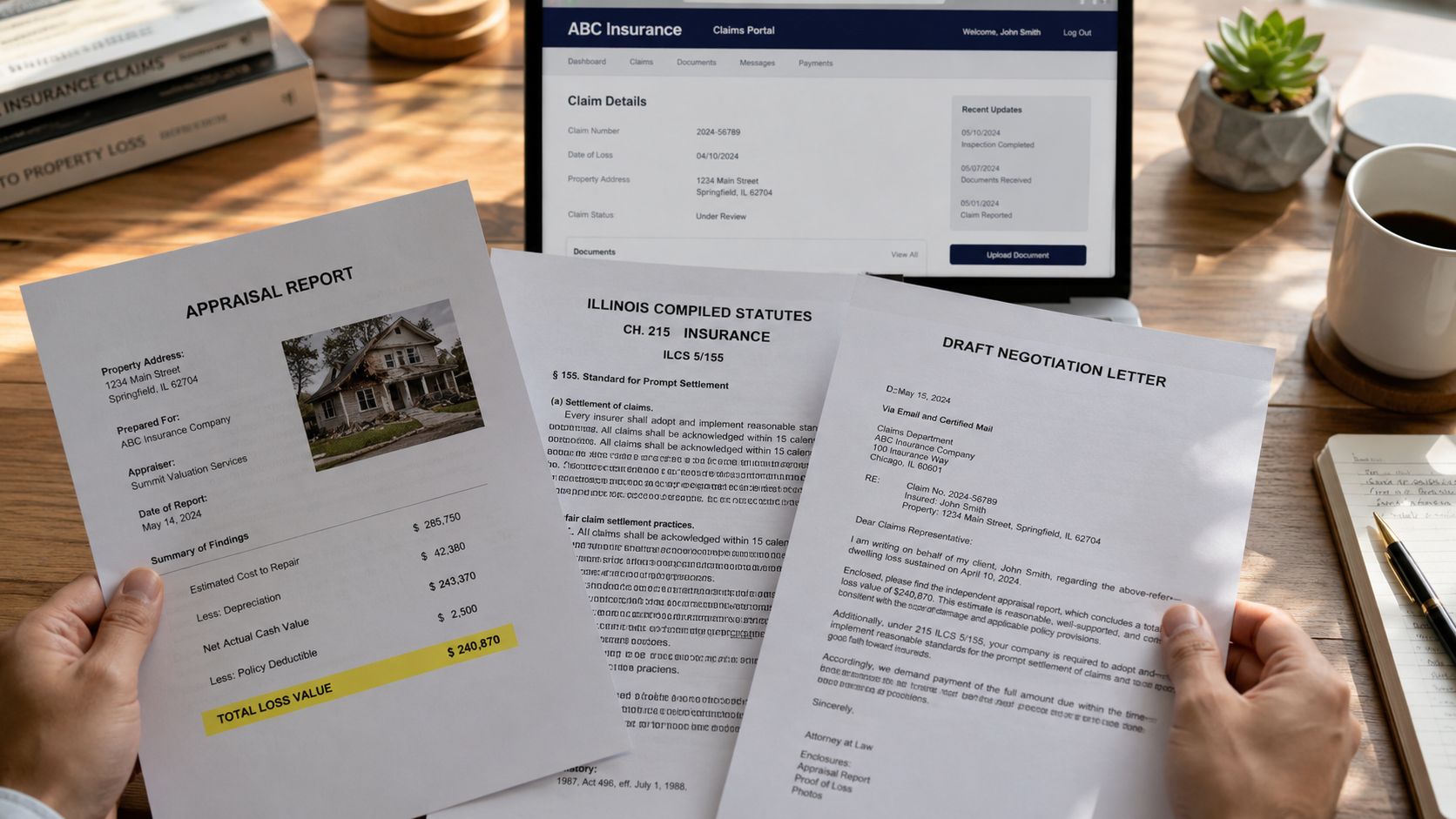
Send the report to the at-fault driver's insurer with a short, direct demand for payment. Keep your tone factual. You're not arguing philosophy, you're presenting documented loss. If the insurer counters with a low figure and ignores your market comparables, reply with the specific pages they missed and keep the paper trail clean.
Negotiating Your Illinois Diminished Value Claim
Insurers try to shrink the claim into a number that feels tidy on their side. They'll lean on internal formulas, skim the repair order, and act like the market doesn't matter. That's the mistake you shouldn't make. Your advantage comes from a credible appraisal, local comparables, and the fact that this is a third-party property-damage claim, not a goodwill request.
What insurers usually do first
They often come back low. Sometimes they rely on a formula that ignores local market demand, sometimes they argue that the repairs were complete, and sometimes they hope you won't push. That is why a generic estimate usually loses to an independent report backed by real comparables. A report with market evidence forces the adjuster to deal with the actual resale impact, not just the repair finish.
The broader claims environment helps anchor expectations. The National Association of Insurance Commissioners notes that diminished value losses in real-world settlements often land around 10% to 20% of the direct physical damage loss, which is a useful benchmark when an insurer's offer feels unrealistically small. NAIC benchmark via Illinois diminished value reference That doesn't mean every claim lands there, but it does mean a tiny offer deserves skepticism.
When to push, and when to escalate
Push when the insurer ignores local comparables, discounts structural damage, or treats the appraisal like an inconvenience. Ask them to address the specific evidence in writing. If the claim is in the moderate range, remember that Illinois small claims court covers amounts up to $10,000, so you're not trapped if the adjuster refuses to play fair. Illinois small claims threshold
If the gap is big enough, an attorney can help, especially when repair quality is disputed or the insurer keeps moving the target. But don't hand over your power by accepting the first low number just because it arrives quickly. Quick is not the same as fair.
The hard truth is this, the insurer's first number is often a negotiation position, not a valuation. Your job is to prove that the local market says more.
When to Contact a Certified Diminished Value Appraiser
Call a certified appraiser when the car matters enough that a bad number will cost you real money. That usually means a newer vehicle, a higher-value vehicle, structural or frame damage, disputed repair quality, or an insurer offer that looks detached from the market. If the car is ordinary and the loss is tiny, you may not need full appraisal work. If the number is meaningful, don't wing it.
A certified appraiser does one job well. They measure the loss with market data, vehicle-specific analysis, and comparable sales, then package it into a report that can support negotiation or, if needed, the appraisal clause process. That matters because insurers don't have to respect your estimate, they do have to confront a defensible valuation file.
Use this rule. If the accident history will bother a buyer, or if the insurer's number feels like it came from a script, get the appraisal. If you want a direct starting point, this Chicago appraiser page is the kind of resource drivers use when they need a documented loss figure instead of a guess.
Don't let the repair invoice be the end of the story. Pull your documents together, get an independent appraisal, and force the insurer to answer the market, not its own shortcut formula. If you want help building a real diminished value claim in Illinois, contact Total Loss Northwest and get the file started now.