Modern vehicles are getting written off sooner than most drivers expect. One industry legal analysis reported total-loss determinations for vehicles under three years old rose from 7.9% in the first half of 2018 to 8.01% in the first half of 2019, and about half of inspected totaled vehicles had significant frame damage.
That's why a small-looking collision can turn into a total-loss letter weeks later. The car may still roll, the lights may still work, and the body shop may even say it can be repaired, but the insurer is usually doing a different calculation behind the scenes.
Why Total Loss Decisions Are Happening Sooner Than You Expect
A driver leaves the scene thinking the car needs a bumper, a fender, maybe a radiator support. Then the estimate comes back, supplements pile up, and the adjuster sends a total-loss packet instead of a repair authorization. That shock is more common now because newer vehicles are crossing the economic line faster, even when the crash didn't look catastrophic.
The legal analysis tied total-loss determinations for vehicles under three years old to a rise from 7.9% to 8.01% between the first halves of 2018 and 2019, while vehicles aged four to six years moved from 13.03% to 13.41% over the same period source. Those numbers matter because they show the trend isn't limited to old beaters. Newer cars are getting swept into total-loss decisions more often.
What that feels like in the real world
A customer can walk away from a low-speed impact, drive home, and assume the car is safe to fix. The shop then discovers structural movement, sensor issues, or a repair path that quickly gets expensive. Once the estimate starts climbing, the insurer compares that growing number against the car's actual cash value, then decides whether the repair still makes economic sense.
Practical rule: the more modern the car, the less likely “it still drives” means “it's worth repairing.”
A 2024 review cited in Repairer Driven News found that about 50% of inspected totaled vehicles had significant frame damage source. That doesn't mean every frame hit becomes a total loss, but it does show how often structural damage sits at the center of the decision. Frame damage pushes the claim toward write-off territory because the repair isn't just about replacing parts, it's about restoring structure.
Modern unibody construction, sensors, and crash systems make that line blurrier than many drivers realize. The total-loss outcome is no longer reserved for dramatic wrecks. It's increasingly a math problem wrapped around a technical repair question.
Understanding Frame Damage and Its Severity Levels
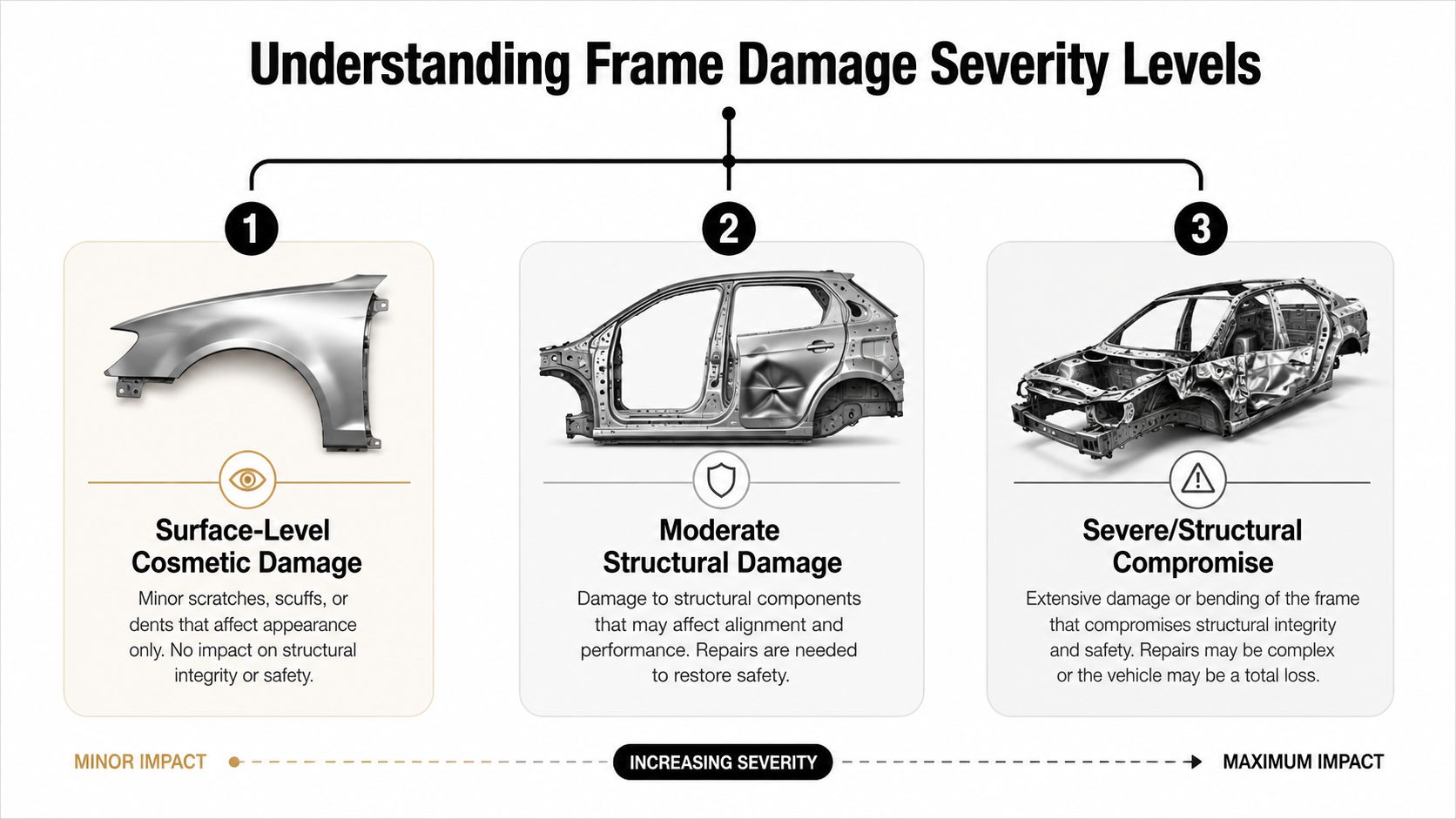
Frame damage gets talked about as if it were one thing. It isn't. In practice, the fight usually falls into three buckets, cosmetic scarring, structural misalignment, and true structural compromise.
The three severity levels that matter
Surface-level cosmetic damage is the stuff you can see right away, scuffed brackets, a bent sheet-metal edge, or a cover that sits crooked. It's ugly, but it doesn't automatically mean the structure is out of spec.
Moderate structural damage is where disputes often begin. Rails, pillars, pinch welds, or suspension points may have moved enough to affect alignment and crash behavior, even if the car still looks “mostly fine” from the outside.
Severe structural compromise is the point where the vehicle may not be returnable to factory geometry without major intrusion, or at all. That's the kind of damage insurers and shops worry about because the car's engineered crash performance is no longer a given.
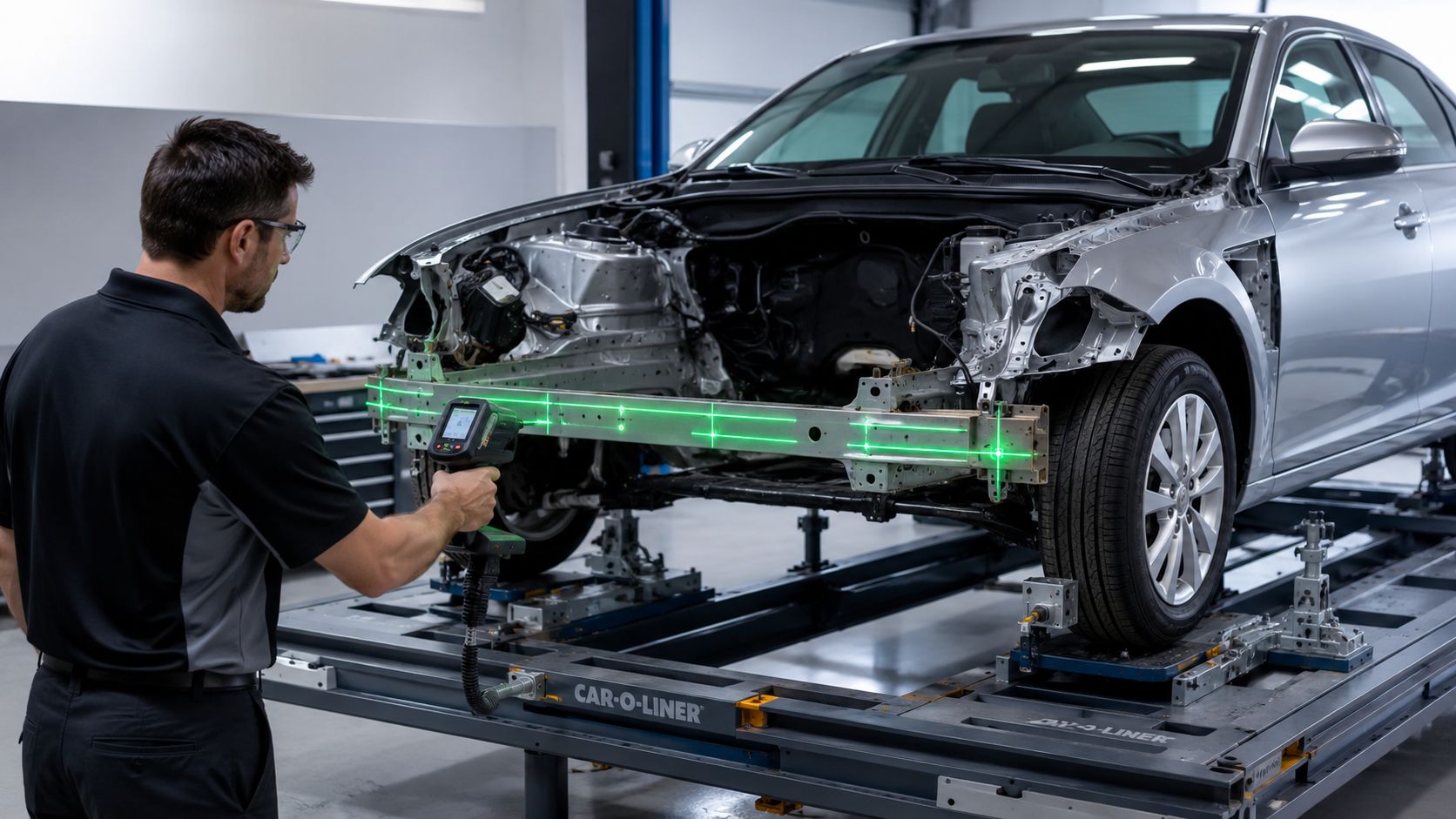
Modern shops don't guess at this. They use computerized laser measuring systems on a frame rack and compare suspension, rail, pillar, and pinch-weld points against OEM specifications, often to tolerances of only a few millimeters source. If the post-pull measurements can't get back within spec, the repair may no longer restore the vehicle to its designed crash performance.
That technical threshold matters more than whether the metal looks straight. If the geometry is off, the car can be repaired cosmetically and still remain structurally wrong. That's the hidden boundary in many frame damage total loss disputes.
For owners hauling parts, tools, or work equipment, even the way a damaged vehicle is transported can affect how the problem is documented. If you need a practical reference for equipment and transport setups, all steel work trailers guide is a useful example of how load-bearing gear is discussed in the trades.
Bottom line: visible straightening is not the same thing as restoring OEM tolerance.
Independent appraisal guidance also reports typical diminished-value losses of 20% to 40% for repaired structural damage and 50% or more for major frame damage source. So even when the repair succeeds, the market may still punish the history.
How Insurers Decide a Vehicle Is a Total Loss
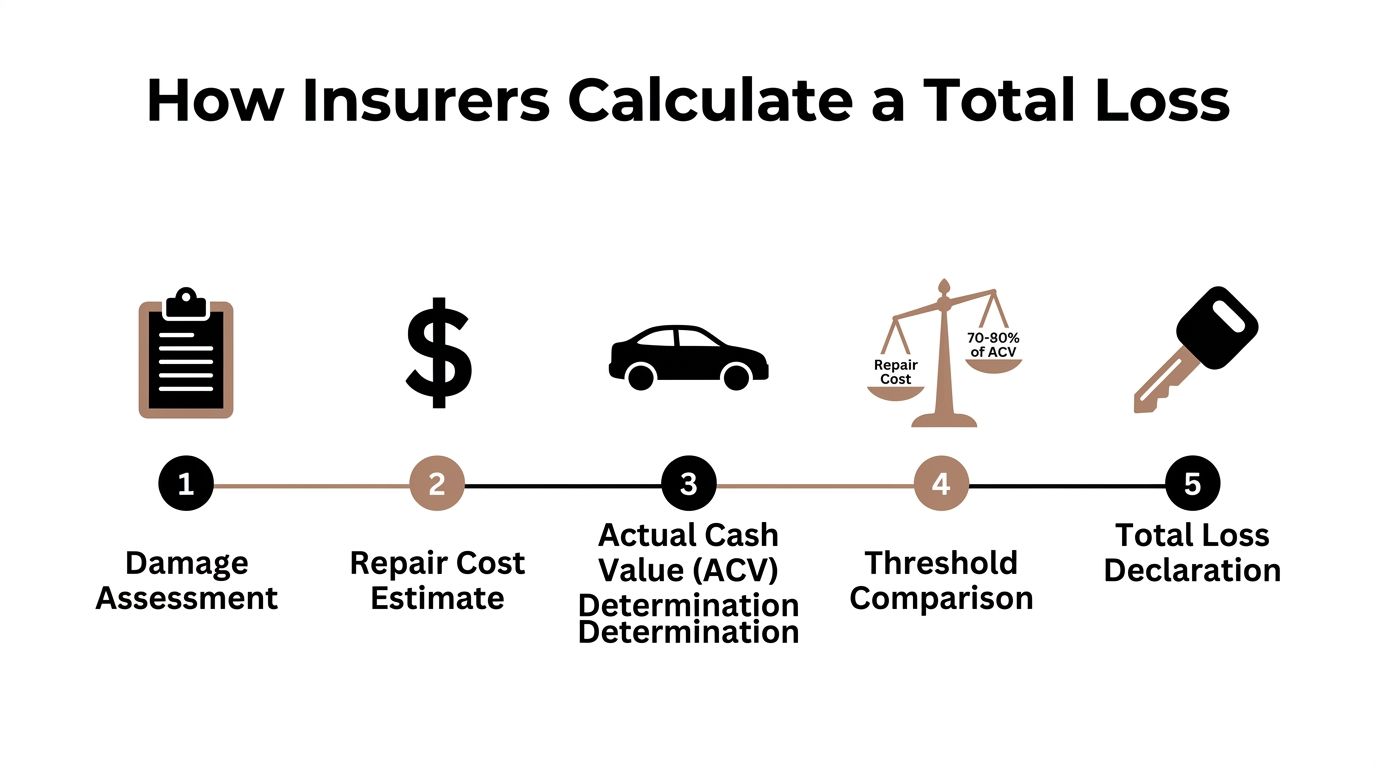
The insurer's question is never “Can this car be made to look nice again?” It's “Does the math still support repairing it?” That math usually starts with repair cost, reconditioning, and salvage value, then gets compared against the car's actual cash value.
The decision isn't based on one number
Repair cost alone doesn't settle the claim. A car with a modest repair estimate can still be totaled if its market value is low enough, while a high-value vehicle can sometimes survive a very expensive repair. The insurer is weighing several inputs at once.
The core formula is straightforward in concept. If the combined repair and related costs, plus salvage value, overtake the vehicle's actual cash value, the insurer has a strong basis to declare a total loss. Some states also apply percentage thresholds or similar statutory tests, which can trigger a total-loss determination before the math gets to that point.
That's why frame damage cases are so unpredictable for consumers. A structural hit can add hidden labor, calibration, and teardown costs that weren't obvious from the first estimate. Once the estimate changes, the total-loss line can move with it.
Why state rules and salvage values matter
State total-loss rules aren't uniform. Some use a percentage threshold, some rely on different formulas, and some give insurers more discretion than drivers expect. A car that might be repairable under one rule can be written off under another because the math is evaluated differently.
Salvage value also changes the outcome. A higher salvage bid makes the loss more expensive to the insurer, which can push a repairable-looking car over the economic line. Actual cash value moves too, depending on condition, mileage, equipment, and the local market.
If you're reviewing a claim file, the inspection report matters just as much as the valuation report. The internal inspection process can drive the whole decision, which is why it helps to understand the kind of evidence the carrier used. A good place to start is a document like the insurer's own vehicle condition inspection process, because the first estimate rarely tells the whole story.
The important thing is this. A total loss declaration is an economic judgment, not a moral one. It doesn't mean the car was destroyed beyond recognition. It means the numbers, under the insurer's rules, stopped favoring repair.
What a Total Loss Declaration Means for Your Title and Your Vehicle
Once the insurer calls it a total loss, the paperwork starts changing the car's identity. That title branding follows the vehicle long after the payout is issued, and it changes how future buyers, lenders, and insurers view it.
Salvage and rebuilt titles change more than resale
A salvage title usually means the vehicle was damaged enough to be declared a total loss and is being sold in that condition. A rebuilt title means someone repaired it enough to return it to road use, but the history doesn't disappear. The branding remains attached to the vehicle's record.
That branding has a real market effect. Independent appraisal guidance reports diminished-value losses of 20% to 40% for repaired structural damage and 50% or more for major frame damage, while salvage or rebuilt titles often lose 65% to 75% of pre-accident value source. A $35,000 vehicle can lose roughly $7,000 to $14,000 under the structural-damage range, and a $50,000 vehicle can lose $10,000 to $20,000 under the same assumptions source.
Why the loss doesn't stop at the settlement check
A totaled vehicle can be paid off and still remain a financial problem. If the owner wants to replace it later, the branded history may make financing harder, resale weaker, and comparisons with clean-title cars lopsided. Even repaired structural damage can scare off buyers who don't want prior frame work in the vehicle's history.
Buyers don't pay clean-title money for a car with a structural story, even when the repair looks good on paper.
That's why total-loss disputes often overlap with diminished-value claims. If the insurer shortchanges the ACV on the front end, the owner gets hit twice, first on the settlement, then on the market value of the replacement vehicle. Frame damage matters because it keeps affecting value after the wreck is over.
Repairable Frame Damage Versus Economic Total Loss Scenarios
Not every car with frame damage should be treated the same way. Some are technically repairable within OEM tolerance, while others are so expensive or so far out of spec that the insurer is justified in treating them as an economic total loss.
Two cars can look similar and still end up in different places
A vehicle with moderate structural movement may be repairable if the shop can measure it, pull it, and bring it back to factory dimensions. That only works if the OEM procedures support the repair and the finished car can regain its engineered crash performance. In those cases, the repair is about restoring structure, not just straightening sheet metal.
By contrast, a car with high repair cost relative to ACV can be totaled even if the structure is technically fixable. That's the part many owners miss. Repairability and economic worth are related, but they aren't the same thing.
KBB notes that frame damage can be repairable and that insurers usually total a car only when repair cost exceeds vehicle value. Repairer Driven News also notes that a second opinion or appraisal clause can be used to challenge the insurer's decision source. That distinction matters because a car can be repairable in theory and still not be a smart claim outcome in practice.
What makes one case repairable and another not
Use these questions when you're looking at your own file:
- Can the structure be measured accurately? If the shop can't document the movement, it's hard to argue for a sound repair path.
- Does the OEM publish a repair procedure? If the manufacturer has a path, the repair has a stronger technical foundation.
- Will the finished car return to crash performance? If not, the repair is only cosmetic.
- Does the estimate stay below the economic cutoff? If it doesn't, the insurer may still total it.
For more on how estimate writing affects that line, see repair shop estimates.
Frame damage total loss decisions become contentious when those answers conflict. A shop may say it can be fixed, while the carrier's math still says the car is worth less dead than alive. That's where the appraisal fight starts.
Actionable Steps for Vehicle Owners Facing a Total Loss Claim
The worst time to get organized is after the vehicle has already been released and the paperwork is moving. Once the insurer has the car and the estimate is locked in, your negotiating power shrinks fast.
What to do first
- Document everything before surrendering the car. Take photos of every panel, every wheel, the interior, the dash lights, and the underbody if you can safely do it. Video helps because it captures the whole vehicle in context.
- Get an independent appraisal. A certified appraiser can review the file with real market data and structural context instead of just the insurer's valuation software. In disputed cases, that's often the cleanest way to challenge a low number.
- Read the repair estimate line by line. Watch for missing blend labor, calibration items, teardown assumptions, and structural operations that were skipped or minimized.
- Invoke the appraisal clause when the policy allows it. That removes the carrier's biased valuation output from the center of the fight and forces a more formal review.
- Dispute the offer with evidence, not emotion. Comparable vehicles, condition documentation, repair procedures, and independent measurements carry more weight than frustration.
If you're in Oregon or Washington, this is the point where a state-specific total-loss and diminished-value approach matters. The file has to be built around the local claim rules, not just the shop's first impression. A firm that handles this work, such as Total Loss Northwest, is one example of the kind of independent appraisal resource owners use when the number feels off.
What evidence actually moves the claim
The most useful evidence is boring, organized, and hard to argue with. It includes the pre-loss condition, the exact damage photos, the valuation source, and any repair path that shows the car can or can't be restored within OEM tolerance.
If you can prove the car was worth more, or prove the repair path was written too aggressively, the settlement conversation changes.
Owners of high-value, collector, and custom vehicles should be especially careful. Standard valuation tools often miss equipment, condition, and market nuance. That's where independent documentation has real value.
Real Scenarios That Show What Is Possible
One owner brought in a late-model vehicle that had been labeled a total loss after the insurer leaned on an inflated repair estimate. The file hadn't been measured carefully, and the estimate treated the structural hit as if it required far more work than the OEM procedure called for. An independent appraisal showed the frame could be restored within tolerance, the repair cost came in materially lower, and the dispute ended in the owner's favor.
A second driver took the first settlement check and moved on. Months later, the car's structural history surfaced in resale conversations, and the owner realized the vehicle had suffered a 35% diminished-value loss that was never recovered source. The repair looked acceptable on the surface, but the market didn't care about appearances.
Those two outcomes come from the same kind of claim file. The difference was documentation, timing, and whether someone challenged the first number. A total-loss declaration is not always the final word, but once you accept it without testing the math, the advantage usually disappears.
When the frame is involved, the question isn't just whether the car can be fixed. It's whether the repair can be proven, measured, and supported well enough to beat the insurer's economic cutoff.
If your car's frame damage claim feels off, Total Loss Northwest can review the valuation, prepare an independent appraisal, and help challenge a low total-loss or diminished-value settlement in Oregon or Washington. Visit Total Loss Northwest if you want a claim file built around real market value, structural evidence, and the appraisal process rather than the insurer's first number.