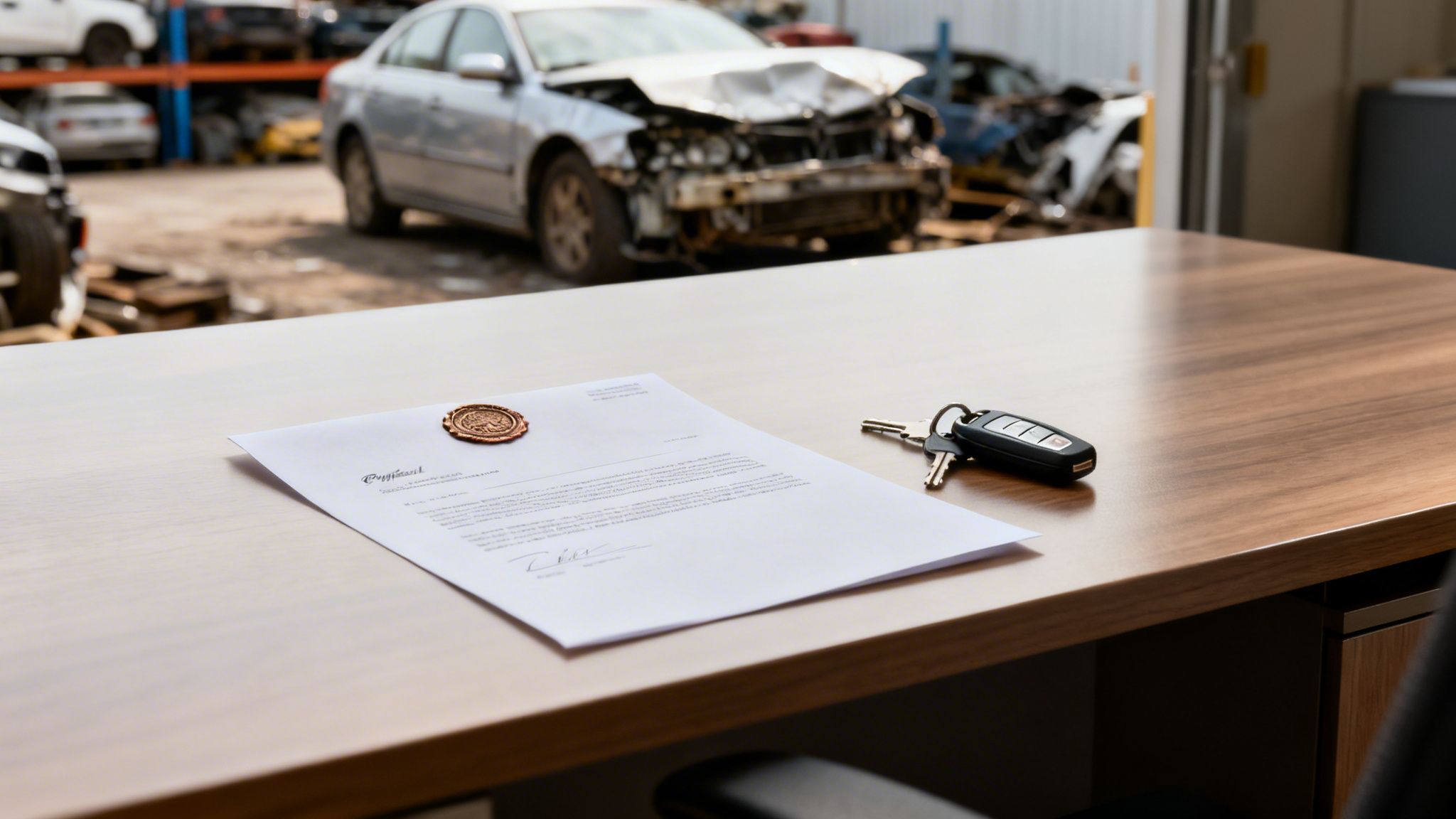
When your car is declared a total loss but you still owe money on it, things can get complicated. This is where a Letter of Guarantee for a total loss comes into play. Think of it less as a formal letter and more as an official payoff quote sent directly from your lender to your insurance company.
This document is the lynchpin of the whole process. It spells out the exact, to-the-penny amount needed to clear your auto loan. Once your insurer pays that amount, the letter guarantees the lender will release the lien, giving the insurance company a clean title to the salvaged vehicle.

Understanding the Key Players and the Process
After a total loss, a small group of people and companies need to work together to get your claim settled. The Letter of Guarantee is the central document that keeps everything moving and legally sound.
Essentially, it's a safety measure. It stops the insurance company from just cutting you a check and walking away, leaving your bank with an unpaid loan and a messy legal fight over the car's title. It's the official permission slip from your lender that tells the insurer, "Pay us this much, and the car is yours." This situation most often comes up after serious auto and motorcycle accidents, which are the primary cause of total-loss claims.
Who Is Involved in the Process
Getting your claim finalized involves a few key parties, and knowing their roles helps you understand what's happening and why.
To break it down, here’s a look at the main players and what they do during the settlement.
Key Players in the Letter of Guarantee Process
Understanding each party's role is the first step to a smooth total loss settlement.
| Player | Role in the Process |
|---|---|
| You (The Policyholder) | Your main job is to give your lender permission to talk to your insurer and provide details like your loan account number. |
| Your Insurance Company | They assess your car's value, make a settlement offer, and formally request the Letter of Guarantee from your bank or credit union. |
| Your Lender (The Lienholder) | As the title holder, they must provide the official payoff quote and instructions on how to send the payment before they'll release their lien. |
Each player has a distinct responsibility, and when they communicate effectively, the process goes smoothly. When they don't, you're the one stuck in the middle.
The core purpose of this letter is to eliminate risk for the insurer. Without it, they could pay the claim but still not have a clear title to the salvaged vehicle, making it impossible for them to recover costs at auction.
The path to settlement when you total a financed car can feel tangled, especially when you're trying to coordinate between your insurer and your bank. By knowing who's responsible for what, you can keep tabs on your claim and spot any hiccups before they turn into major delays.
So, What Exactly Is This "Letter of Guarantee"?
When your car is declared a total loss, the insurance settlement process can feel like a confusing mess of paperwork. One of the most critical documents you'll encounter is the letter of guarantee total loss.
Think of it this way: when you sell a house that still has a mortgage, you can't just hand over the keys and walk away. There's a formal closing process where the bank states the exact amount needed to pay off the loan and release their claim on the property. A letter of guarantee does the same thing for your totaled car.
This isn't just a casual email with a payoff quote. It’s a formal, binding document from your lienholder (the bank or credit union that financed your car). It spells out the precise loan balance, including any daily interest charges, and gives the insurance company exact instructions on where to send the money. Most importantly, it serves as a legal promise: once that payment is made, the lender will release the car's title, no strings attached.
This little piece of paper is what keeps the entire process moving smoothly and securely. Your lender gets their money, the insurer gets a clean title to the salvage vehicle, and you are officially free from that car loan.
It's All About Connecting the Dots
At its core, the letter of guarantee is a financial bridge. It links three different parties—you, your lender, and your insurer—who all have a stake in the outcome but different priorities. It forces everyone to get on the same page for a clean, final transaction. Without it, everything would screech to a halt over who owns what and who owes whom.
Here's how it helps everyone involved:
- For the Insurance Company: It’s their assurance that they won’t pay out a large settlement only to find out they don't legally own the wrecked vehicle. They absolutely need this guarantee before they can take the car and sell it at a salvage auction.
- For Your Lender: It confirms they will get the exact amount owed to them before they have to give up their ownership interest (the title).
- For You: This is your proof of closure. It confirms your debt is paid off, officially severing your financial ties to a car that's no longer drivable.
What's Actually in the Letter?
A proper letter of guarantee is much more than just a single payoff number. It's packed with specific details that make the transaction legally sound and give the insurance company everything they need to act.
Be aware: The payoff amount in a letter of guarantee has an expiration date. It's usually only good for about 10 business days. If the insurance company drags its feet and misses that window, you'll have to get a new one to account for the extra interest that's piled up.
Here’s what you can expect to see in the document:
- Total Loan Payoff Amount: The final, bottom-line number needed to close out your loan.
- Per Diem Interest: The daily interest charge. This is crucial because it tells the insurer how much to add for each day that passes until their check arrives.
- Good-Through Date: The deadline by which the payoff amount is valid.
- Payment Instructions: The nitty-gritty details—who to make the check out to and the exact mailing address.
- Vehicle Information: The VIN, make, and model of your car to make sure everyone is talking about the same vehicle.
By putting all this information in one official document, the letter of guarantee cuts through the confusion. It turns what could be a messy, three-way headache into a straightforward, legally protected transaction.
Why the Insurance Company Needs This Letter to Pay Your Claim
Ever found yourself wondering why the insurance company can’t just cut you a check after they’ve totaled your car? It all boils down to one simple concept: risk.
For an insurer, paying out a total loss settlement without a letter of guarantee is like buying a house without getting the title. It's a huge financial and legal gamble they are just not willing to take.
Without that official letter from your lender, the insurance company has a major problem. They could pay you the full settlement, but your lender’s lien would still be legally tied to the vehicle's title. This is where things get messy.
The insurer would be stuck with a wrecked car they can't legally own, can't sell at a salvage auction, and can't get rid of. The letter of guarantee is their ironclad protection against this scenario. It’s a legally binding promise from your lender that they will release the lien as soon as they get paid.
Avoiding a Legal and Financial Mess
Try to see it from the insurance company's side for a second. Their goal is to close your claim cleanly and move on. To do that, they need to pay what they owe and take legal ownership of the salvaged vehicle so they can sell it to recoup some of their costs. The letter of guarantee is the key that unlocks this whole process.
From their perspective, the letter does two critical things:
- It confirms the exact payoff amount. The letter spells out the precise dollar figure needed to close out your loan, including any per diem interest. This leaves no room for guesswork or disputes down the road.
- It guarantees a clean title. This is the big one. The letter is a formal promise that once the payoff is sent, the lender will hand over a clean, unencumbered title to the insurance company.
It's a non-negotiable step that ensures a clean break for everyone involved. Your lender gets their money, you are officially off the hook for the loan, and the insurer gets the salvage title they are legally entitled to.
The entire settlement process is essentially on hold until the insurer has this letter. It's the green light they need to finalize your claim and release the funds, knowing they are completely protected from any future legal claims on the vehicle.
A Modern Fix for an Old-School Bottleneck
In the not-so-distant past, getting this letter was a painfully slow ordeal. It often involved weeks of back-and-forth phone calls and faxes, bringing your settlement to a grinding halt.
Thankfully, technology has finally caught up. Digital platforms now connect insurers and lenders directly, dramatically speeding things up. Today, insurers see 78% of letters of guarantee come back within a single business day, with the average turnaround time now just 14 hours.
This is a massive leap forward, especially when you consider that an estimated 60-70% of the 5 million cars totaled each year in the US have an active loan. The old, manual system could drag out a settlement for up to 90 days, leaving you stuck in limbo. You can read more about these total loss payoff improvements and the positive impact they've had.
How to Get the Letter of Guarantee for Your Claim
When your insurance adjuster asks for a letter of guarantee for your total loss, it’s easy to feel stuck in the middle. On one hand, your insurer says they can’t move forward without it. On the other, your lender won’t just hand over your private financial info. The good news? You hold the key to breaking this logjam and getting your settlement moving again.
Your adjuster might kick off the request, but you're the one who has to green-light it. Because of privacy laws, your bank or credit union can't share your loan details with anyone—not even your insurance company—unless you give them explicit permission. Taking charge of this communication yourself is the single best way to speed things up.
This little document is the linchpin of the whole process. Think of it as the official proof your insurer needs to confidently pay off your loan and take possession of the salvaged vehicle.

As you can see, the letter of guarantee essentially removes the "block" created by the lien, clearing the path for the insurer to finalize the settlement and get the salvage title.
Your Step-by-Step Guide to Obtaining the Letter
Don't wait around for your insurer and lender to figure things out on their own. That's a recipe for weeks of frustrating delays. A hands-on approach is always best. Here’s exactly what to do.
Find the Right Department
Your first call is to your lender's main customer service number. You need to ask specifically for the department that handles insurance total loss claims. It might be called the "Lienholder Services," "Title Department," or simply the "Total Loss Department." Getting to the right people from the jump is half the battle.Gather Your Info
Before you even pick up the phone, get your paperwork in order. Having these details ready will make the call quick and painless.- Vehicle Identification Number (VIN)
- Loan Account Number
- Insurance Claim Number
- Your Insurance Adjuster's Name and Contact Information
Give Your Authorization
Once you’re connected with the right department, you need to be very clear. Tell them you authorize the release of your loan payoff information to your insurance company for your total loss claim. They’ll tell you exactly how they need that authorization—it could be verbal on the phone, or they might require you to submit a form online. Follow their instructions to the letter.
Taking these steps puts you in control, bridging the communication gap and keeping your claim on track.
Common Pitfalls and How to Avoid Them
Even if you do everything right, you can still hit a few snags. The most common one by far is an expired payoff quote. A letter of guarantee isn't good forever; most are only valid for 10 business days. If the insurance company doesn't cut the check within that window, the whole process starts over.
Pro tip: A few days after giving your authorization, follow up. A quick call to confirm your lender sent the letter and that your adjuster received it can save you from getting stuck in administrative limbo.
Also, double-check every single piece of information you provide. A simple typo in your VIN or claim number is enough for the request to be rejected, causing completely avoidable delays. For more expert advice on the entire process, check out our complete guide on what to do when your car is totaled. By staying organized and involved, you can navigate this part of your claim with confidence.
How an Appraisal Helps You Avoid the Negative Equity Trap
Here’s the biggest financial gut punch you can face after a total loss: the insurance company’s settlement offer is less than what you still owe on your car loan. It's an all-too-common nightmare known as negative equity, and it can leave you stuck making payments on a car you can't even drive.
A letter of guarantee is crucial because it tells everyone the exact payoff amount for your loan. But it does absolutely nothing to fight a lowball offer from your insurer. For that, you need an independent appraisal.

Before you ever dream of accepting a settlement, remember this: you have the right to invoke the Appraisal Clause in your policy. This is your secret weapon. It lets you bring in a certified, independent appraiser to determine what your vehicle was really worth right before the accident.
The Appraisal Clause: Your Best Defense
Invoking the Appraisal Clause completely changes the game. It takes the power out of the insurance company’s hands and forces them to the negotiating table. Suddenly, they have to deal with objective facts and real market data, not just the biased software they use to keep payouts low.
A detailed, professional appraisal report can often close—or completely eliminate—the gap between their initial offer and what you owe. It’s the difference between walking away free and clear or being saddled with a debt for a car that’s already been hauled off to a salvage yard. You can get a deeper look into what a car appraisal involves in our complete guide.
This problem isn't just for daily drivers. Think about a classic car or a custom truck you've poured your heart and money into. If it gets totaled, the potential for a massive shortfall is even greater. Your loan balance could dwarf the insurance payout, creating a serious financial mess. This is where tools like guaranteed auto protection (GAP) insurance and the letter of guarantee process are lifesavers. With used car values always in flux, an independent appraiser is your best shield against a valuation that doesn't reflect reality.
Why an Independent Valuation Is So Powerful
An independent appraisal is much more than a second opinion; it's a meticulously researched report built on solid evidence. Here’s how it works in your favor:
- It Finds Real Comps: A good appraiser digs up recently sold vehicles that are a true match for your car's make, model, trim, and pre-accident condition—not just the cheapest listings the insurer's software cherry-picks.
- It Values Your Upgrades: The appraisal properly accounts for aftermarket parts, recent big-ticket maintenance (like new tires), and unique features that the insurer's automated system almost always overlooks.
- It Gives You Real Leverage: A certified appraisal is a professional document that carries weight. It forces the adjuster to justify their low number, and frankly, they often can't.
Let's be blunt: the insurance company’s valuation software is programmed to save them money. An independent appraiser has only one job: to determine the fair, actual cash value (ACV) of your vehicle.
At the end of the day, a letter of guarantee tells you the size of the hole you're in. An independent appraisal is the tool you use to dig yourself out. It's the single most effective way to escape the negative equity trap and get the fair settlement you deserve.
Answering Your Top Questions About This Process
Navigating the aftermath of a total loss can feel like learning a new language, with unfamiliar terms and procedures around every corner. The letter of guarantee total loss process is a big one, and it's where most of the practical questions pop up.
Let's break down the most common concerns I hear from clients—from timelines and payment logistics to what happens when the numbers just don't add up. This is where the rubber meets the road, where your settlement offer finally gets measured against your loan balance. Getting these final steps right is the key to protecting your finances.
How Long Does It Take to Get a Letter of Guarantee?
Thankfully, the days of waiting around for a fax to slowly crawl out of a machine are mostly behind us. Most major insurers and lenders are plugged into digital platforms that have seriously streamlined this process.
Once you give your lender the green light to release your loan information, you can typically expect the letter to be issued within 1-3 business days. But of course, delays can still happen. The most common hold-ups I see are:
- Simple Typos: A single wrong digit in your VIN or loan account number is enough to get the request kicked back.
- Smaller Institutions: Local credit unions or smaller banks might not be hooked into the newer digital systems, meaning they have to handle the request manually, which always takes longer.
If a week goes by and you've heard nothing, it's time to make some calls. A polite follow-up with your insurance adjuster and your lender’s total loss department can usually shake things loose.
Can I Get the Settlement Check if the Letter Is Delayed?
I get this question all the time, and the answer is a firm no. Your insurance company will not release a single penny of your settlement until they have that official Letter of Guarantee in hand. This isn't just them being difficult; it's a legal and financial requirement.
Think of the letter as their legal shield. It’s the one document that proves they have the undisputed right to take ownership of your vehicle's title once they pay off your loan. Without it, they'd be paying out thousands for a salvaged car they can't legally own or sell. Your entire settlement is effectively on pause until this piece of paper arrives.
Your claim is in a holding pattern until the letter of guarantee arrives. It is the final green light the insurer needs to cut the check and close your claim, so any delay directly impacts how quickly you receive your money.
What if the Settlement Is Less Than My Loan Payoff?
This is easily one of the most stressful situations anyone can face in a total loss claim. When the insurance company’s settlement offer is lower than the payoff amount on your Letter of Guarantee, you're officially "upside-down" on your loan. And here’s the hard truth: you are responsible for paying the difference.
But here’s the critical thing to remember: the payoff amount on that letter is a fixed debt, but the settlement offer is not set in stone. This is precisely why you should never, ever accept an insurer's first offer without a fight. The gap between what they offer and what you owe is called negative equity, and you don’t have to just accept it.
This is where an independent appraisal becomes your most powerful tool. By invoking the Appraisal Clause in your policy, you can formally challenge the insurer's low-ball valuation. A certified appraiser will determine your car's true pre-accident market value, forcing the insurance company to negotiate based on facts, not their own cost-saving software.
A solid appraisal can dramatically increase the settlement, often closing or even eliminating that financial gap entirely. And if a difference still remains, Guaranteed Auto Protection (GAP) insurance—if you bought it with your loan—is designed to cover exactly that shortfall.
Don't let an insurer's lowball offer leave you paying for a car you no longer own. If you're facing a total loss in Washington or Oregon, Total Loss Northwest can help. We are certified independent appraisers who fight to get you the true, fair market value for your vehicle. We invoke the Appraisal Clause on your behalf to ensure your settlement is accurate and just. Protect your finances by visiting us at https://totallossnw.com to get the expert appraisal you deserve.