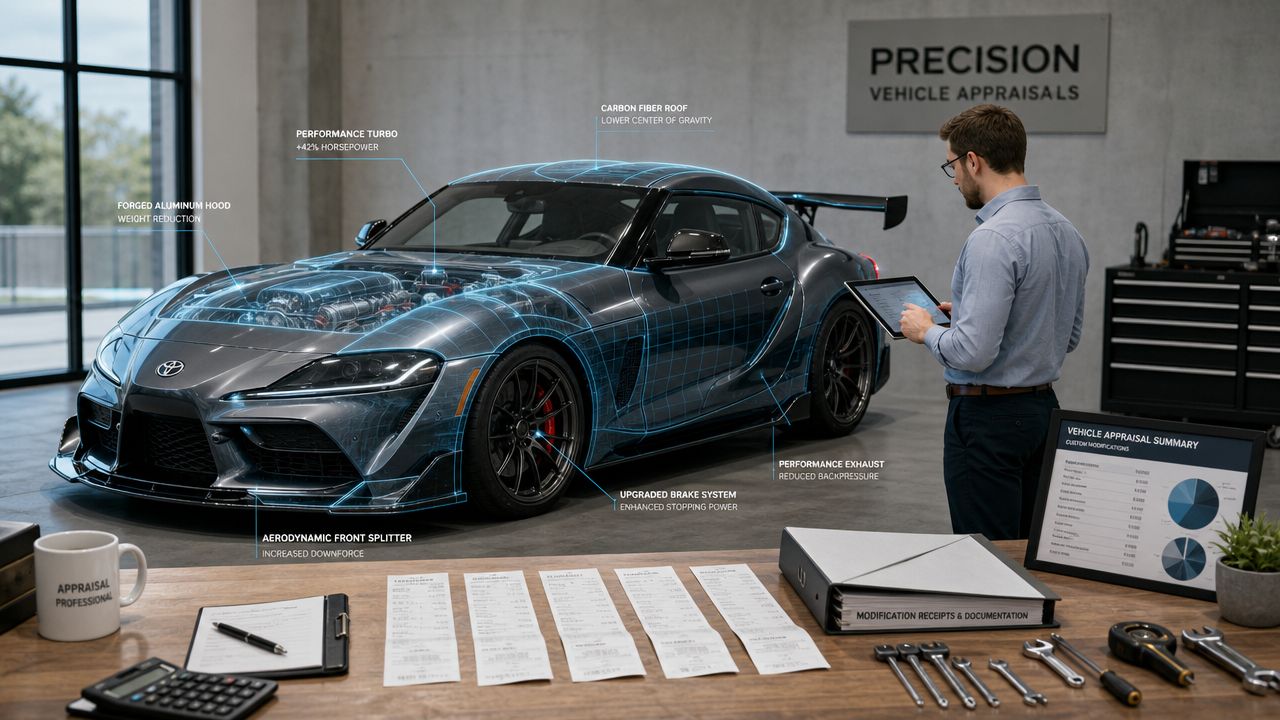
You did the work right. The parts were quality. The install was clean. You kept receipts, took photos, maybe even saved dyno sheets and alignment specs. Then the accident happened, the insurer ran your truck or performance car through a standard valuation system, and the offer came back looking like they priced a stock example with none of the upgrades that made the vehicle worth owning.
That shock is common. It's also fixable.
A modified vehicle doesn't fit neatly into generic pricing tools. Those systems are built for average vehicles sold through broad retail channels. Your lifted truck with premium suspension, bumpers, wheels, and documented shop labor is not average. Your tuned performance car with supporting fuel, brake, and handling upgrades is not average either. The claim turns into a fight over fair market value, and the insurer often starts from a number that ignores the very things a real buyer would pay for.
A proper modified vehicle appraisal closes that gap. It doesn't rely on a one-size-fits-all book figure. It documents the build, evaluates condition, and connects the vehicle to the niche market where similar builds sell. That's how you move the discussion away from “aftermarket parts have no value” and toward evidence an adjuster, appraiser, arbitration panel, or court can follow.
Your Modified Car Is Worth More Than They Say
A familiar claim story starts like this. A driver buys a late-model truck, adds suspension, wheels, tires, lighting, armor, and a premium bumper. Or a car owner builds a balanced street performance setup with intake, tune, exhaust, brakes, and suspension. The work is professional, the receipts are organized, and the vehicle gets attention because it's well done.
Then a crash turns it into a total loss or a diminished value dispute.
The insurer's first number usually comes from software that compares the vehicle to stock listings. That's where owners get blindsided. The software may recognize trim, mileage, and options, but it often treats quality modifications as irrelevant, risky, or impossible to measure. The result is a settlement offer that feels disconnected from the actual market.
That frustration is justified. If you need a plain-language grounding in what insurers are supposed to pay, start with this explanation of fair market value after a vehicle loss. It matters because fair market value is not the same thing as a bare book figure.
The market for modified vehicles is real
Collectors and enthusiasts aren't a fringe corner of the auto world. According to JMK Classic Cars' discussion of modified and restored vehicle valuation, the Historic Automobile Group International reported that global auction turnover for classic and modified vehicles exceeded $1.2 billion in 2021, and Hagerty's 2022 market analysis indicated demand for modified and custom collector vehicles rose by about 40% between 2019 and 2021, with many selling at or above 120% of guideline values when documentation was strong.
That doesn't mean every modified vehicle is worth more than stock. It means the market already distinguishes between average builds and documented, desirable ones. Insurance software often doesn't.
Strong documentation changes the conversation. A modified vehicle without records looks like a risk. The same vehicle with invoices, photos, and build details looks like a product with a trackable market.
Why owners lose value in the first round
The first offer often misses three things:
- Build quality: The insurer sees non-OEM parts. A real buyer sees quality brands, proper fitment, and coherent upgrades.
- Niche demand: Modified trucks and performance cars often sell to specialty buyers, not generic used-car shoppers.
- Proof of execution: Shop invoices, install records, alignment sheets, dyno logs, and before-and-after photos can separate a premium build from a pile of parts.
That's why a low initial offer isn't the end of the process. It's often just the insurer's starting position.
What Is a Modified Vehicle Appraisal
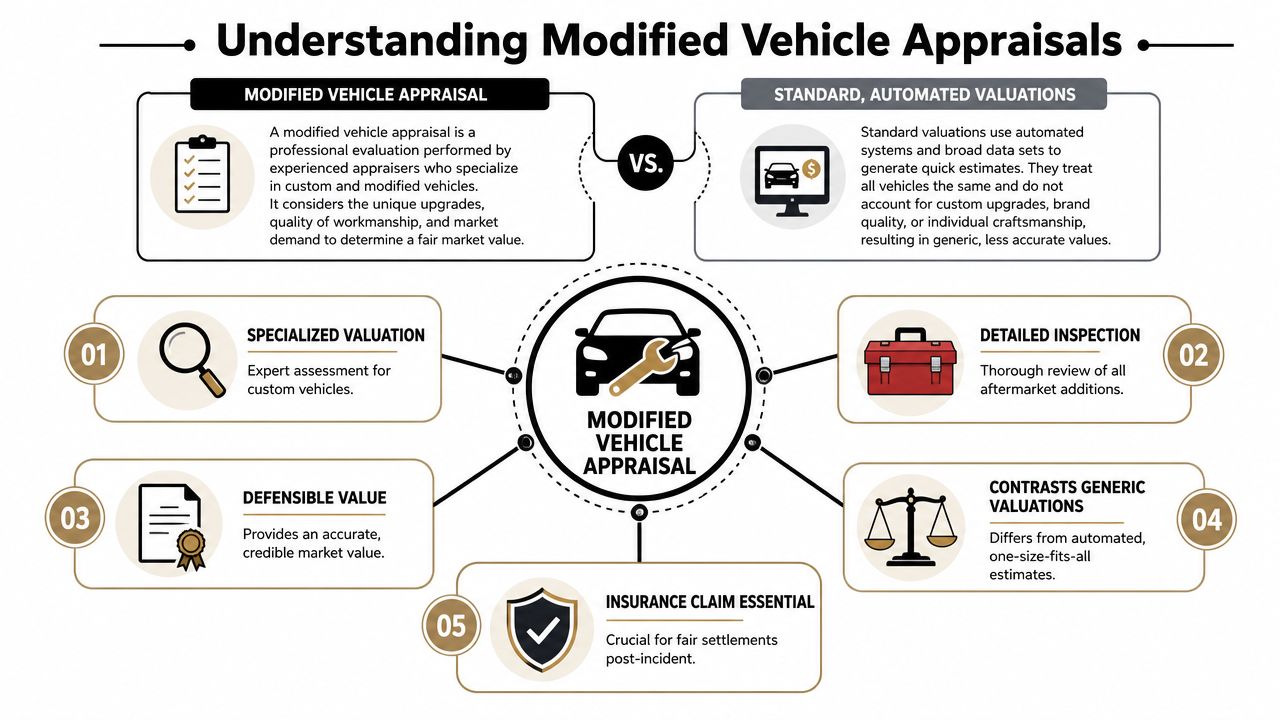
A modified vehicle appraisal is an independent valuation that measures what your specific vehicle would reasonably sell for in its actual market, not what an automated system says a stock version should bring. Compare this to valuing a custom home. A tract house can be priced by pulling nearby sales with the same floor plan. A custom-built home needs someone to account for materials, craftsmanship, unique features, and buyer demand.
A modified truck or performance car works the same way.
If you want a baseline explanation of the service itself, this overview of what an appraisal for a car involves is a useful starting point. For modified vehicles, the job goes further because the appraiser has to connect custom work to actual market behavior.
What an automated valuation usually misses
Standard insurance tools are efficient. They are not nuanced. They often do a decent job on ordinary vehicles with ordinary equipment. They struggle when a vehicle has been meaningfully changed from stock.
A 2023 J.D. Power survey summarized here found that 38% of owners of modified vehicles felt their settlement was lower than the true market value because insurers treated the vehicle as “non-standard” without concrete regional market data for those builds. That lines up with what owners see in practice. Many valuation tools strip out aftermarket value instead of analyzing it.
What a real appraisal looks at
An appraiser doesn't just total receipts. Cost matters, but market response matters more. The work usually includes:
- Base vehicle analysis: Year, make, model, trim, mileage, condition, prior history, and originality where relevant.
- Modification review: Parts used, brands, installation quality, supporting upgrades, and whether the build makes sense as a whole.
- Documentation audit: Receipts, build sheets, dyno logs, photos, service records, alignment reports, and shop names.
- Market matching: Comparable sales from places where similar vehicles trade, including niche enthusiast channels when appropriate.
- Condition separation: The appraiser distinguishes the underlying condition of the vehicle from the added or reduced value created by the modifications.
Practical rule: A receipt proves money was spent. It does not automatically prove market value. The appraisal has to show why buyers in that vehicle's niche would pay for the build.
Why this matters in a claim
A modified vehicle appraisal gives the insurer something better than an argument. It gives them a report with evidence, comparable sales logic, and a value conclusion they can either accept or challenge on the merits. That changes the claim from “I know what I have” into a documented valuation dispute.
How Modifications Affect Your Car's Value
Not all modifications help. Some add value because buyers want them, trust the brands, and can see the work was done correctly. Others narrow the buyer pool or signal future problems. The appraiser's job is to separate upgrades that increase desirability from changes that reduce it.
A 2019 industry survey summarized by iDrive Certified found that appraised, well-documented, and professionally installed modifications could increase a vehicle's market value by 15% to 35% over its stock equivalent. The same summary notes that poorly executed or undocumented modifications can reduce value by 10% to 25%.
What usually adds value
For custom trucks, buyers often respond well to cohesive builds. That means suspension matched to wheel and tire size, quality armor or bumpers, proper alignment, clean wiring, and a look that feels intentional rather than unfinished.
For performance cars, value tends to follow balanced upgrades. A tune with no supporting hardware can worry buyers. A complete package with cooling, fueling, braking, and records reads differently.
| Modification Category | Factors That ADD Value | Factors That REDUCE Value |
|---|---|---|
| Engine and tuning | Professional install, reputable brand parts, supporting mods, dyno logs, clean calibration | Aggressive tune with no records, drivability issues, check-engine lights, unknown parts |
| Suspension and brakes | Quality components, proper geometry, alignment records, matching use case | Poor ride quality, uneven tire wear, rubbing, mismatched parts |
| Wheels and tires | Correct fitment, premium brands, strong tread, market-appropriate style | Cheap wheels, incorrect offsets, worn tires, poor load rating choices |
| Exterior upgrades | Durable materials, proper fit, paint-match quality, functional add-ons | Flaking finish, poor panel fit, cosmetic excess, visible shortcuts |
| Interior and electronics | Clean upholstery work, integrated gauges, tasteful upgrades, intact factory functions | Cut panels, wiring issues, highly personalized design, disabled features |
A premium bumper is a good example of the difference between appearance and substance. On trucks, buyers often care whether the part is built well, fits properly, and holds up to actual use. That's why resources like Galhor vs. cheap chrome can help owners understand how materials and construction affect perceived value. An appraiser looks at that same distinction in market terms.
What appraisers notice immediately
Small details tell a big story. Wiring routed cleanly with proper protection. Matching fasteners. No rubbed-through hoses. No hacked interior trim. No overspray where there shouldn't be any. No mystery switches with no labels.
Those details matter because buyers use them to judge the whole build.
A vehicle can have expensive parts and still appraise poorly if the installation quality suggests future headaches.
Documentation is part of the value
When the same modification appears on two otherwise similar vehicles, the documented one usually presents better. Buyers trust records because records reduce uncertainty. Insurance carriers and arbitrators react the same way. If the vehicle has build photos, parts invoices, shop names, and service follow-up, the premium is easier to defend.
The Modified Vehicle Appraisal Process
Most owners expect the appraisal to be complicated. It's methodical. The stress usually comes from the claim itself, not from the valuation process. Once you know what the appraiser needs, the work becomes manageable.
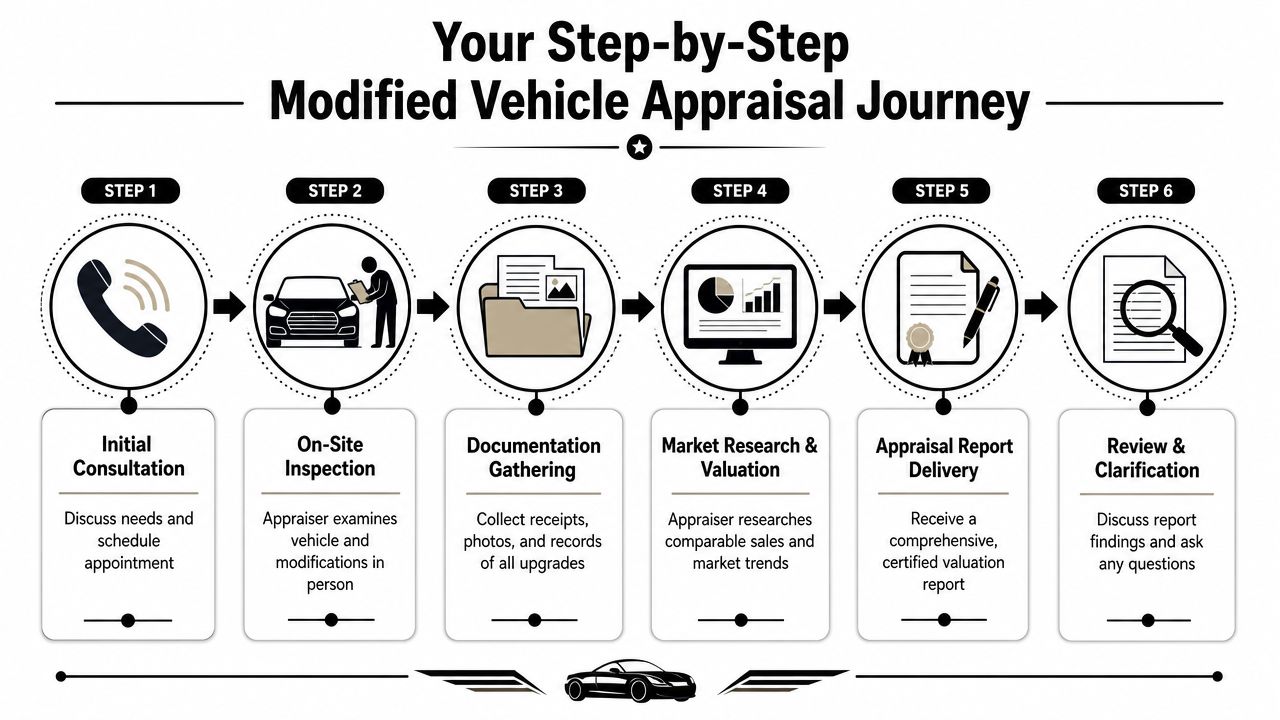
A strong report is built in layers: vehicle facts, modification proof, condition analysis, and market support.
Step one is paperwork, not guessing
The first thing an appraiser needs is your documentation. Owners often think receipts are enough. They're not enough by themselves, but they're a strong start. Build the file before the inspection if you can.
Bring together:
- Invoices and receipts: Parts, labor, paint, fabrication, tuning, alignment, and maintenance after the build.
- Photos: Before, during, and after the work. Include close-ups of branded components and installation details.
- Build summary: A clean list of what was changed, who did it, and why those parts were chosen.
- Supporting records: Dyno sheets, corner-balance sheets, service notes, show history, and any certification paperwork.
Inspection and condition scoring
The physical or virtual inspection focuses on both the vehicle and the build. The appraiser then checks whether the records match the car and whether the execution supports a premium.
As summarized by iDrive Certified's appraisal guidance, industry-standard appraisal guides use condition scoring frameworks where a vehicle with documented, high-quality modifications may justify a premium modifier of 1.15 to 1.25 on its base value. The point isn't to apply a magic multiplier. The point is to use a structured method that ties quality and condition to observed market results.
Later in the process, many owners find it helpful to watch a concise explanation of how valuation disputes get handled in practice:
Market research for niche vehicles
This is the step generic tools usually skip. A modified truck may sell through enthusiast groups, specialty dealers, local off-road communities, or custom-truck marketplaces. A performance car may trade through forums, marque-specific groups, private listings, or event-based sales. An appraiser searches for comparables that reflect that reality.
The final report should do more than state a number. It should explain:
- What the stock vehicle market looks like
- Which modifications are recognized as value-contributing
- How condition changes the value
- Why the selected comparables fit the subject vehicle
- Where the insurer's method likely missed relevant value
That report is what gives you an advantage. Not just because it's independent, but because it's explainable.
Using Your Appraisal in an Insurance Claim
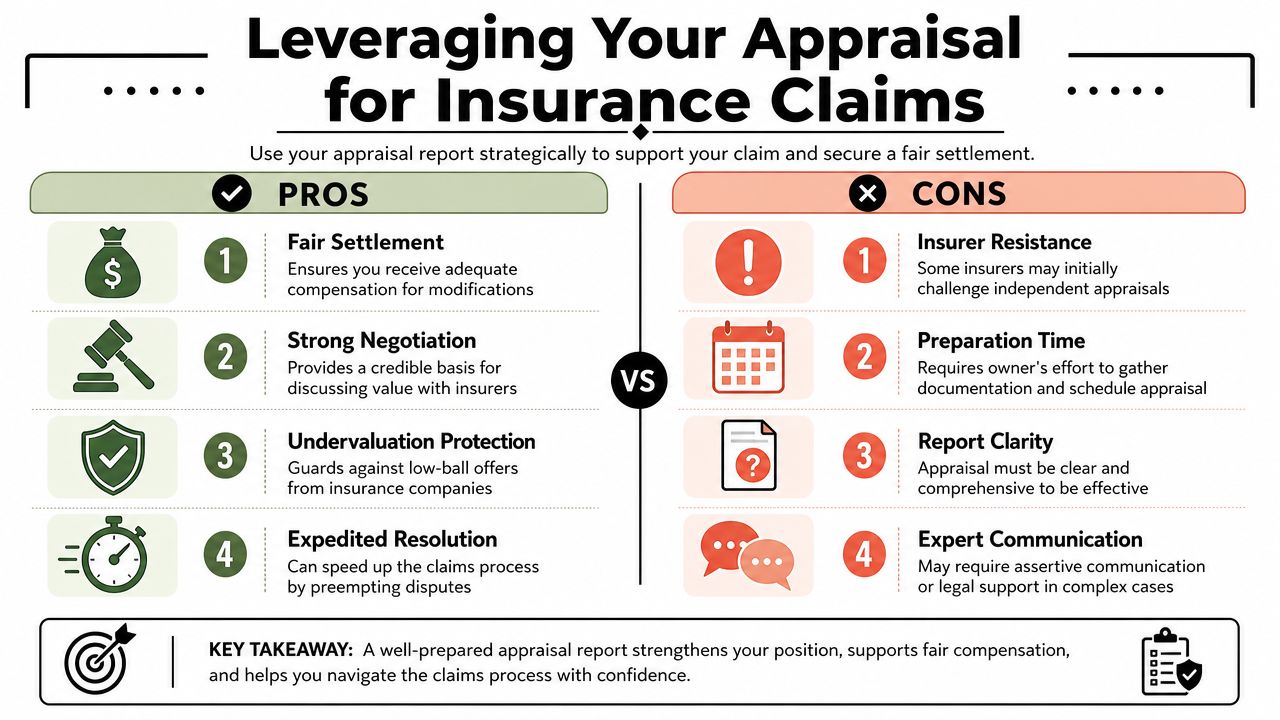
A good appraisal matters most when you use it strategically. Sending over a PDF and hoping the adjuster changes course isn't always enough. You need to frame the report as evidence of actual market value and, when necessary, use the contractual tools already built into many policies.
Modified vehicles often trade outside the channels insurance software relies on. According to Auto Praise's summary of niche-channel pricing, custom trucks can trade 15% to 30% above retail benchmarks in enthusiast-focused channels, yet most valuation tools ignore those venues. That's why a formal appraisal that organizes build logs, receipts, and niche market comparables into a format insurers or arbitration panels can review is so important.
How to present the appraisal effectively
Don't treat the report like a complaint attachment. Treat it like the centerpiece of your valuation response.
- Submit it with a written summary: Identify the insurer's valuation gaps. Mention omitted modifications, missing comparables, and any stock assumptions.
- Attach supporting records: Receipts, build photos, dyno results, and maintenance records should reinforce the report, not sit in a separate pile.
- Ask direct questions: Which modifications did the insurer include, which did it exclude, and what market data supports those choices?
If your loss involves theft as well as valuation issues, a practical companion resource is this guide to stolen car insurance, because theft claims often raise the same documentation and proof problems modified-vehicle owners face after a collision loss.
The appraisal clause is often the turning point
Many owners don't realize their policy may include an appraisal clause, sometimes called a right to appraisal. That provision usually allows each side to hire its own appraiser if there's a dispute over value. If the two appraisers can't agree, they may select an umpire to resolve the difference.
This process isn't about being difficult. It's about using the valuation mechanism the policy already provides.
If you're reviewing coverage before or during a claim, it also helps to understand the broader context of insurance options for modified cars. Policy language matters because standard coverage often treats custom work differently than owners expect.
When the insurer's software is built for stock vehicles, a formal appraisal is how you put your actual vehicle back into the file.
What hurts your position
Three mistakes show up again and again:
- Accepting the first offer too quickly: Once a claim closes, negotiating power usually diminishes.
- Arguing cost instead of market value: “I spent this much” isn't the same as “the market pays this much.”
- Sending disorganized proof: Adjusters respond better when the evidence is sorted, labeled, and tied to the valuation conclusion.
A calm, documented challenge is more persuasive than a frustrated one.
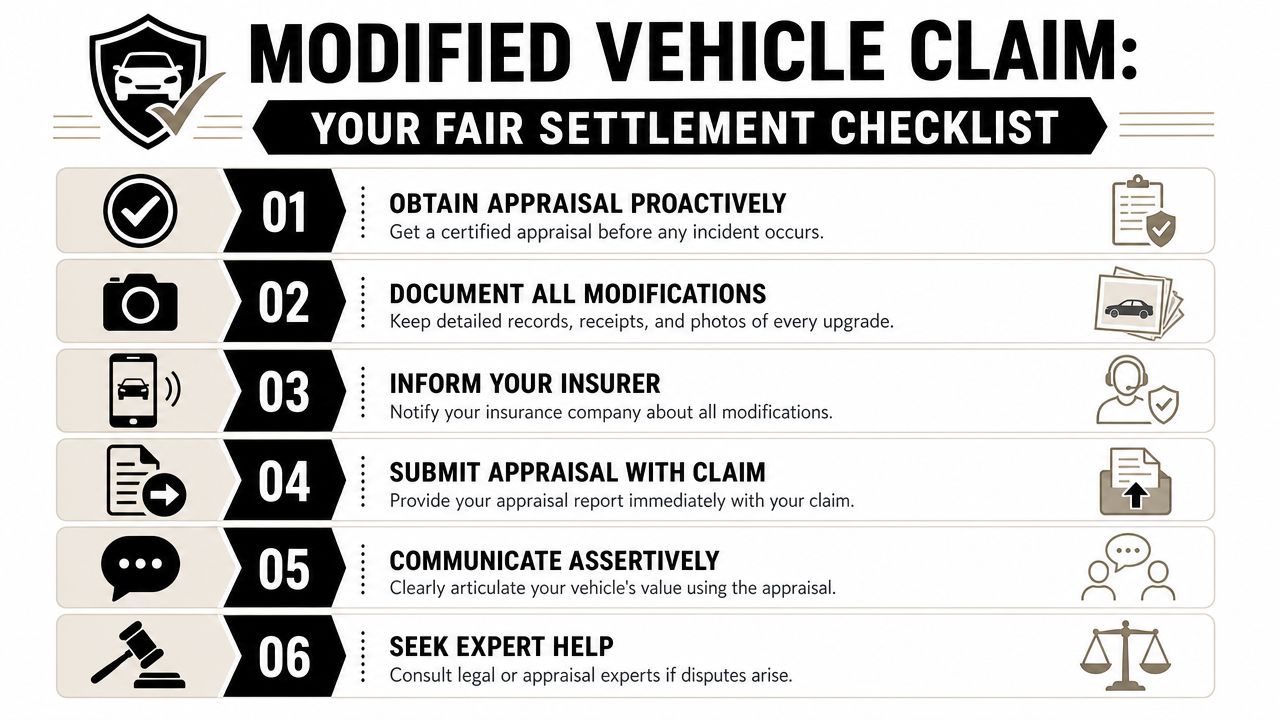
Your Checklist for a Fair Settlement
When the claim is active, clarity matters more than volume. The owners who usually do best are the ones who document early, respond in writing, and keep the dispute focused on evidence rather than emotion.
Use this checklist as your working file.
What to do right away
- Photograph everything: Get wide shots, close-ups, interior photos, engine bay photos, and images of all visible modifications.
- Gather every record: Pull parts invoices, labor receipts, tuning sheets, alignment paperwork, and service history into one folder.
- Write a clean mod list: Include brand names, install dates, shop names, and any related supporting upgrades.
What to do before responding to the offer
- Read the valuation carefully: Check whether the insurer described the vehicle accurately and whether it treated the vehicle like stock.
- Look for omissions: Missing wheel packages, suspension systems, bumpers, engine hardware, interior upgrades, and electronics change the discussion.
- Separate sentimental value from market value: Your attachment is real, but your strongest claim comes from market evidence.
What to do if the offer is low
- Don't accept it just to move on: A rushed signature can lock in an undervalued settlement.
- Request the insurer's support: Ask which comparables were used and how modifications were treated.
- Get an independent modified vehicle appraisal: The report should connect the build, condition, and actual market.
- Review your policy for an appraisal clause: If negotiations stall, that clause may be your next step.
Bottom line: The stronger your file is before the argument starts, the less room the insurer has to treat your build like a generic used vehicle.
A fair settlement on a modified vehicle usually comes from preparation, not luck. Owners win these disputes when they can show that the parts were quality, the work was done properly, the vehicle appealed to a real niche market, and the insurer's standard tools failed to account for that.
If you're dealing with a low total-loss offer or a diminished value claim on a modified vehicle, Total Loss Northwest can help you challenge the insurer's number with a certified, evidence-backed appraisal. They specialize in total loss and diminished value appraisals, invoke the appraisal clause on behalf of vehicle owners, and build reports designed to hold up in negotiation.