You're standing there with a fresh estimate in your inbox, and it doesn't feel like a settlement at all. The other driver caused the crash, your car is in pieces or stuck in a shop, and the number they sent barely reflects what you've already lost. In a not at fault accident settlement, that first offer is usually the opening move, not the finish line.
The mistake I see most often is treating the claim like one number. It isn't. A property-only claim is usually built from repair cost or actual cash value, diminished value, loss of use, and rental or carrier expense, and the insurer will only pay what you document well enough to defend. In Oregon and Washington, that matters even more because the fight is often over valuation, not liability.
What a Not at Fault Accident Settlement Actually Means
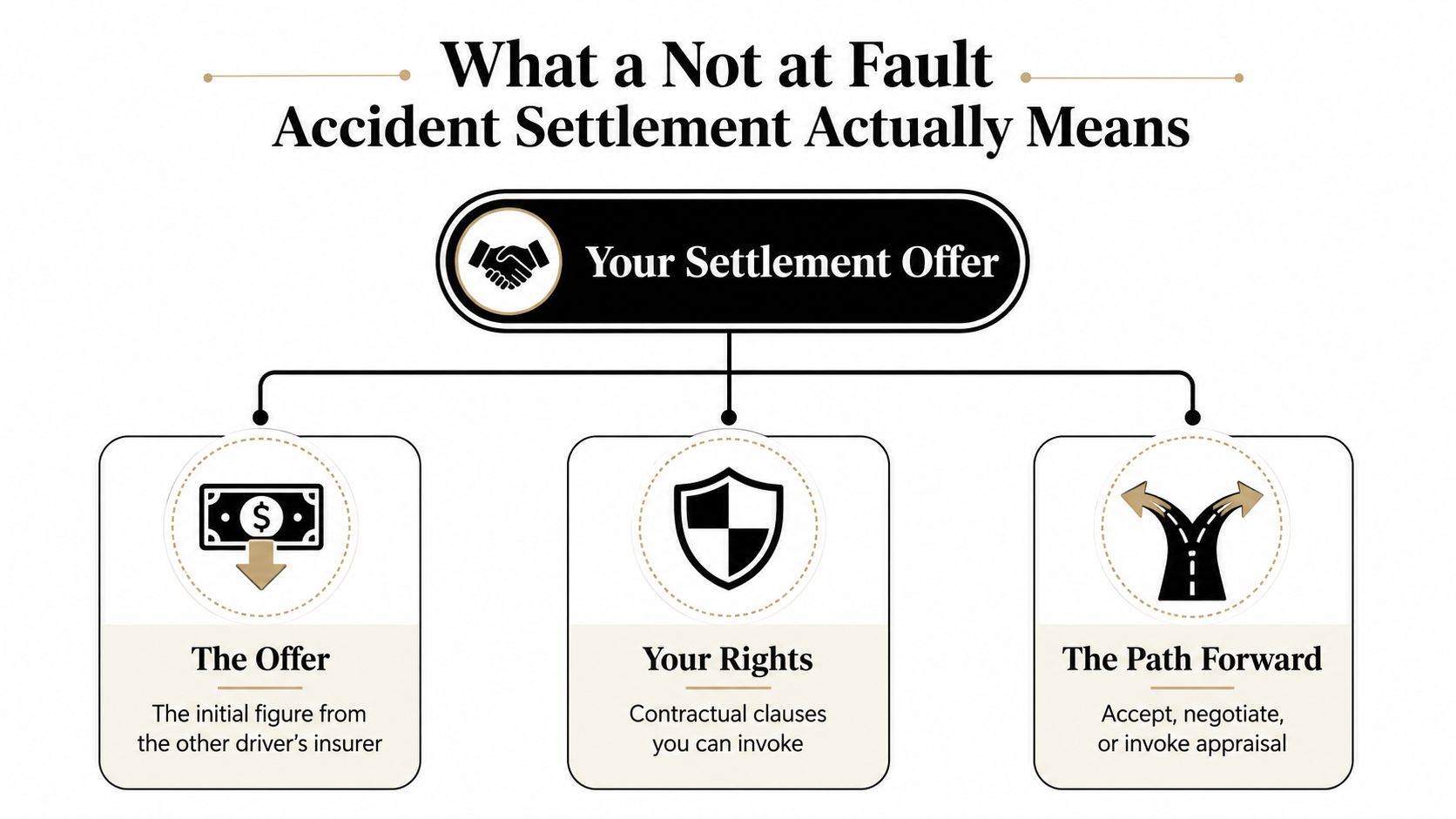
A not at fault accident settlement is the amount the at-fault driver's insurer owes you for the losses caused by the crash. That sounds simple until you see how often insurers pay only part of the claim and leave out the rest. In a no-injury crash, the payout can still cover property damage and other accident-related losses, and published 2026 summaries put typical non-injury settlements at $500 to $25,000, with one research-based estimate averaging $9,900 (ConsumerShield).
Third-party claim versus first-party claim
When you file against the other driver's carrier, you're making a third-party claim. If you file under your own policy first, that's a first-party claim. The difference matters because the at-fault insurer is not trying to help you recover every dollar, it's trying to close the file for the least amount it can justify.
That's why “no injury” doesn't mean “no payout.” It usually means the claim is narrower, not worthless. The money often turns on repair bills, loss of use, rental days, and whether the insurer accepts the vehicle's true market condition after the crash.
Why the offer feels low
In a property-only claim, the first offer often reflects the insurer's preferred valuation, not your actual loss. They may acknowledge liability and still undercount the claim by leaving out diminished value or using a repair estimate that doesn't match the shop that will perform the work. The result is a number that sounds official but doesn't fully resolve the damage.
If you want a useful state-specific overview of fault rules, check NC fault rules with Select Insurance is a practical example of how liability rules shape settlement rights, even though every state handles the mechanics differently.
Practical rule: If the insurer's number only covers part of what changed after the crash, it isn't a settlement in the real sense. It's just an opening valuation.
The Four Line Items That Make Up Your Payout
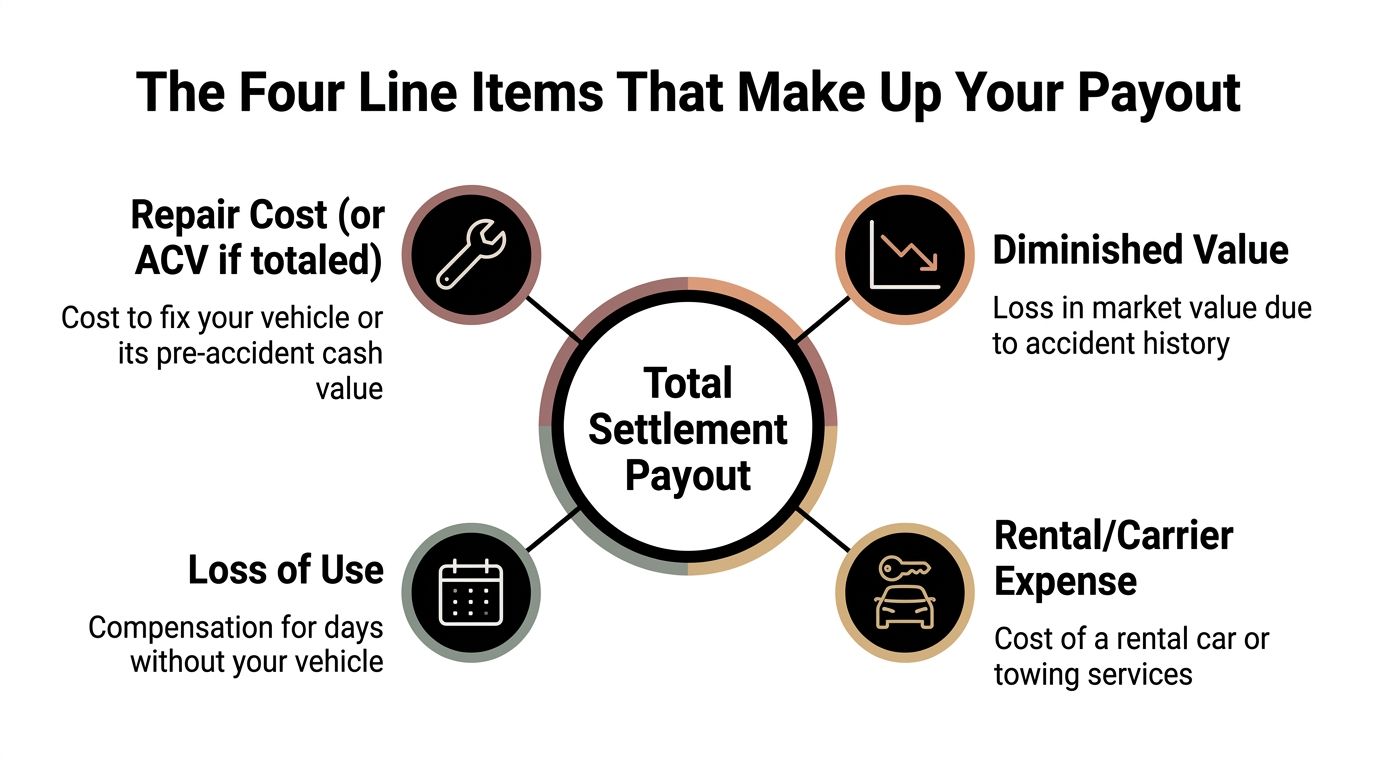
Most insurers start with the easiest line item and hope you stop there. That's usually the repair cost, or actual cash value if the car is totaled. The rest of the claim is where money gets left on the table.
Repair cost or actual cash value
If the vehicle is repairable, the insurer pays the reasonable cost to fix the damage. If it's a total loss, the payout turns on the car's pre-loss market value, not what you wish it was worth or what you still owe. One total-loss guidance source explains that the settlement is normally based on market value at the time of the accident, and if the vehicle is financed, the money usually goes to the lender first, which can leave the owner short when there's negative equity or a large payoff balance (Total Loss Gap).
Diminished value
This is the loss in resale value after a repaired crash. A clean repair doesn't erase the accident history, and the market often prices that history in. Many insurers default to zero unless you prove the reduction with comparable vehicles and condition-based adjustments.
Loss of use
This is the value of being without your car while the claim is pending. It can be framed as transportation expense or as the practical cost of downtime. Insurers often try to compress this into a short rental window, even when the vehicle was unavailable longer because of parts delays or valuation disputes.
Rental or carrier expense
This is the hard out-of-pocket cost of staying mobile, including rental charges and, in some claims, towing or carrier-related expense. Consumer guidance on accident compensation notes that recoverable categories can include rental car costs and diminished value, depending on the state and claim type (Chicago Lawyer).
Every line item needs its own evidence file, because the insurer won't bundle them for you.
For a deeper view of how market value is measured in practice, see the explanation of actual cash value in this total-loss ACV guide.
Building the Evidence File the Insurer Cannot Ignore
The cleanest claims are the ones that force the adjuster to answer each dollar with a document. A good file starts in the first 72 hours, before memories fade and repair choices get made for you. The order matters because claim handlers read for gaps, not just for damage.
Start with scene proof and liability support
Take photos of the damage, the vehicle position, the intersection, plate numbers, and road conditions. Add the police report and any witness info you can get. Those pieces don't value the claim by themselves, but they anchor the rest of the file and reduce the chance of a later liability fight.
Add repair and valuation support
Get estimates from a certified repair shop, not just the insurer's preferred network estimate. Keep OEM part quotes when the repair depends on them, because parts quality affects both repair cost and post-repair value. If the car is likely a total loss, gather comparable listings that match trim, mileage, options, and condition, because valuation fights usually hinge on whether the insurer compared your car to the right vehicles.
The same logic applies to diminished value. Comparable sales after the loss, before-and-after condition notes, and a clear explanation of why the market treats repaired cars differently all make the claim harder to dismiss. If you're using a professional valuation approach, auto-claim documentation guidance is the kind of reference that helps organize the file before you send a demand.
Don't send a pile, send a claim
A strong demand letter doesn't just attach documents. It connects each document to one line item and one dollar figure. That's the part most self-handled claims miss, because the insurer needs to see how the repair estimate, diminished value evidence, and rental receipts fit together.
- Photos and report: show the event happened and document the damage.
- Repair estimate: proves the cost to restore the vehicle.
- Comparable listings: support market value or diminished value.
- Rental receipts: support downtime and transportation expense.
- Demand letter: ties the file to a settlement number.
Repair, Total Loss, and Diminished Value
The three numbers that matter most on a damaged vehicle are not the same number. Repair cost says what it takes to fix the car. Actual cash value says what the vehicle was worth right before impact. Diminished value says what the market takes away after a repair, even if the car looks fine.
| Scenario | What the Insurer Pays | Common Gap |
|---|---|---|
| Repairable loss | Repair cost to restore the car | Diminished value and downtime |
| Total loss | Pre-loss actual cash value | Loan payoff shortfall or missing options |
| Repaired vehicle with market loss | Repair cost plus claimed diminished value if proven | Insurer often underprices the post-crash loss |
A 3-year-old truck can show why the math gets messy. If repair cost comes in at $11,000, an ACV offer at $18,500 may look generous until you compare it to the local market and the value hit that remains after repair. If the same truck supports a diminished value claim of roughly $3,200, the settlement isn't one number, it's a stack of numbers that should be evaluated separately.
The insurer's choice between repair and total loss is usually driven by vehicle value, repair cost, and internal thresholds. But even when the car is repaired, the accident history doesn't disappear. That's why the same claim can have two layers, the repair payment and the post-repair value loss.
OEM versus aftermarket parts matter here too. If the estimate assumes cheaper parts but the vehicle's market expects OEM-level repair quality, the car may still lose value after it's fixed. That gap often shows up most clearly in newer vehicles, higher-trim trucks, and well-optioned SUVs where the market notices trim, packages, and condition more than the insurer's spreadsheet does.
Invoking the Appraisal Clause When the Number Is Wrong
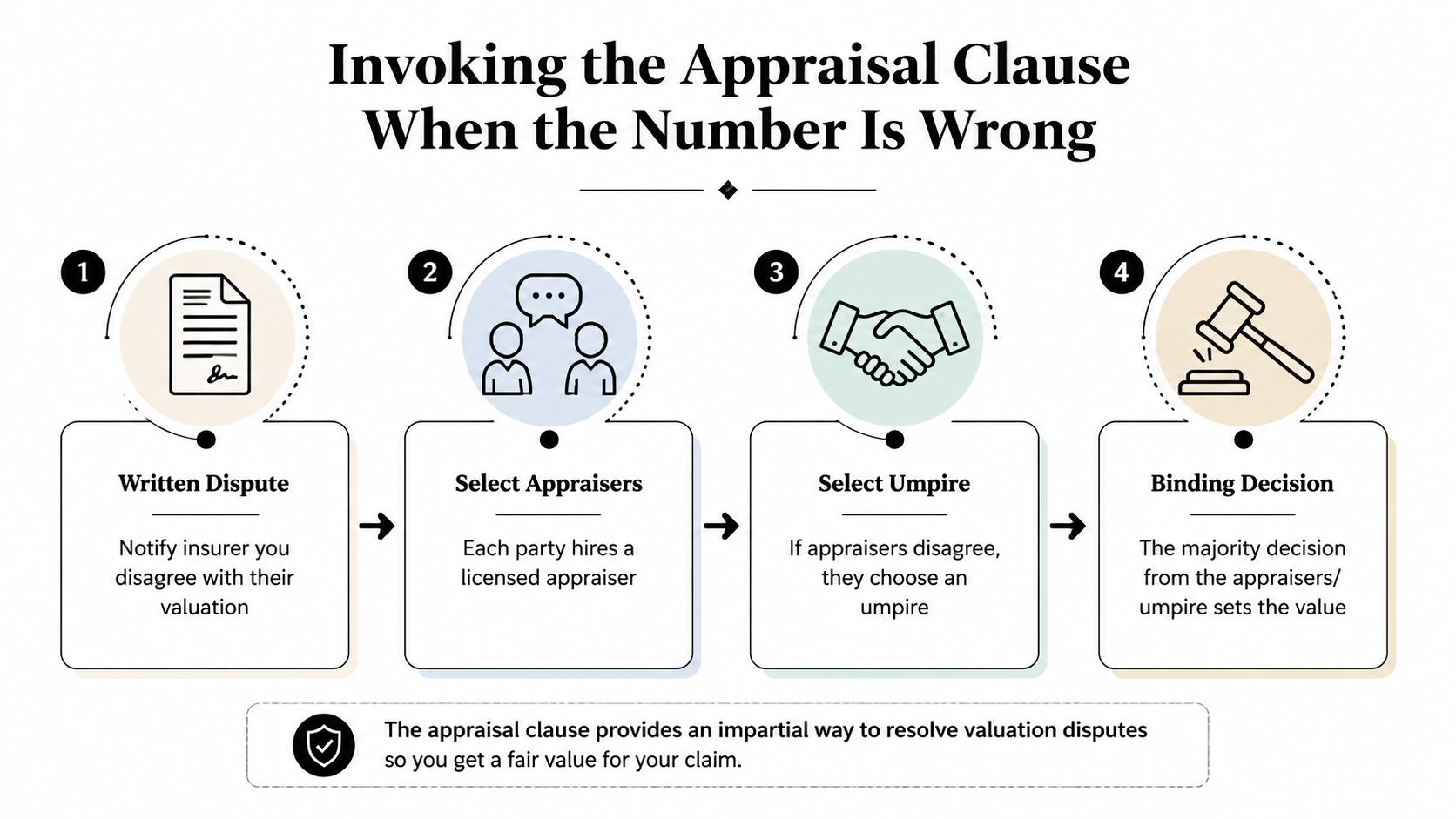
When the argument is about value, not fault, the appraisal clause is often the cleanest pressure point. It's a contractual process in many auto policies that lets each side hire an appraiser, then use an umpire if those appraisers can't agree. A plain-English overview of the process is available in this insurance appraisal process guide.
How the process works
The first step is a written dispute. You tell the insurer you disagree with the valuation and invoke appraisal under the policy language. Then each side picks an appraiser, and those appraisers try to settle the number.
If they can't, they select an umpire. The appraisers and umpire review the file, the comparables, the condition evidence, and the valuation logic. The resulting decision is binding on the value issue, which is why this process is useful for ACV and diminished value disputes, but not for liability fights or coverage denials.
Who should use it
Appraisal makes sense when the insurer ignored strong comparables, undervalued the trim level, or left out options and upgrades. It also has value when the total-loss offer is close to the lender payoff and the gap matters. It's not a bluff and it's not a lawsuit. It's a valuation mechanism, and you need to use it exactly the way the policy requires.
What it asks from you
You need patience, a written demand, and a file that can survive scrutiny. The process isn't instant, and that's part of the trade-off. But when the number is wrong and the evidence is solid, appraisal can move the claim farther than repeated phone calls ever will.
Two Real Settlements From Oregon and Washington
A Portland driver brought in a low-mileage Toyota Tacoma after a not-at-fault collision. The insurer's first pass used a regional multiplier that didn't respect the local market shortage, and the offer felt like a spreadsheet answer instead of a truck-specific value. The file changed once the claim included stronger comparables, trim-level proof, and a tighter valuation narrative.
A Bellevue owner had a higher-trim SUV with a recent OEM suspension upgrade. The insurer's total-loss offer missed that upgrade at first, which meant the pre-loss value came in light. Once the evidence package tied the upgrade to the vehicle's actual market position, the settlement moved closer to the true loss instead of the default number.
What these two claims have in common is more useful than the vehicle brands. The insurer did not volunteer the better value in either file. The owner had to document scarcity, trim, and condition in a way the adjuster could not ignore.
The different outcomes came from the same playbook, but the market reacted differently because the vehicles were different. A work truck with tight local demand and a high-end SUV with equipment-sensitive pricing don't settle the same way. The lesson is simple, the insurer's first number is a starting point, not a verdict.
When an Independent Appraiser Pays for Themselves
An independent appraiser earns their keep when the gap is large enough to justify the work. The clearest trigger is an ACV dispute of more than roughly $2,000, especially when the insurer ignored good comparables or substituted weak ones. Another trigger is a total-loss file where the lender payoff sits close to or above the payout, because that's where a small valuation change can matter a lot.
A proper appraisal report doesn't just repeat the insurer's number. It identifies the vehicle, analyzes comparable sales, explains condition adjustments, and states the appraiser's concluded value. That's what makes it useful in negotiation or in an appraisal-clause demand.
This is also where a property-only specialist can make sense. Total Loss Northwest is one example of a firm that handles diminished value and total-loss appraisals in Oregon and Washington, including certified appraisal work and demand-letter support. That kind of help is most useful when the claim turns on valuation, not on who caused the crash.
The boundary matters. An appraiser can move value. They don't decide liability disputes, and they don't replace counsel when coverage issues or injury claims are involved. If the problem is the number, appraisers are often the right tool. If the problem is denial, policy language, or fault allocation, that's a different lane.
Timelines, Templates, and the Two Mistakes That Cap Your Settlement
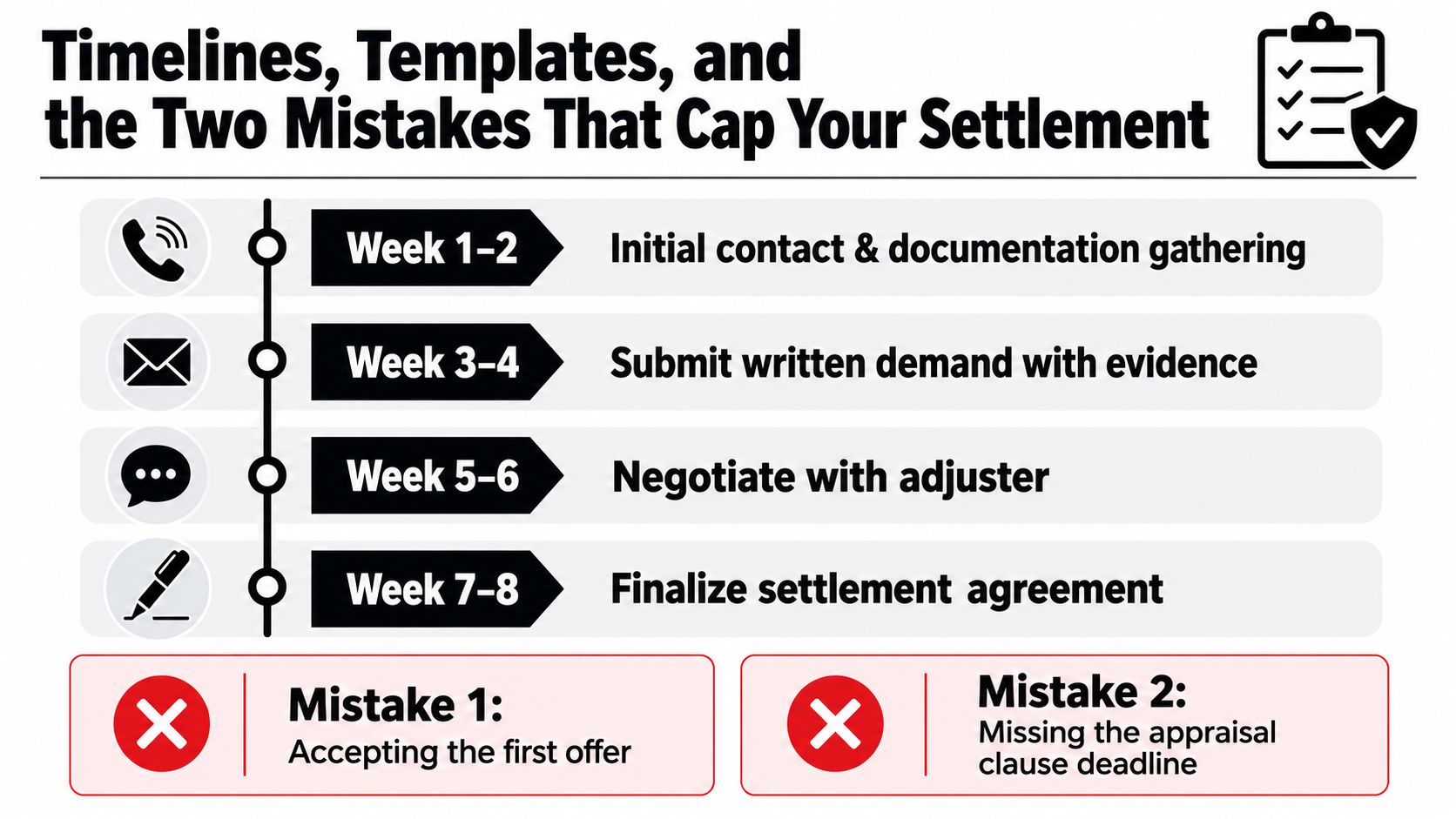
A property claim usually moves in waves, not in a straight line. In the first week or two, gather photos, the report, repair estimates, and any rental records. In weeks three and four, send a written demand with the evidence attached. Weeks five and six are usually negotiation time, and weeks seven and eight are where the file either closes or shifts into appraisal.
A short written demand can stay simple:
Subject: Dispute of valuation and demand for revised settlement
Body: I disagree with the current offer because it does not fully reflect the vehicle's actual value and related losses. Attached are the repair estimate, comparable vehicles, rental records, and supporting photos. Please review the file and issue a revised written response.
The first mistake that caps a settlement is accepting the first ACV figure without comparables. Once that check is cashed and the release is signed, you've often given away the right to push the number. The second mistake is treating the repair estimate as the only number that matters.
Those mistakes are avoidable if you track the file like a valuation dispute, not a favor. Keep the claim focused on evidence, ask for written responses, and don't let the insurer collapse separate losses into one low figure. If the valuation is wrong, the policy has a process for that, and the clock starts when you get the first offer.
If your claim is sitting on a low ACV, a missing diminished value payment, or a rental bill the insurer won't fully recognize, gather your photos, estimates, and comparables now and press for a written valuation response before you sign anything. A short delay can cost real money, and the best time to challenge the number is before the release is finalized. A CTA for Total Loss Northwest.