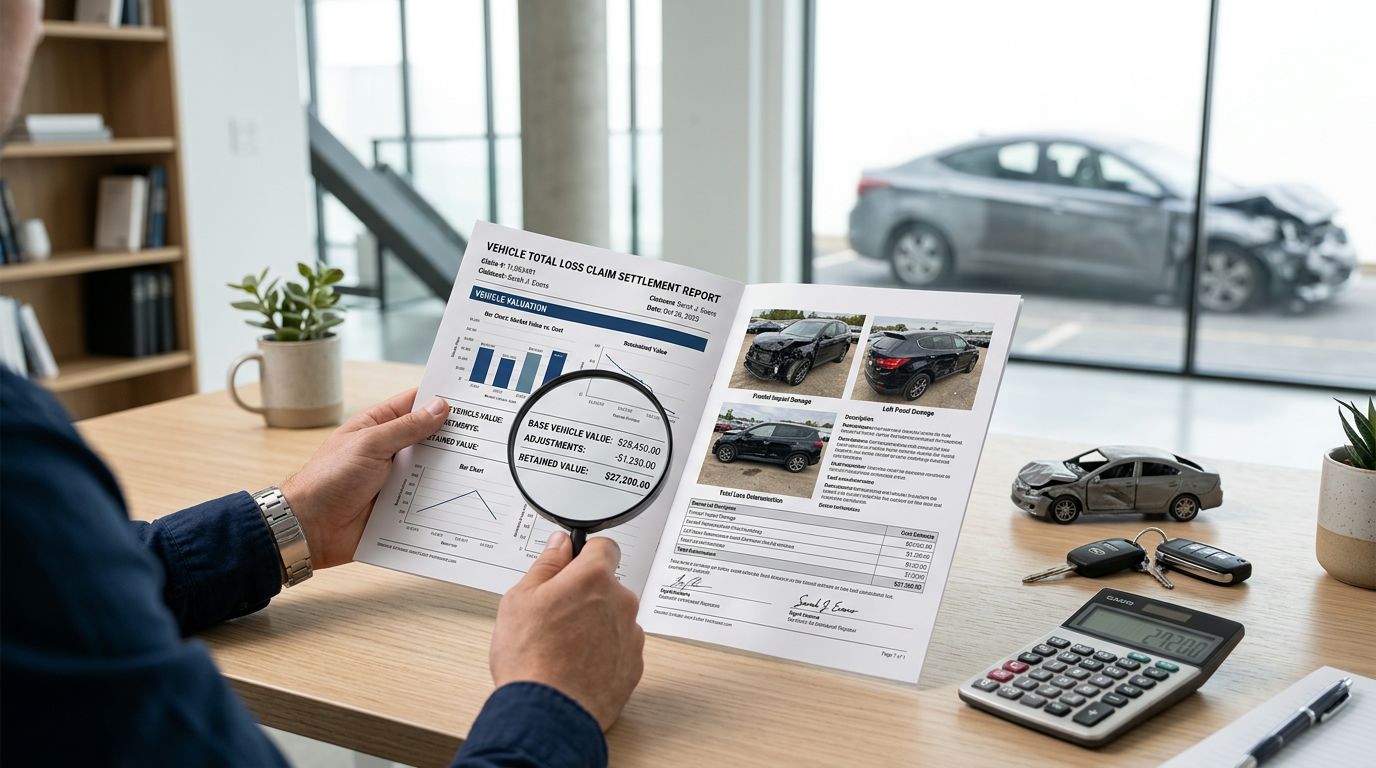
You got the call. The adjuster was polite, maybe even reassuring, and then gave you a number that made no sense. You look at the settlement offer, compare it to what it would actually cost to replace your car, and the gap is obvious. That reaction is valid. In a total loss claim, the first offer often reflects the insurer's process, not your vehicle's real market position.
A frequent error involves arguing with the adjuster on the phone, sending a few listings, and hoping the carrier “reconsiders.” That usually goes nowhere. If your car has been totaled, you need a strong position, not frustration. A Totaled Vehicle Appraisal gives you that strong position because it turns your disagreement into a documented valuation dispute backed by evidence.
The Lowball Offer and Your Next Move
The typical scenario is painfully familiar. Your car is gone. You're dealing with rental deadlines, missed work, and the hassle of finding replacement transportation. Then the insurer sends a valuation report full of questionable comparables, missing options, and deductions that drag the number down.
That low offer doesn't happen by accident. Insurers use systems built to control claim costs. They're not pricing your car the way you would shop for a replacement on the open market. They're pricing it through a claims lens.

Why the offer feels wrong
A lot of drivers still think a car is only totaled once repairs cross 50% of value. That's not how it works. In states like Oregon and Washington, insurers can declare a total loss at thresholds up to 80%, and they often rely on internal policies that leave owners with low offers, which is why your right to an appraisal matters so much, as explained in Car and Driver's guide to fighting a totaled car offer.
That means two things. First, your vehicle may have been totaled under rules you didn't know existed. Second, the insurer counts on you not knowing how to challenge the value.
Practical rule: Don't argue value by phone before you've reviewed the valuation report line by line.
Your next move
Your next move isn't to “ask nicely” for more. It's to treat this as a valuation dispute and prepare evidence. Start by reviewing the carrier's report for wrong trim, missing packages, mileage errors, bad condition adjustments, and comparables from the wrong market. If you need a framework for those conversations, this guide on how to negotiate with an insurance adjuster is a useful starting point.
Then hire an independent appraiser.
Not a friend who knows cars. Not a dealer who gives you a rough number. A qualified appraiser who can document what your vehicle was worth immediately before the loss. That report changes the tone of the claim. You're no longer complaining. You're contesting the insurer's valuation with a defensible number.
What a Totaled Vehicle Appraisal Actually Is
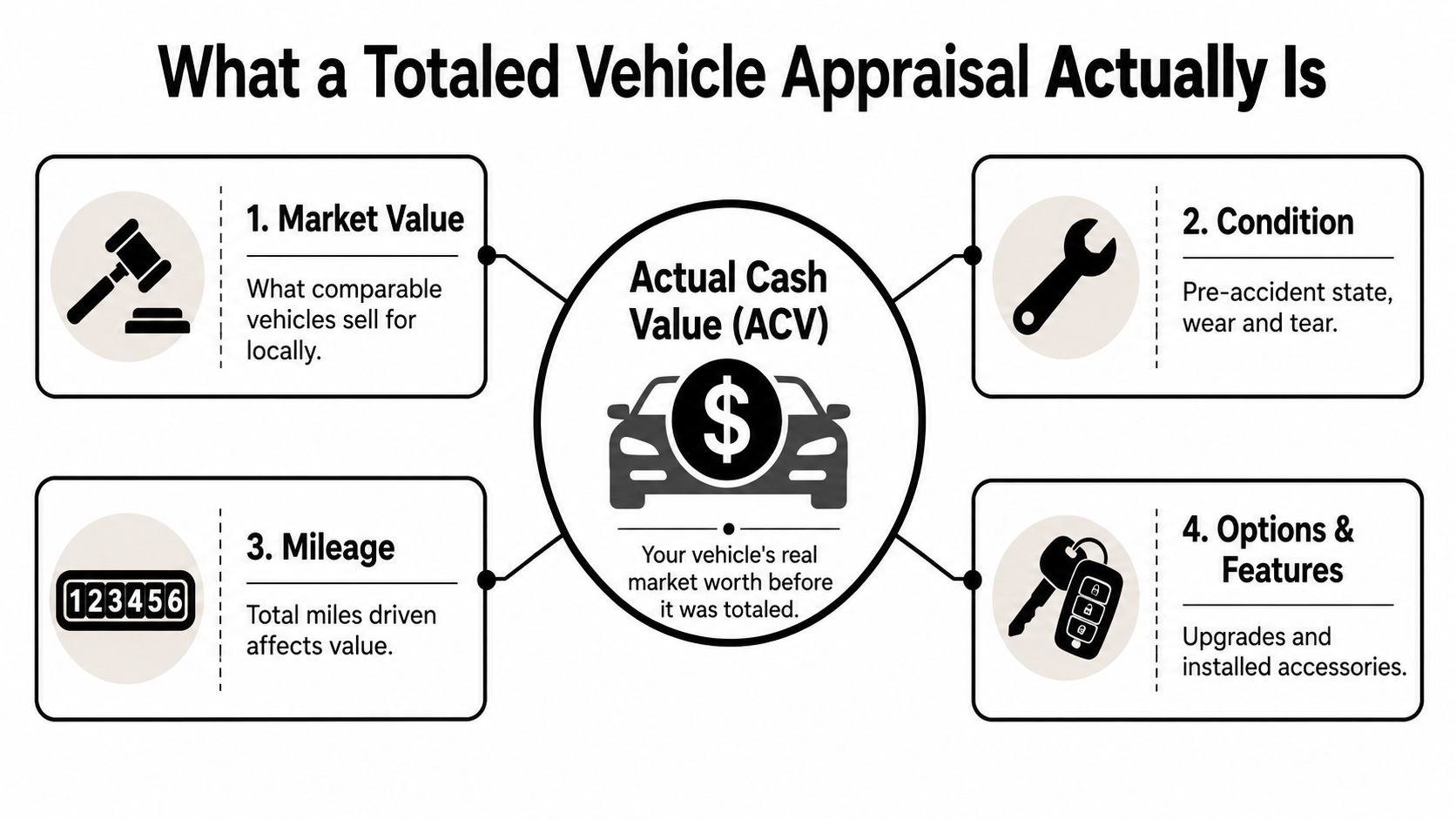
A Totaled Vehicle Appraisal is not a second guess. It's a formal valuation of your vehicle's Actual Cash Value, or ACV, immediately before the accident. That's the number the insurer owes on a total loss claim, not what you originally paid, and not what a brand-new replacement costs.
ACV is supposed to reflect your vehicle's real market worth before the crash. In practice, that means looking at comparable vehicles in your area and adjusting for mileage, condition, equipment, and features. It is not supposed to be a vague average pulled from thin air.
The house appraisal analogy fits
Think of the insurer's valuation like a quick automated estimate for a house. It spits out a number based on broad data, but it can miss upgrades, location differences, and condition details. An independent appraisal is the equivalent of a certified professional walking the property, reviewing the market, and producing a report that can stand up to scrutiny.
Your vehicle deserves that same level of analysis.
Why this matters legally
The Appraisal Clause in many auto policies gives you the right to dispute the insurer's ACV. Invoking it can shift the valuation away from proprietary software, which may undervalue vehicles by 5-10%, and toward a certified report grounded in real market data, as described in this explanation of how insurance companies determine total loss value.
That's the often-overlooked difference. An appraisal isn't just persuasive. It can activate a contractual dispute process the insurer has to respond to.
What a real appraisal should establish
A credible appraisal should answer a few basic questions clearly:
- What was the exact vehicle worth before impact: Not a broad model average, but your specific year, make, model, trim, and configuration.
- Which local comparables support that value: Comparable listings and sales should reflect your actual market, not some distant market with lower prices.
- What condition evidence supports adjustments: Tires, interior, paint, maintenance, options, and documented upgrades all matter.
- Why the insurer's report is wrong: A good appraiser doesn't just give a new number. They identify the errors in the old one.
The report should read like evidence, not opinion.
If the appraisal is thin, generic, or based on stale data, it won't move the claim. If it's detailed, market-based, and written by someone who understands total loss disputes, it becomes a tool you can use in a binding process.
How Independent Appraisers Determine Fair Market Value
A proper appraiser doesn't start with a software printout and work backward. We start with the vehicle itself, then the market around it.
That distinction matters because a total loss claim is really a market valuation question. What would a buyer in your area have reasonably paid for your vehicle, in its pre-loss condition, right before the crash? That's the target.
The evidence that actually moves value
A professional appraisal uses a Fair Market Value method built on active local sales data. Static book values can understate a vehicle's worth by 15-25% compared with current dealer inventory and private transaction records, which is why appraisers rely on live market evidence instead of generic guides, as noted by Total Loss Northwest's explanation of fair market value.
That process usually includes:
- Vehicle identification: VIN, trim, drivetrain, factory packages, and installed options.
- Condition documentation: Pre-loss paint, interior wear, tire condition, glass, service records, and any prior damage history.
- Mileage analysis: Not just the odometer reading, but how that mileage compares with similar vehicles in the same segment.
- Comparable research: Similar vehicles listed or sold in the same regional market.
Retail value matters more than trade-in logic
Often, insurers tilt the playing field. They may lean on data that behaves more like trade-in or wholesale logic than true consumer replacement value. That's a problem because you aren't trading your totaled car in. You're replacing it.
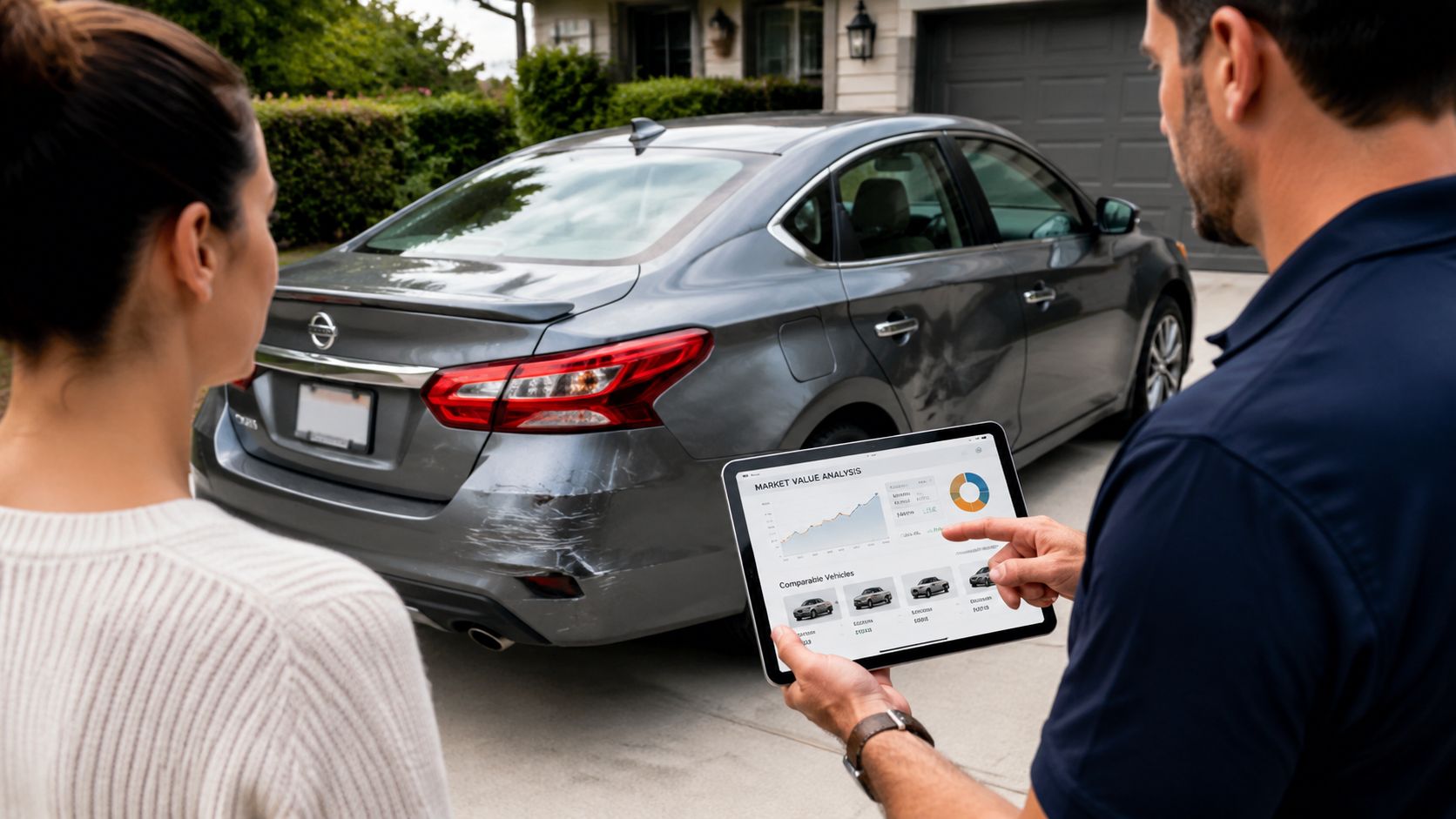
An independent appraiser looks for comparables a real buyer would shop. Dealer inventory is often especially useful because it reflects the market where replacement happens. Private-party sales can matter too, but only if they're comparable and well documented.
Here's what a sound comparison looks like:
| Comparison point | Weak insurer comp | Strong appraiser comp |
|---|---|---|
| Geography | Outside your practical market | Local or tightly regional |
| Trim and options | Similar model, wrong equipment | Matching trim and key features |
| Condition basis | Assumed or generic | Documented from records and photos |
| Price relevance | Aged or mismatched listing | Current, market-relevant support |
What gets missed most often
Owners of clean daily drivers, trucks with packages, and customized vehicles get hit hardest by lazy valuations. If your report misses towing equipment, premium audio, wheel packages, recent tires, or major maintenance, the number drops fast. The insurer may call those details minor. They aren't minor when they affect replacement cost in your market.
One option in Oregon and Washington is to use a service like Total Loss Northwest, which prepares independent total loss appraisals using market comparables and condition-based valuation support. Whatever provider you choose, make sure they know how to build a report that can survive insurer scrutiny.
Good appraisals don't chase a higher number. They prove a supportable one.
The Appraisal Process Step by Step
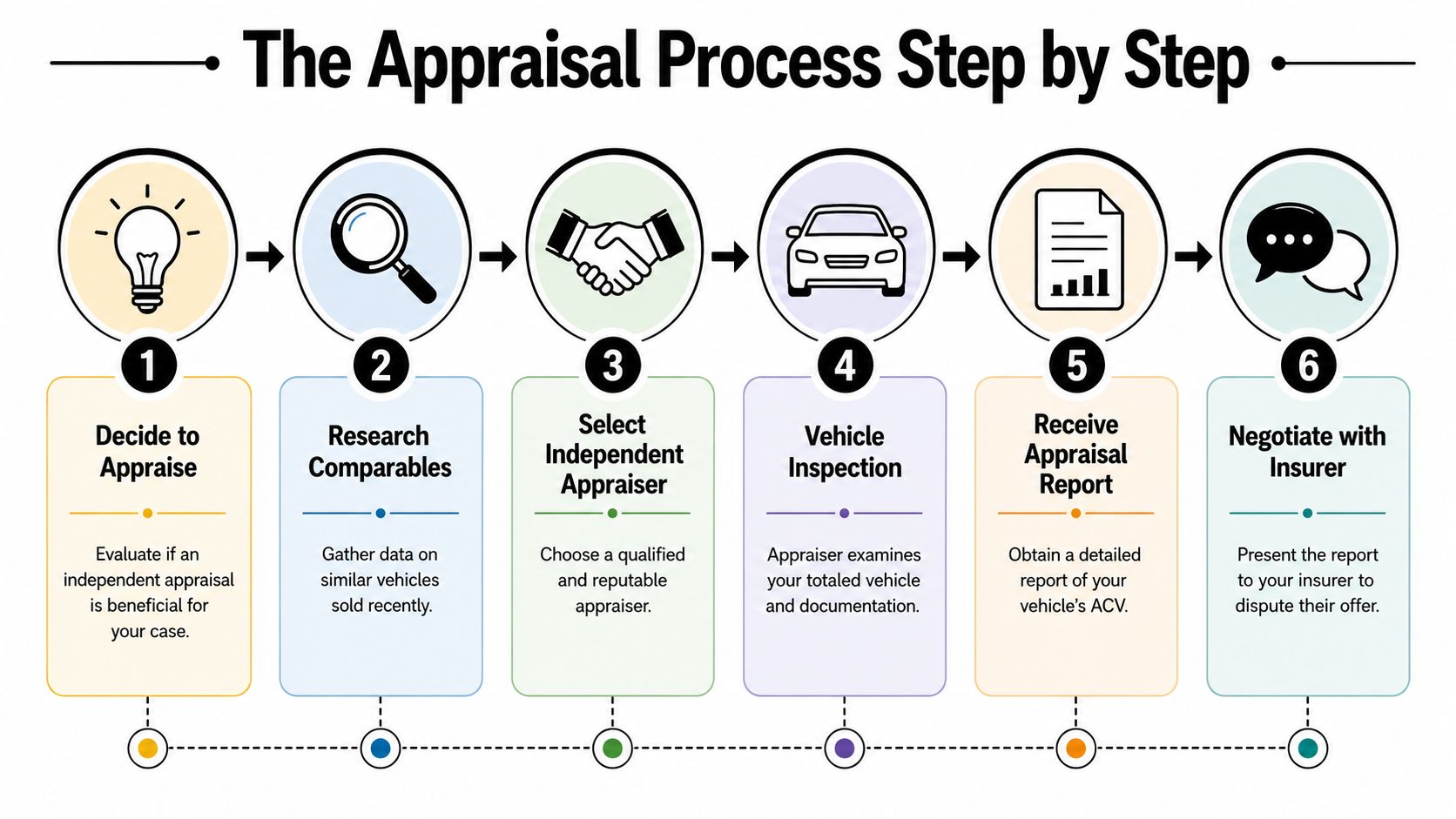
Once you've decided the offer is wrong, move quickly and stay organized. Delay helps the carrier, not you. The strongest total loss disputes are the ones that start before you sign anything, transfer title, or cash a check.
Step 1 through Step 3
Decide to challenge the valuation early
If the insurer's comparables are weak or the offer won't buy a similar replacement, don't wait for the adjuster to “review it again.” Treat the file as disputed.Gather your documents
Pull together the insurer's valuation report, photos of the vehicle before the loss, maintenance records, receipts for recent repairs, proof of upgrades, and any dealer window sticker or build sheet you still have.Hire an independent appraiser
Choose someone who handles total loss disputes routinely, not just general vehicle opinions. Ask whether the report includes a market analysis and condition support.
Step 4 through Step 6
Invoke the Appraisal Clause in writing
This is the key move. Your policy language controls the exact process, but the basic point is the same. You formally notify the insurer that you dispute their ACV and are invoking the appraisal provision in the policy.Cooperate with the appraiser's investigation
If the vehicle is available, provide access. If it's already at a tow yard or salvage facility, send photos, records, and any prior documentation you have. The appraiser then builds the value from evidence, not guesses.Submit the completed report and hold your ground
Don't water down your position once the report is in. The insurer may push back, request more support, or appoint its own appraiser. That's normal.
A strong report has to do more than state a value. It needs a USPAP-compliant Comparable Market Analysis and detailed condition documentation. Reports with those elements have helped vehicle owners recover 15-40% more than the initial insurance offer, according to Certified Auto Appraisers' total loss appraisal guidance.
This video gives a practical overview of the process before you start the dispute:
What to avoid
- Don't cash the check too fast: That can complicate your dispute.
- Don't rely on random online listings alone: Listings help, but they don't replace a formal analysis.
- Don't send angry emails instead of evidence: Emotion is understandable. It won't carry the claim.
- Don't hire the cheapest report you can find: If it isn't defensible, it's wasted money.
Invoking the Appraisal Clause and Negotiating
At this point, your claim stops being a casual disagreement and becomes a contractual process.
The Appraisal Clause exists for one reason. Insurers and policyholders often disagree on value. Instead of leaving that fight entirely in the adjuster's hands, the policy can require each side to appoint an appraiser. If those appraisers can't agree, they select a neutral umpire. The umpire's decision is typically binding under the policy terms.
Why this clause changes the balance of power
Without the clause, you're asking the insurer to voluntarily increase its own payout. That's a weak position. Once you invoke appraisal, the carrier has to deal with a structured dispute process rather than a frustrated customer.
That matters even more because states often set total loss thresholds in the 70-75% range of ACV, and a vehicle can also be totaled when Cost of Repair + Salvage Value ≥ ACV, as outlined in Matthiesen, Wickert & Lehrer's total loss thresholds chart. When insurers undervalue ACV, they distort the entire total loss analysis. Independent appraisers matter because they push the valuation back toward the legal and economic reality.
How to invoke it properly
Start with your policy. Read the appraisal language carefully. Then send a clear written notice to the insurer stating that you dispute the ACV and are invoking the Appraisal Clause under your policy. Keep it simple and professional. Don't bury the request inside a long complaint.
If you want a plain-English overview of how that process works, read this explanation of the insurance appraisal clause.
A good notice should include:
- Your claim details: Policy number, claim number, vehicle information, and date of loss.
- Your dispute position: State that you disagree with the insurer's ACV determination.
- Your formal demand: Say plainly that you are invoking the policy's appraisal provision.
- Your appraiser information: If available, identify the appraiser you've retained.
Send the invocation in writing and keep proof of delivery. Phone calls don't protect you.
Oregon and Washington drivers should be especially alert
In Oregon and Washington, drivers often assume the carrier's total loss decision and value are fixed. They aren't. These claims frequently turn on local market conditions, option accuracy, and replacement realities that software misses. If you own a truck, SUV, hybrid, performance model, or anything with meaningful package content, a sloppy valuation can cost you real money.
Negotiation after invocation is different from pre-appraisal haggling. You're no longer trying to convince the adjuster to be reasonable. You're forcing the dispute into a mechanism the policy already allows.
Real-World Results Case Studies
I'm not going to invent fake client stories or throw out made-up recovery figures. What I can tell you is what a strong appraisal changes in real life.
A weak claim looks emotional. A strong claim looks documented. The moment you replace “I think my car was worth more” with a report supported by local comparables, condition evidence, and correction of report errors, the claim gets harder for the insurer to brush aside.
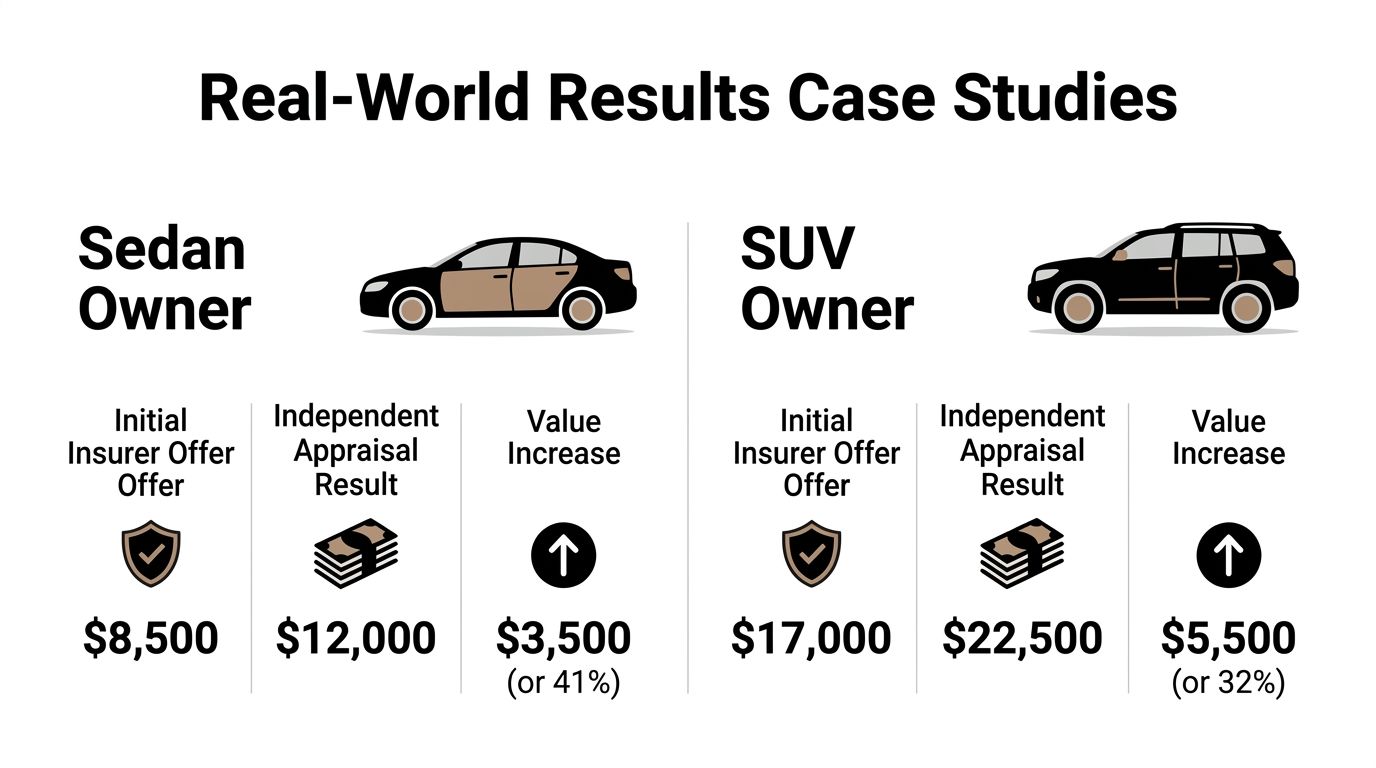
Daily driver with missing equipment
A common case involves a late-model sedan where the insurer's report misses trim-level features and recent maintenance. The owner sees a number that might look plausible at first glance, but the comparables are base models or poorly matched vehicles. After independent review, the dispute centers on equipment accuracy and local replacement pricing. Those are fixable valuation errors, not subjective complaints.
SUV or truck with market-sensitive pricing
SUVs and trucks often expose software shortcuts. Regional demand, drivetrain differences, towing packages, and clean-condition premiums can separate a weak ACV from a fair one. When the appraiser uses current local inventory and documents those features correctly, the insurer has to confront a better-supported market picture.
Custom or specialty vehicle
Generic reports quickly prove inadequate. Modified vehicles, collector cars, and uncommon trims don't fit neatly into broad databases. If the insurer applies a flat book-style number, the result is usually detached from reality. A detailed appraisal can document pre-loss upgrades, condition, and specialty market support in a way a generic total loss report won't.
The biggest difference isn't magic negotiation language. It's evidence the insurer can't easily dismiss.
The point of these cases is simple. Appraisals work when they are specific, local, and built for dispute resolution. They don't work when they're generic, rushed, or disconnected from the actual replacement market.
Totaled Vehicle Appraisal FAQs
How much does a totaled vehicle appraisal cost
Fees vary by provider, vehicle type, and whether the case needs a desk review or a more involved analysis. Daily drivers are usually simpler than collector cars or heavily modified vehicles. Treat the fee as a claim expense tied to protecting the settlement, not as an optional add-on.
If a report fixes a bad valuation, it can pay for itself quickly. If the insurer's number is already fair, a reputable appraiser should tell you that too.
How long does the process take
The appraisal itself can move quickly if your documents are organized and the vehicle information is clear. The negotiation timeline depends more on the insurer's response, whether they appoint their own appraiser, and whether the dispute goes to an umpire.
Your part is straightforward. Gather records fast, respond fast, and don't let the file stall because you're waiting to “see what happens.”
What if I still owe money on the vehicle
If you have a loan, the lender usually gets paid first from the settlement. If the settlement exceeds the loan balance, the rest goes to you. If the payoff is higher than the settlement, you may still owe a deficiency unless you have gap coverage.
If the vehicle is leased, the lease contract controls where the money goes and how any shortfall is handled. In both cases, the valuation still matters because a low ACV hurts you whether you financed or leased.
What if the insurer says the appraisal report is only an opinion
Every valuation is an opinion. The key question is whether it's a supported opinion. A proper total loss appraisal is backed by comparable market data, condition documentation, and a clear methodology. That's why quality matters so much.
A thin report invites rejection. A detailed report forces a response.
Is this the same as diminished value
No. A total loss claim pays ACV because the vehicle is considered a total loss. A diminished value claim applies when a vehicle is repaired but loses market value because of the accident history.
If your car wasn't totaled and was instead repaired, you may be looking at the wrong claim type.
What should I do today
Do these three things:
- Request the full valuation report: Don't rely on the adjuster's summary.
- Review the report for errors: Trim, mileage, options, condition, and market area.
- Talk to an independent appraiser before signing anything: That keeps your options open.
If your insurer's total loss offer doesn't reflect what your vehicle was worth, get a professional review before you accept it. Total Loss Northwest provides certified independent appraisals for total loss claims in Oregon and Washington, with support built around real market data and appraisal-clause disputes.