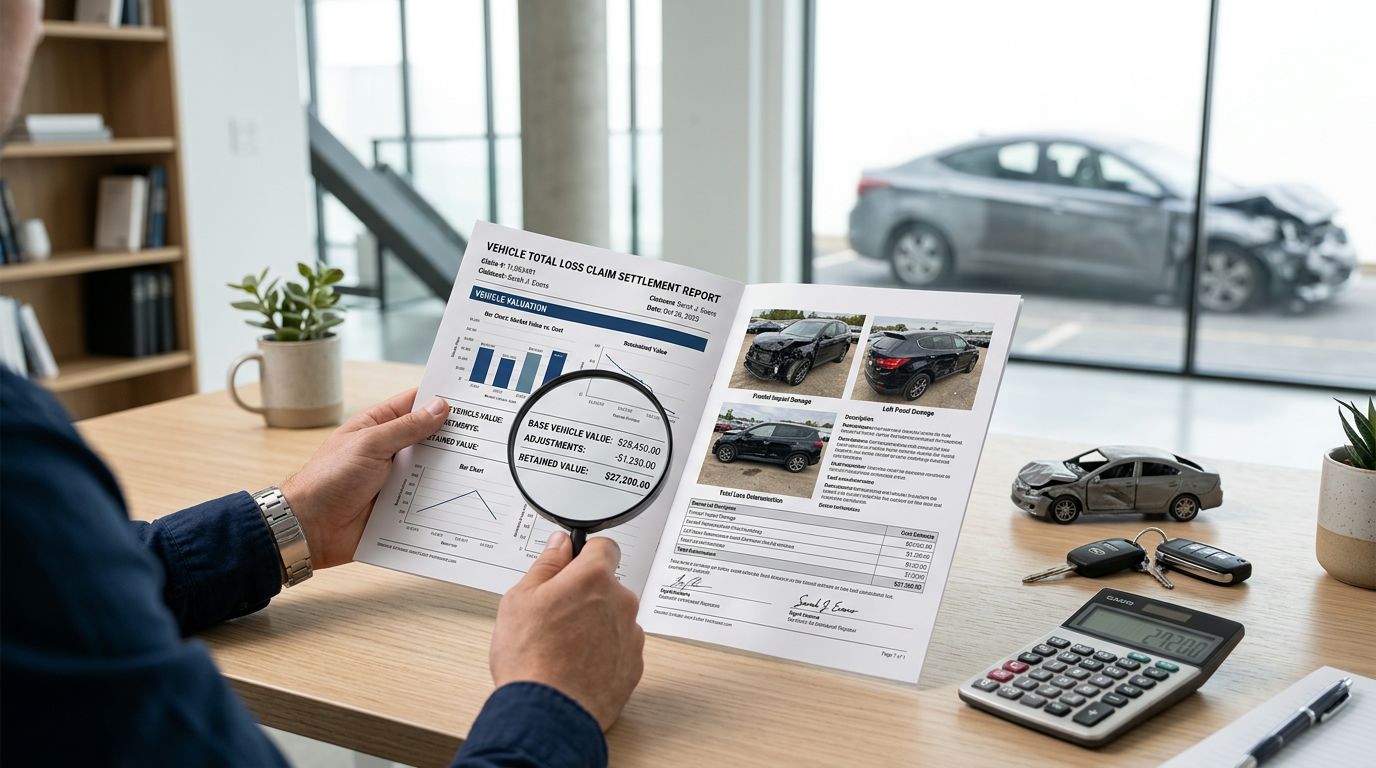
The call usually goes the same way. Your adjuster says the vehicle is a total loss, then gives you a number that feels detached from reality. You start thinking about what you paid, what you still owe, what similar cars seem to cost, and how any of this is supposed to get you back on the road.
That reaction is normal. It's also where a lot of owners make the wrong move. They treat the vehicle total loss claim settlement report like an objective conclusion, when it's really the insurer's valuation argument in document form.
The report may look polished. It may have comparable vehicles, condition adjustments, options, taxes, and a final settlement figure. But polished doesn't mean neutral. The carrier is building a case for a number. Your job is to read that case like a critic, not like a captive audience.
That Lowball Offer is an Opening Bid Not a Final Word
A low total loss offer lands hard because it shows up after the worst part of the claim. The crash already happened. You've already lost use of the car. Then the settlement report arrives and acts like the value question is settled.
It usually isn't.
Most owners read the report from top to bottom and assume the insurer has already done the hard math, checked the market, and arrived at the fair answer. In practice, the report is closer to an opening position than a final truth. It's the insurer saying, “Here is the number we're prepared to defend unless you challenge it.”

That's why owners who understand how to negotiate a total loss settlement approach the report differently. They don't ask, “Why did they decide this?” They ask, “How are they trying to prove this?”
What the report is really doing
A settlement report usually tries to accomplish three things at once:
- Support the total loss decision by showing repair economics that justify not fixing the vehicle
- Set the actual cash value using condition, mileage, options, and market comparables
- Shape the negotiation by making the number appear more final than it is
That last part matters most. Once a report uses technical language and itemized adjustments, many people stop questioning the assumptions behind it.
A clean-looking report can still be built on weak comparables, flat condition ratings, and adjustments that don't match the real market.
If the number feels low, don't argue from emotion alone. “I know what my car was worth” won't move the claim. Evidence will. The right approach is to deconstruct the report line by line and answer it with a stronger valuation argument.
Why Your Car Was Declared a Total Loss
Before arguing value, you need to know why the insurer crossed the line from repairable to total loss. That decision doesn't start with your loan balance, what you paid, or what a dealer might ask on a retail lot. It starts with repair economics.
In many U.S. markets, insurers and regulators treat a vehicle as a total loss when repair costs reach roughly 60% to 80% of the car's actual cash value, although the trigger varies by state and carrier. Some insurers use thresholds as low as 51%, while others go as high as 100%, and some use a formula comparing repair cost plus salvage value against actual cash value. One example often used is a vehicle worth $15,000 with $12,000 in repairs and $3,000 in salvage value. That can be declared a total loss because the combined amounts equal the pre-loss value, as described in this explanation of how total loss value is determined.
Actual cash value is the pivot point
Actual cash value, or ACV, is the pre-accident market value of your vehicle. That's the number the entire total loss decision turns on.
If ACV is set too low, two things happen fast. First, the repair estimate looks larger by comparison, which helps justify the total loss declaration. Second, the payout drops because the settlement ties back to that same ACV number.
A lot of owners mix ACV up with other numbers that feel more personal:
- What you paid for the car doesn't control today's pre-loss market value
- What you owe on the loan doesn't set the claim value either
- What it costs to buy a replacement at a dealer may be relevant in parts of the claim, but it isn't automatically the ACV
The threshold isn't the whole story
Two vehicles with similar damage can end up on different paths if their values are handled differently. That's why you should treat the total loss decision and the valuation decision as connected, not separate.
Practical rule: If the insurer undervalues the car, it becomes easier for them to say repairs no longer make economic sense.
The total loss call often sounds like a pure damage issue. It isn't. It's a value issue dressed up as a damage decision. Once you understand that, the settlement report starts making more sense. The report is there to justify both the declaration and the payout using one underlying figure.
Decoding the Key Sections of Your Settlement Report
Most total loss reports look official by design. Dense formatting, market grids, option codes, and condition tables give the impression that the number came from a neutral process. It didn't arrive by magic. Someone fed inputs into a valuation system, and every one of those inputs can be questioned.
A vehicle is typically declared a total loss when the estimated repair cost exceeds the car's actual cash value, and insurers determine ACV using pre-loss condition, mileage, options, and local comparable sales. For owners challenging the number, the critical issue is whether the report uses sufficiently similar comparables and properly reflects pre-accident condition, because small changes can materially change ACV, as outlined in GEICO's explanation of the total loss process and ACV factors.
Start with the condition report
The condition section often looks harmless. It isn't, as a vehicle gets pushed into “average” or downgraded in categories the owner never had a fair chance to discuss in detail.
If your car was clean, well-maintained, recently serviced, or unusually nice for its age, a flat condition rating can suppress the value before the comparable search even starts. Many owners focus only on the comps and miss that the report has already dragged down the base vehicle.
Look for these trouble spots:
- Interior ratings that ignore clean upholstery, intact trim, or above-average care
- Exterior deductions that overstate ordinary wear
- Mechanical assumptions made without a meaningful inspection of pre-loss condition
- Tire or maintenance issues listed broadly without support
Then inspect the comparable vehicles
Comparable vehicles are where the insurer's argument usually looks strongest. It's also where it often gets weakest under scrutiny.
A comp isn't useful just because it has the same make and model. Trim level, drivetrain, mileage, options, condition, and local market all matter. A report can lower value by picking vehicles that are technically similar but economically weaker than yours.
Here's a simple way to read the report like an appraiser.
| Report Section | What It Means | What to Look For |
|---|---|---|
| Vehicle description | The base identity of your car | Wrong trim, missing packages, incorrect drivetrain, wrong model year details |
| Condition report | The report's judgment about pre-loss condition | Generic ratings, unsupported deductions, condition lower than your records and photos support |
| Comparable vehicles | The market examples used to estimate value | Vehicles that are not truly similar in mileage, equipment, condition, or local market relevance |
| Adjustments | Dollar changes added or subtracted for differences | One-sided deductions, questionable mileage treatment, missing credits for options or upgrades |
| Settlement summary | The final value logic | Whether the conclusion actually matches the evidence listed above |
Adjustments are where value disappears quietly
Small line-item adjustments deserve more attention than they usually get. A report can look reasonable overall while shaving value through repeated deductions.
Some adjustments are legitimate. Many are contestable. The key question is not whether the report contains adjustments. It's whether the adjustments reflect the actual market.
Watch for patterns such as:
- Mileage deductions that feel heavy compared with the actual difference between vehicles
- Missing options that your vehicle had but the report didn't credit
- Feature mismatches where a comp lacks equipment your vehicle included
- Geographic stretching that pulls vehicles from markets that don't behave like yours
If the comps aren't truly comparable, the math that follows is just precise-looking noise.
Read the report as evidence, not paperwork
Owners often ask whether a total loss report is “correct.” That's not the best question. A better one is whether the report is defensible.
A defensible report should use vehicles that really match yours, describe your pre-loss condition fairly, and explain its adjustments in a way that lines up with the market. If it doesn't, you're not stuck with it. You've identified the weak points in the insurer's case.
The Problem with Automated Valuation Software
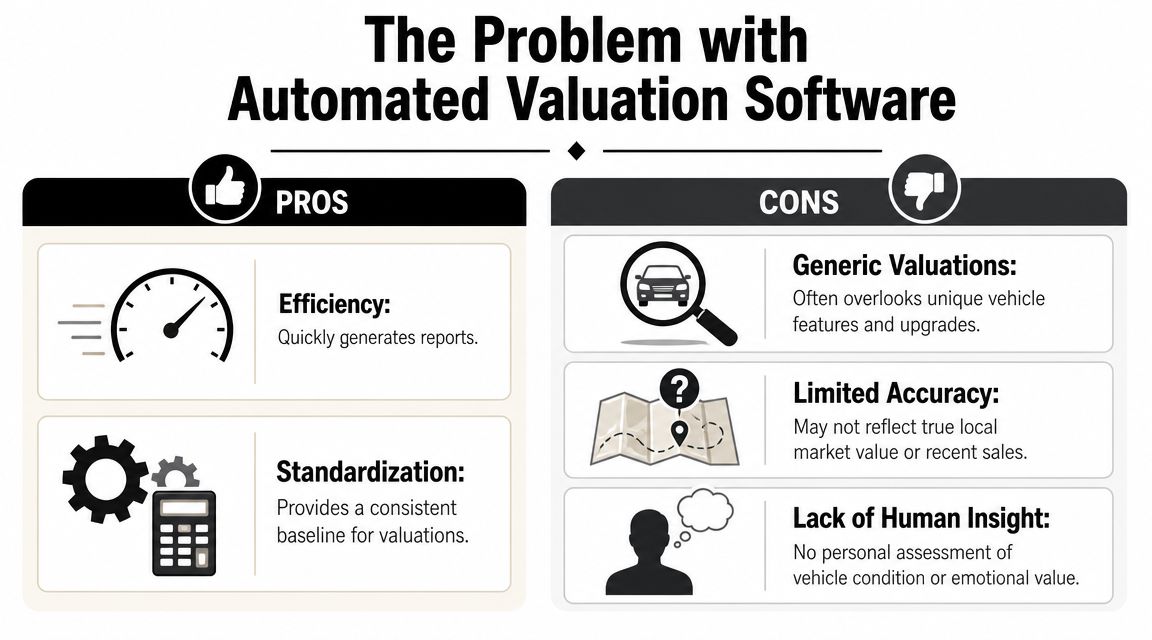
Most insurers don't build your value from scratch by hand. They run your vehicle through valuation software, usually from platforms such as CCC or Mitchell, then issue a report that carries the software's authority.
That creates a problem. Software can generate a fast, standardized baseline. It can't personally inspect your vehicle before the loss, understand why one local market behaves differently than another, or recognize when a rare trim package changes buyer behavior.
If you want a closer look at one of the most common systems behind these reports, this breakdown of CCC auto valuation methods is worth reviewing.
Software is built for scale, not judgment
Insurers handle claims volume. Automated valuation software helps them move files quickly and produce a consistent format. That efficiency is real. So is the trade-off.
The system has to make assumptions. It has to bucket condition. It has to search for comps based on rules. It has to apply adjustments according to a formula. Those are useful tools for processing claims. They are not the same thing as independent appraisal judgment.
A lot of owners make the mistake of arguing with the output only. It's often more effective to challenge the inputs.
Where these systems tend to fall short
Automated reports commonly run into trouble in a few predictable ways:
- They flatten uniqueness. A clean, unusually well-kept car can get valued like a typical one.
- They over-rely on asking-price logic. The listed price of a vehicle isn't always the same thing as a real transaction-level value.
- They can stretch market area. A comp from a distant market may not reflect your local replacement reality.
- They struggle with enthusiast or specialty vehicles. Rare configurations, collector interest, and documented upgrades don't fit neatly into a standard template.
That doesn't mean every automated valuation is wrong. It means you shouldn't confuse a standardized result with a final answer.
The insurer's software is a negotiation tool. It gives them a number they can defend efficiently. That's different from a number that fully reflects your vehicle.
Human review changes the quality of the dispute
Once the claim turns into a disagreement over market value, a software-generated report has limits. A trained appraiser can evaluate comp quality, identify missing equipment credits, weigh condition more precisely, and explain why one market example is stronger than another.
That's especially important when the vehicle isn't a plain, average commuter with plain, average history. The more your car departs from generic assumptions, the less comfortable you should be with a generic valuation model.
Your Right to Fair Value The Appraisal Clause
When back-and-forth with the adjuster stops producing movement, most owners think the insurer has all the power. In many policies, that's not true. The strongest tool in a total loss value dispute is often already in the contract.
It's the appraisal clause.
This provision usually applies when you and the insurer agree there is coverage but disagree on the amount of loss. In plain terms, you're not arguing whether the policy applies. You're arguing over what the vehicle was worth.
Why this matters now
This isn't a niche issue. Total-loss claims accounted for 27% of collision claims in 2022, up from 24% in 2021, according to Illinois insurance guidance that also explains how carriers must determine retail value and, in that state, pay applicable sales tax plus transfer and title fees if the insured replaces the vehicle within the required time frame. You can review that guidance on Illinois total loss auto claims.
As total losses become a larger share of claims, valuation disputes become more common too. The report is no longer just a damage summary. It's the centerpiece of the negotiation.
How the appraisal clause usually works
The process is straightforward in concept:
- You invoke the clause under your policy because you disagree on value.
- You hire an independent appraiser to represent your side of the valuation.
- The insurer hires its own appraiser.
- If the two appraisers can't agree, an umpire is selected to decide the remaining dispute.
That structure changes the conversation immediately. Instead of arguing with an adjuster who keeps repeating the software report, you move into a formal value dispute process where evidence carries more weight.
For many owners, this is the first time the claim gets treated as a valuation problem instead of a customer-service conversation.
When to stop negotiating informally
Not every dispute needs appraisal. Sometimes a clear documentation package and a good counterargument are enough. But there's a point where continued informal negotiation becomes wasted motion.
Consider invoking appraisal when:
- The carrier won't move meaningfully off the report
- The comp list is weak and they won't replace it
- Condition errors are obvious but remain unchanged
- The vehicle has qualities automated software handles poorly
- You've already submitted your evidence and the response is mostly scripted
A useful policy-level explanation of the process appears in this guide to the auto insurance appraisal clause.
Appraisal doesn't guarantee your preferred number. It does force the value dispute into a structured process where the insurer's report has to compete with real market evidence.
Choose the right kind of help
The quality of the appraiser matters. You want someone who understands total loss valuation, can build a credible market file, and can explain why the insurer's report misses the mark.
That may be a local independent appraiser, a specialist in total loss disputes, or a firm such as Total Loss Northwest, which provides independent appraisals and appraisal-clause support in this area. The point isn't brand loyalty. The point is getting someone who can turn your disagreement into a documented valuation case.
Actionable Checklist for Disputing a Lowball Offer
If the offer is low, don't respond with a rant and don't go silent. Treat the dispute like a file you're building. Organization wins more of these fights than emotion does.
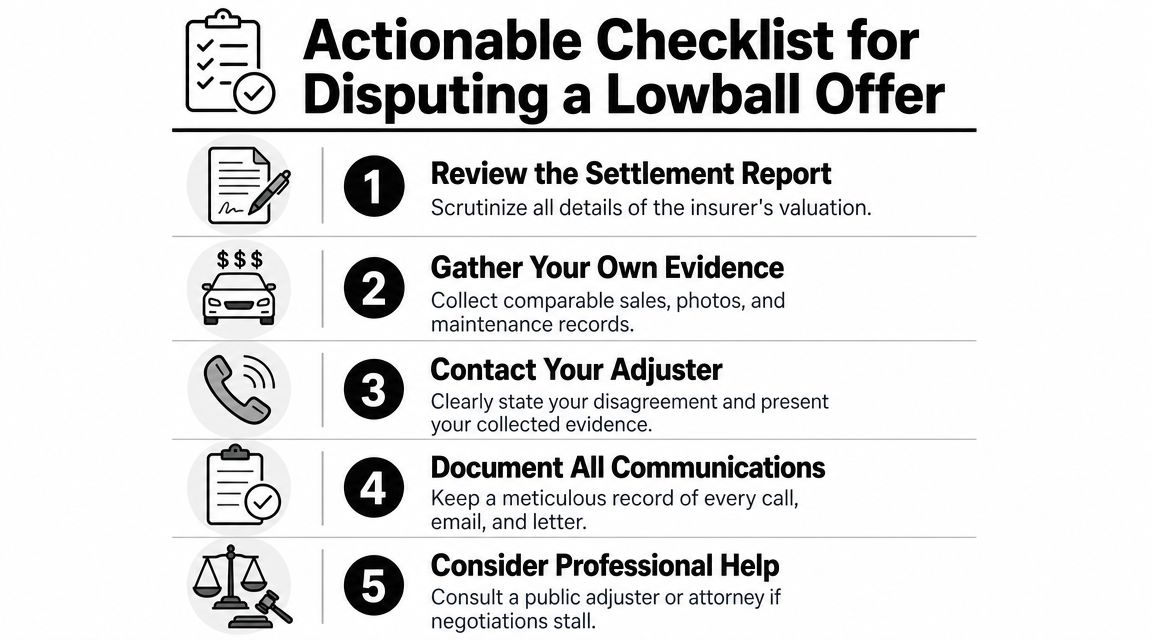
Your working checklist
Get the full valuation file. Ask for the complete vehicle total loss claim settlement report, not just the summary page or payout screen. You want the comp list, condition pages, adjustments, options, and settlement breakdown.
Read for errors before arguing value. Wrong trim, missing package, bad mileage entry, or omitted options can sink the number before the debate even starts.
Build your own evidence folder. Include pre-loss photos, maintenance records, upgrade receipts, window sticker if you have it, and your own local comparable vehicles. Keep your comps comparable. Don't undermine yourself with wishful examples.
Answer the report in writing. A clear email beats a frustrated phone call. Identify the bad comp, the missing option, the weak condition assumption, and the correction you want.
Before you make that call, it helps to hear a concise explanation of how these disputes usually unfold:
When the claim starts stalling
At some point, you'll know whether the adjuster is engaging with your evidence or just repeating the original report.
Use this second-stage checklist:
- Document every contact. Save emails, note call dates, and keep track of what the adjuster agreed to review.
- Ask specifically about taxes and fees if your state requires them under the circumstances of replacement.
- Don't mistake delay for evaluation. Some claims linger because the file isn't moving, not because anyone is rethinking the value.
- Escalate when needed. If you're still disappointed with a low offer, that consumer-oriented guidance gives a practical overview of next-step options when settlement talks stall.
- Invoke the appraisal clause when informal negotiation has clearly run out of road.
Keep your dispute professional. The stronger your tone control, the easier it is to keep the focus on evidence instead of personality.
If you need an independent valuation review, Total Loss Northwest handles total loss appraisals and appraisal-clause disputes for owners challenging low settlement reports. The work is centered on market-based valuation evidence, not insurer software output.