You're standing at the kitchen table with a repair estimate in one hand and a payout letter in the other, and the gap is obvious. The insurer says that number is “fair.” Your gut says it isn't. The problem is that most drivers were never shown how fair value is calculated, so they end up arguing about a single offer instead of the valuation inputs that produced it.
In an auto claim, fair value usually comes from three things you need to pressure-test, not one. The first is the comparable sales set, the second is the adjustments for your car's condition, mileage, and options, and the third is the treatment of depreciation or salvage, depending on whether the car is repairable or a total loss. If you don't challenge those pieces, you're just reacting to a software output.
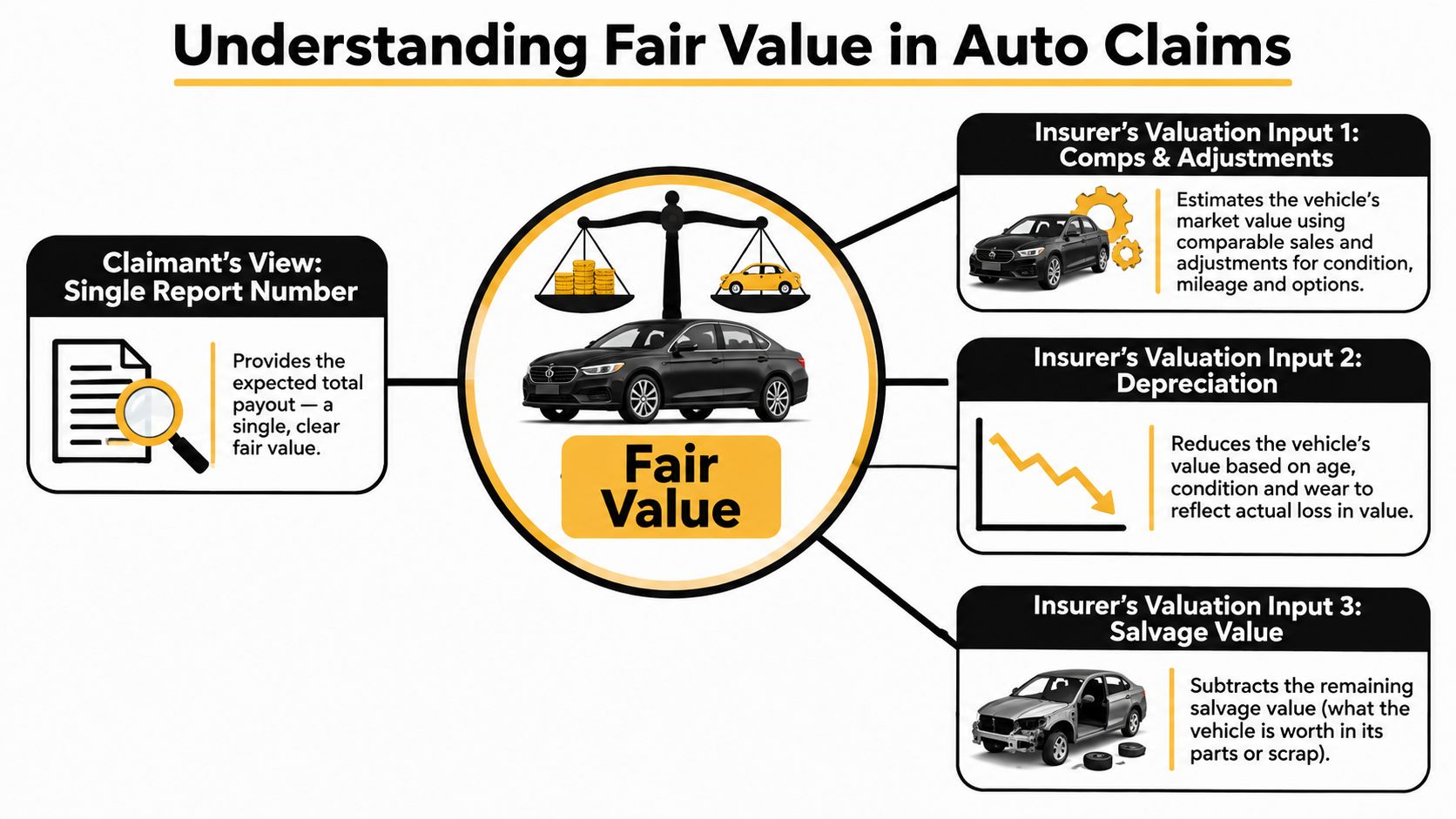
The bad habit I see all the time is treating the insurer's report as if it were the truth. It isn't. It's one valuation opinion built from assumptions, and the assumptions are where the money moves. A strong claim starts when you replace the insurer's black box with a market-based number you can defend.
What Fair Value Really Means in an Auto Claim
You're not trying to win a debate over semantics. You're trying to prove what a buyer would pay for your vehicle in the market, with its exact trim, mileage, condition, and history. That's the practical meaning of fair value in an auto claim, and it's very different from whatever number appears at the bottom of an insurer's report.
A proper fair value calculation starts with a market-comparable framework. That means looking at vehicles that resemble yours, then adjusting for differences instead of pretending every listing is the same. The valuation answer changes by asset class, and mainstream fair value guidance says there's no single formula for every situation, because the right method depends on the asset being valued and the available evidence (Investopedia's overview of fair value).
The number you see is not the whole number
The insurer's report usually shows one figure, but that figure is only the end product of a chain of inputs. Those inputs can include the comparables selected, the depreciation logic used, and the salvage estimate if the vehicle is totaled. In other words, the offer is the output, not the process.
Practical rule: don't argue the final number first. Argue the comps, the adjustments, and the salvage treatment that created it.
That's where most lowball offers fall apart. A report can look polished and still rely on weak comparables, stale listings, or a condition assumption that doesn't match the car in front of you. The gap between a rushed insurer valuation and a careful independent appraisal is often not small, because even small changes in assumptions can materially move fair value, which is exactly why conservative, documented assumptions matter in valuation work (IR Tracker on fair value workflow).
For claimants, the core insight is simple. Fair value is not the insurer's first number, it's the most defensible market number after proper adjustments. If you start there, you stop accepting valuation software as if it were a settlement formula.
Picking Comparable Sales That Hold Up
Comparable sales only work when they are comparable. Feed the valuation with weak peers, and the answer looks polished right up until someone checks the file. Good comps are tight, plain, and boring, because they match your vehicle closely enough that the remaining gaps can be adjusted without guesswork.
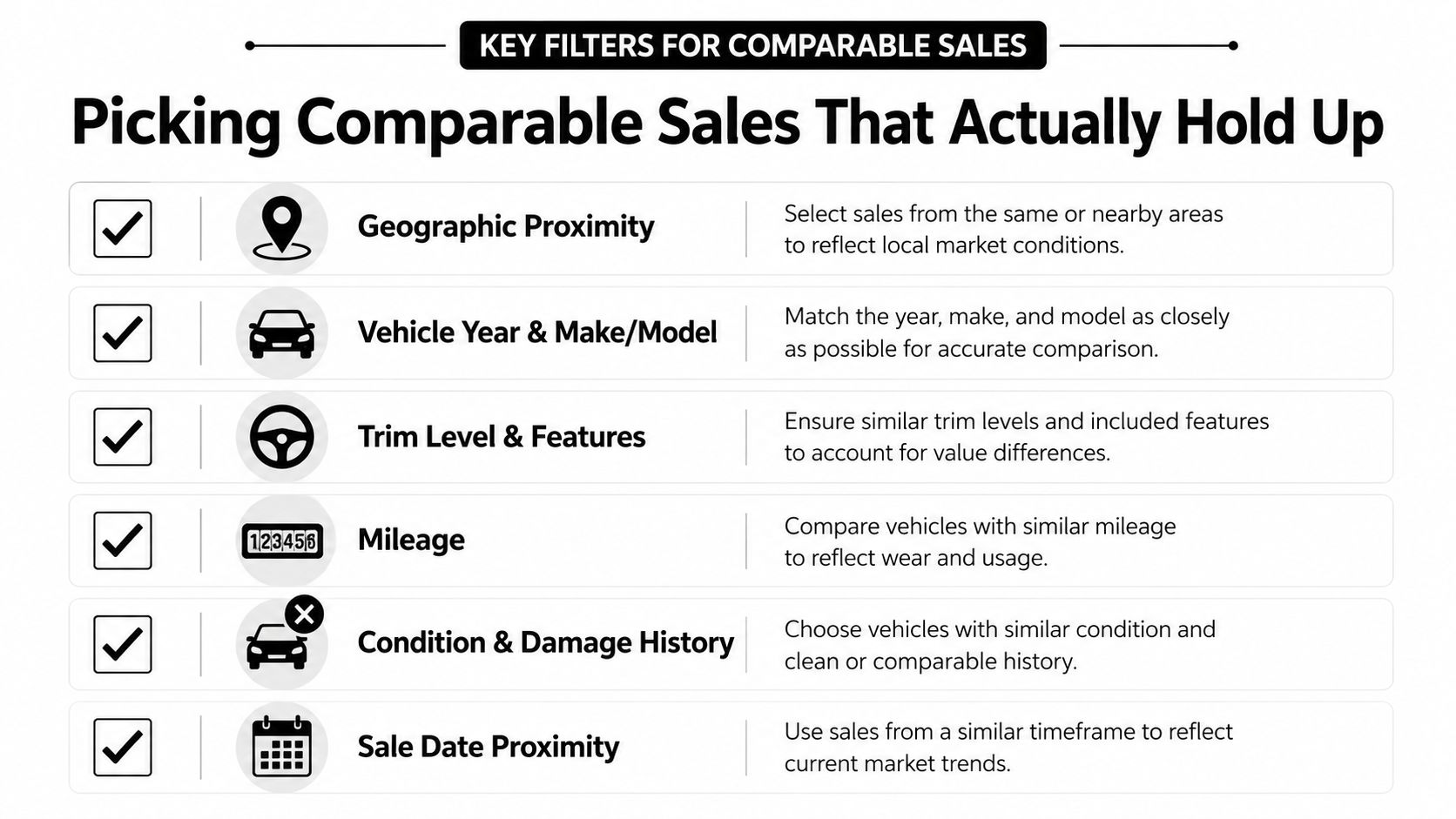
Start with the basics. Match the year, make, model, and trim as closely as possible, then check mileage, equipment, damage history, and sale location. If the vehicle went through a mid-cycle refresh, do not mix pre-refresh and post-refresh units as if they were the same car, because they often are not.
Narrow the pool before you argue the number
A working appraiser does not drown in listings. For claim disputes, the target is a narrow set of direct peers, then a clear explanation of why each one belongs. Too many comps usually means weak matches are hiding inside the group. Too few can leave you with a cherry-picked result that will not survive scrutiny.
Use these filters in order:
- Geographic proximity. Pull vehicles from the same or a similar market, because regional supply and demand affect price.
- Trim and equipment. Keep the same trim family and only include options that change market value.
- Mileage band. Stay close enough that the mileage adjustment is a correction, not a rescue mission.
- Condition and damage history. Exclude vehicles with prior losses, salvage titles, or obvious condition mismatches.
- Sale type. Private-party and dealer sales do not always behave the same, so do not blend them casually.
- Sale date. Favor recent transactions, because stale listings can overstate value in a rising market and understate it in a falling one.
A realistic search might start with a wide stack of listings for a mid-size SUV, then get cut down after trim and mileage filters, then again after condition and geography checks, and finally end with a handful of legitimate comps that support the conclusion. That is the discipline insurers often skip when they rely on automated feeds or broad listing pools.
For a more detailed look at how good comps are chosen, the comparables for appraisal guide is worth using. The goal is not to collect more data. It is to collect better data.
Rule of thumb: if a comp only works after three or four excuses, it is not a comp.
Adjusting for Condition, Mileage, and Options
Raw comp prices aren't the answer. They're the starting line. The whole job of fair value work is to convert a generic market price into the value of your vehicle, and that means making disciplined adjustments, not decorative ones.
Four adjustments that actually change the number
The cleanest way to think about this is in four buckets: mileage, condition, options, and geography. Mileage adjustment accounts for how far the subject vehicle sits above or below the comp average. Condition adjustment captures visible wear, prior repairs, and overall grading. Options adjustment covers manufacturer packages and equipment that affect resale. Geographic adjustment handles market differences between regions.
A simple working example looks like this:
| Adjustment Type | Comp Average | Subject Vehicle | Dollar Adjustment |
|---|---|---|---|
| Mileage | 72,000 | 64,000 | Positive adjustment for lower mileage |
| Condition | Clean | Very Good | Positive or negative based on inspection |
| Options | Base package | Added convenience package | Positive if the package is market-recognized |
| Geography | Stronger market | Weaker market | Positive or negative based on local demand |
That table is the right framework, even though the exact dollars must come from the actual market data and inspection. The reason is simple, if the comp has more mileage than your vehicle, your vehicle is worth more. If the comp has a condition problem you don't have, your vehicle is worth less than that comp on the face of it, and the adjustment has to reverse that gap.
A clean option package can matter, but only if the market pays for it. If the package is already baked into the trim, don't count it twice.
That last mistake is common. Insurers and claimants both get sloppy when an option is standard for the trim but gets listed as if it were an upgrade. The same problem shows up with aftermarket add-ons, because not every added part increases settlement value. Some items help, some don't, and some only help if the market recognizes them.
If you want a more detailed document trail for condition proof, use the vehicle condition inspection reference. The winning habit is to connect each adjustment to a real difference in the market, not to what feels reasonable in the abstract.
Depreciation and Salvage Considerations
A fair value number can still be wrong if you ignore time and salvage. That's where a lot of claim disputes get sloppy. The comp might be strong, but if the sale date and valuation date don't line up, or if a total loss claim uses the wrong salvage assumption, the final figure drifts.
Depreciation matters when the market moved
Depreciation in claims work is usually about the time gap between the comparable sale and the valuation date. If the market softened after the comp sold, the old sale can overstate value. If the market tightened, the old sale can understate it. This is why stale comps are dangerous, even when they look clean on paper.
For a late-model sedan, that time gap may only nudge the number modestly. For a high-mileage work truck, the same gap can hit harder because utility vehicles often react differently to supply changes and condition. The correct approach depends on the actual market, not a generic age curve.
Salvage can move a total loss settlement fast
Total loss claims add one more variable, salvage value. If the insurer keeps the salvage, it typically deducts the salvage amount from the actual cash value figure. If that salvage estimate is inflated, your payout gets squeezed. That's why salvage bids deserve the same skepticism as the comp set.
The standard framework for fair value accounting says salvage and replacement-style thinking are separate from historical cost, and inventory fair value can be measured as net realizable value, not replacement cost (PwC's fair value concepts). In claim language, that means you care about the market result, not what the vehicle cost you years ago.
If you're questioning the salvage figure, the salvage value assessment guide is the right place to start. The key move is to separate the car's pre-loss market value from the salvage deduction. Those are not the same number, and insurers sometimes blur them when they want the file to close cheaply.
When and How to Invoke the Appraisal Clause
If the valuation is wrong, the appraisal clause is the key point. Most drivers never use it because they think it sounds formal, expensive, or risky. It's none of those things in a serious dispute. It's a contract right, and it exists for exactly this kind of disagreement.
Use the clause when the valuation gap is real
Don't invoke appraisal just because you're annoyed. Use it when the comps are weak, the condition grading is off, the mileage adjustment is sloppy, or the salvage number is dragging the settlement down. If the difference is small, the cost and delay may not justify the move. If the gap is meaningful and the insurer won't budge, appraisal is the cleanest path.
The exact trigger language can be simple. Say, in writing, that you disagree with the insurer's valuation and demand appraisal under the policy's appraisal clause. Keep it short and direct. Don't argue the whole case in the triggering notice. You're opening the process, not trying to win the process in the first email.
What happens after invocation
Each side selects an appraiser. Those appraisers review the file, inspect the vehicle if needed, compare the data, and try to narrow the gap. If they can't agree, an umpire steps in. The umpire is there to resolve the disagreement, not to redo the insurer's entire file from scratch.
Costs are usually split according to the policy language and the way the appraisal process is set up. That's why you should read the clause before you start. Some insurers push back on your chosen appraiser, especially if that appraiser is known for challenging bad valuations, but pushback doesn't mean the demand is invalid.
The clause is a negotiation tool backed by contract language. Use it when the insurer has stopped evaluating and started defending a number.
This is also where a specialist can help. Total Loss Northwest, for example, offers independent total loss appraisal work and valuation review focused on actual market data and comparable vehicle research. That kind of file support matters when the insurer's number is disconnected from the market and you need a formal challenge, not a phone argument.
Documentation Checklist Before You Challenge an Offer
A good challenge starts before the first dispute letter goes out. If your file is thin, the insurer will treat your complaint like a preference. If your file is organized, you force the conversation onto evidence. That's the difference between frustration and advantage.
What to gather first
Start with the documents that can move the settlement figure. Then collect the items that mainly show diligence. The strongest files usually include:
- Maintenance records. Oil changes, brake work, tire replacement, and major repairs help establish how the vehicle was cared for.
- Title status and history. Clean title, prior branded title issues, or prior losses matter because they affect market value.
- Photos before and after the loss. Clear images support condition arguments better than vague descriptions.
- Inspection reports. A recent inspection can anchor condition, tire wear, and pre-loss quality.
- Recent repairs. Receipts for work that improved the vehicle can support an options or condition argument when the market recognizes the change.
- Comparable sales screenshots. Save the listing data, sale dates, mileage, and trim details for each comp.
- Market context. Regional availability, trim scarcity, and seasonality help explain why your vehicle should be valued differently.
What matters most versus what just looks organized
Not every document changes the settlement. Maintenance records and condition photos often do. A tidy folder of screenshots looks professional, but it only matters if the listings are comparable and recent. The insurer wants reasons to discount your request, so don't hand them a messy file with weak comps and no inspection support.
The best file is one that tells the same story from every angle. The vehicle history says the car was maintained. The photos show the condition. The comps show the market. The inspection report ties the whole package together. If those pieces point in the same direction, the insurer has less room to hide behind its first offer.
Putting It All Together With a Real Example
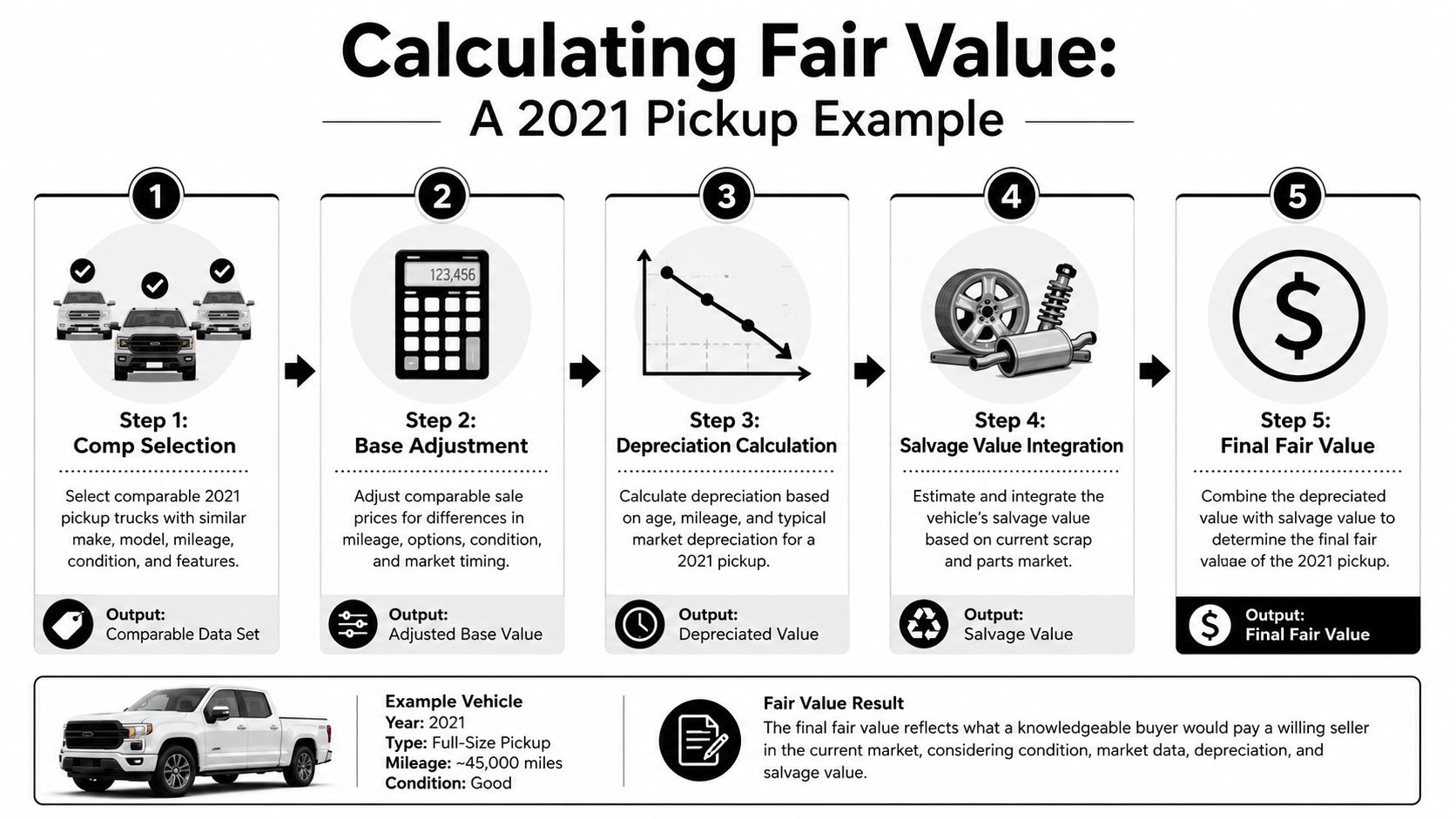
A 2021 pickup truck claim usually turns on the same four levers, comp selection, condition, time, and salvage. Start with a tight comparable set, strip out weak peers, and then make only the adjustments you can defend from the market evidence. That's the difference between a settlement built on an estimate and a settlement built on valuation.
A clean claim file beats a loud complaint
Suppose the insurer gives you a number that assumes generic comps and a soft condition grade. Your independent review uses a tighter peer set, corrects for mileage, applies a proper condition adjustment, and checks whether the salvage deduction is fair. That's the path to an accurate number, not a “best guess.”
The winning move is simple. Start by printing the valuation report, then mark every comp that doesn't match your truck's trim, mileage, or region. After that, gather your photos, service records, and title documents, and build the file around the strongest evidence. If the insurer still won't move, invoke the appraisal clause and force the issue into a formal valuation process.
Don't accept a total-loss offer until you can answer one question, which comps did they use, and why are they better than yours?
A solid challenge usually recovers value by correcting the parts of the report that were weakest from the start. The more precise the file, the less room the insurer has to pretend the first offer was final.
If you're staring at a low settlement and want a real market-based review, Total Loss Northwest can evaluate the comps, condition, and salvage assumptions behind the insurer's number. Visit Total Loss Northwest to get an independent appraisal review and push your claim toward the fair value your vehicle supports.