The adjuster called. The repair estimate came in. Then you heard the phrase nobody wants to hear: your car is a total loss.
That's usually the moment the whole thing stops feeling like an accident claim and starts feeling like paperwork, math, and bad choices. You're trying to figure out whether to keep the car, whether the insurance offer is fair, whether the damage is even worth rebuilding, and what a salvage title will do to the vehicle later. If you're in Oregon or Washington, the confusion gets worse fast because the two states don't handle salvage vehicle registration the same way.
I've seen owners make the same expensive mistake over and over. They focus on the rebuild first and the settlement second. That's backwards. The insurance valuation sets the financial reality for everything that follows. If the carrier undervalues your vehicle, the buyback stops making sense before you even pick up a wrench.
Your Car Is Totaled Now What
A common version of this story goes like this. You were hit, or slid into someone, or came out to find the front corner crushed. The body shop says the damage is bad but maybe fixable. Then the insurer says “total loss,” sends a valuation report, and gives you two paths: take the payout and surrender the car, or keep it and accept a reduced settlement because of the salvage retention.
That second option sounds simple until you live it.
You start hearing terms like salvage title, rebuilt title, owner-retained total loss, and inspection. Meanwhile, you still need a car, you're trying to get personal items out of storage, and the insurer wants an answer on the settlement. Most drivers haven't dealt with this before, so they assume they can decide later. You usually can't. The settlement decision comes first, and it affects every salvage vehicle registration step after that.
If you're in the middle of that mess, start with a grounded checklist on what to do when your car is totaled. Read it before you sign anything.
Don't agree to a total loss payout just because the carrier says the number is “standard.” Their number may decide whether keeping the vehicle is smart or foolish.
For Oregon and Washington owners, the right question isn't “Can I rebuild this?” The right question is “After the settlement, the title branding, the inspection, the documentation, and the insurance fallout, should I rebuild this?”
Sometimes the answer is yes. A well-understood older truck, a collector car, or a vehicle with sentimental value may justify the trouble. Sometimes the answer is no, especially when hidden structural damage, parts sourcing, or future insurance headaches turn a cheap buyback into a money pit.
First Steps After a Total Loss Declaration
The first job is to get the language straight, because bad decisions usually start with bad definitions.
A salvage title is a title brand placed on a vehicle after it's been declared a total loss. A rebuilt title is what you pursue after repairs and state inspection. The title doesn't go back to “clean.” The history stays with the vehicle.
Early on, it helps to see the sequence clearly.
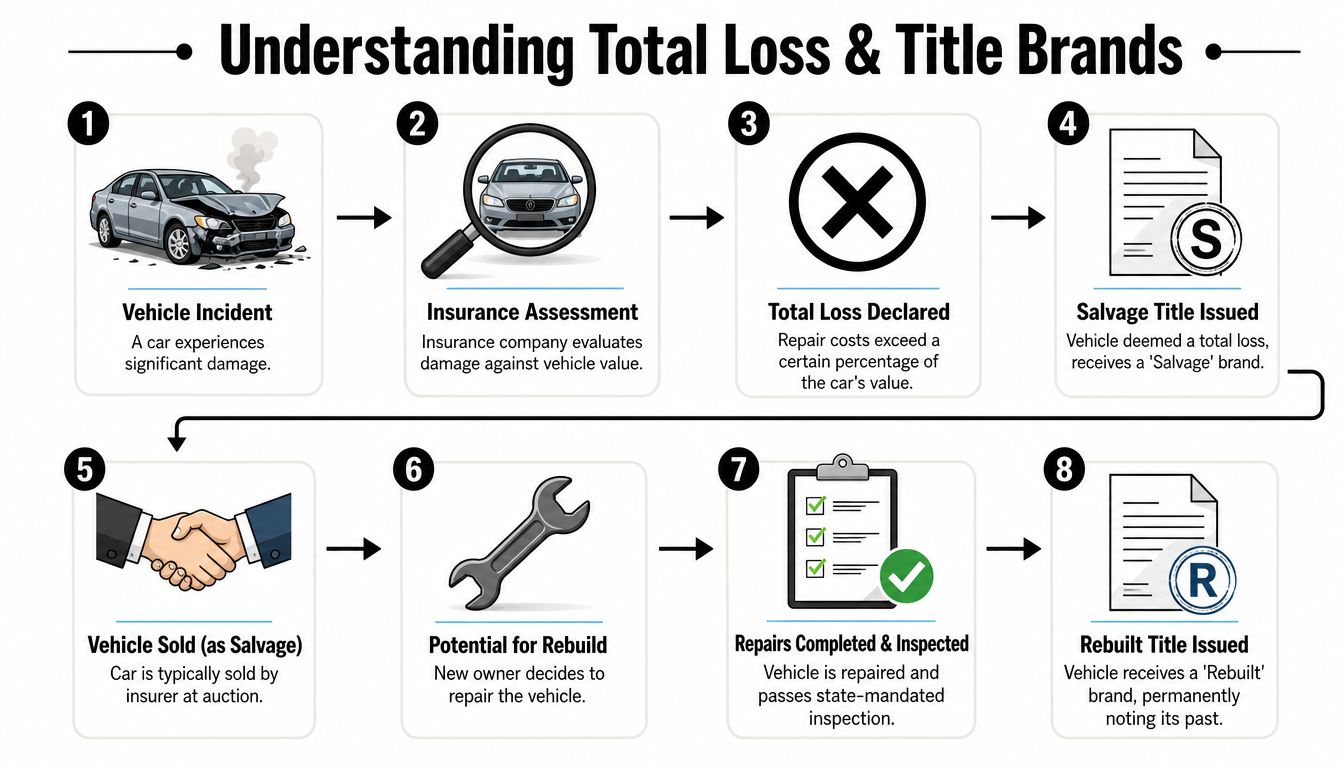
Know what the title brand actually means
Title brands aren't just state paperwork sitting in a file cabinet. They're tracked across a national system. According to the National Motor Vehicle Title Information System consumer overview, approximately 87% of the entire U.S. vehicle population is covered by NMVTIS, which tracks brands such as salvage and total loss so buyers, regulators, and insurers can see a vehicle's prior condition.
That matters for two reasons:
- You can't assume the vehicle's history will disappear. It won't.
- You should verify history before spending money on repairs. If prior branding or damage history is already on record, it can affect value and future resale.
Decide whether to keep the car
This is the fork in the road. You either:
- Accept the settlement and let the insurer take the vehicle, or
- Keep the vehicle as a buyback, then repair it and work through salvage vehicle registration.
Owners often rush this decision because they're attached to the car or because the visible damage looks manageable. That's not enough. You need to compare the settlement amount, the retention deduction, the likely repair scope, the inspection path in your state, and the long-term title consequences.
The most overlooked issue is the valuation itself. If the insurer's total loss figure is low, the buyback can look affordable on paper while trapping you in a bad rebuild. If the valuation is fair, the same buyback may work.
Practical rule: settle the valuation fight before you commit to keeping the car.
That's why owners should understand whether their policy includes an appraisal clause and whether it makes sense to use it. If you haven't looked into that angle yet, watch this short overview first.
Don't make a repair decision with incomplete numbers
Before you say yes to a buyback, answer these questions in writing:
- What is the exact total loss settlement offer? Get the valuation report.
- What amount will be deducted if you retain the salvage? Don't accept a verbal estimate.
- What damage is still unknown? Suspension, frame, electrical, airbag, and restraint issues often surface later.
- What will the finished title status be? You're not restoring a clean-title vehicle.
- What will insurance look like afterward? This becomes a serious issue later.
If you can't answer those cleanly, pause. Salvage vehicle registration isn't something you improvise through after a rushed settlement.
Your Blueprint for Rebuilding and Documentation
Once you choose to keep and rebuild the vehicle, your job changes. You're not just an owner anymore. You're the recordkeeper for a future inspection file.
Most first-time rebuilds go sideways at this point. The car may be repaired well, but the paperwork is weak. The state doesn't inspect your intentions. It inspects your proof.
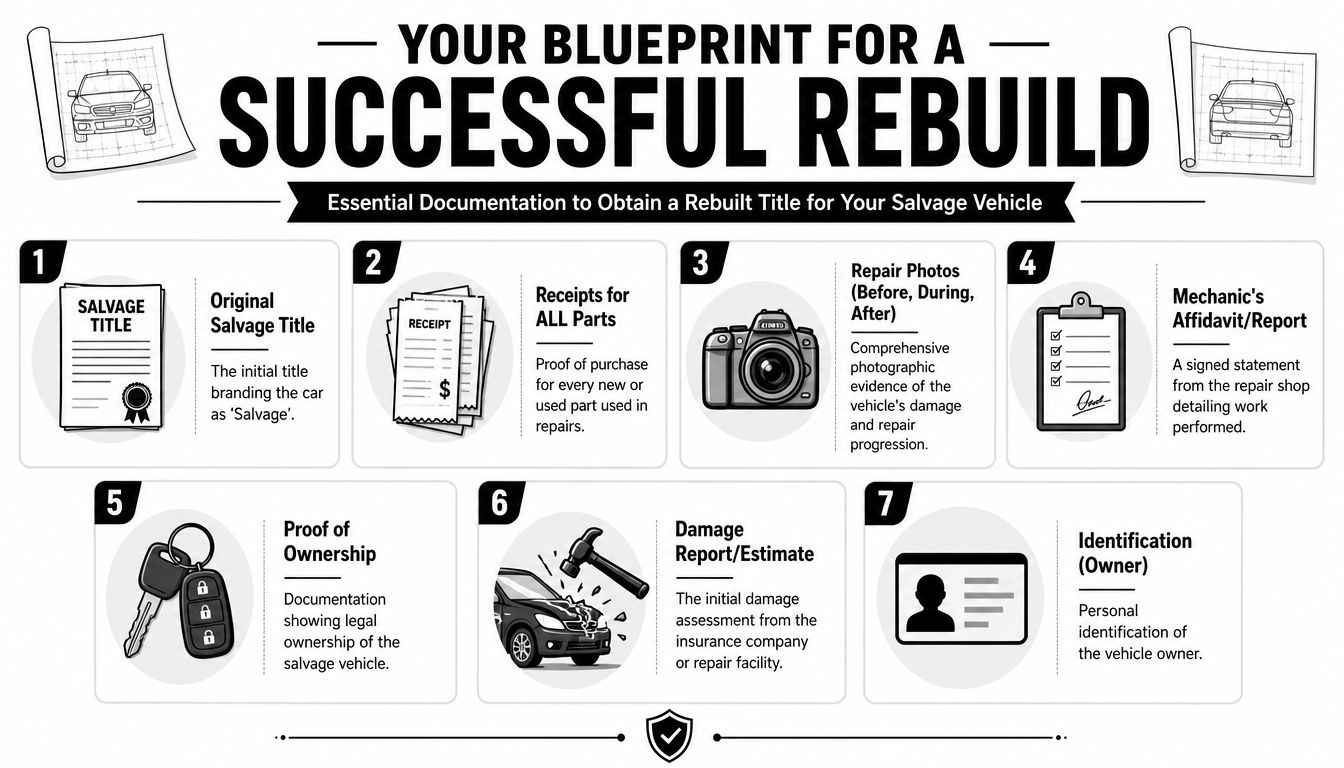
According to the Bid N Drive salvage registration guide, the success rate for legally registering a salvaged vehicle for first-time applicants is estimated at 72%, and failure to provide detailed repair receipts is the single most cited reason for rejection in 35% of failed cases.
That tracks with what experienced appraisers and rebuilders already know. Missing paper kills good projects.
Build your file like an auditor will read it
You need a binder, folder, or digital file system containing the whole repair story from damage to completion.
Keep these items:
- The salvage title paperwork. You need the branded ownership record, not just a bill of sale or insurer release.
- Itemized receipts for every part. Not a credit card summary. Not a handwritten total. Actual receipts that identify what was purchased.
- Photos before, during, and after repairs. Include the VIN plate, the damaged areas, and the repaired areas.
- Labor records. If a shop did the work, get invoices that describe what was done. If you did the work yourself, keep a detailed written log and every supporting purchase record.
- Initial damage estimate or total loss paperwork. That helps connect the repair narrative.
- Proof of ownership and identification. Don't wait until inspection week to gather these.
For a more detailed overview of the salvage title process, review the sequence before you buy parts.
What inspectors want to see
Inspectors are looking for two things. First, the car has to be safe enough to move forward in the process. Second, the parts and repairs have to make sense on paper.
That means your receipts need to answer practical questions:
| Document issue | Why it causes trouble |
|---|---|
| Part receipt is vague | The inspector can't tell what was installed |
| Seller information is missing | Part origin becomes harder to verify |
| Labor isn't documented | Repair quality and scope become harder to assess |
| Photos are incomplete | You can't prove the progression of repairs |
A rebuilt vehicle file should tell a straight story. Damaged bumper replaced. Headlamp sourced legally. Airbag components addressed properly. Structural work documented. Paint work tied to the repair invoice. If the paper trail jumps around, you invite delays.
Keep every receipt the day you get it. Going back later to reconstruct a build file is where salvage projects start to unravel.
Don't repair first and organize later
That habit burns people. They throw receipts in the glovebox, lose online order confirmations, forget to photograph the damage before teardown, and then act surprised when the state or inspector wants proof they can't produce.
If the vehicle matters enough to rebuild, it matters enough to document correctly. Every step in salvage vehicle registration gets easier when your paperwork is better than average.
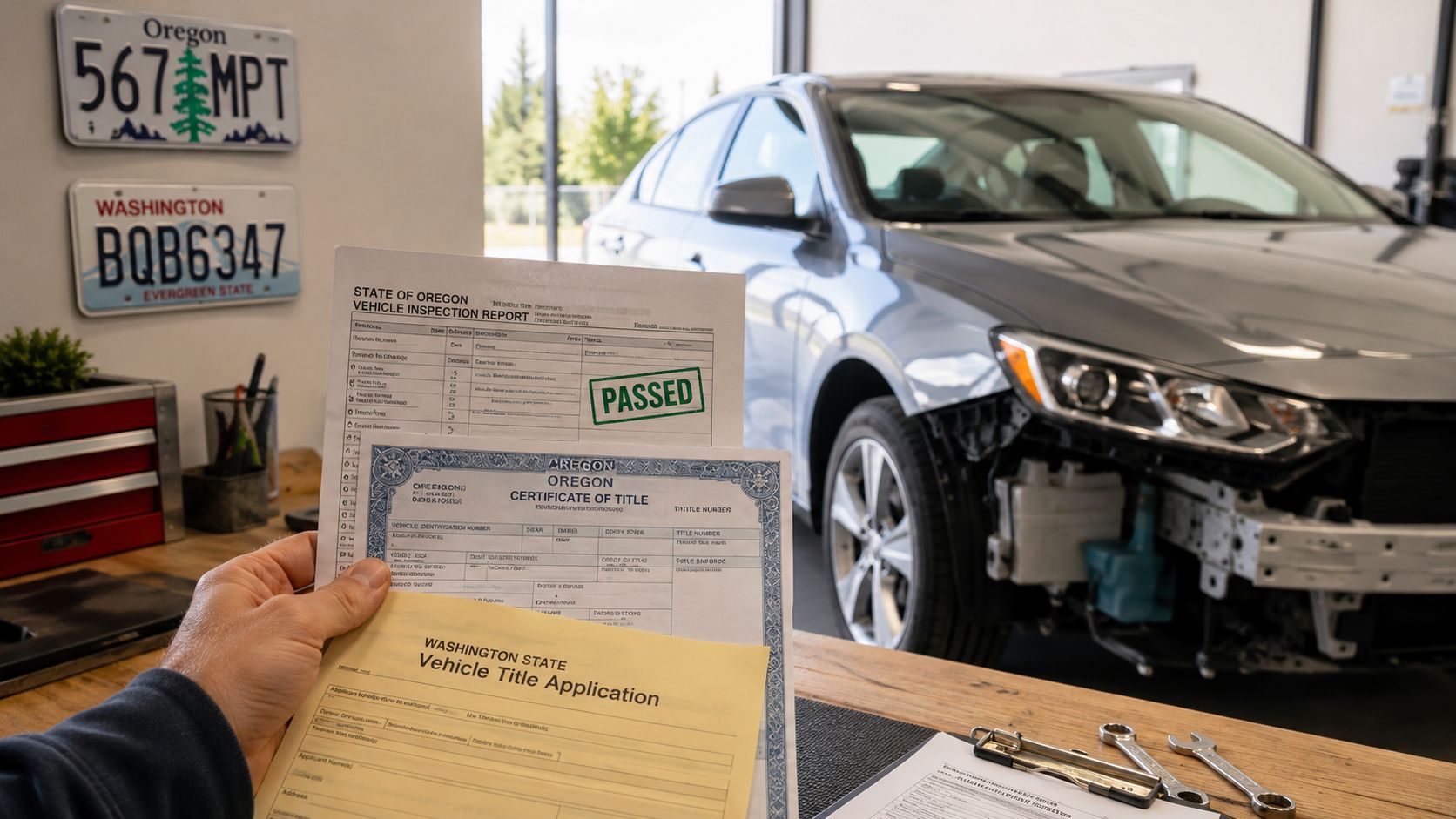
Navigating the Oregon vs Washington Inspection Process
This is the section where generic internet advice usually fails. Oregon and Washington are neighbors, but they don't run the same salvage inspection path. If you mix up forms, inspection agencies, or scheduling assumptions, you can lose weeks.
That's not a minor inconvenience. The lack of standardized requirements across states creates a real barrier. The California DMV discussion of revived salvage requirements is a good example of how state-by-state variation creates confusion, and the verified data tied to that issue notes 40% higher rejection rates for first-time applicants who assume generic advice is enough, with registration delays of 3 to 5 weeks when paperwork doesn't match the state's actual process.
Oregon and Washington aren't California, but the lesson is the same. Follow your state's exact path, not a generic “rebuilt title” article.
The practical difference
In broad terms, Oregon owners often deal with a DMV-centered process that may involve a certified private business or designated inspection workflow depending on the vehicle and situation. Washington owners more commonly run into inspection procedures tied to the Washington State Patrol for rebuilt vehicles. That difference affects appointment availability, travel, and how you prepare your file.
If you need a quick refresher on the distinction between title brands, this breakdown of rebuilt title vs salvage title is worth reading before you schedule anything.
Oregon vs Washington Salvage Inspection Requirements
| Requirement | Oregon | Washington |
|---|---|---|
| Inspection path | Often routed through Oregon DMV requirements and, in some cases, DMV-certified or designated inspection channels | Commonly routed through Washington State Patrol rebuilt vehicle inspection procedures |
| Main scheduling issue | Owners need to confirm the right inspection type before showing up with an incomplete file | Appointment access can become the bottleneck if the vehicle is ready before inspection slots are available |
| Paperwork focus | State-specific title and inspection forms, ownership records, receipts, and repair proof must align with Oregon requirements | State-specific rebuilt application materials, ownership records, receipts, and repair proof must align with Washington requirements |
| Common owner mistake | Using a general salvage checklist from another state and assuming it applies in Oregon | Bringing repair paperwork that proves work was done, but not in the format Washington expects |
| Best preparation step | Call or verify with Oregon DMV before final assembly is complete so you know what will be checked | Review Washington inspection instructions before sourcing parts so your documentation matches inspection expectations |
Where owners get tripped up
The mistake isn't usually the wrench work. It's administrative sloppiness.
Some owners in Oregon assume any receipt is fine. Some owners in Washington assume a body shop invoice alone will carry the inspection. Both assumptions can cost you. Your paperwork has to match what your state wants to see, and the inspector has to be able to follow it without guessing.
Use this checklist before you book:
- Confirm the exact inspection authority for your vehicle and situation.
- Match every major repair to a receipt or invoice.
- Verify title paperwork is in your name or properly assigned.
- Bring photos that show the vehicle before and during repairs, not just the finished result.
- Check whether any additional state forms apply before the appointment date.
A salvage inspection isn't the place to “see if this is enough.” Show up knowing it is.
The Oregon versus Washington split matters because each state has its own rhythm. One may frustrate you with form detail. The other may frustrate you with appointment logistics. Either way, salvage vehicle registration goes smoother when you stop looking for universal rules and start following the state-specific playbook.
The Long-Term Reality of a Rebuilt Title
Passing inspection feels like the finish line. It isn't. It's the point where the car becomes road-legal again, but with a permanent story attached to it.
That story follows the vehicle in two places that matter most: insurance and resale.
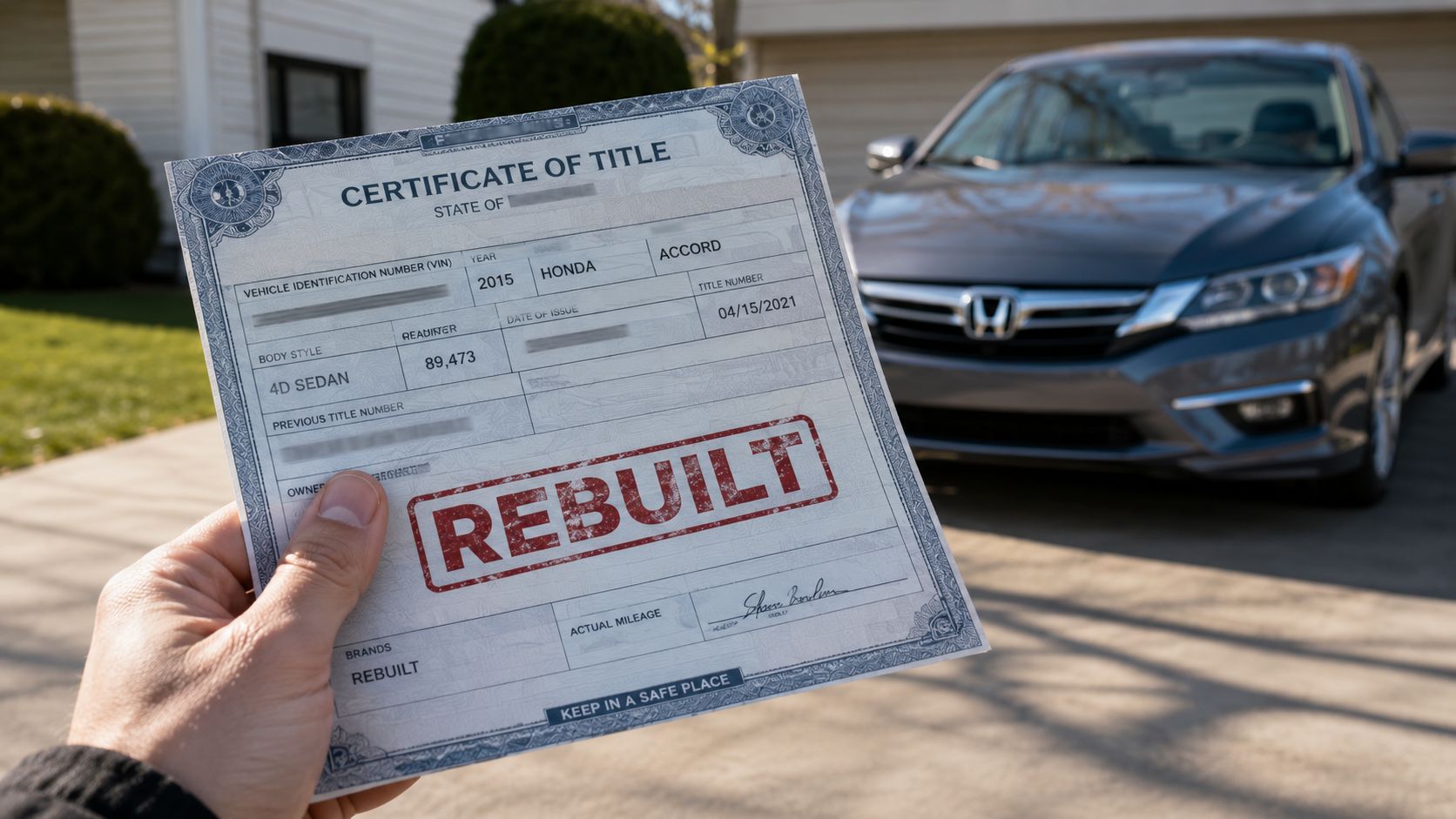
Insurance gets harder after the rebuild
Most owners assume that once they have a rebuilt title, they can insure the vehicle normally. That's too optimistic.
The major issue isn't always liability coverage. It's physical damage coverage. According to Insure on the Spot's rebuilt title insurance discussion, 60% of insurers in major markets refuse collision and other physical damage coverage for rebuilt title vehicles, which can push owners into liability-only coverage.
That changes the risk calculation dramatically. If the rebuilt car is stolen, vandalized, or damaged in another collision, you may be carrying far more exposure than you expected.
Resale won't work like a clean-title car
A rebuilt title stays with the vehicle. Buyers know that. Dealers know that. Lenders know that too.
Even if the repair work is excellent, many shoppers will walk away as soon as they hear “rebuilt.” Others will still consider it, but they'll want documentation and they'll negotiate hard. That's why your repair file still matters long after registration.
Keep a permanent packet with:
- Damage photos
- Parts receipts
- Shop invoices
- Inspection approval documents
- Any post-repair maintenance records
When a future buyer asks what happened, don't give a speech. Give them a clean file.
The best defense against rebuilt-title skepticism is organized proof, not reassurance.
When rebuilding still makes sense
I'm not against rebuilt vehicles. Some are smart buys. Some owners know the car's history, supervise the repairs carefully, and plan to keep it long enough that resale matters less. In that situation, a rebuilt title can be perfectly reasonable.
But don't kid yourself. A rebuilt car is not a clean-title equivalent with a discount sticker. It's a different asset with different insurance friction, different buyer resistance, and a narrower future market.
If you go forward, do it with open eyes. Salvage vehicle registration gets the car back on the road. It doesn't erase the consequences of the total loss.
Common Questions About Salvage Vehicle Registration
Can you drive a salvage-titled vehicle before it's rebuilt?
Usually, no. In practice, owners should assume a salvage-titled vehicle is not road-ready until the state says it is. Some states allow limited transport or permit-based movement in narrow situations, but you should verify that directly with your state before driving anywhere other than through an approved transport method.
If you gamble on this point, you risk tickets, towing, and a bigger mess with your insurer.
How long does salvage vehicle registration take?
There isn't one clean timeline. Repair complexity, parts delays, inspection scheduling, and paperwork quality all control the pace. A simple cosmetic rebuild with perfect records moves faster than a late-model vehicle waiting on multiple components and a hard-to-book inspection.
The smartest move is to think in phases, not dates:
- Settlement and title decision
- Repair planning and parts sourcing
- Documentation assembly
- Inspection scheduling
- Title issuance and registration
If any one of those phases gets sloppy, the whole job drags.
What if you bought a car and later learned it had salvage history?
Stop relying on the seller's verbal explanation and pull the title history immediately. Check your state records and compare the vehicle's branding against the documents you received. If the branding wasn't disclosed correctly, you may have a consumer problem, not just a registration problem.
Also, don't spend money improving the vehicle until you know what title status you're dealing with.
What if you're missing one important receipt?
Try to replace it before inspection. Contact the seller, the parts yard, the online vendor, or the repair shop and request a duplicate invoice. If that fails, gather every supporting record you still have, such as order confirmations, card records, packaging labels, and related work notes.
That missing receipt may or may not sink the application, but hoping the inspector won't care is a weak strategy.
Is rebuilding worth it after a total loss?
Sometimes. Usually when one or more of these is true:
- You know the vehicle well and trust the pre-loss condition.
- The damage is concentrated, not scattered through safety systems and structure.
- You have access to quality repair work and can document all of it.
- You plan to keep the vehicle, not flip it quickly.
- The total loss settlement was handled fairly, so the buyback economics still make sense.
If those pieces aren't in place, walking away is often the smarter financial move.
What's the biggest mistake people make?
They treat the rebuild as a body shop problem instead of a title, insurance, and valuation problem.
That's why some owners end up with a repaired car they can't easily register, can't insure the way they expected, and can't sell for anything close to what they put into it. The salvage vehicle registration process is manageable. The expensive part is misunderstanding the full chain of consequences.
If your insurer declared your vehicle a total loss and the numbers don't look right, get the valuation reviewed before you decide whether to surrender the car or keep it. Total Loss Northwest helps Oregon and Washington owners challenge low total loss valuations through independent appraisals and appraisal clause support, so you can make the salvage decision with real numbers instead of insurer shortcuts.