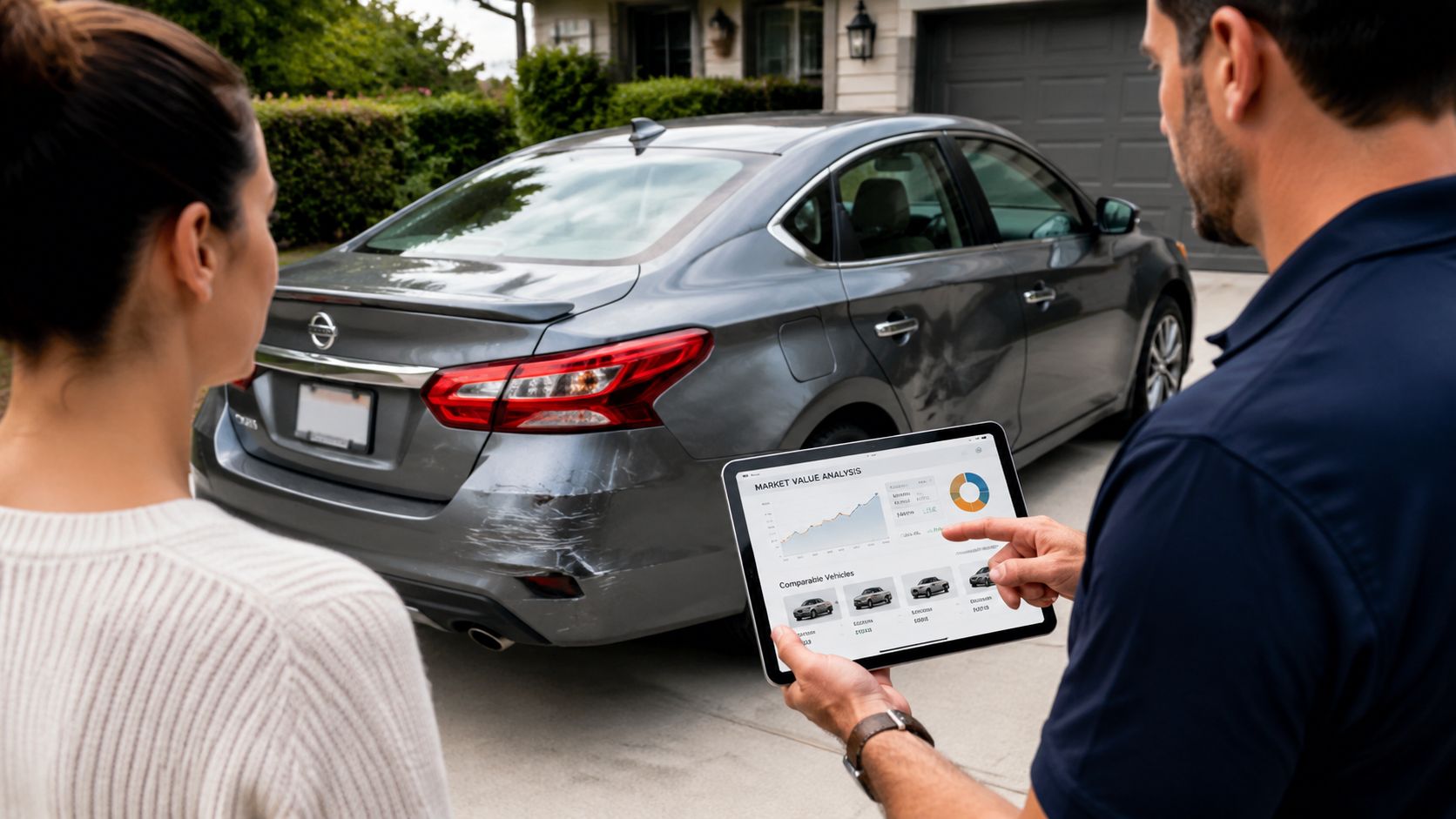
You're standing at the curb watching your damaged vehicle get loaded onto a tow truck, and the first insurance call already feels like a fight you didn't ask for. The adjuster says total loss, the number feels thin, and you're left wondering whether the company is pricing your car like a real replacement or just trying to close the file fast. That's where replacement cost coverage matters, because the policy language decides whether you get a practical replacement value or a bargain-bin settlement.
The same mistake shows up in home insurance all the time. Homeowners are often underinsured, not fully protected, and the gap between what a policy says and what it pays can get ugly fast. MoneyGeek reports that a Harvard Business School working paper found the average U.S. homeowner with a mortgage insured only 70% of rebuild cost in 2011, and that fell to about 50% by 2020. It also reports that a Federal Reserve Bank of Philadelphia analysis of about 5,000 Marshall Fire claims found 74% of affected homeowners were underinsured, with 36% below 75% of replacement cost, while Colorado's Division of Insurance found only 8% of homeowners carried guaranteed replacement coverage (MoneyGeek on underinsurance). That's not a niche problem. That's the industry's default behavior.
When the Adjuster Says Total Loss
The worst part of a total loss call is how calm the adjuster sounds while your day falls apart. Your car is in a yard, your insurance file is open on someone else's screen, and the word total loss starts to feel like a verdict instead of a claim label. That label is not about how badly you feel after the crash, it's about whether the insurer thinks repair cost and settlement math make the vehicle economically uneconomical to fix.
Practical rule: a total loss is a settlement decision, not a moral judgment about your car.
That matters because the payout isn't driven by the accident alone. It's driven by the coverage language sitting in your policy. If the policy pays only actual cash value, depreciation gets baked into the check. If the policy or endorsement promises replacement cost coverage, the math changes, and so does the outcome.
Drivers get tripped up here because they assume “full coverage” means replacement money. It doesn't. A declaration page can look strong and still leave you short when the insurer's valuation software decides your vehicle is worth less than a comparable replacement on the local market. That's why the first thing I tell people to do is slow down, gather the claim paperwork, and keep one eye on the policy wording.
If you're juggling family logistics after the loss, keep your accident papers, photos, and policy docs together in a single folder. A practical household example of that kind of organization is the emergency preparedness for parents binder approach, which works because the same habit that saves time in a family emergency also saves you from missing claim documents.
What Replacement Cost Coverage Actually Means
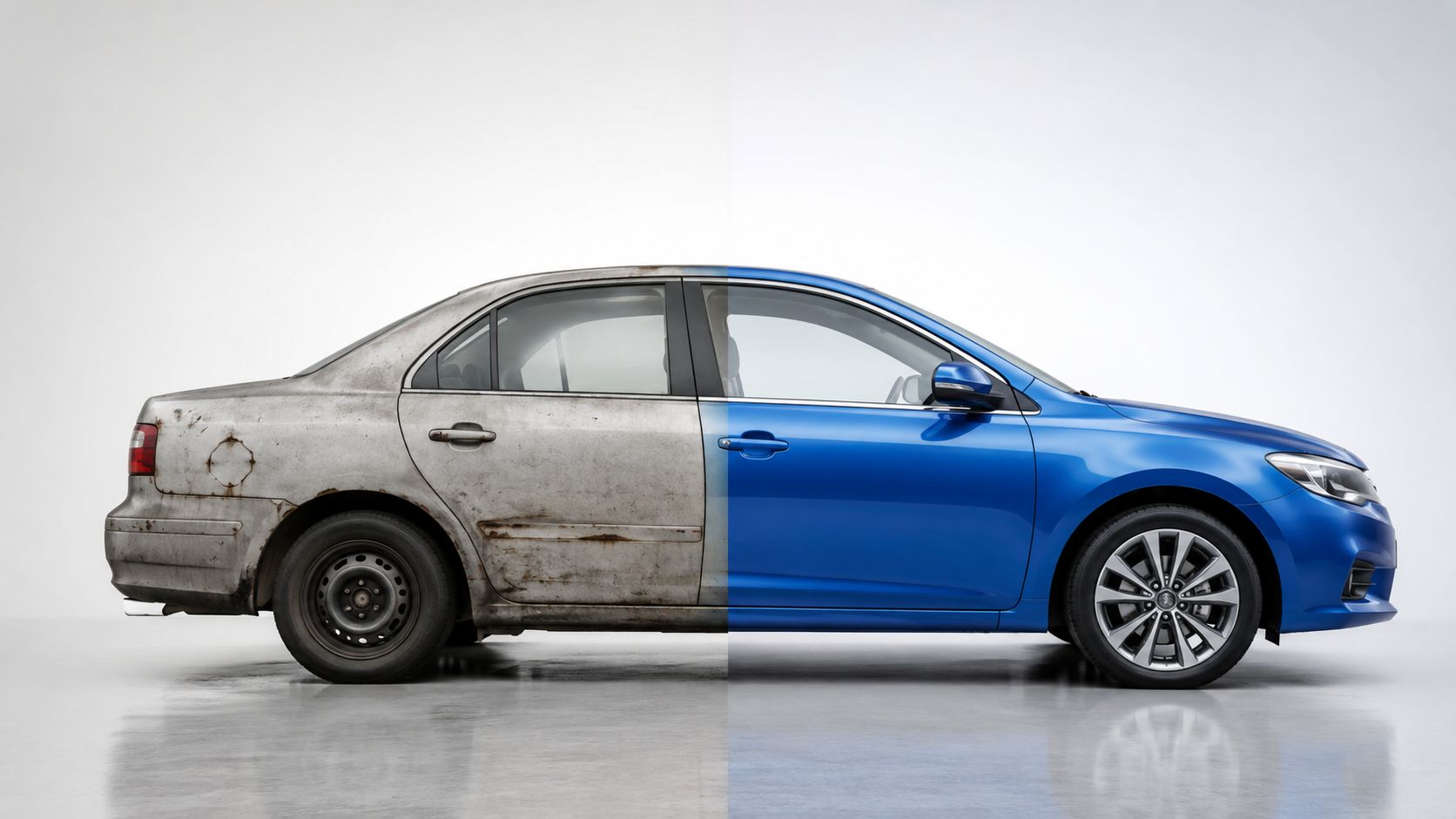
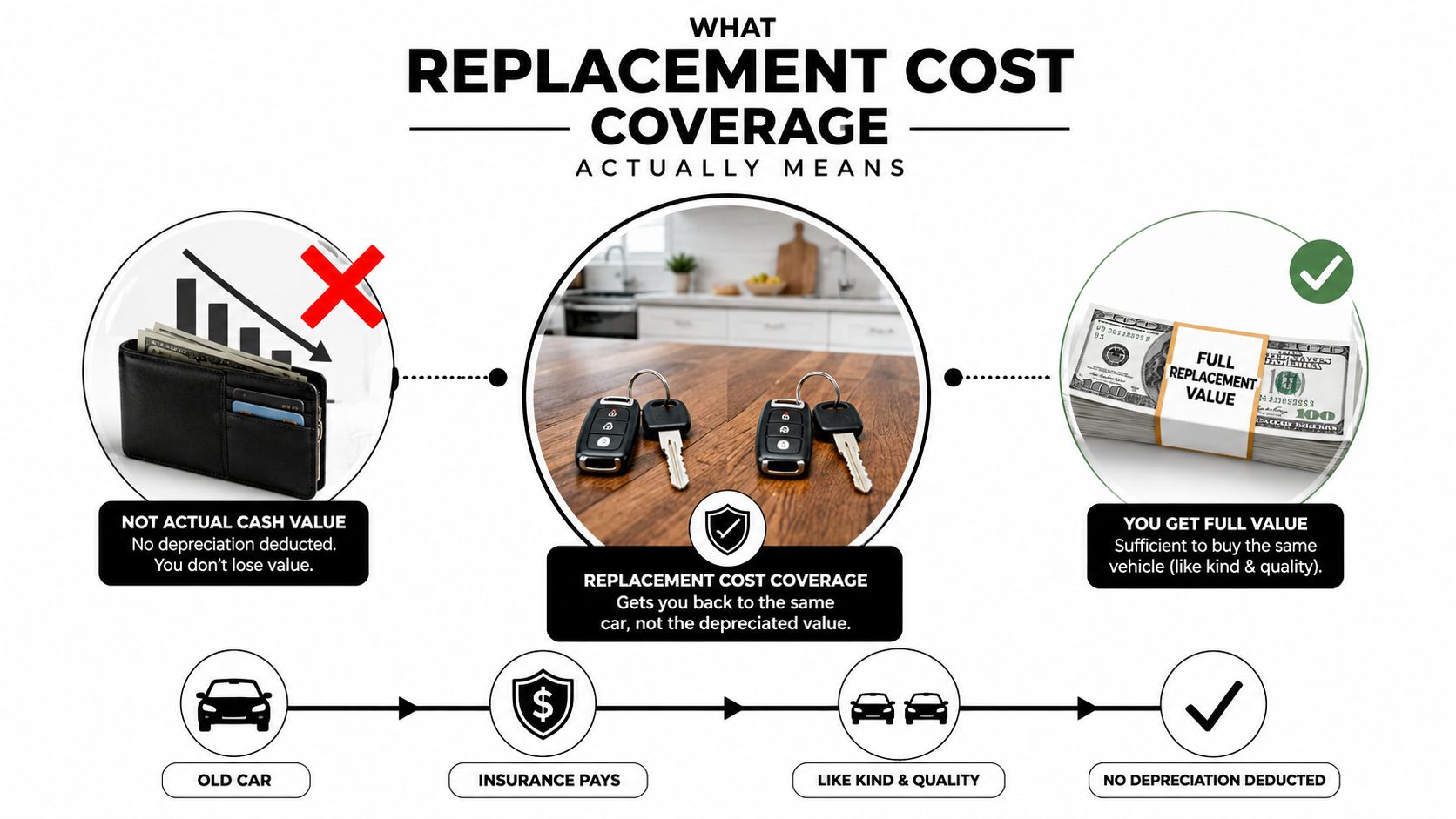
Replacement cost coverage means the insurer pays what it takes to replace the damaged property with something of like kind and quality, without knocking off depreciation first. The cleanest way to think about it is this, if your five-year-old laptop dies, replacement cost buys a comparable new laptop, it doesn't reimburse you for what that worn unit is worth on a resale site. That's the core distinction.
The simple version
For vehicles, the phrase gets used a little differently than it does in homeowners insurance, but the logic is the same. Replacement cost is aimed at putting you back in a comparable vehicle, while actual cash value is aimed at paying the depreciated value of the one you lost. Market value is another animal entirely, because it's shaped by what buyers are paying right now, not just by bookkeeping on age and wear.
The NAIC's definition of replacement cost value coverage says it pays the cost to repair or replace damaged property using materials of like kind and quality, while market value includes land and real estate conditions. State Farm says replacement cost is the estimated cost to rebuild the dwelling structure at current construction prices, not what the home and land would sell for (NAIC replacement cost guidance). That property language is useful because the underlying principle is the same in auto claims, even if the policy form differs.
The kitchen-table test
If you can explain it at the kitchen table, you probably understand it. Replacement cost says, “put me back where I was with a comparable item.” Actual cash value says, “pay me for what this item was worth after age and use took their toll.” If you're still hearing the insurer say “depreciation,” then you're not looking at replacement cost.
Bottom line: if depreciation is being deducted, you're not getting true replacement treatment.
Replacement Cost Coverage vs Actual Cash Value
The offer on a total loss claim can look clean on paper and still leave you short. The gap usually comes from depreciation, because depreciation is what trims the settlement and turns a promising number into a low one.
For a closer look at how carriers build that number, review this explanation of actual cash value in total loss claims. Once you understand that math, you can spot where the insurer is shaving value.
| Criteria | Replacement Cost Coverage | Actual Cash Value |
|---|---|---|
| How the payout is calculated | Pays to replace with like kind and quality | Pays replacement cost minus depreciation |
| Depreciation | Not deducted | Deducted |
| Settlement goal | Put you back into a comparable replacement | Compensate for the value lost through age and wear |
| Best fit | Drivers who want a truer replacement outcome | Drivers willing to absorb depreciation risk |
What changes in real life
Here is the real-world difference. Under replacement cost treatment, the settlement is built around what it costs to get a comparable vehicle or property back in your hands. Under ACV, the insurer starts with what the damaged item was worth after time, mileage, and use took a bite out of it. That is why ACV usually looks lower, even when the loss feels identical.
In total loss claims, insurers and valuation software usually default to ACV because it protects the carrier from paying for wear you already used. That is the part drivers miss when they hear “full coverage” and assume it means replacement money. It does not. It usually means the insurer will calculate a depreciated number and call that fair.
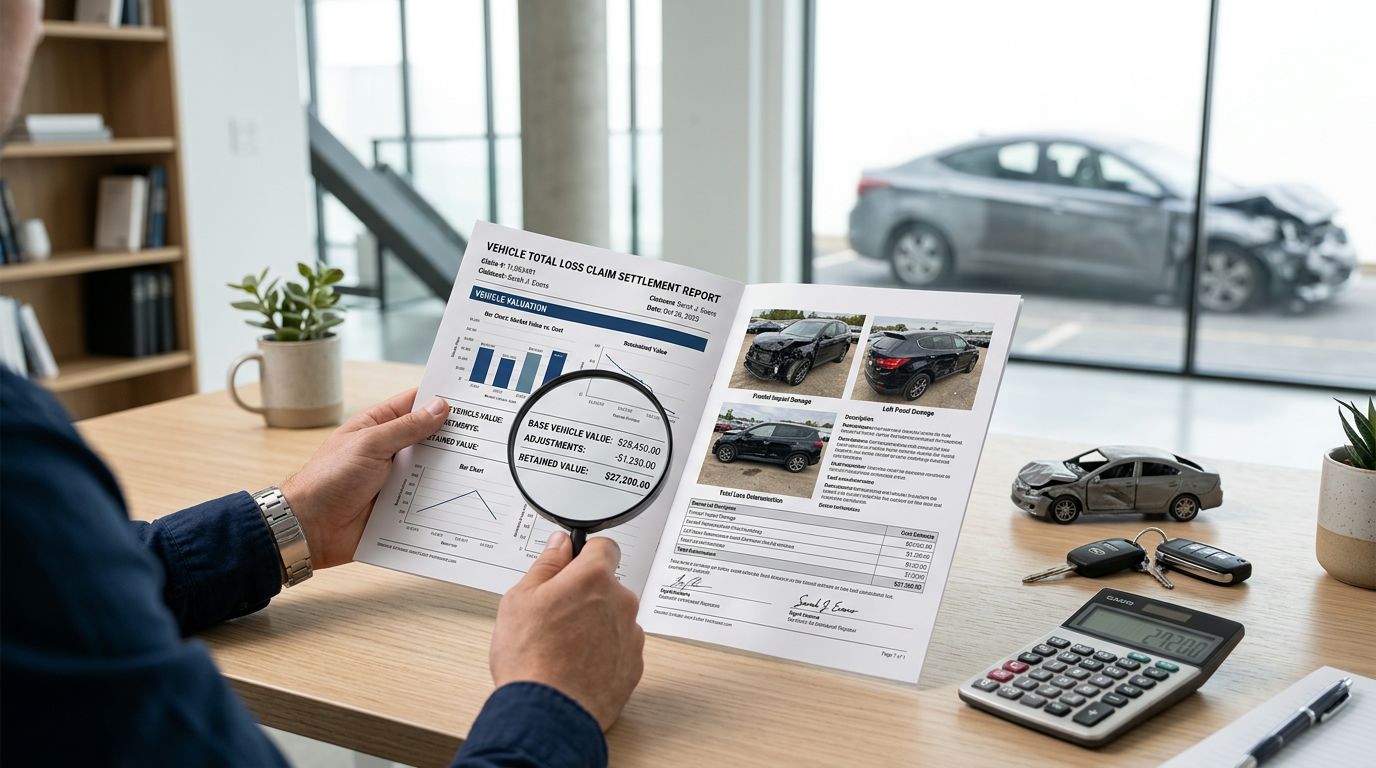
A good appraiser challenges that number by testing the valuation, not by accepting the first printout. If comparable vehicles are wrong, options are missing, condition is overstated, or the market adjustments are weak, the ACV offer can move. That is exactly why the actual cash value in total loss claims formula matters before you sign anything.
For the contract side of it, the same discipline applies to the policy language itself. The logic behind valid fax agreements with SendItFax is straightforward, because wording only matters if the terms are clear and the insurer is bound by them.
Endorsements, Exceptions, and Policy Traps
A policy's promise is only as good as the exceptions hiding underneath it. The most important ones are endorsements, limits, and conditions. If you don't read them, you can think you bought replacement protection and still end up fighting a small settlement.
The endorsements that actually change the check
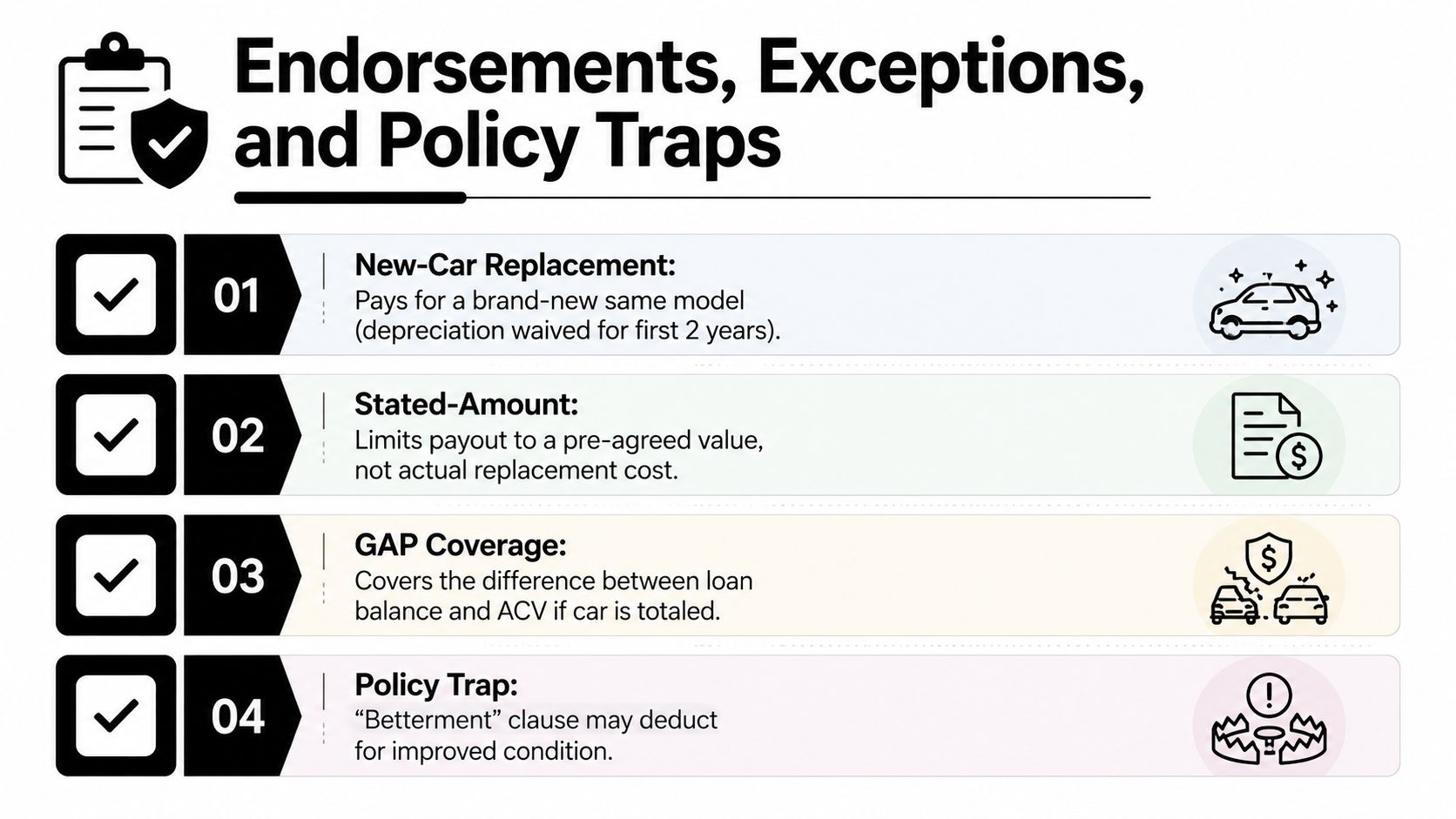
New-car replacement is the one people understand fastest. Stated-amount is different, because the payout is capped at a pre-agreed value, not necessarily what a comparable replacement costs. GAP coverage is aimed at the loan balance gap when ACV is below what you owe, so it solves financing risk rather than replacement risk. And the trap most drivers miss is the betterment concept, where an insurer argues that an upgraded or newer part should be offset because you're supposedly better off than before.
For a plain-English discussion of whether a signed agreement really binds the parties the way they think it does, the valid fax agreements with SendItFax article is useful context. That same mindset applies here, because policy language only helps if the wording is enforceable and fits the claim facts.
The questions to ask before you need a claim
Ask your declarations page these things, not the claims desk after a wreck:
- What exactly pays on a total loss, ACV, replacement cost, stated amount, or GAP?
- Does the policy contain a limit that is lower than real replacement cost?
- Are custom parts, prior damage, or maintenance records used to cut the claim?
- Is there a betterment clause that can reduce the payout?
Two identical cars can end up with very different checks because the policy language is different. That's not theory. That's how claim files get built.
For a comparison of how preset value and actual value differ in practice, see agreed value versus actual cash value. The label on the endorsement matters, but the limit and the exclusions matter more.
A Total Loss Settlement Worked Out Step by Step
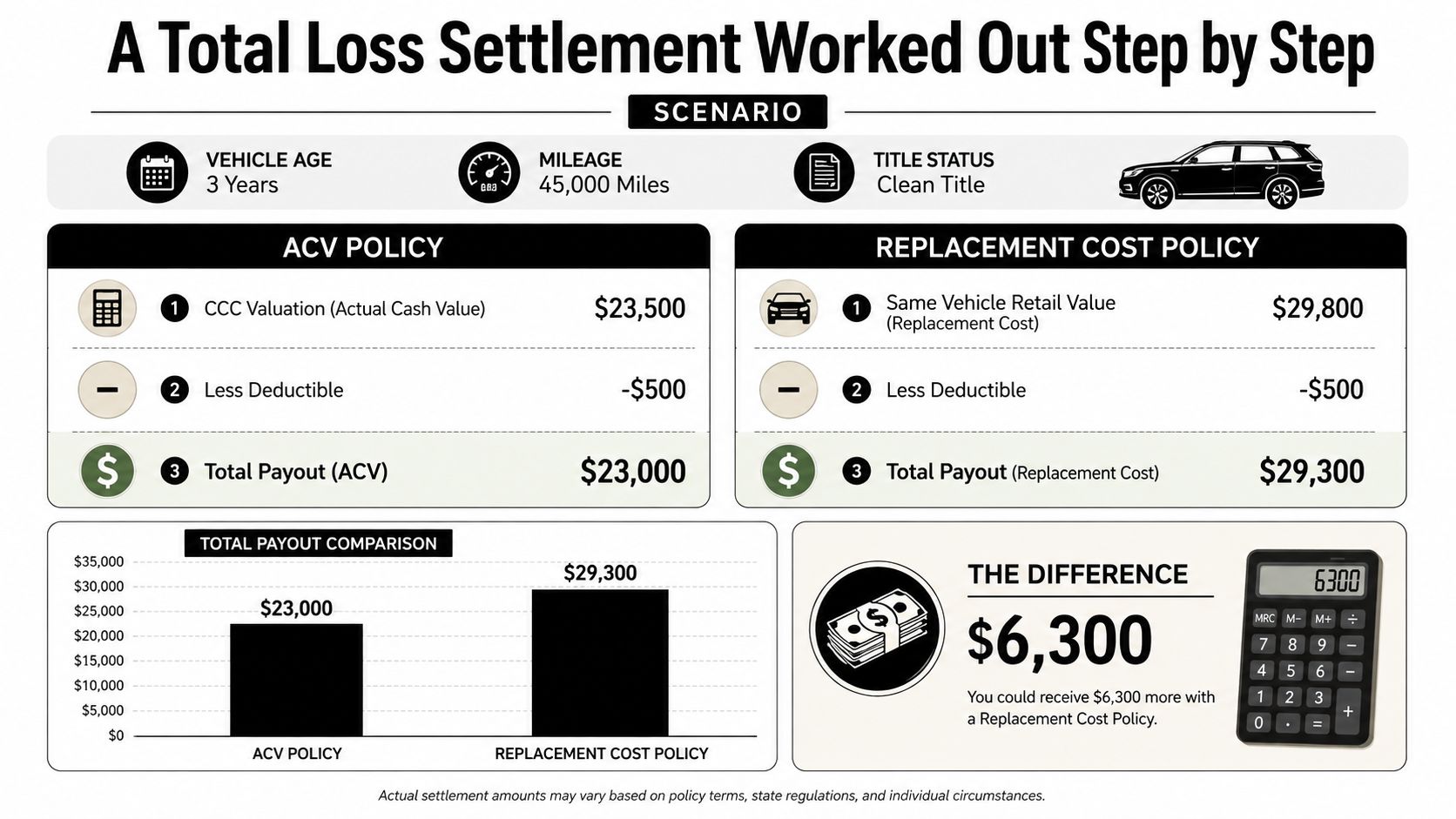
A three-year-old SUV with 45,000 miles and a clean title is a classic total loss fight. The insurer may open with one number, you may see a different replacement number in the local market, and the gap can be painful. The key is not the label on the estimate, it's the line items.
The ACV version
The scenario says the insurer's CCC-style valuation comes in at $23,500. Subtract the $500 deductible, and the payout lands at $23,000. That's the ACV check, and it reflects the insurer's view of what your vehicle was worth before it was wrecked, not what it costs to buy a replacement in the market.
The replacement cost version
Now use the comparable vehicle's retail value of $29,800. Subtract the same $500 deductible, and the payout becomes $29,300. The difference is $6,300. That's not a rounding error, that's a car payment's worth of money that the policy either gives back or keeps.
A few claim costs often get ignored in the first offer, and you need to watch them. Taxes, dealer fees, rental coverage, and diminished value issues may not be handled the way a driver expects, so don't assume the first worksheet is complete. If the insurer's valuation report leaves out the actual local replacement market, the file is still open for challenge.
Practical rule: if the insurer's number won't buy a comparable vehicle, it isn't a fair replacement number.
What to Do When the Offer Hits Your Inbox
The first offer is not the final answer. It's the starting point. Treat it that way, and you stop surrendering before you've even checked the math.
Step one, get the offer in writing
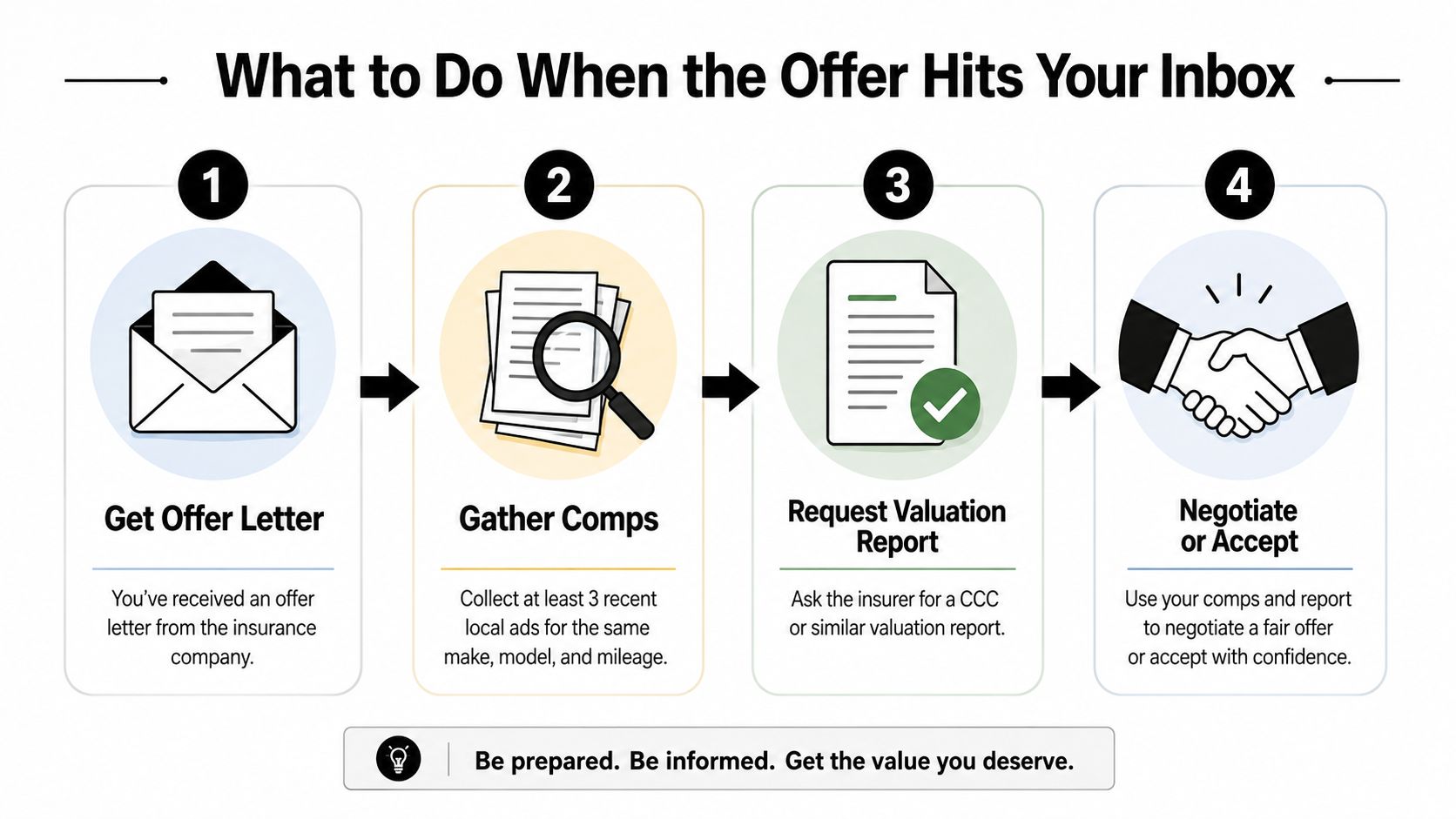
Don't negotiate from a phone call. Get the offer letter, the valuation pages, and every adjustment the insurer used. If they won't send the full report, ask for it again in writing and keep the request polite but firm.
Step two, gather local comparables
Collect comparable listings from your local market, not just distant examples the carrier prefers. Make sure the vehicles are the same make, model, and similar mileage range, and save the screenshots or printed ads. Three solid comps are usually enough to show whether the insurer's number is anchored in reality.
Step three, document condition
Service records, photos, and prior maintenance matter because they show the car was not a neglected mess before the loss. If you have receipts for recent work, keep them together. A clean condition file makes it harder for the insurer to pretend your vehicle was worth less than it was.
Step four, do not sign too early
A release can close the claim before you've challenged the valuation. Once you sign, your negotiating position shrinks. If the number is off, push back first and accept later.
Keep every communication in writing once the number starts moving. Verbal promises vanish fast in total loss files.
Invoking the Appraisal Clause for a Fair Settlement
When the carrier won't move and the number is wrong, the Appraisal Clause is the cleanest tool a not-at-fault driver has. It forces a valuation dispute into a structured process instead of letting the insurer's software be the last word. That matters because the insurer's first number is still just an opinion, even when it looks polished.
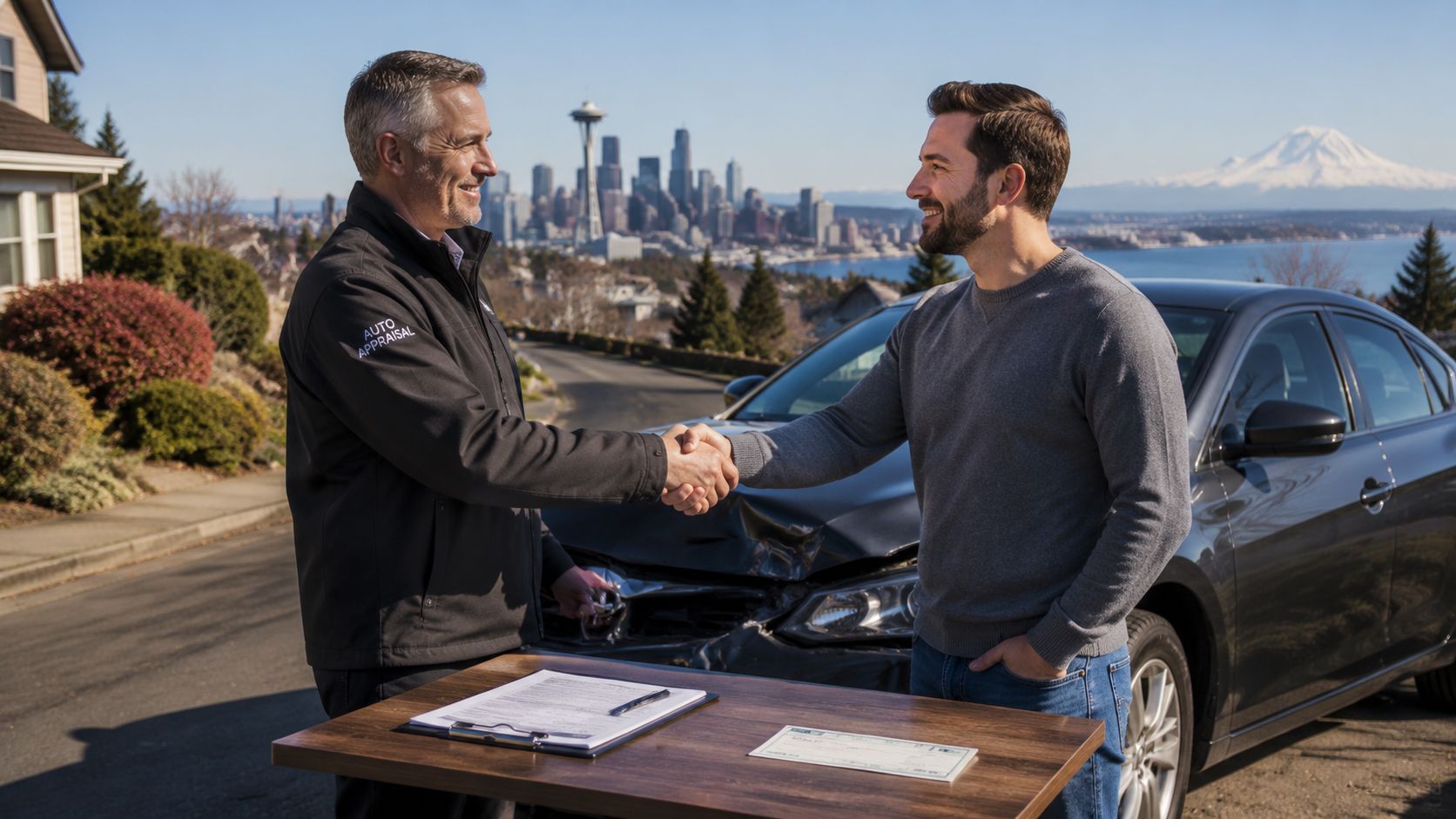
A certified independent appraiser can challenge the file with a real market analysis, not a canned valuation printout. That's the practical value of the clause, especially in Oregon and Washington, where Total Loss Northwest handles diminished value and total loss appraisals and provides diminished value support in all 50 states. If you want the process itself broken down, this insurance appraisal process guide is the right place to start.
How the clause usually works
You select an appraiser, the insurer selects one, and if they still disagree, an umpire helps decide the value. Costs are usually split according to the policy terms. That structure keeps the fight focused on valuation evidence instead of personalities.
I've seen enough total loss files to be blunt about this. If your counter-valuation is credible, documented, and built from the market, carriers often move. If it's sloppy, they ignore it. An independent appraiser earns attention because the report is built to survive scrutiny, not to close a claim quickly.
Best leverage: bring a defensible number, not a complaint.
Key Takeaways and Common Questions
Replacement cost coverage is about getting back to a comparable replacement, while ACV pays depreciated value. Most drivers lose money because they assume the policy's marketing language controls the settlement. It doesn't. The declarations page and the valuation report do.
What if I want to keep the salvage? Ask before you sign anything, because salvage affects the math and the payout. Are taxes and fees included? Not always, so get the worksheet and read it line by line. How long does an appraisal dispute take? Long enough that you should expect paperwork, not instant relief. What if the other carrier stonewalls? Put everything in writing and escalate with a credible counter-valuation.
If you're staring at a total loss offer that won't buy a comparable vehicle, Total Loss Northwest can review the valuation, prepare a certified independent appraisal, and push the claim through the Appraisal Clause when the insurer's number is off. Visit Total Loss Northwest if you want a hard look at the settlement before you sign away your position.