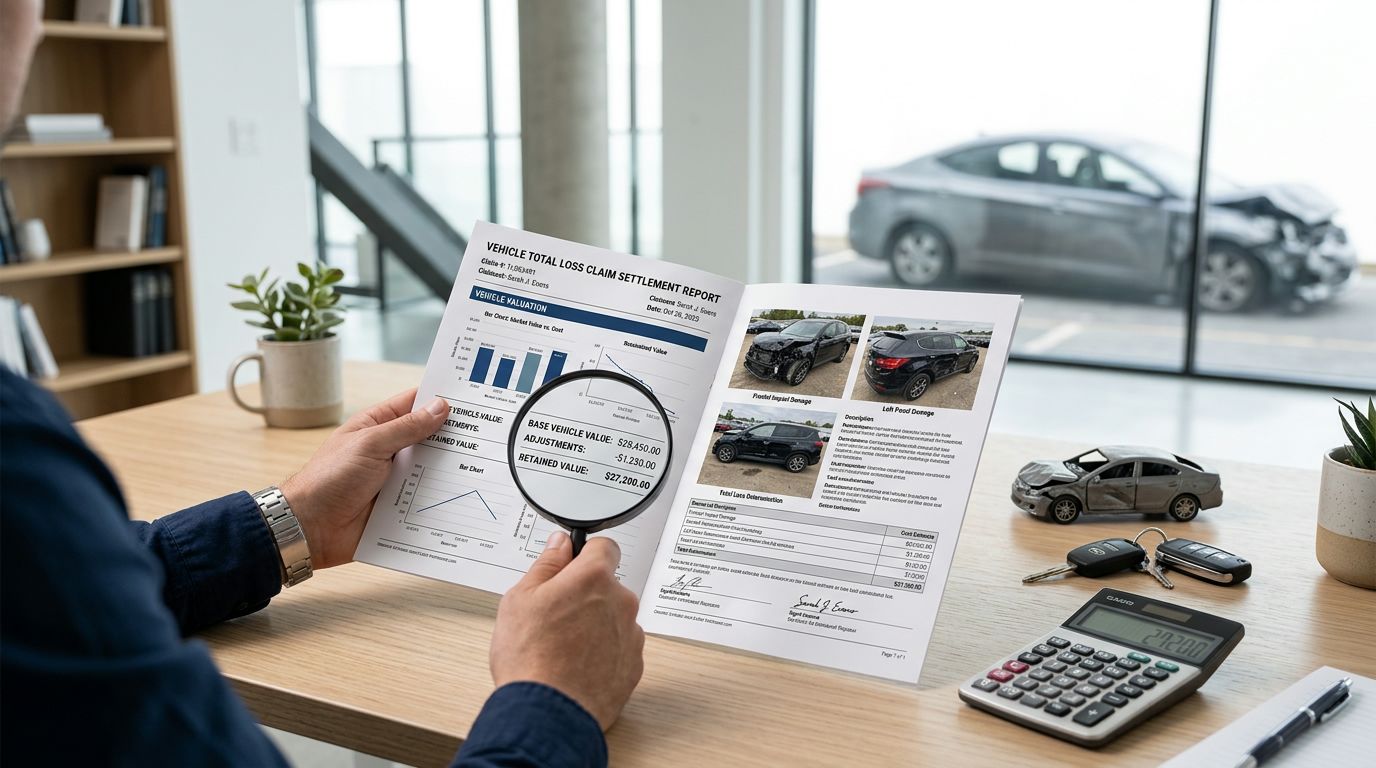
You just got the estimate, and it feels off. The car's crumpled, you've missed work, your neck still hurts, and the insurer is already talking like your claim is a tidy little number they can close this week. It isn't. The answer to how much is my accident claim worth comes from the losses you can prove, the fault reduction that gets applied, and the policy limits standing between you and a full payout.
Where Your Settlement Number Actually Comes From
A fair claim value starts with the crash itself, not with the insurer's first offer. If you were rear-ended, the car was towed, and the adjuster calls two days later with a number that barely covers the bumper, that's not a valuation, it's a starting position. The number you recover is built from recoverable damages, then reduced by your share of fault if any, then capped by available coverage.
Think in layers, not in one number
The cleanest way to look at a claim is this, damages minus fault haircut, capped by coverage. Damages include medical bills, wage loss, property loss, and the harder-to-price injury losses. Fault reduces the claim if the other side says you helped cause the crash, and policy limits set the ceiling even when your losses are bigger.
That ceiling matters more than most drivers expect. In insurance data summarized in a settlement overview, the average collision claim was $5,992 while average liability claims tied to injuries were $24,211, about 4.0 times higher (Insurance Information Institute data summarized here). In plain English, once an injury is documented, the claim usually moves into a different value class.
Practical rule: If your file only shows vehicle repair, you're negotiating one kind of claim. If it shows treatment, missed pay, or ongoing limitations, you're negotiating another.
The wrong question is, “What's the average?” The useful question is, “Which damage categories apply to me, how much fault can be pushed onto me, and what insurance money is on the table?” That's the frame to keep in mind before you send anything to an adjuster.
The Five Recoverable Damage Categories
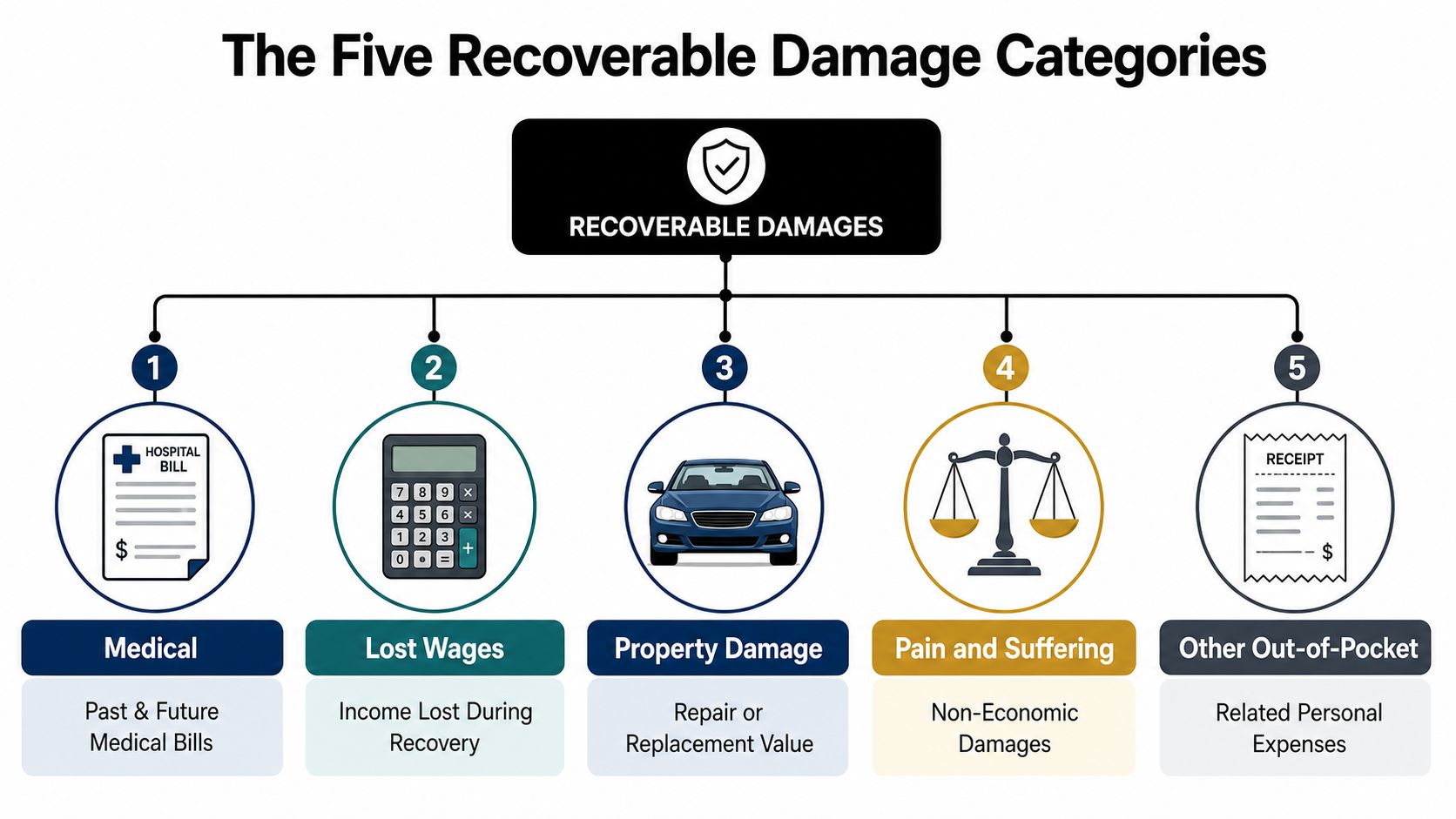
A claim gets bigger when you stop thinking like a driver and start thinking like a records clerk. Every loss you can document belongs in one of five buckets, and if you leave a bucket out, the insurer will happily pretend it never existed.
Start with the losses that leave paper
Medical bills and future care are the obvious ones. That includes ER visits, imaging, physical therapy, chiropractic care, injections, surgery, follow-up visits, and anything a doctor says you'll need later. If a treatment plan points to continued care, that's part of the claim, not an afterthought. A useful internal reference on this point is the breakdown of injury claim medical costs in this medical-bills guide.
Lost wages and lost earning capacity cover pay you missed while recovering, plus income you may lose later if the injury affects your job long term. A missed week of overtime is one thing. A back injury that cuts the hours you can safely work is another. The second one is worth more because it follows you.
Property damage includes repair or replacement, and for vehicles that aren't total losses, it can include diminished value after a clean repair. A repaired car can still be worth less on the market because it now has an accident history. If the vehicle is a total loss, the value question changes from repair cost to actual cash value and salvage handling, which is a different negotiation altogether. The value side is often where people get squeezed, especially on high-line, custom, or collector vehicles. A useful reference for claims paperwork tied to vehicle losses is this auto-claim documentation guide.
Pain and suffering is the non-economic part. Insurers hate this category because it isn't a receipt, but it's real. The two common ways people frame it are the multiplier method, where medical specials are multiplied based on severity, and the per-diem method, where a daily value is assigned to the recovery period.
Other out-of-pocket losses are the small charges that add up fast. Rental cars, towing, rideshares, medication, parking, and medical travel belong here too.
If your recovery involved therapy and you're sorting through how appointments, records, and billing should look on paper, a plain-language guide like ICBC therapy Penticton can help you understand how treatment documentation is usually organized.
Write it down tonight: If you can't point to a document, photo, bill, or pay record, the insurer will treat the loss as optional.
Turning the Categories Into a Dollar Range
A decent estimate starts with the medical side because that's where claim valuation software usually begins. That doesn't mean the software is right, it means it's predictable. Once you know the inputs, you can pressure-test the number instead of accepting whatever shows up in the first offer.
Use formulas as a rough screen, not a verdict
The multiplier method takes your medical expenses and applies a severity-based factor. A mild claim might sit low on the scale, while surgery, prolonged treatment, or permanent impairment pushes the figure higher. If your documented medical losses were $8,000 and the facts support a moderate injury range, the rough result would be $12,000 to $24,000 before fault and coverage issues are applied. That's not a promise, it's a way to see whether the insurer's number is absurd.
The per-diem method assigns a daily value to the recovery period. If someone argues a daily value of $150 for 60 days of active recovery, that rough pain-and-suffering number lands at $9,000. It's simple, which is why adjusters like to dismiss it when it helps you and use it when it helps them.
Property loss has its own math
For a repairable car, the frame is usually repair cost plus diminished value. If the car is declared a total loss, the frame becomes actual cash value minus salvage. Those are not interchangeable. A clean repair can still leave you with a diminished-value problem, while a total loss demands a value fight over what the car was worth in the market, not what the insurer's software says it was worth.
Here's the part people miss. The formulas don't fully capture future surgeries, permanent impairment, lost earning capacity, or emotional damage. That's why the “average claim” conversation usually falls apart fast in serious cases.
If your injuries changed your work, sleep, or mobility, a bare multiplier is usually too low.
The right move is to use these formulas as a floor, then add the missing pieces that your records support. If the insurer's offer only reflects today's bills, it's incomplete by design.
Documentation That Holds Up Under Negotiation
Most low settlements aren't caused by bad law. They're caused by thin files. Adjusters pay more when your paperwork makes denial awkward, and they pay less when your file looks like a guess.
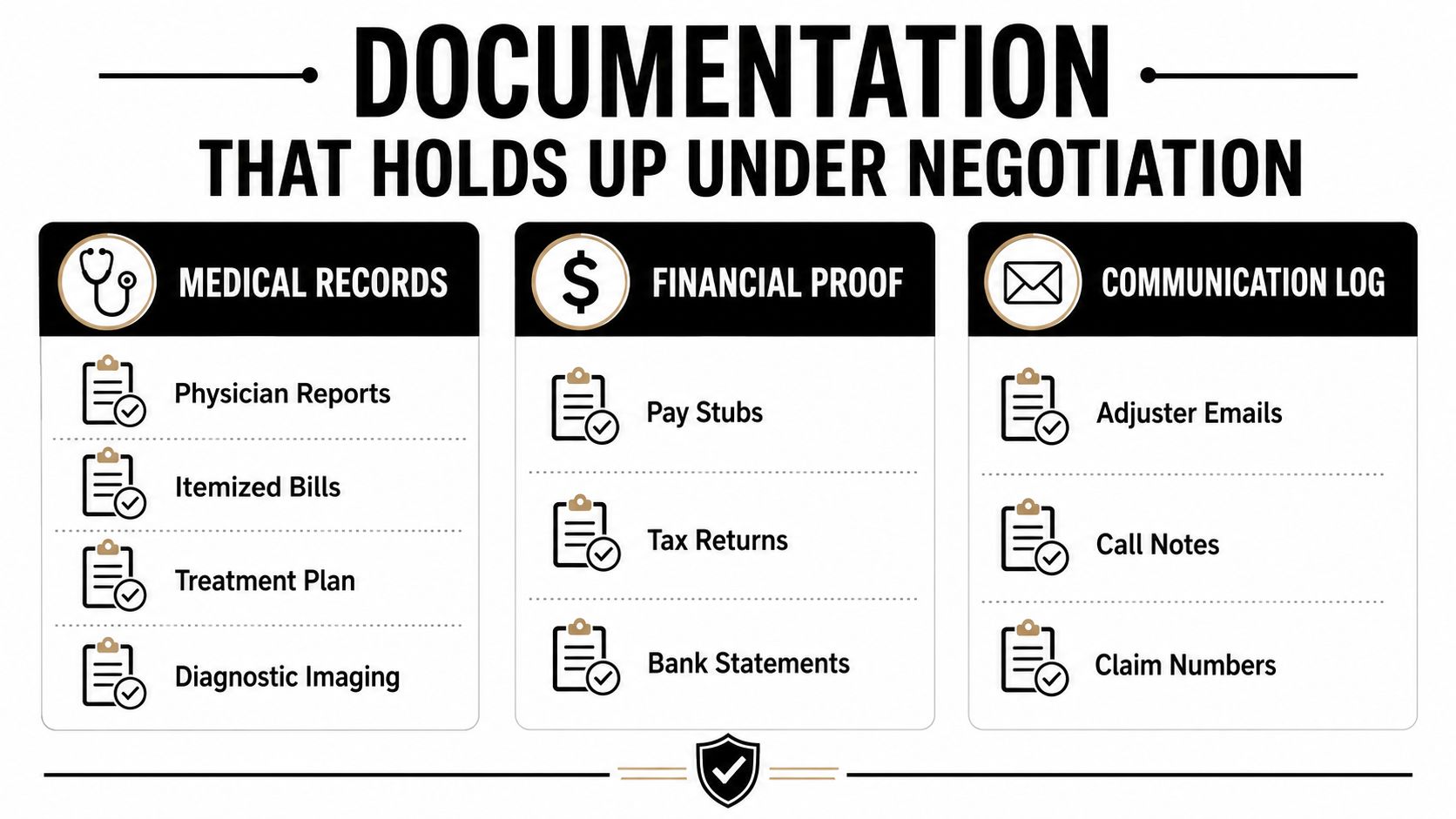
Build three folders, not one messy stack
Medical records need the physician reports, itemized bills, treatment plan, and diagnostic imaging. Don't just keep invoices. Keep the records that explain why you were treated and what the doctor expected next. If there were gaps, write down why. Silence helps the insurer more than it helps you.
Financial proof should include pay stubs, tax returns, and bank statements if you're self-employed or your wages vary. If you missed work, ask your employer for a letter showing dates missed, the role you held, and whether the time off was unpaid or used against your leave balance. That turns “I lost income” into a provable number.
Vehicle-side proof is where people sabotage themselves. Keep repair estimates, photos from the scene, photos of the car after towing, comparable sales listings, and records showing the car's condition before the crash. For collector or heavily modified vehicles, add restoration receipts, build sheets, maintenance records, and pre-loss photos. Standard comps often miss those cars by a mile.
A plain-language medical report guide like this example resource is useful if you're trying to understand how treatment notes should read when you're checking your own file for gaps.
Don't wait until the insurer asks for missing documents. Build the folder first, then send the demand. That sequence matters because a strong demand package tells the adjuster you're not fishing, you're presenting a case.
How Fault and State Rules Cap Your Number
Two people can suffer the same injuries and end up with very different checks. The difference is usually fault law, and insurers know exactly how to use it against you.
Fault rules can slash the claim before coverage even matters
Under pure comparative fault, you can recover even if you're partly responsible, but your recovery gets reduced by your percentage of fault. Under modified comparative fault, recovery usually stops at 50% or 51% depending on the state. Under contributory fault, even a small share of blame can block recovery entirely.
A simple example makes it obvious. If your claim is worth $30,000 and you're 30% at fault, your recovery drops to $21,000. That's not the insurer being generous, that's the haircut the law allows. If the other driver argues you were mostly to blame, the ceiling drops again or disappears, depending on the state rule.
| Comparative Fault Rules by State Type | Recovery at 30% Fault | Recovery at 51% Fault | Recovery if At-Fault |
|---|---|---|---|
| Pure comparative fault | Reduced, but still recoverable | Reduced, but still recoverable | Not recoverable from the other driver |
| Modified comparative fault | Reduced, if below the bar | Barred in 50% or 51% states, depending on the rule | Not recoverable from the other driver |
| Contributory fault | Usually barred once fault is assigned | Usually barred once fault is assigned | Not recoverable from the other driver |
Policy limits set a hard ceiling
Even when your damages are clear, the at-fault driver's bodily-injury policy limit can cap what you can collect. If the policy only covers a limited amount, that's the most the carrier will pay from that policy, no matter how ugly the crash was. When injuries exceed that ceiling, your own underinsured-motorist coverage may be the only path to the rest.
Bottom line: liability decides whether you can collect, fault decides how much gets shaved off, and policy limits decide whether you'll ever see the full value.
That's why a serious claim is never just a medical-bills exercise. The law in your state and the available insurance can matter as much as the injury itself.
Overriding the Insurer's Valuation on Vehicle Losses
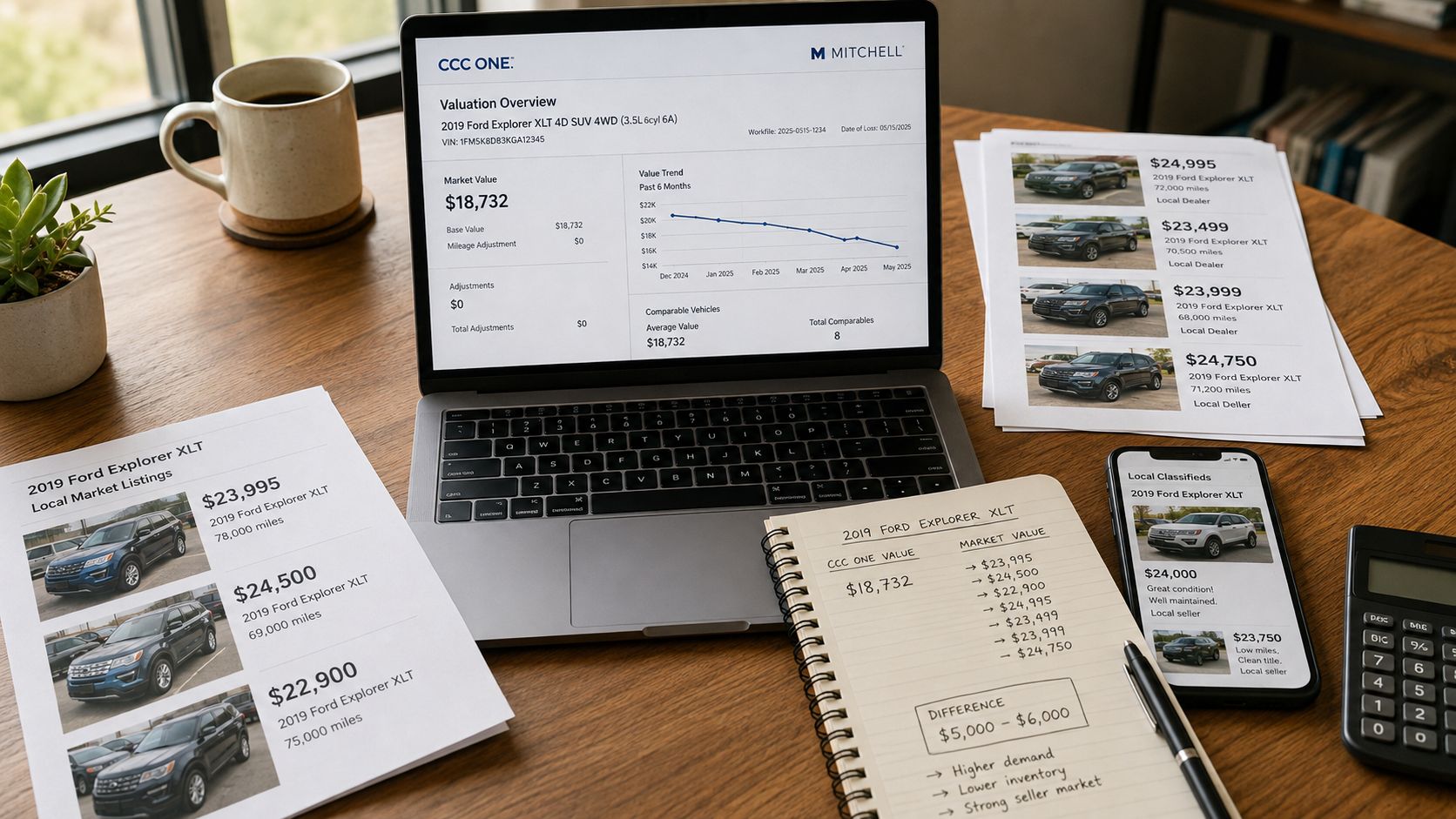
Insurer valuation systems are built to close files fast, not to price your exact car. That's why CCC, Mitchell, and similar platforms regularly miss the market on trims, options, condition, upgrades, and hard-to-compare vehicles. If you drive a high-line, custom, or collector car, the software is often the problem, not your evidence.
Use the appraisal clause before you accept the number
The appraisal clause is the underused tool in a lot of auto policies. If you and the insurer disagree on vehicle value, you can demand an independent appraisal rather than arguing forever with the same adjuster and the same database. Each side picks an appraiser, the appraisers compare notes, and if needed an umpire breaks the tie.
That process matters because it pulls the dispute out of the insurer's box. Once the insurer's valuation software is no longer the only number in the room, real-market evidence gets a fair hearing. For a person whose car was underpriced by thousands, that's often the cleanest path to a better result.
What the process usually looks like
You notify the insurer that you reject the valuation. You hire your own appraiser. The insurer hires theirs. The two appraisers exchange reports, review comparable vehicles, mileage, condition, maintenance records, and upgrade receipts, then either agree or submit the gap to an umpire. If you've got a modified or niche vehicle, that documentation can matter more than another round of phone calls.
That's also why a claim can be stronger on the vehicle side than on the bodily-injury side. The car loss is often easier to prove, and the insurer's number is easier to attack when the comps are weak. If you want to see how this tool fits into a broader valuation process, a concise walkthrough is available in this appraisal-clause resource.
My view: if the vehicle number looks low and the insurer won't budge, appraisal is usually worth more than arguing with the same desk adjuster for another week.
When to Handle It Yourself, Send a Demand, or Hire Counsel
If the claim is small, property-only, and you've got clean comparables, a documented counteroffer can be enough. If the injury is modest but liability is clear, a formal demand letter with records and a deadline usually gets the file moving. If fault is disputed, the injuries are serious, or the policy limits are in play, stop treating it like a DIY project.
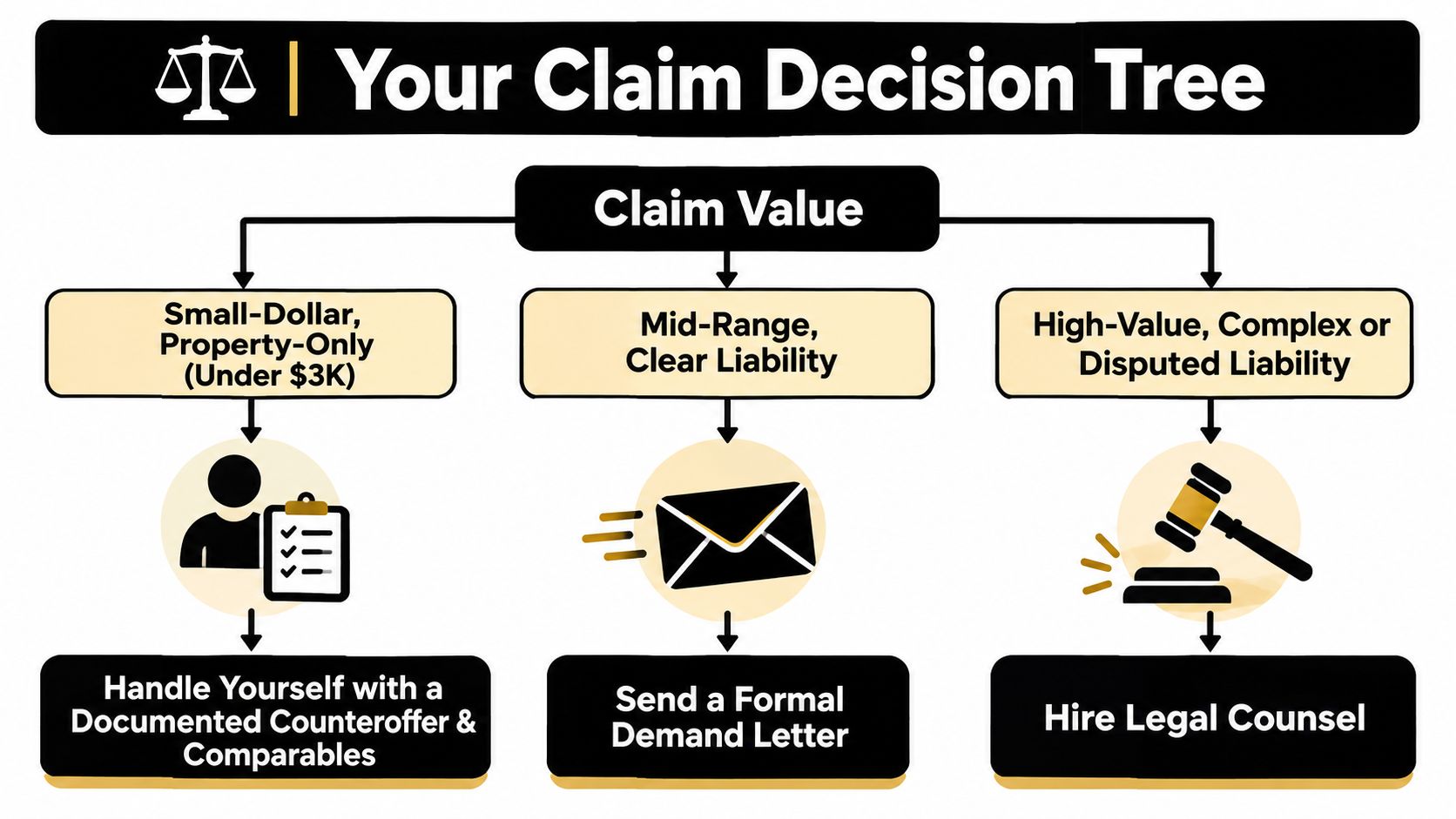
Pick the lane that matches the claim
Small-dollar, property-only claims under a few thousand dollars can often be handled yourself if you have repair photos, comparable listings, and a clean paper trail. Don't overcomplicate a simple file.
Mid-range injury claims deserve a demand package, not a casual email. Put the medical records, wage proof, treatment timeline, and pain-and-suffering argument in one place, then force the insurer to answer the whole file.
High-value, disputed, or policy-limit cases need counsel. Permanent impairment, future care, reduced earning ability, and comparative-fault fights are where experienced representation earns its keep. The point isn't to dramatize the case, it's to stop the carrier from anchoring the number at the bottom.
If you need a vehicle-side valuation challenge, Total Loss Northwest handles diminished value and total-loss appraisal work, which can be useful when the insurer's number is the weak point in an otherwise solid claim.
Before you do anything else this week, get your police report, gather every bill and photo, pull your pay records, and write down the timeline while it's still fresh. Then decide whether you're making a counteroffer, sending a demand, or getting a lawyer involved before the next offer locks you into a low number.
If your claim is being underpriced, Total Loss Northwest reviews the vehicle side of the file, challenges low valuation reports, and helps drivers push back on total-loss and diminished-value offers. If you want a sharper read on what your car is worth after the crash, visit Total Loss Northwest and start with the valuation tools and appraisal support they provide.