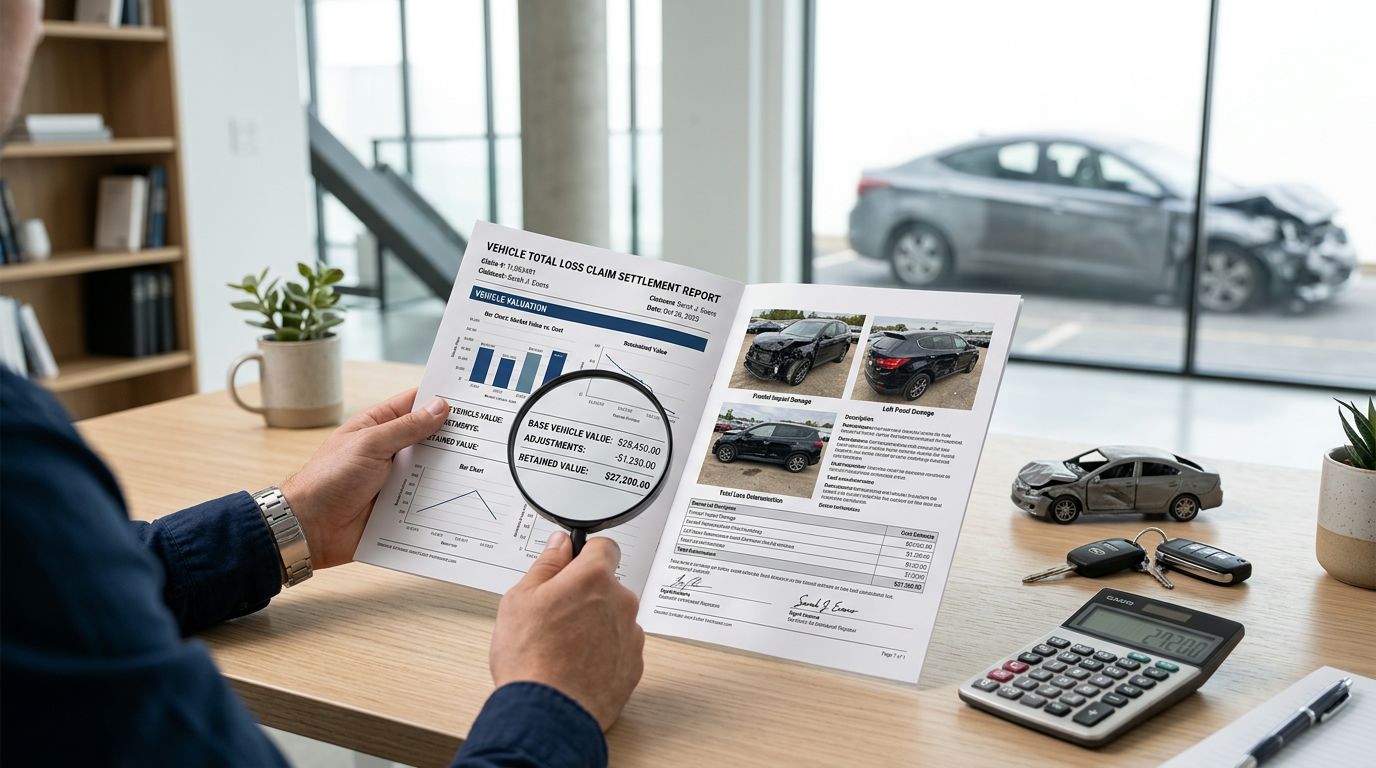
Most drivers hear the same advice after a crash: take the insurance company's first offer and move on. That advice protects the carrier's schedule, not your financial position. A total-loss offer is often only the insurer's opening valuation, and accepting it without reviewing the data can leave you paying the difference between what the carrier calculated and what a comparable replacement vehicle costs.
Insurance company obligations are more specific than many adjusters suggest. Depending on the state and policy, insurers may have duties involving claim acknowledgment, investigation, valuation disclosures, communication, payment, and appraisal. Washington and Oregon drivers should treat the claim as an evidence dispute, not a customer-service conversation. The adjuster has a process. You need one too.
Why Insurers Lowball Total Loss Settlements
A carrier doesn't automatically become a neutral vehicle appraiser because your car was declared a total loss. The adjuster's job is to resolve the claim under the policy and the applicable rules, but the first valuation often comes from software, vendor data, and a standardized adjustment process. Those tools can be useful starting points. They aren't the same as proving what a comparable vehicle would cost in your local market.
The first offer also anchors the discussion. Once an adjuster gives you a number, every later conversation tends to revolve around whether you can disprove that number. That reverses the proper question. The carrier should be able to explain how it reached the settlement value, which vehicles it used, what condition adjustments it applied, and whether it included the items required by the policy or state rules.
Practical rule: Treat the first offer as a position to audit, not a conclusion you're required to accept.
Lowballing often hides inside technical details rather than an obviously dishonest statement. The valuation may use a vehicle from a different market, omit a factory option, misstate mileage, apply an unsupported condition adjustment, or compare your maintained vehicle with one carrying materially different equipment. A generic “book” figure can also fail to reflect the retail cost of finding a substantially similar replacement.
What the adjuster's number may leave out
Start with the valuation report, not the settlement total. Look for:
- Incorrect vehicle identification: Verify trim, drivetrain, body style, packages, factory options, mileage, and model year.
- Weak comparables: Check whether the selected vehicles are similar and available in your regional market.
- Unexplained adjustments: Demand support for deductions tied to condition, equipment, mileage, or prior damage.
- Missing settlement components: Review taxes, license charges, transfer fees, deductible treatment, and salvage deductions under the applicable policy and state rules.
- Condition errors: Maintenance records and pre-accident photographs can contradict a report that labels a well-kept vehicle as average or below average.
The legal obligation matters because an insurer isn't free to use an opaque number because a computer produced it. In states that require retail-value methods or comparable vehicles, the carrier must use a defensible valuation foundation. Your task is to make the errors visible and force a written response.
Legal Duties Your Insurer Cannot Ignore
A fair claim process has measurable parts. An insurer must acknowledge the claim, investigate it, explain its valuation, communicate status, and pay according to the policy and applicable law. The exact rules differ by state, so Washington and Oregon policyholders should read the policy alongside state requirements rather than relying on an adjuster's summary.
Oregon provides a particularly useful total-loss disclosure rule. Under ORS 742.554, when an insurer declares a vehicle a total loss and makes a cash settlement offer, it must provide the valuation or appraisal reports used to determine the vehicle's value, along with a written statement describing total-loss rights and valuation duties. The disclosure is due when the offer is made. If the offer is oral, the written disclosure must follow within one business day. Oregon rules also require reliance on regional average values for substantially similar vehicles and local market retail costs when valuing a total loss. Oregon's total-loss disclosure guidance gives policyholders a concrete basis for requesting the underlying data.
California illustrates what enforceable claim-processing duties look like. Insurers must acknowledge a claim within 15 calendar days, accept or deny it within 40 calendar days after receiving proof of claim, and pay promptly after acceptance. If payment isn't made within 30 days after settlement is reached, the insurer is out of compliance. California also requires total-loss settlements to include taxes, license, and transfer fees, with the payout reflecting a comparable vehicle of like kind and quality. The California Department of Insurance's auto-claim guidance shows why deadlines and valuation standards are more useful than a vague promise to act reasonably.
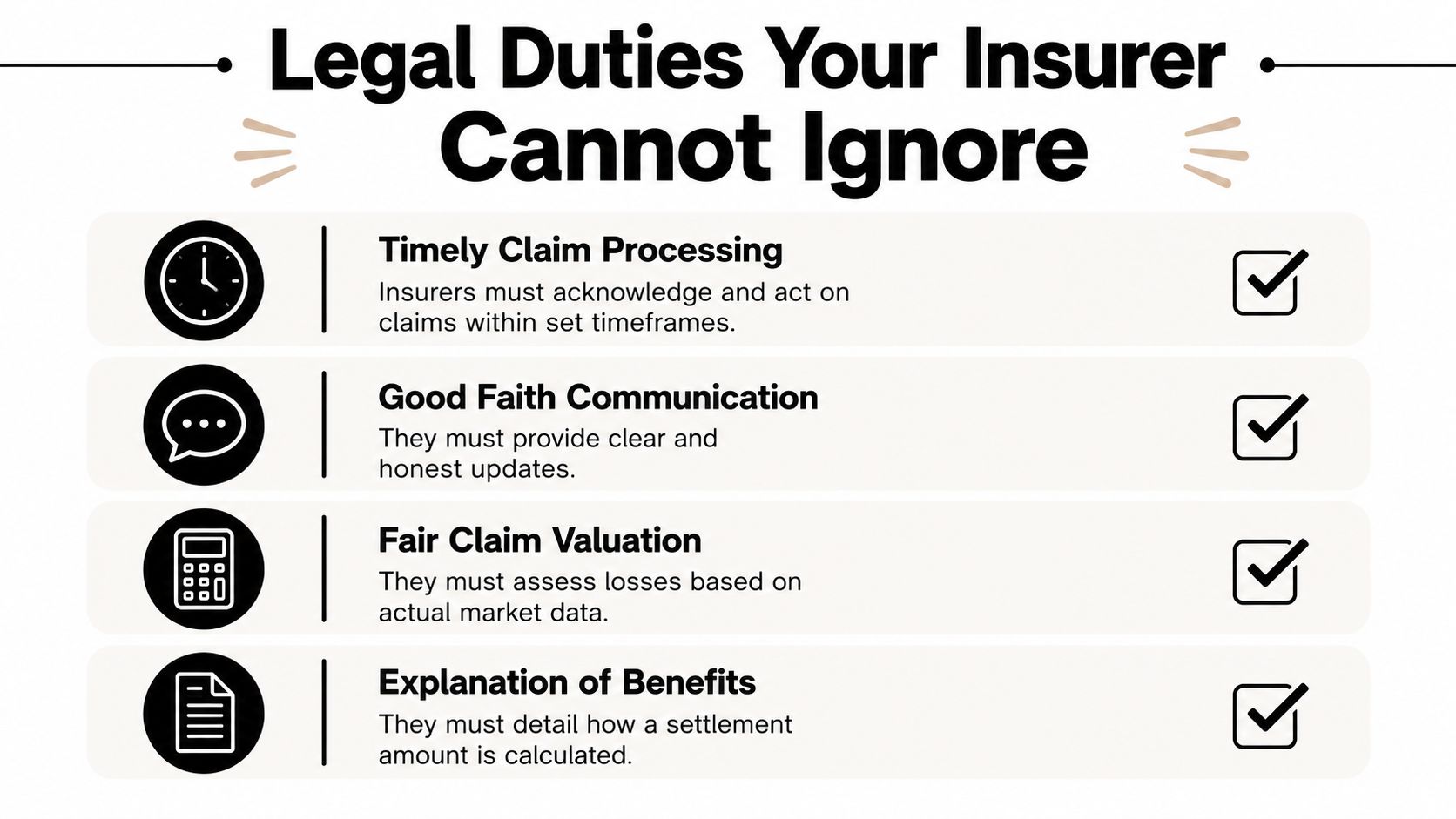
Build a duty checklist
For an Oregon or Washington claim, ask the adjuster to confirm in writing:
- Claim status: What has been completed, and what remains under investigation?
- Valuation basis: Which database, reports, dealer quotes, or local listings support the offer?
- Comparable selection: Why does each vehicle match your car in trim, equipment, mileage, and market?
- Fee treatment: Which taxes, title, license, and transfer charges are included or excluded?
- Dispute procedure: What policy provision governs an unresolved valuation disagreement?
If you're dealing with property damage alongside an auto claim, a practical resource such as HIBCO ROOF LLC insurance adjuster help can help explain how to organize communications with an adjuster. For auto-specific disputes, keep a written record and review guidance on bad-faith insurance practices. The point isn't to accuse the carrier prematurely. It's to make the insurer identify the obligation it says it has satisfied and the evidence supporting that position.
Evidence You Must Gather Before the First Offer
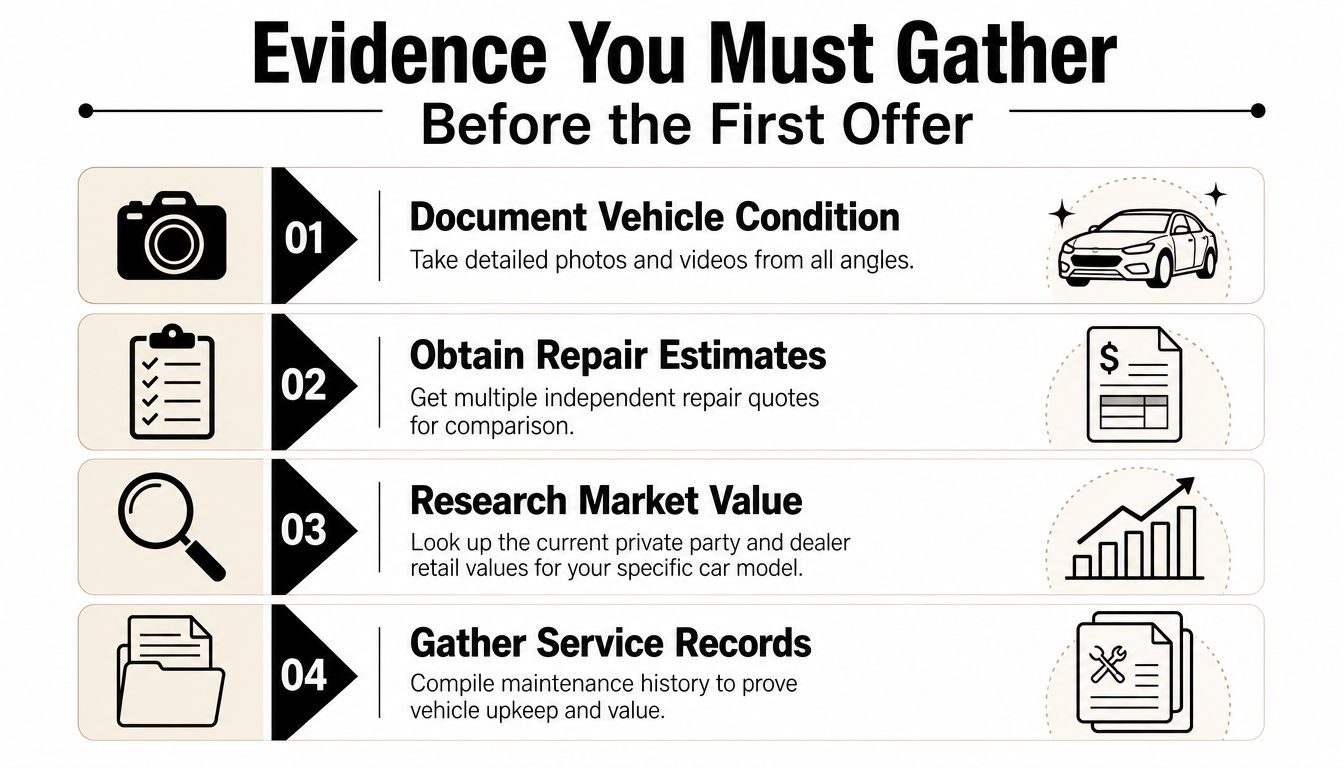
The strongest valuation challenge starts before the adjuster gives you a number. Once the carrier anchors the claim with its report, you'll spend time correcting assumptions that could have been prevented with a complete evidence file.
Create a digital folder and preserve original files. Name documents clearly, save emails as PDFs, and keep a simple contact log showing the date, person, subject, and promised next step. A clean record makes it difficult for the carrier to claim it never received your evidence.
Assemble the vehicle file
Photograph the pre-accident condition. Use existing phone photos, dealership photographs, service-center images, and personal records that show the vehicle before the collision. Include the exterior, interior, wheels, tires, installed equipment, and any distinctive features. If you only have post-accident photographs, save those too, but label the timing accurately.
Collect maintenance and repair records. Oil-service invoices, tire purchases, brake work, major repairs, and dealership service histories help establish that the vehicle was maintained. They don't automatically add every repair dollar to the settlement, but they can challenge a condition rating that ignores documented upkeep.
List factory and aftermarket equipment. Identify trim-level features, technology packages, towing equipment, upgraded wheels, suspension work, audio systems, camper components, and other additions. Separate factory equipment from modifications, then attach receipts, installation records, and photographs where available.
Research comparable retail vehicles. Search local dealer and private-party listings for vehicles that match the year, trim, drivetrain, mileage range, options, and condition. Save the complete listing, including location, asking price, photographs, equipment, and date captured. Don't present an unrelated luxury trim as proof of value. A weak comparison gives the adjuster an easy reason to dismiss the entire package.
Present evidence in a usable format
Put the strongest items first: vehicle identification, mileage proof, condition evidence, equipment list, service records, and comparable listings. Add a short cover letter that identifies each error in the insurer's report and states the replacement value you're asking the carrier to consider. Avoid emotional arguments. A concise correction tied to a document is harder to ignore.
A detailed auto claim documentation guide can help you organize the file and avoid sending scattered attachments. Send the package through a channel that creates a receipt, then ask the adjuster to confirm which materials were reviewed and whether the valuation will be revised.
How Valuation Methods Affect Your Settlement
The valuation method controls the starting point for the settlement. A database report may produce a neat figure, but neat formatting doesn't prove that the figure reflects the local retail market. Dealer quotes and comparable listings can reveal replacement costs that a generic estimate misses.
State rules demonstrate why this distinction matters. North Carolina requires a total-loss offer to use published regional average values for substantially similar vehicles or the retail cost of at least two substantially similar local vehicles available within the relevant period. Maryland requires a minimum cash-settlement offer based on a nationally recognized valuation manual or computerized database, with applicable taxes and transfer fees, or a qualified dealer quote with those fees. North Carolina's total-loss valuation rule illustrates the broader principle: the method must connect the offer to retail replacement evidence.
| Valuation Method | Data Source | Typical Impact on Settlement | Legal Standing |
|---|---|---|---|
| Automated database valuation | Vendor records, database entries, and algorithmic adjustments | Can understate value when equipment, condition, or local inventory is wrong | Potentially usable, but the report must comply with the applicable policy and state valuation rules |
| Dealer quote | Retail quote from a qualified dealer | Can provide a concrete replacement reference, especially for uncommon vehicles | Recognized in some state rules when the quote meets qualification requirements |
| Local retail comparables | Substantially similar vehicles offered in the regional market | Usually gives a stronger replacement-cost reference than a wholesale proxy | Required or expressly recognized in some jurisdictions, including the methods described in North Carolina and Oregon rules |
Audit the report line by line
Don't argue only that the total is too low. Identify the exact defect. A comparable may have fewer options, higher mileage, accident history, or a different drivetrain. The report may also apply a condition deduction without photographs or records supporting it. Ask the adjuster to correct each error and provide the revised calculation.
The actual cash value baseline determines the settlement before deductible and salvage adjustments. That's why a disagreement over trim, comparables, or retail methodology can affect the entire claim. The correct response to a weak report is a documented valuation critique, not a general demand for “more money.”
Invoking the Appraisal Clause to Force a Fair Value
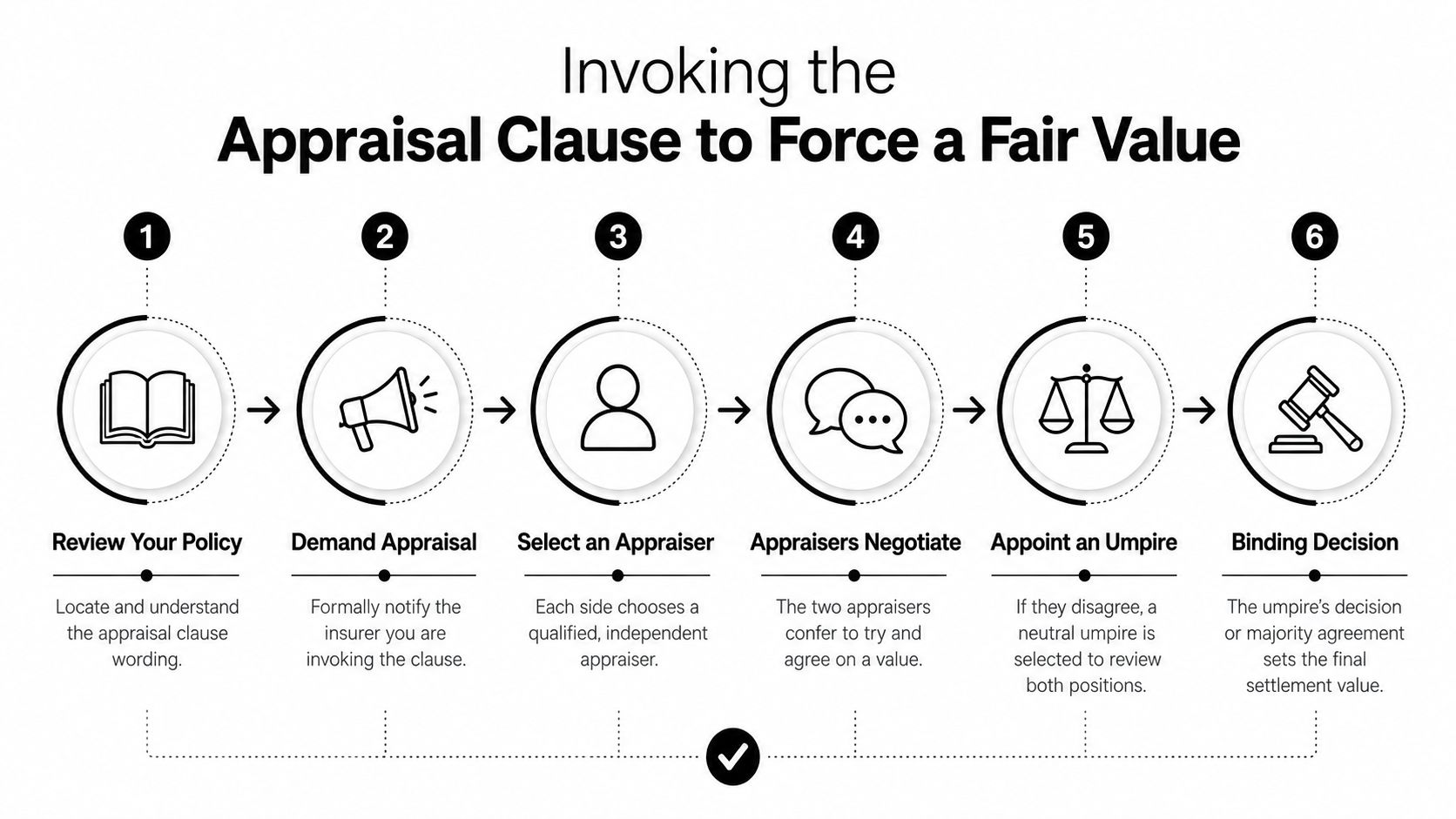
Negotiation has limits. If you've supplied credible evidence and the insurer keeps repeating the same unsupported number, stop treating the dispute as a customer-service problem. Check the policy's appraisal clause, which may provide a formal process for resolving disagreement over the amount of loss.
The usual structure is straightforward. You and the insurer select independent appraisers. Each appraiser evaluates the vehicle and supports a position with market evidence. If the appraisers disagree, they may submit the dispute to an umpire, and the required agreement or decision becomes binding under the policy and applicable rules.
Oregon allows an insurer to conclude the loss settlement under the policy's appraisal section and requires reimbursement of reasonable appraisal costs. Appraisal-clause guidance also describes the result as binding once the appraisers or umpire determine value, with the insurer obligated to pay that value subject to contract adjustments such as the deductible and salvage. Oregon's appraisal rule is the place to start for Oregon policyholders. Read the policy carefully for notice requirements, selection procedures, and limits.
Use a formal written demand
Your notice should be calm, precise, and tied to the policy. Adapt this template:
Subject: Formal demand for appraisal
I dispute the amount of loss stated in the insurer's total-loss valuation for [vehicle identification]. Pursuant to the appraisal provision in policy [policy number], I am invoking appraisal to determine the vehicle's value. Please identify the insurer's appraiser and provide the information required to proceed under the policy. I reserve all rights regarding coverage, fees, taxes, transfer charges, and any other applicable settlement components.
Send the demand through the insurer's designated channel and keep proof of delivery. Don't sign a release that resolves the claim before you understand whether it waives appraisal or other rights. Also don't assume appraisal decides coverage, fault, or every disputed issue. It generally addresses the amount of loss, so separate disagreements may require another process.
Prepare for the appraisal
Choose an appraiser who can explain market selection, equipment adjustments, condition, mileage, and local availability. Give that appraiser the same evidence package you assembled, including the carrier's report and every correction you've identified. The insurance appraisal process can help you understand how the procedure operates before you send the demand.
Appraisal works best when the disagreement is documented. It shifts the conversation away from an adjuster's repeated opening number and toward comparable evidence, condition documentation, and policy language. The result isn't a promise of a specific value. It is a mechanism that requires the dispute to be evaluated under the process the contract provides.
When and How to Escalate Your Dispute
Escalation becomes necessary when the insurer stops performing the basic work of adjustment. Warning signs include missed responses, unexplained delays, refusal to provide the valuation report, failure to address documented errors, and contradictory statements from different claim representatives.
Communication isn't a courtesy. It gives you the information needed to verify the claim, correct mistakes, and meet policy deadlines. Australia's compliance reporting recorded 45,331 claims-handling breaches, a 16% increase, and identified the duty to update policyholders at least every 20 business days as the most commonly breached obligation. The same reporting recorded 17,238 complaints-handling breaches, an 82% increase, and 1.18 million reported complaints, which shows why communication failures deserve attention rather than dismissal. The compliance reporting summary supports a practical conclusion: a silent claim file can be an operational failure, not merely an inconvenience.
Follow an escalation ladder
- Write the adjuster. State the disputed facts, attach the supporting documents, and request a written response to each issue.
- Ask for a supervisor review. Include the claim number, prior correspondence, valuation report, evidence package, and a chronology of missed or incomplete responses.
- Use the formal complaint channel. Follow the carrier's complaint procedure and request a final written position.
- Contact the state regulator. Washington and Oregon drivers can ask their state insurance department about complaint procedures and applicable claim-handling rules. Submit documents, not just a narrative.
- Evaluate legal action. Consult an attorney when the dispute involves coverage, release language, significant damages, injury, or a potential bad-faith claim.
Document every promise: If the adjuster says a revised report will arrive, record the date, the person's name, and the promised action. A paper trail turns a frustrating call into evidence.
A certified independent appraiser becomes useful when the value gap is substantial, the vehicle is modified or collectible, or the insurer's report contains repeated factual errors. For broader property-related claim questions, a commercial property claims guide offers a separate framework for documenting damage and dealing with claim representatives. Don't mix the legal standards for property and auto claims, but use the same discipline: preserve documents, demand explanations, and escalate in writing.
Your Action Plan for a Fair Total Loss Settlement
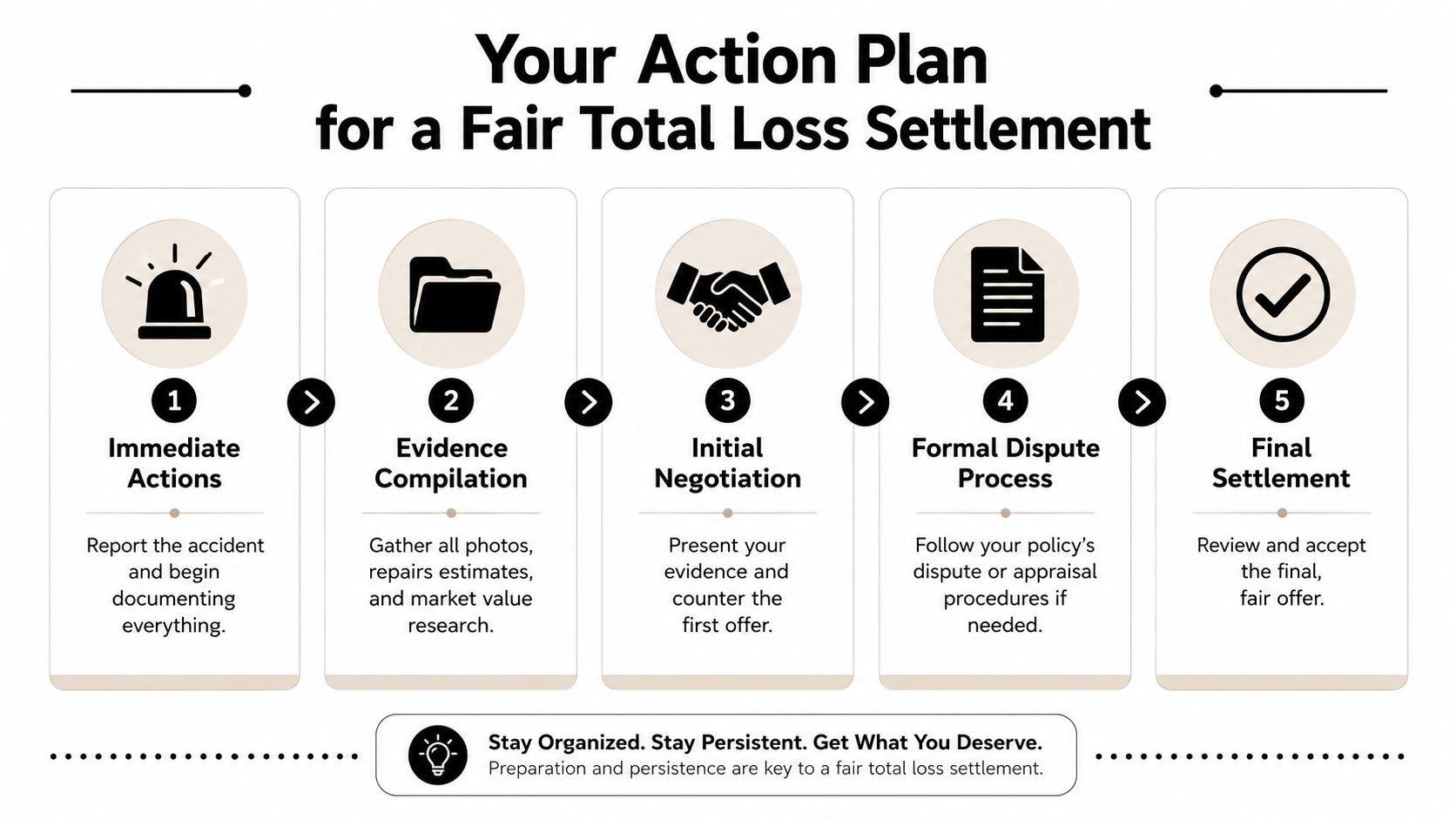
The first offer isn't the finish line. Use this sequence instead:
- Immediately after the accident: Report the loss, preserve every message, and save photographs, videos, towing records, and vehicle documents.
- Before valuation: Gather service records, equipment information, mileage proof, condition evidence, and carefully selected local retail comparables.
- When the offer arrives: Request the complete valuation report. Check the vehicle description, comparable selection, adjustments, fees, deductible, and salvage treatment.
- If the report is wrong: Send a written rebuttal with corrected evidence and request a revised calculation. Keep the communication factual.
- If negotiations stall: Review the appraisal clause, follow the notice procedure, select an independent appraiser, and notify the carrier formally. Escalate unresolved communication or compliance problems to a supervisor and the appropriate state regulator.
If the vehicle was repaired rather than totaled, a separate diminished value issue may remain. The car can be worth less in the resale market because its accident history follows it, even after quality repairs. Handle that as a distinct appraisal question and preserve the pre-loss and post-repair evidence.
Total Loss Northwest provides independent total-loss and diminished-value appraisals, including appraisal-clause representation for owners disputing an insurer's valuation in Oregon and Washington. If your offer relies on incorrect comparables, missing equipment, or unsupported adjustments, visit Total Loss Northwest and submit the claim details for a professional review.