You're on the phone with the adjuster. Your vehicle has been declared a total loss, and the insurer has offered an actual cash value that doesn't match the cars you're finding for sale, the options your vehicle carried, or the condition it was in before the crash. The loan balance is higher than the offer, and the adjuster treats that difference as your problem.
It isn't. A loan payoff doesn't determine market value, but neither does an insurer's first worksheet. Washington insurance law gives drivers regulated claims standards and, for qualifying policies, a new statutory appraisal process for disputes over actual cash value and amount of loss. The practical question is whether you'll accept the first number or build a record that forces the valuation to be examined properly.
When the Adjuster's First Number Feels Wrong
A Washington driver gets a call after a collision. The adjuster says the repairs would cost too much and the vehicle is a total loss. Then comes the number.
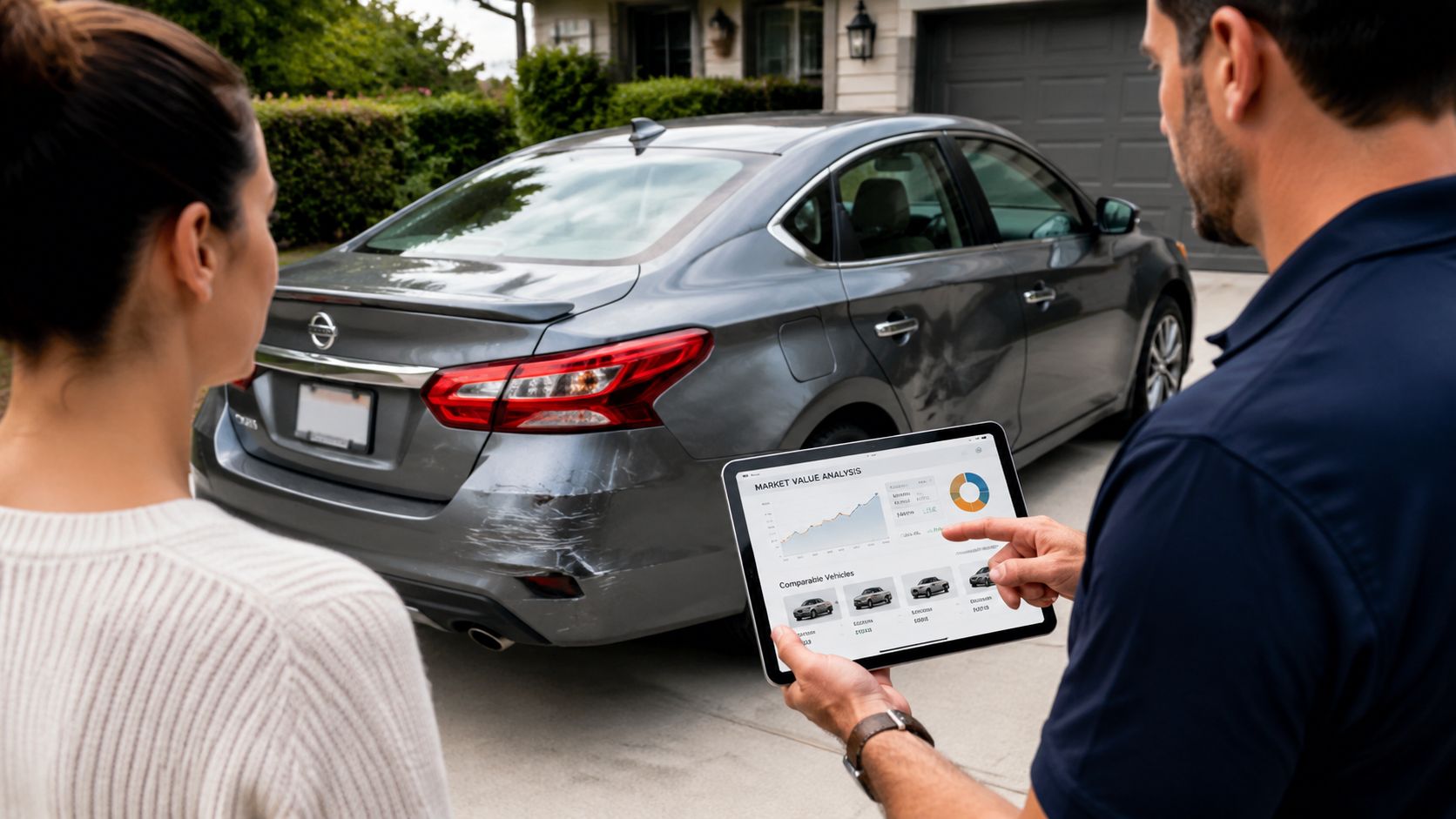
The driver checks listings and finds comparable vehicles with the same trim, similar mileage, and matching equipment priced higher than the insurer's valuation. The driver also remembers the maintenance history, upgraded package, clean interior, and careful ownership that the worksheet barely mentions. The loan balance is higher still, but that balance is a financing issue, not proof of the car's market value.
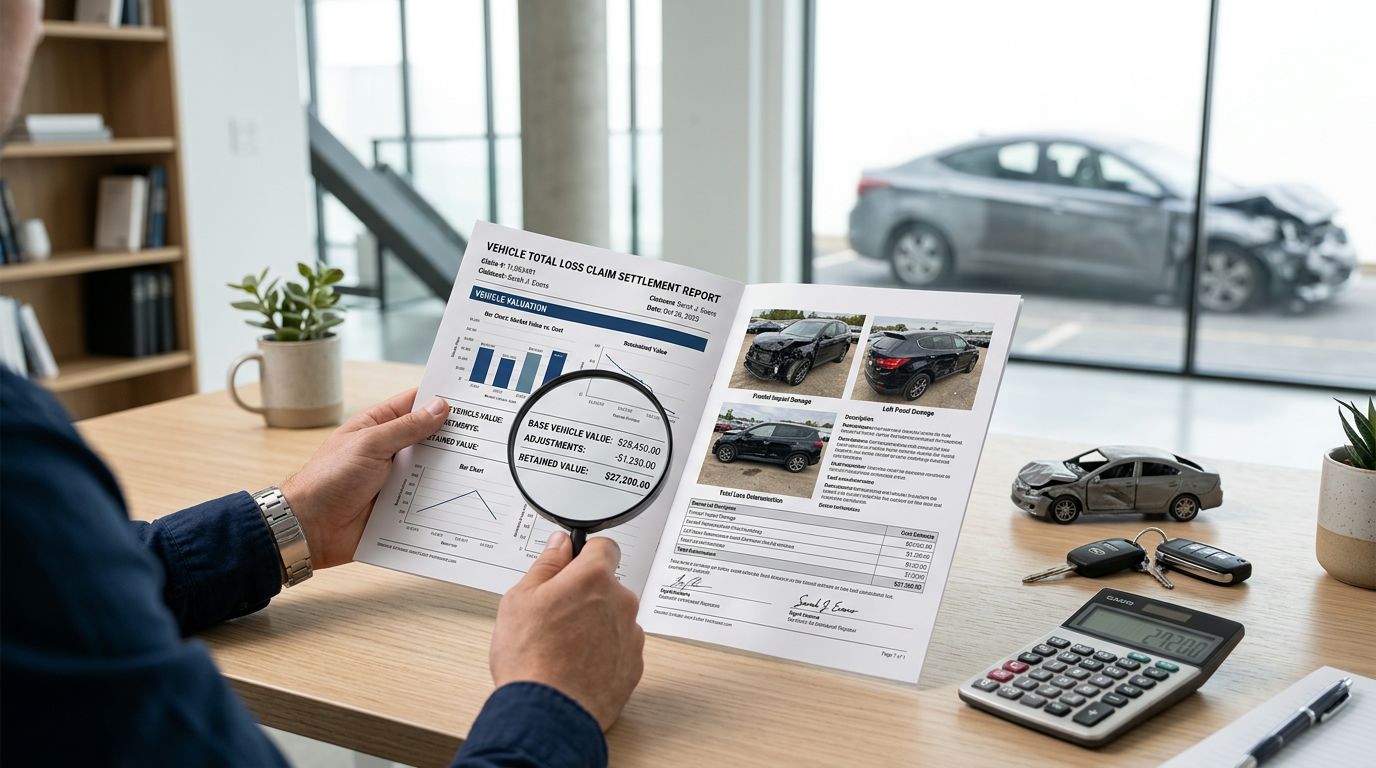
The insurer's offer may be based on a valuation report assembled from selected comparables and adjustments. That report can be useful, but it isn't automatically accurate. If the comparables are stale, distant, materially different in trim, or missing important equipment, the resulting actual cash value, or ACV, is open to challenge.
Practical rule: Treat the first offer as the insurer's opening position, not as a final ruling on what your vehicle was worth.
Washington's claims environment gives consumers more influence than a simple private disagreement over a contract. The state regulates insurer conduct, sets claims-handling standards, and now requires a formal appraisal provision in qualifying auto policies issued or renewed on or after January 1, 2026. That process focuses on the amount of loss and actual cash value, which are exactly where many total-loss disputes begin.
The rest of the analysis comes down to evidence. You need to separate the vehicle's market value from the loan payoff, identify weaknesses in the insurer's report, preserve written communications, and choose the right dispute mechanism. A low offer isn't solved by arguing louder. It's solved by showing, line by line, why the number doesn't describe the vehicle that was damaged.
How Washington Insurance Law Is Built
Washington doesn't leave insurance claims to private contract alone. The Insurance Commissioner sits at the center of market oversight, and Washington law says a person may not act as an insurer or transact insurance without a certificate of authority issued by the commissioner. That structure explains why Washington insurance law focuses on licensing, solvency, consumer protection, and claims conduct.
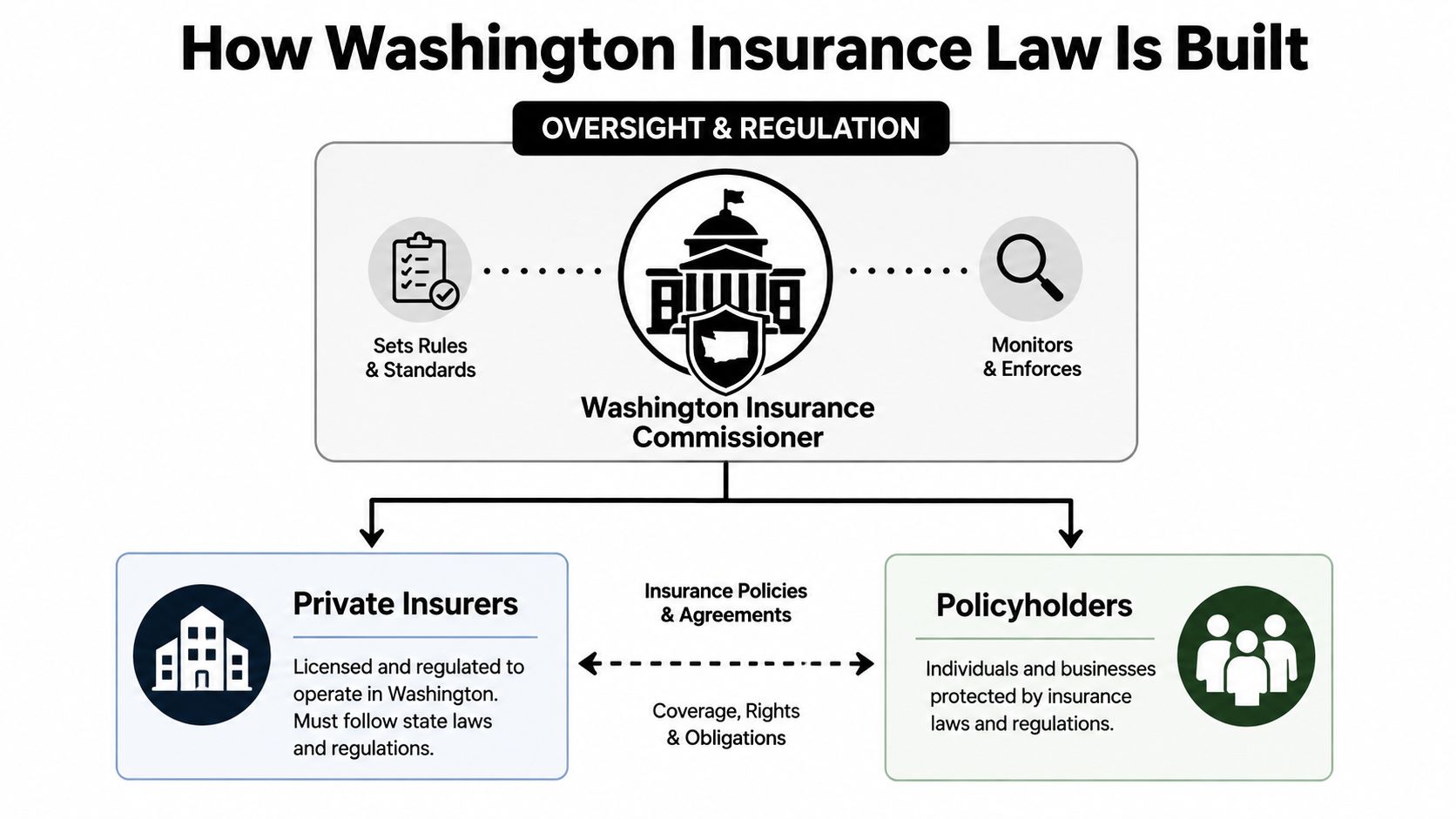
The regulatory layer behind an auto claim
Chapter 48.30 RCW contains Washington's broad unfair-practices rules. The state's regulations also establish minimum claims-settlement standards, and conduct can be treated as unfair when it occurs often enough to show a general business practice. For auto claims, Washington's rules address prompt handling and settlement conduct, rather than allowing every decision to disappear behind an adjuster's discretion. The statutory framework is set out through the Washington insurance code provisions on insurer authority and regulation.
Washington enacted RCW 48.30.015 in 2007 and titled it the Insurance Fair Conduct Act. That milestone matters because it signaled a stronger consumer-protection approach to insurance disputes. It doesn't turn every disagreement into bad faith, but it does give the claims process a public regulatory dimension.
That distinction matters in a total-loss claim. An insurer can disagree with your valuation. It still has to handle the claim within Washington's regulated standards. Delays, incomplete explanations, and unsupported valuation practices should be documented because they may matter separately from the amount of the vehicle's value.
Why this matters outside the claims file
A claims dispute can involve several layers at once:
- Value: What was the vehicle worth immediately before the loss?
- Amount of loss: What amount is owed under the applicable coverage?
- Conduct: Did the insurer handle the claim in a manner consistent with Washington requirements?
- Coverage: Does the policy respond to the claimed damage?
Don't confuse those questions. A valuation disagreement belongs in an evidence-based negotiation or appraisal. A pattern of unfair handling may justify contacting the Office of the Insurance Commissioner. Coverage questions may require policy analysis and legal advice.
Vehicle owners also encounter adjacent warranty and service issues after a collision, especially when repairs involve commercial trucks or specialized parts. A separate guide to part warranties for truck owners can help clarify what a parts warranty does and doesn't cover, which is different from proving a vehicle's pre-loss market value.
If you need help organizing a Washington valuation dispute, Washington claim support from Total Loss Northwest is one available resource. The essential point is simple: the adjuster operates inside a supervised claims system, and the paper trail matters.
Total Loss Rules and How Insurers Calculate ACV
Washington's total-loss rule uses a comparison between repair economics and vehicle value. Under the state's regulation, a vehicle is a total loss when repair parts and labor, plus salvage value, meet or are likely to meet or exceed the vehicle's actual cash value. The rule is about whether repairing the vehicle makes economic sense, not whether the owner still owes money on it.
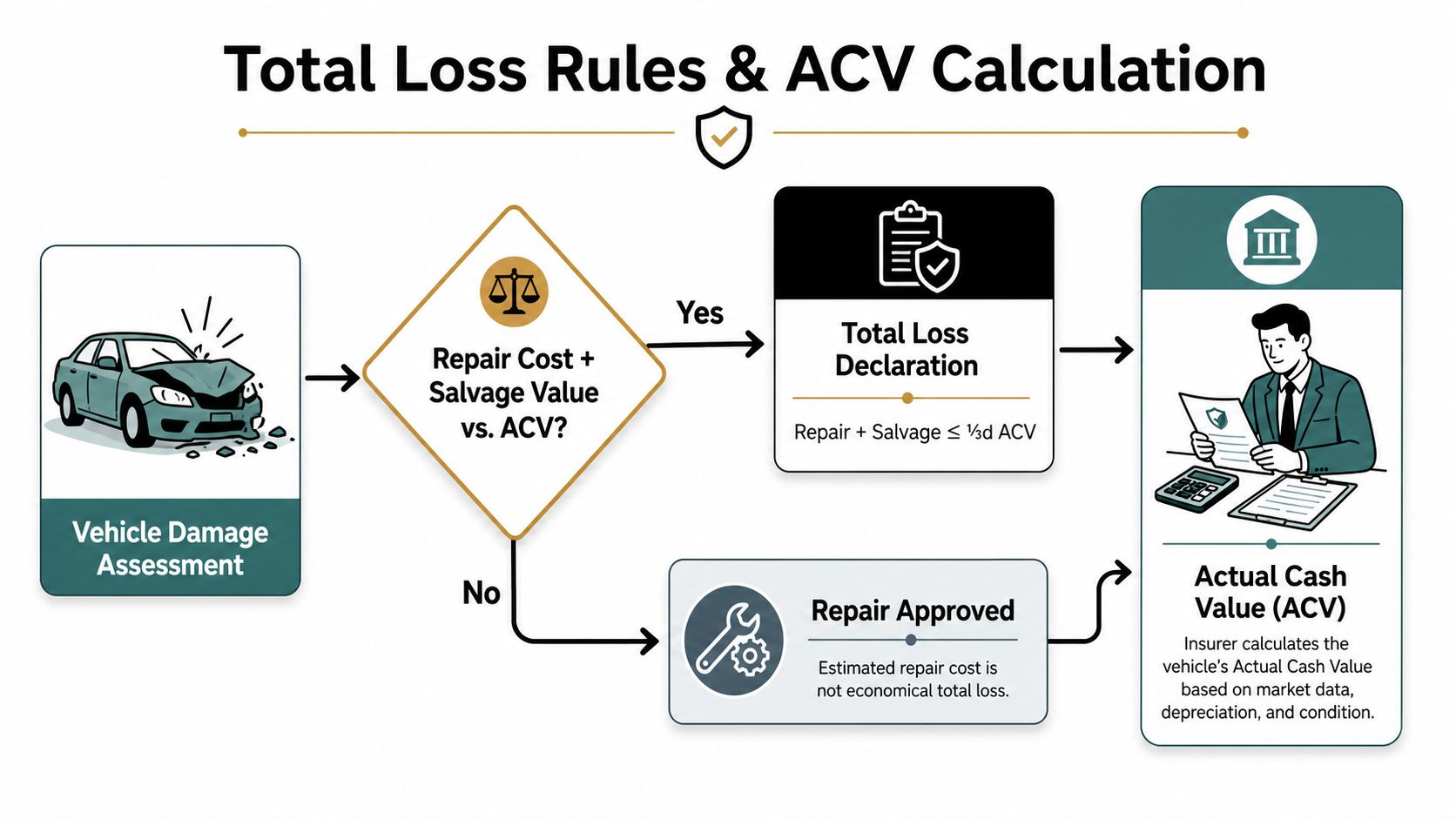
ACV is a market-value question
Actual cash value is the vehicle's pre-loss market value. It isn't the replacement cost for a newer vehicle, and it isn't the loan payoff. If you owe more than the vehicle was worth, that shortfall may involve separate financial protection, but it doesn't raise the ACV.
The insurer's worksheet should reflect the vehicle as it existed before the collision. Review it for:
- Trim and equipment: Check whether the report captures the correct model, drivetrain, technology, safety package, seating configuration, and factory options.
- Comparable quality: A comparable should resemble your vehicle in meaningful ways, including mileage, age, condition, equipment, and local market relevance.
- Condition adjustments: Service records, recent maintenance, and documented condition can expose weak assumptions about the vehicle's pre-loss state.
- Market geography: A vehicle available in a distant market may not represent what a Washington buyer would pay locally, particularly when supply and equipment differ.
- Timing: Listings and sales data become less useful when they no longer reflect the market around the loss date.
Don't waste your strongest argument on repair-line disagreements after the insurer has already declared a total loss. The more important fight is usually the vehicle's value before damage.
Photo estimates and in-person inspections
Washington's claims guidance and regulatory direction have made inspection procedure increasingly important. When an insurer relies on photo estimating, ask for an in-person inspection if the photographs don't show the damage clearly or the valuation depends on details that can't be assessed remotely. Keep the request in writing and preserve the response.
An in-person inspection won't automatically increase ACV. It can, however, create a better factual record about condition, equipment, and damage. If the insurer refuses to inspect or delays the process, those communications may become relevant when assessing claims conduct.
A clean valuation report is only as strong as the vehicle identification, comparable selection, and adjustments behind it.
The insurer's worksheet is not the end of the analysis. It's the document you audit.
Diminished Value Claims in Plain English
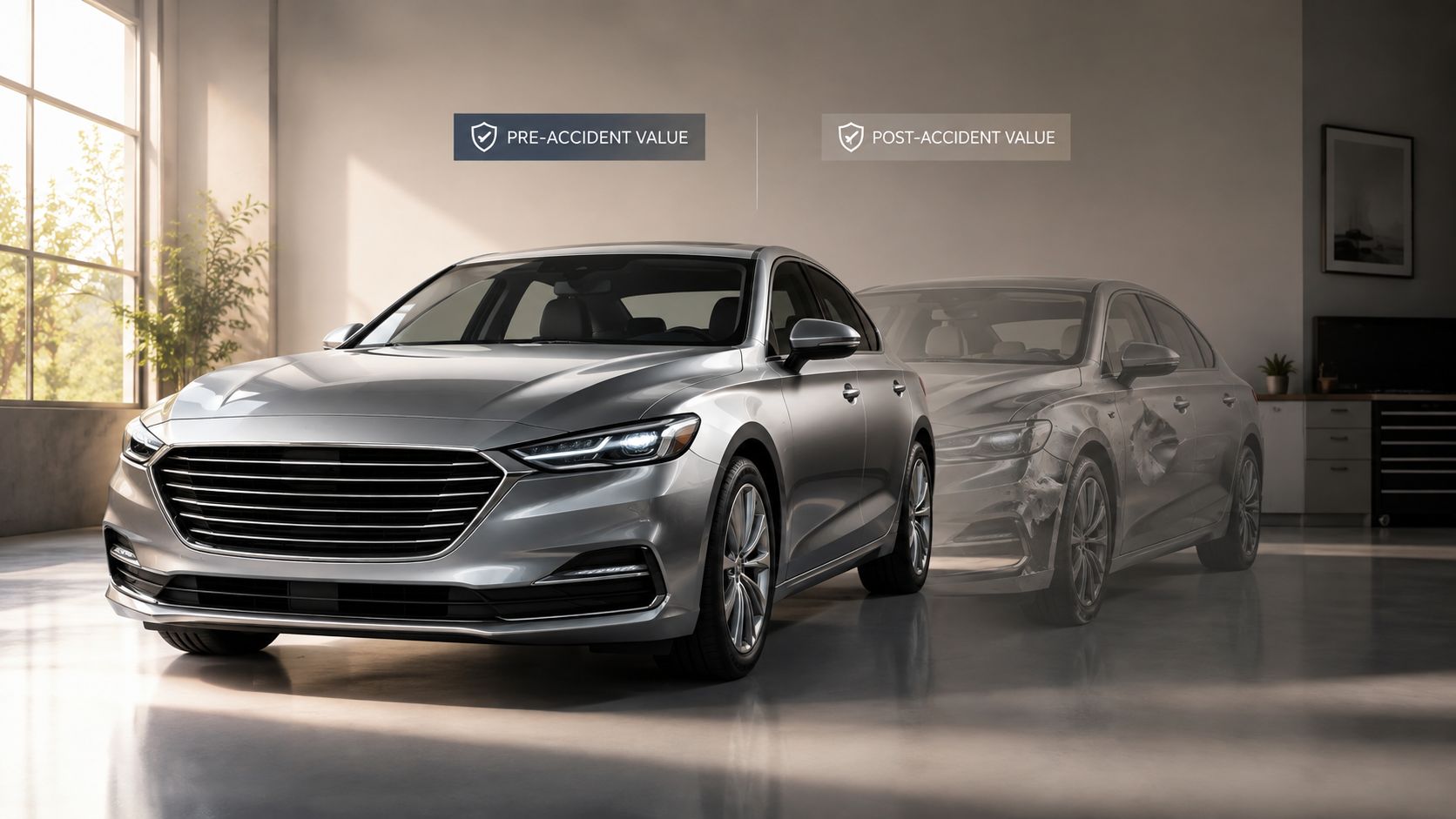
Washington's insurance guidance defines diminished value as the difference between a vehicle's market value before an accident and its market value after repairs. The vehicle may look excellent when the shop returns it, yet a future buyer can still see the accident history as a reason to pay less.
That reduction is different from repair cost. A repair invoice answers what it took to fix the vehicle. A diminished-value claim asks what the repaired vehicle is worth in the market after the collision record follows it.
Who receives the claim
Washington says diminished-value claims are typically pursued against the at-fault driver's insurer, rather than your own carrier. That distinction changes who receives the demand and what liability coverage may be involved. Start by confirming fault, identifying the other carrier, and preserving the repair record.
The strongest file establishes both sides of the comparison:
- Before the crash: Document the vehicle's pre-loss mileage, condition, equipment, service history, photographs, prior listings, and market position.
- After repairs: Keep the final repair invoice, parts information, alignment or structural documentation where relevant, and evidence of the accident history.
- Market impact: Use credible market evidence to show how an accident history affects what buyers will pay, especially for a vehicle whose condition and provenance mattered before the loss.
High-value, classic, and custom vehicles often need more careful valuation work because their pre-loss identity is tied to equipment, condition, originality, restoration, or modifications. A generic database entry can miss the feature that made the vehicle valuable.
This Washington diminished-value claim resource can help owners identify the documents and valuation issues that deserve attention.
A diminished-value appraisal can be useful when the insurer dismisses the claim with a generic response. The report should explain the pre-loss market, the post-repair market, and the reasoning connecting the accident history to the value difference.
The visual below shows why a repaired vehicle can remain financially different from an undamaged one.
Don't present diminished value as an automatic payment. Present it as a market-value claim supported by evidence.
The New Appraisal Clause You Should Know About
Washington's major auto-claims development is RCW 48.18.620. For every automobile policy with first-party physical-damage coverage issued or renewed on or after January 1, 2026, the policy must include an appraisal provision for disputes over actual cash value and amount of loss. The statute gives qualifying policyholders a defined process instead of forcing every valuation dispute into informal negotiation or litigation.
The process begins with a written demand for appraisal. After that demand, each side must select a competent and disinterested appraiser within 10 days. The appraisers then have 30 calendar days from selection to complete their appraisals. If they can't agree, they must appoint an umpire within 15 days, and the commissioner may identify one if they deadlock. The umpire's costs are shared equally.
The deadlines create pressure
The statute is useful because it replaces vague delay with defined procedural steps. You should not make a casual phone request and assume appraisal has been invoked. Send a written demand that identifies the valuation or amount-of-loss dispute, preserves your position, and asks the insurer to identify its appraiser.
Each appraiser evaluates the disputed value independently. If the two appraisers agree, their agreement controls. If they don't, the umpire participates in resolving the disagreement. Any agreement by two of the three decision-makers is binding, so selecting a qualified appraiser is the central strategic decision.
| Step | Deadline | Who acts |
|---|---|---|
| Written appraisal demand | Starts the process | Policyholder or insurer |
| Select appraiser | 10 days | Each side |
| Complete appraisal | 30 calendar days after selection | Appraisers |
| Agree on umpire | 15 days if appraisers disagree | The two appraisers |
| Identify umpire if needed | After appraiser deadlock | Insurance Commissioner may identify one |
| Umpire costs | Shared equally | Both sides |
The Washington appraisal clause guide explains how the process can apply to a total-loss valuation dispute. Remember its limits. Appraisal decides valuation and amount of loss. It doesn't decide every coverage, liability, or legal-conduct issue.
Selection matters: The insurer already has a valuation position. Your appraiser should be independent, competent, disinterested, and able to explain market evidence under pressure.
If the policy was issued or renewed before the statute's effective date and hasn't received qualifying new policy treatment, don't assume the statutory provision applies. Read the policy and confirm the relevant effective or renewal date.
How to Dispute a Lowball Settlement Offer
Most low ACV offers are evidence problems before they become legal problems. The adjuster used a valuation report, and the report used assumptions you haven't challenged yet. Your job is to replace weak assumptions with better vehicle-specific evidence.
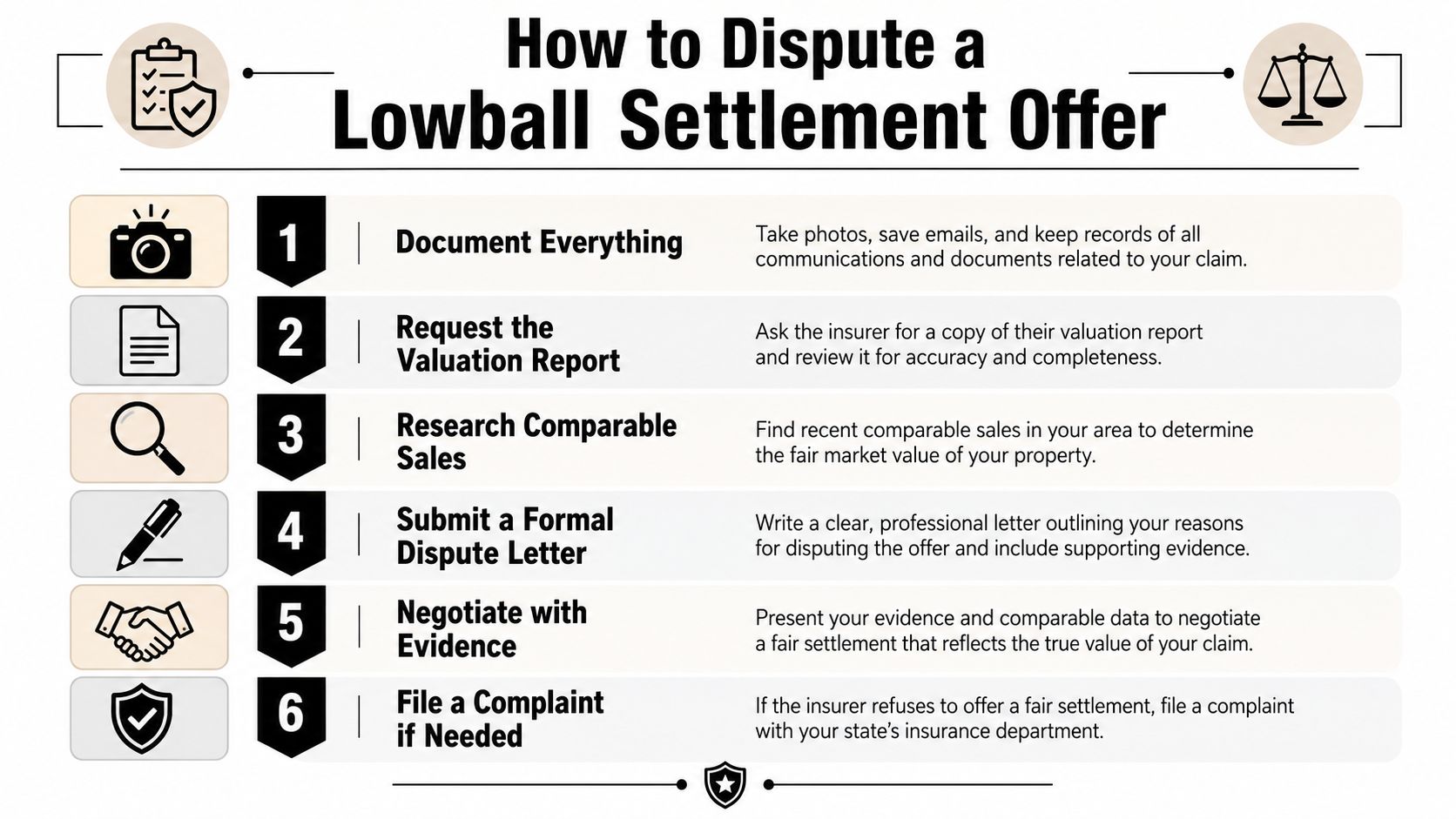
Build the file before making the demand
Start with the insurer's complete valuation worksheet, not just the settlement summary. Ask for the comparable vehicles, adjustment calculations, equipment coding, mileage treatment, condition assumptions, and any explanation for rejected evidence.
Then assemble your own package:
- Comparable listings: Save local examples with the same trim, drivetrain, equipment, mileage range, and condition. Record the listing date and preserve screenshots or downloaded documents.
- Dealer evidence: Dealer inventory can show what the market asks for vehicles with similar specifications. Asking price isn't the same as completed-sale price, so label it accurately.
- Independent valuation: A qualified appraiser can analyze the market and explain why a vehicle-specific value differs from a software-generated result.
- Options and packages: Gather window stickers, purchase records, build sheets, photographs, and service invoices proving equipment the worksheet missed.
- Condition records: Maintenance history, recent tires, documented repairs, and dated photographs help establish the vehicle's pre-loss condition.
- Written communications: Keep every email, text, letter, inspection request, delay explanation, and settlement revision in one file.
Arguing only about repair costs is usually a mistake after a total-loss declaration. Repair estimates may explain why the insurer classified the vehicle as a total loss, but the settlement still turns on ACV and the amount of loss.
Watch the handling, not just the number
Washington's regulatory direction has focused attention on conduct that can distort valuation outcomes. That includes delaying appraisal, using appraisers from outside the loss area, and influencing appraisers toward a results-oriented value. Don't accuse the adjuster in an emotional email. Document dates, names, requests, and responses.
A clear dispute letter should identify the errors, attach the evidence, state the value you support, and reserve the right to invoke appraisal under the policy and applicable Washington law. If you're researching broader negotiation practices, this explanation of how professionals negotiate insurance settlements in Ohio offers useful general context, but Washington's appraisal rules control a Washington policy dispute.
The strongest submission reads like an audit, not a complaint.
Choosing Your Next Move After a Low Offer
Your next move depends on what you're disputing. Don't file a lawsuit just because the first offer is low, and don't invoke appraisal when the problem is coverage.
Use appraisal for valuation
If the dispute is the vehicle's ACV or amount of loss, and your qualifying policy contains the statutory appraisal provision, appraisal is usually the most direct tool. It puts the question before appraisers and an umpire if necessary, rather than leaving the result to repeated calls with the same adjuster.
Hire an independent appraiser before you demand the process if possible. The appraiser should review the insurer's report, inspect the evidence, identify comparable problems, and explain a defensible market value.
Use the OIC complaint process for conduct
Contact the Office of the Insurance Commissioner when the concern centers on handling conduct, such as unexplained delay, failure to address written evidence, or resistance to an inspection request. A complaint creates a regulatory record, but it doesn't replace a valuation report and shouldn't be treated as a substitute for appraisal.
Reserve litigation for the right dispute
Litigation makes more sense when the insurer refuses a required process, the disagreement includes coverage or legal issues that appraisal can't decide, or the financial gap justifies legal expense. Get advice from a Washington attorney before filing, especially if deadlines, releases, or policy conditions are involved.
For a straightforward value dispute, start with an appraiser and evidence. Escalate only when the facts justify the cost.
Your Washington Claims Checklist and Common Questions
A disciplined file beats a frantic phone call. Use this checklist after receiving a low total-loss offer or beginning a diminished-value claim:
- Save the policy: Confirm coverage, effective dates, renewal information, and any appraisal language.
- Request the worksheet: Obtain the valuation report, comparables, adjustments, and vehicle specifications.
- Check the vehicle identity: Verify trim, mileage, drivetrain, options, condition, and location.
- Build market evidence: Save comparable listings and supporting records before they disappear.
- Document every contact: Keep written requests, inspection responses, delays, and revised offers.
- Choose the dispute path: Use appraisal for qualifying valuation disputes, an OIC complaint for handling concerns, and legal advice for coverage or enforcement issues.
- Avoid premature releases: Don't sign a final settlement or title document until you understand what rights the document affects.
Common questions
How long does an insurer have to respond?
The answer depends on the particular request, policy language, and applicable claims-handling requirement. Ask in writing, set out what you need, and preserve the response or lack of response. Washington's claims rules require regulated handling standards, but a valuation disagreement doesn't disappear just because the insurer takes a position.
Can I keep the totaled vehicle?
Possibly, but retaining a vehicle can affect salvage, title, settlement calculations, and practical use. Ask the insurer for the written financial impact before agreeing.
What does an umpire do?
The umpire helps resolve the valuation dispute when the two appraisers don't agree. Under the statutory process, an agreement by any two of the three decision-makers is binding, and umpire costs are shared equally.
Does the new appraisal right apply to older policies?
The statute requires the provision for auto policies with first-party physical-damage coverage issued or renewed on or after January 1, 2026. Older policy treatment depends on the policy's effective and renewal history, so read the actual contract before demanding appraisal.
Don't let the loan balance, a rushed inspection, or an unexplained worksheet decide the case for you. Build the value record first, then use the process Washington provides.
Total Loss Northwest helps Washington vehicle owners challenge disputed total-loss valuations and document diminished value through independent appraisal work. If the insurer's number doesn't reflect your vehicle's market evidence, visit Total Loss Northwest to review the available claim-support options.