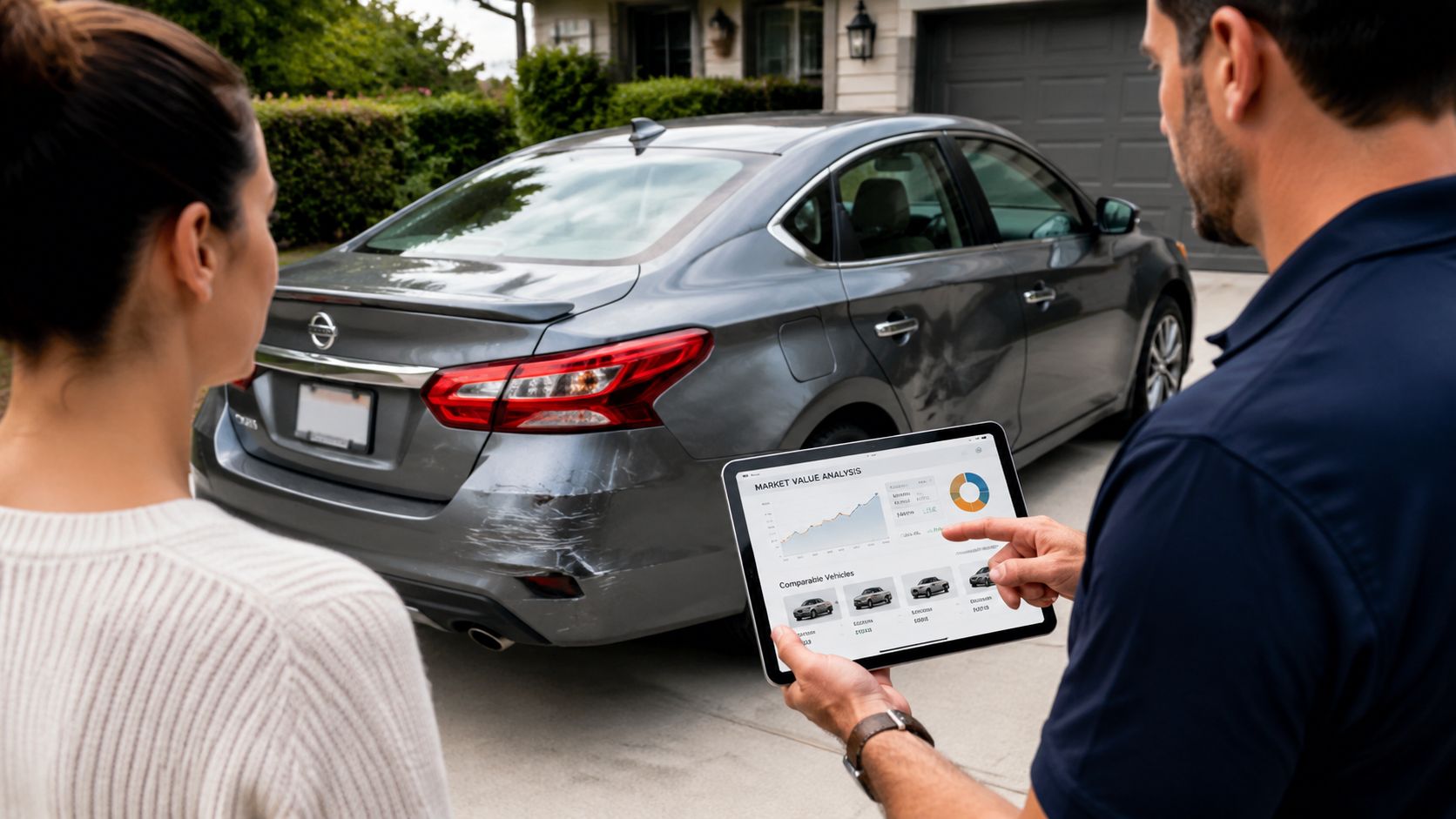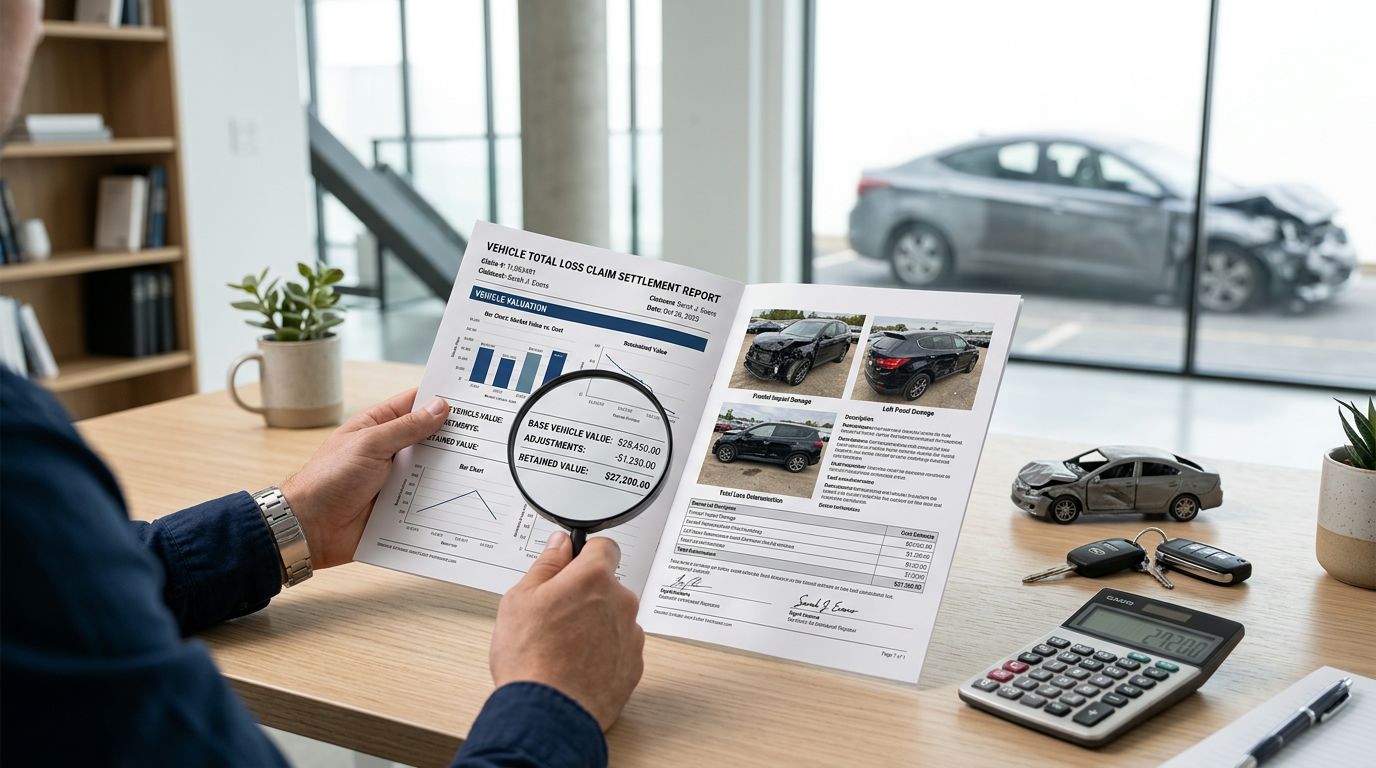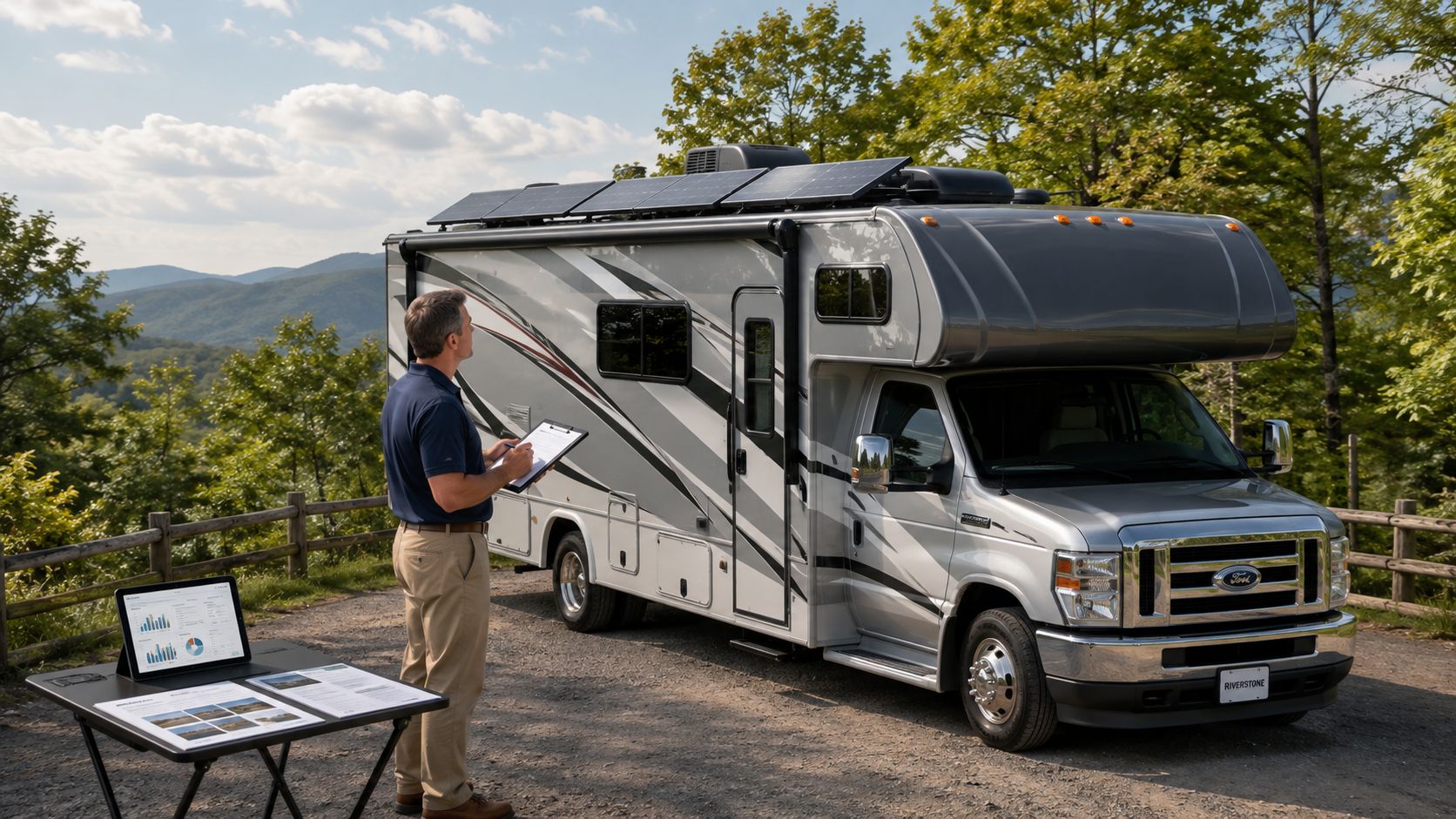
An RV appraisal determines the defensible value of your rig at the relevant date, and insurance total-loss claims usually turn on actual cash value, not what you paid or what a replacement unit costs. For broader market context, Black Book's RV valuation product covers wholesale, retail, finance advance, and MSRP values for model years from 1997 through the current year, while motorhome wholesale values averaged $62,637 in Q4 2025. Black Book's RV valuation data and its market update show why a current, documented number matters.
The familiar sequence is frustrating. Your RV is damaged, the adjuster declares it a total loss, and an insurer sends a settlement offer generated from software. The number looks official because it appears in a polished report, but the report may miss the lithium battery system, solar array, suspension work, upgraded appliances, regional comparables, or the actual condition of your rig before the loss.
That's where a recreational vehicle appraisal becomes useful. An independent appraiser rebuilds the valuation from the RV's exact identity, equipment, condition, records, and comparable market evidence. The objective isn't to assign an emotional value. It's to replace an incomplete number with a documented valuation you can use in a settlement negotiation.
What Happens When Your Insurer Lowballs Your RV
The moment usually arrives by phone. An adjuster explains that the Class C motorhome is a total loss and gives you an actual cash value figure. You know the rig had a permanently installed solar array, lithium batteries, upgraded suspension, and meticulous maintenance records, but none of those details appear in the insurer's valuation worksheet.
The problem isn't that insurance software has no purpose. It creates a starting point from broad market data. The problem is that a starting point can become the final offer when nobody tests the inputs. A software report may identify the correct general model while missing the floor plan, factory package, permanently attached upgrades, condition evidence, or comparable units that more closely match the pre-loss RV.
Practical rule: Treat the insurer's first valuation as a position, not as proof that the number is correct.
An independent appraisal gives you a structured response. The appraiser verifies the year, manufacturer, make, model, floor plan, mileage or usage, condition, maintenance history, and equipment. The resulting report should explain the comparable vehicles used, show how differences were adjusted, and distinguish between wholesale, retail, and actual cash value rather than presenting one unexplained figure.
Why RV owners face a special valuation problem
An RV combines a vehicle, living space, appliances, electrical systems, plumbing, and specialized equipment. Two units with the same model designation can have different layouts, usage histories, options, and maintenance conditions. Water intrusion, delamination, roof deterioration, and neglected systems can reduce value sharply, while documented upgrades can support a higher figure when buyers in that market recognize them.
The broader industry also creates pressure for current valuations. One market estimate places the global recreational vehicle market at USD 60.01 billion in 2025 and projects USD 105.77 billion by 2034, with a projected 6.5% CAGR from 2026 through 2034. The market outlook from Straits Research illustrates the long-term scale of the sector, but the same source context doesn't eliminate short-term changes between segments, regions, or seasons.
When hiring an appraiser makes sense
You should consider an appraisal when the offer ignores documented equipment, the comparable units are clearly mismatched, the insurer uses the wrong floor plan, or the value affects whether the RV is repairable or totaled. It's also appropriate when the claim involves a high-value motorhome, a custom fifth wheel, a well-maintained older rig, or a dispute over a repaired unit's post-accident value.
An appraisal isn't a casual estimate and it isn't a dealer trade-in quote. It's a claim document designed to give you evidence and negotiating strength when the carrier's number doesn't reflect the RV you really owned.
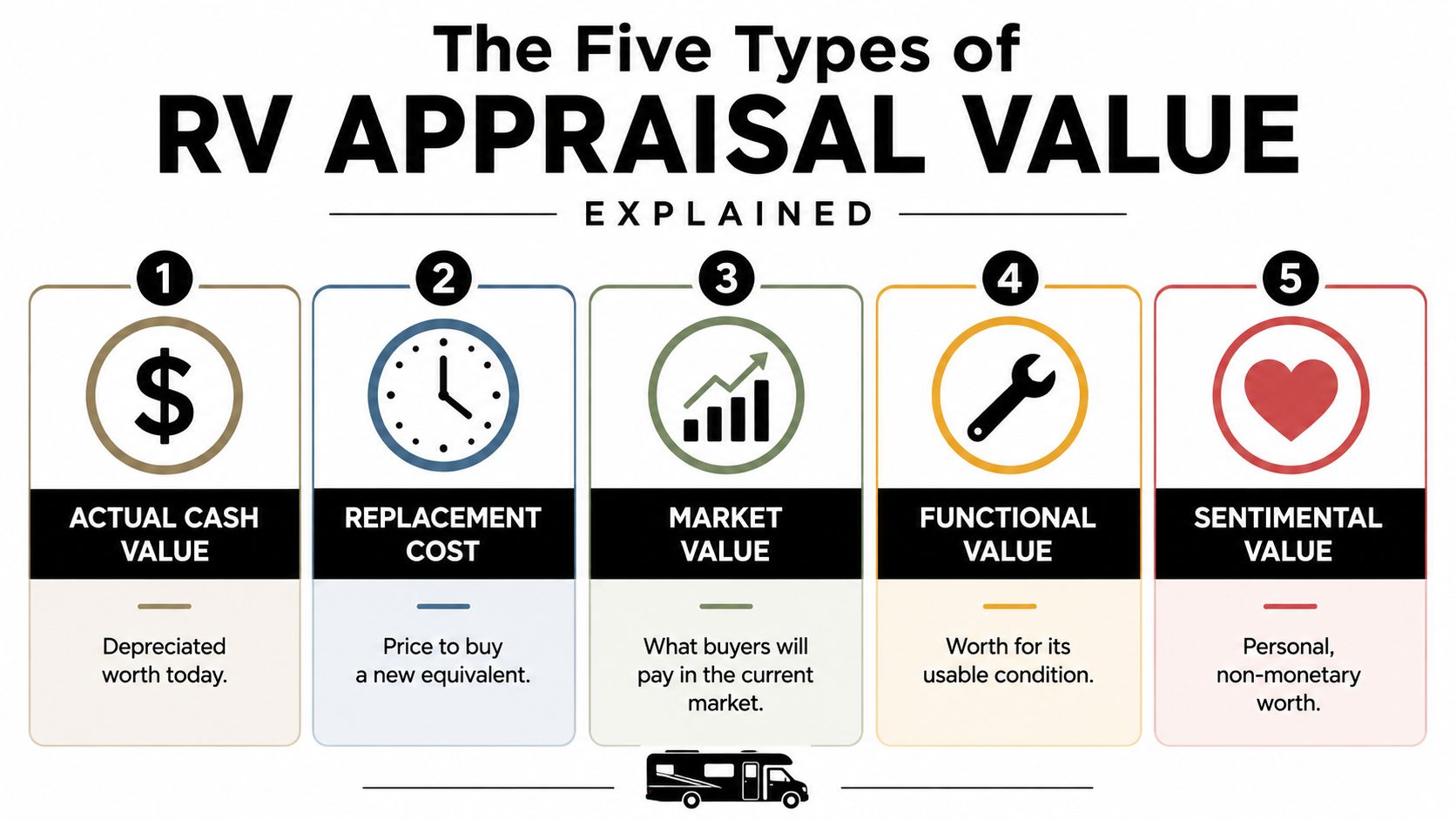
The Five Types of RV Appraisal Value Explained
Owners often use “value” to mean one thing. Insurance professionals, lenders, dealers, and buyers use it in different ways. Before challenging a settlement, identify the value definition in the policy and the report. Negotiating toward the wrong valuation standard creates confusion and weakens your position.
Actual cash value
Actual cash value, or ACV, is the central number in most total-loss disputes. Think of it as the amount the RV was worth in the market immediately before the loss, after accounting for age, depreciation, condition, equipment, usage, and market demand. It isn't the original purchase price, the loan balance, or the cost of a new equivalent.
For insurance purposes, the appraiser reconstructs the pre-loss market position. Guidance on RV total-loss settlements describes ACV as the usual settlement basis and explains why a repair estimate alone can't establish the RV's pre-loss worth.
Replacement cost
Replacement cost answers a different question: what would it cost to buy a new or equivalent replacement? A replacement may have newer technology, a different floor plan, changed manufacturer equipment, or a different market position. Unless the policy specifically provides replacement-cost treatment, you shouldn't assume this is the amount the carrier owes.
Market value
Market value is the price a willing buyer might pay in the current market for a comparable RV. It relies on actual market evidence, including comparable listings and available inventory. Market value helps an appraiser test whether the insurer's ACV inputs make sense, but the final claim valuation still needs to follow the policy's settlement language.
Functional value
Functional value focuses on what the RV is worth in its usable condition. This can matter when the rig has unusual equipment, an older design, or a configuration that doesn't fit neatly into a standard database. A unit may be fully functional yet differ substantially from the average example used by a valuation system.
Sentimental value
Sentimental value belongs to the owner, not usually to the insurance settlement. Family memories, travel history, and personal attachment are real, but they generally don't create recoverable ACV. Put your negotiation effort into provable characteristics, records, equipment, condition, and market comparables.
Total-loss treatment also depends on the carrier and state. Industry guidance places common total-loss triggers in a broad range of about 70% to 100% of ACV, as noted in the RV total-loss settlement discussion. That range matters because a revised pre-loss value can affect whether the insurer treats the rig as repairable or totaled. Owners with an agreed-value policy should review the policy language and, where relevant, learn how an agreed-value appraisal differs from a standard ACV analysis.
What an Appraiser Actually Looks At
A credible RV appraisal begins with identification, not opinion. The appraiser needs the exact year, manufacturer, make, model, floor plan, chassis or platform where relevant, mileage or usage, and factory configuration. A broad description such as “large Class A in good shape” isn't precise enough to support a settlement figure.
The appraiser then tests the condition and equipment against market evidence. Black Book's RV product covers several valuation levels and model years from 1997 through the current year, and it provides historical valuations as well. That historical coverage matters when an older rig needs to be compared with appropriate examples rather than forced into a newer-unit formula.
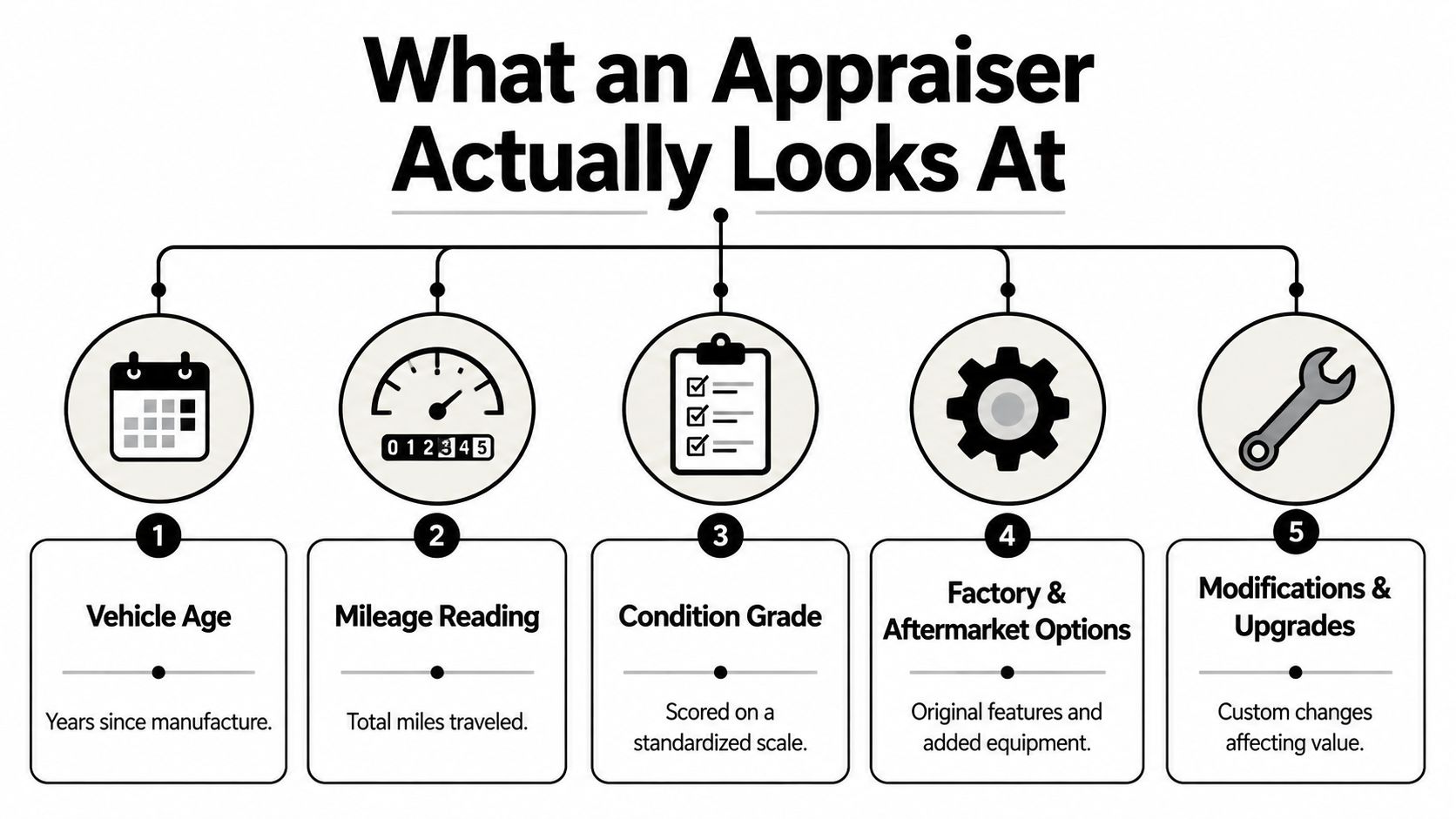
The inputs that move the number
Age establishes the depreciation framework. RV depreciation is often front-loaded. Independent valuation guidance commonly describes first-year depreciation around 20% to 30%, with cumulative five-year losses often near 45% to 50% or more for mainstream units, before the curve flattens. NADA's consumer vehicle valuation resources provide the referenced valuation context. Those figures are not a substitute for a comparable-market analysis, but they explain why a nearly new RV and a mature, well-maintained RV can't be valued by applying the same adjustment.
Mileage and usage affect mechanical and market appeal. Motorhome mileage can influence drivetrain wear, while towables require attention to towing use, axle condition, tire history, and system maintenance. The appraiser should interpret the reading alongside service records rather than treating mileage as an isolated penalty.
Condition separates the average unit from the exceptional one. A documented roof resealing history can support a stronger condition assessment. Water intrusion, delaminated sidewalls, collision repairs, staining, deferred maintenance, or nonfunctional appliances move the value downward. Photographs, repair invoices, inspection findings, and storage records give those adjustments credibility.
Factory options and permanent upgrades need item-level documentation. Solar arrays, lithium batteries, suspension upgrades, upgraded inverters, appliances, awnings, and communications equipment may affect value, but the amount paid for an upgrade isn't automatically the amount added to ACV. The appraiser considers whether the equipment is permanently installed, functional, desirable in that market, and reflected in comparable units.
Why comparables matter more than MSRP
MSRP is a reference point, not proof of current market value. A defensible report identifies comparable listings or market examples and adjusts for differences in year, floor plan, condition, equipment, location, and usage. That approach prevents the common mistake of applying a generic depreciation percentage to a rig whose actual equipment and condition differ from the average.
Prepare the title, registration, build sheet, service records, maintenance invoices, upgrade receipts, photographs, and prior damage records. Documentation doesn't guarantee a higher value, but missing documentation makes it harder to prove why your RV belongs above an insurer's generic baseline.
How the RV Appraisal Process Works From Start to Finish
The process should feel organized, not mysterious. A competent appraiser begins with an intake conversation, confirms the claim facts, identifies the valuation date, and requests the records needed to establish the RV's pre-loss condition. The appraiser should also clarify whether the assignment concerns ACV, replacement cost, diminished value, financing, estate planning, or another purpose.
The inspection may occur in person or remotely, depending on the RV's location, condition, and assignment requirements. An in-person inspection allows closer review of the roof, exterior panels, tires, chassis, interior systems, appliances, modifications, and evidence of prior repairs. A remote review can still be useful when supported by clear photographs, videos, records, and third-party inspection information.
A practical sequence
Intake and scope: Provide the claim number, policy information, loss date, RV details, insurer valuation, and your explanation of the dispute.
Document review: Gather the title, registration, build sheet, service history, receipts, photographs, and records for upgrades or prior damage.
Inspection and photography: The appraiser records condition, equipment, identification marks, damage, wear, and features that a generic software entry may not capture.
Comparable research: The appraiser studies relevant market examples and checks that the year, make, model, floor plan, condition, and equipment are reasonably comparable.
Adjustments and report preparation: The report explains the valuation method, condition assessment, comparable evidence, equipment adjustments, and final opinion.
Negotiation support: The report is presented to the insurer with a focused explanation of the disputed line items and the policy process available to resolve disagreement.
RV appraisal process and timeline
| Stage | What Happens | Typical Timeframe |
|---|---|---|
| Intake | The appraiser confirms the assignment, loss date, RV identity, and claim issue. | Depends on document availability |
| Records review | Service records, receipts, photographs, and insurer materials are examined. | After the owner supplies the file |
| Inspection | The RV is inspected in person or reviewed through organized remote evidence. | Scheduled with the owner |
| Market research | Comparable units and relevant valuation references are analyzed. | After identification and inspection |
| Written report | Findings, adjustments, evidence, and the valuation conclusion are documented. | After research is complete |
| Claim presentation | The owner or appraiser submits the report and responds to the carrier. | Based on carrier discussions |
The report should be readable by an adjuster, a lawyer, or an umpire. It should cite comparable listings, explain condition ratings, identify equipment, and tie adjustments to specific evidence. A single number without a transparent path to that number won't give you much influence. Owners who want a fuller explanation of the claim workflow can review the insurance appraisal process.
Using Your Appraisal in an Insurance Negotiation
An appraisal only creates influence when you use it actively. Don't email a large report with no explanation and wait for the insurer to discover the important points. Send a concise cover message identifying the disputed value, the strongest comparable evidence, the omitted equipment, and the policy language that governs the next step.
Insurance valuation software commonly begins with broad databases and standardized inputs. That structure can miss aftermarket solar, lithium conversions, suspension work, upgraded interiors, unusual floor plans, and condition differences. The software isn't inspecting your roof, checking your maintenance file, or deciding whether a specific comparable listing is genuinely similar.
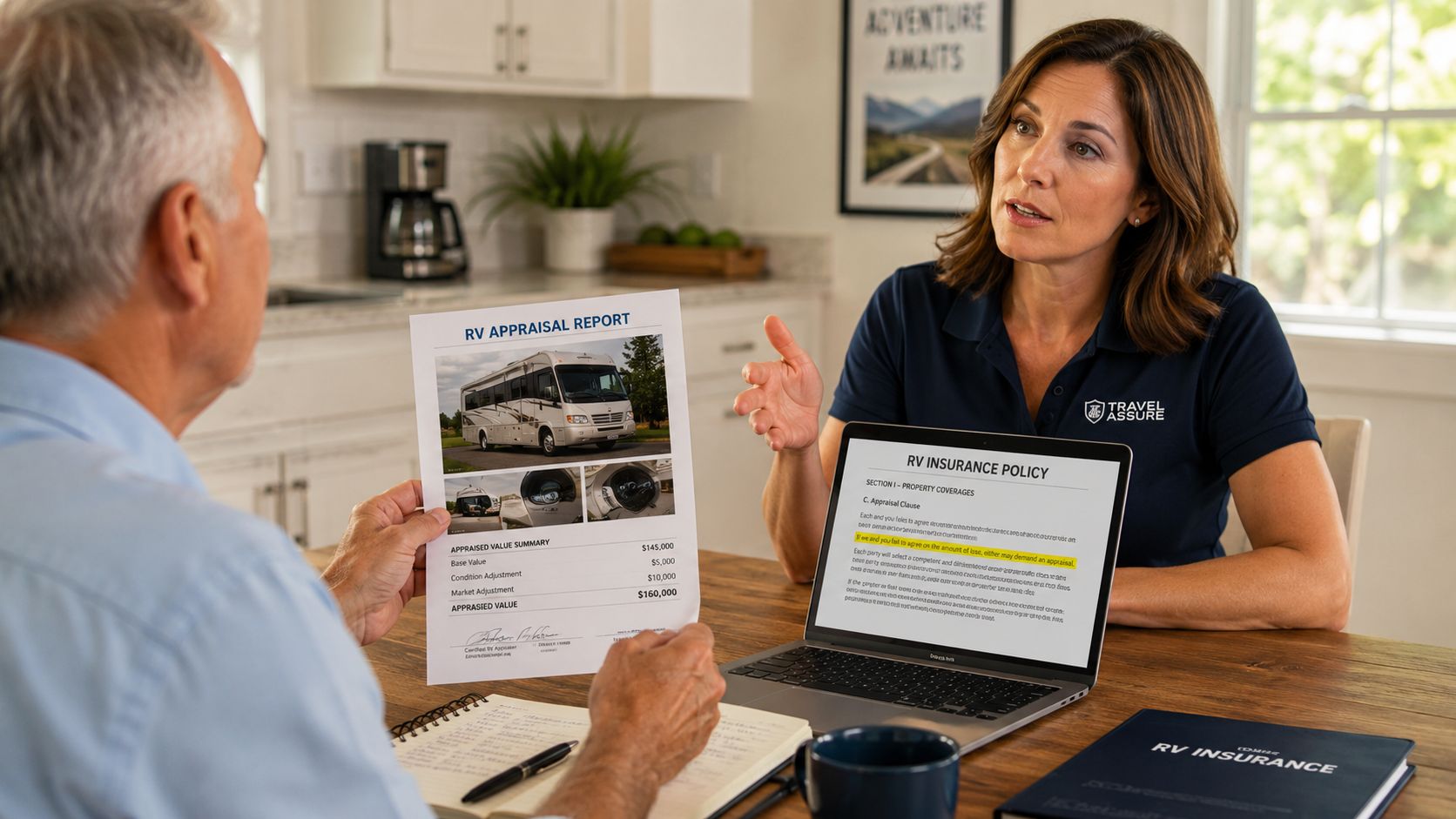
Build the negotiation around evidence
Start with the report's strongest points. If the carrier used the wrong floor plan, say so directly. If it omitted permanently attached equipment, identify the equipment, provide receipts or photographs, and explain how comparable units reflect similar features. If the insurer's examples are in a different condition or market segment, show the mismatch rather than arguing that the offer "feels low."
Use the policy's appraisal clause when negotiation stalls. Many policies provide a mechanism for each side to select an appraiser, with an umpire involved if the appraisers disagree. The exact language controls, so read the policy before making procedural claims. An independent report gives your appraiser a documented position instead of forcing the dispute into an informal conversation.
A strong demand says what is wrong with the carrier's number, what the correct evidence shows, and what action you want next.
Present the report in a way that makes review easy:
- Identify the correction: State the exact model, floor plan, equipment, condition, or comparable error.
- Tie every adjustment to evidence: Use photographs, receipts, inspection findings, and comparable listings.
- Separate value concepts: Don't mix ACV with replacement cost, loan balance, or sentimental value.
- Request a written response: Ask the carrier to explain which evidence it accepts or rejects.
- Escalate through the policy process: If the parties remain apart, follow the appraisal clause and applicable claim procedures.
This video provides another visual explanation of the appraisal process:
Your goal isn't to overwhelm the adjuster. It's to make the insurer confront the specific facts its initial software valuation left out.
Choosing a Certified Independent RV Appraiser
A dealer, an insurer, and an independent appraiser answer different questions. A dealer estimates what the business can pay or resell for the unit. The insurer applies its claim methodology. An independent appraiser develops a market-supported opinion for the assignment you authorize.
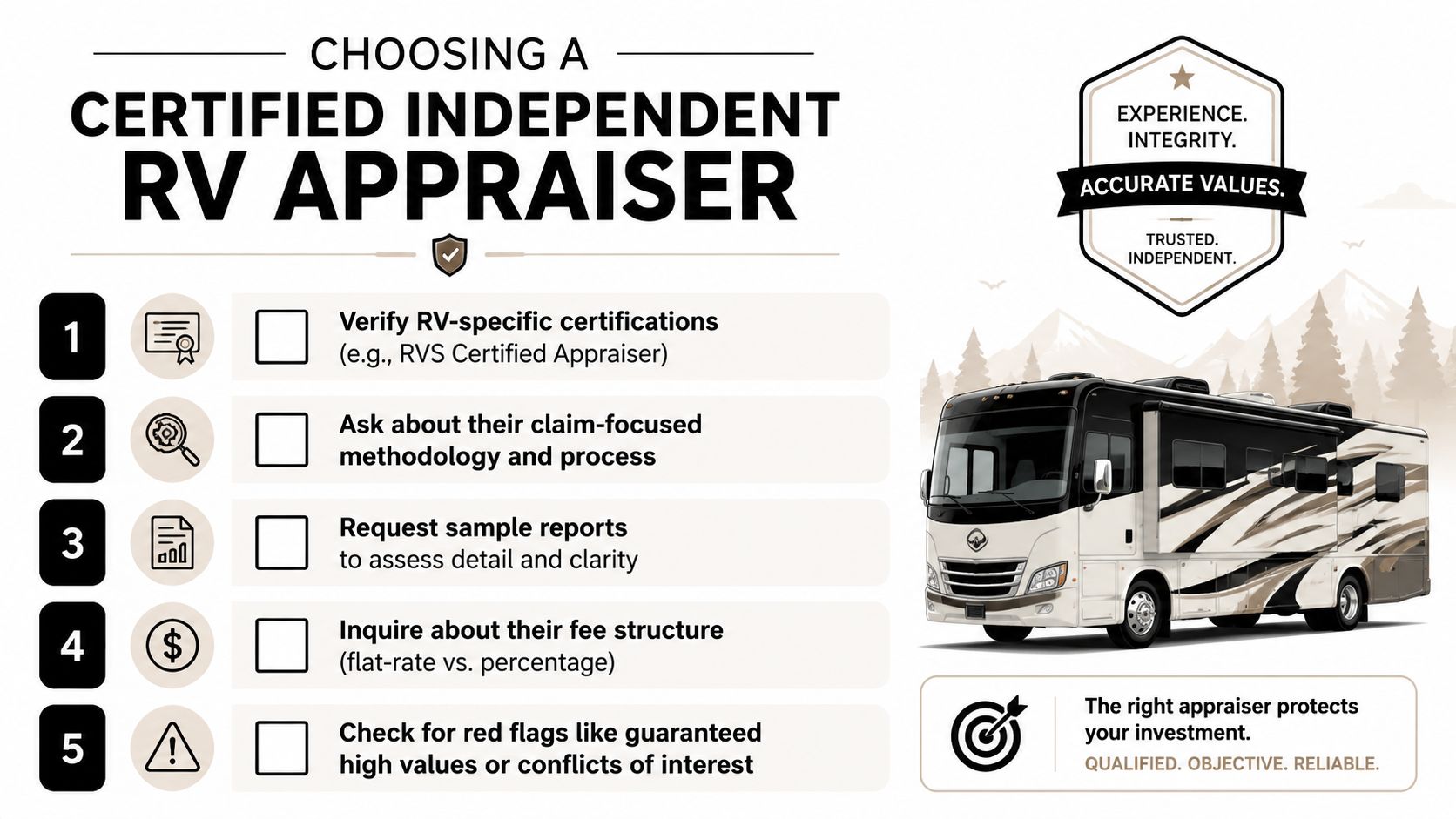
Look for RV-specific training or certification, experience with the relevant unit type, and a clear explanation of methodology. A general auto appraiser may understand vehicle damage but lack familiarity with fifth-wheel floor plans, motorhome systems, towable construction, roof issues, or RV-specific market comparables.
Questions to ask before hiring
- What credentials apply to RV appraisal? Ask for RV-specific certifications, such as an RVS Certified Appraiser credential where applicable, and ask how the credential relates to the assignment.
- How will you establish ACV? The answer should include exact unit identification, condition, equipment, records, and comparable market research.
- Will you inspect the RV? A physical inspection is often stronger than a photo-only review, especially when condition and permanent equipment are disputed.
- Can I review a sample report? Look for clear comparables, explained adjustments, photographs, and a conclusion that a third party can follow.
- How do you charge? Confirm whether the fee is flat-rate or percentage-based, what the engagement includes, and whether additional work costs extra.
- Do you have conflicts? Be cautious if the appraiser is also trying to buy, sell, repair, or finance the RV.
Red flags that should end the conversation
Avoid anyone who guarantees a specific high value before reviewing the RV. A professional can explain the evidence likely to affect the result, but no ethical appraiser should promise a number without inspecting the assignment. Walk away from reports built around a single generic book entry, unsupported upgrade amounts, vague condition language, or a dealer's trade-in objective.
The fee should buy a defensible process, not a promised outcome. Total Loss Northwest is one option for owners seeking independent total-loss and diminished-value appraisal support, including assistance with insurance settlement disputes and appraisal-clause procedures. Compare its scope, credentials, inspection method, report detail, and fee structure with other qualified candidates before hiring.
Oregon and Washington State Considerations
Oregon and Washington owners should read the policy before accepting a settlement or signing a release. The appraisal clause may establish a process for resolving disagreement over the amount of loss, but it doesn't replace the policy's other requirements or eliminate the need to preserve claim documentation. State insurance regulators can also provide consumer guidance, complaint procedures, and access to applicable rules.
Regional evidence matters because RV prices aren't uniform across the country. A comparable from a distant market may have a different floor plan mix, inventory level, seasonality, buyer demand, or dealer pricing structure than an Oregon or Washington example. Coastal markets, mountain travel demand, and cross-border shopping can all affect which listings deserve serious consideration, but the appraiser must connect those conditions to actual comparable evidence rather than making unsupported regional assumptions.
Local research strengthens the file
Ask whether the appraiser has worked with Oregon and Washington carriers, dealers, salvage realities, and RV markets. A locally informed report can identify mismatched comparables that a national database treats as equivalent. It can also explain why a nearby market example is more relevant than a distant listing with different equipment or condition.
Owners should preserve every communication with the carrier, including valuation worksheets, comparable lists, repair estimates, inspection notes, and settlement offers. Don't rely on a phone conversation when the disputed value affects a major financial decision. For Oregon-specific appraisal support and related vehicle valuation information, review Oregon auto appraisal services, then confirm the process that applies to your policy and claim.
Common Pitfalls and Questions RV Owners Ask
Don't accept the first offer, sign a release before reviewing the valuation, or assume aftermarket equipment appears automatically in book data. A dealer trade-in quote isn't an independent appraisal, and an older RV can still deserve a careful market analysis when its condition and records distinguish it from average examples. Appraisals can address total loss, financing, resale, and diminished value after repairs, but the assignment must match the dispute. If the appraiser's number still seems low, ask which evidence supports it, then compare the methodology with the insurer's report.
If your insurer's RV valuation ignores equipment, condition, or appropriate comparables, Total Loss Northwest can prepare independent appraisal support for a total-loss or diminished-value dispute. Review your claim documents and request help from Total Loss Northwest before accepting a settlement that doesn't account for the RV you owned.